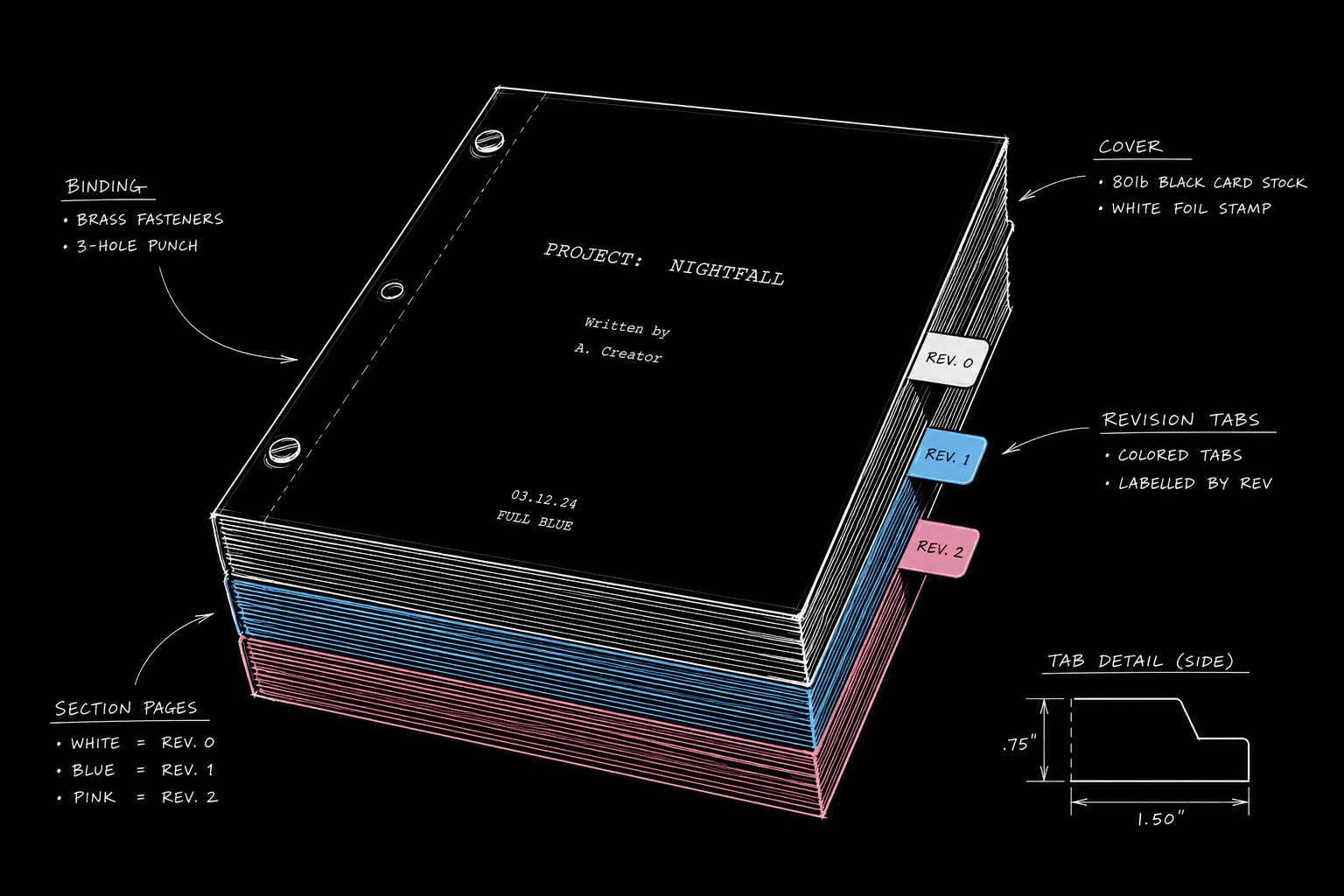

You hear "blue pages" in a hallway and you picture a mood, not a contract. On a working set, screenplay revision colors are how everyone knows which draft they are holding without reading page one. White was the original shoot script. Blue is the first revision pass after lock. Pink follows blue. Then yellow, green, goldenrod, buff, salmon, cherry, tan, gray, and more if the show keeps living. The sequence is not decoration. It is a chain of custody for words that become call sheets.
This guide explains blue pages and the full WGA-oriented color order in plain language. You will see how colored revision pages move through a writers' room, a script coordinator's inbox, and a production assistant's binder. You will get scenarios you can picture, a workflow for marking revisions honestly, and a trench section on mistakes that waste a morning when the wrong color lands on the director's chair.
Revision color is a timestamp you can feel with your thumb on the edge of the stack.
How Revision Colors Enter the Pipeline
When a production locks a script for a shoot day, the white draft is the reference everyone quotes. The moment the showrunner changes a line after lock, the production office issues a revision. The revision pages are printed on colored paper, or stamped with a color header in PDF, so you can spot them in a mixed stack. If an actor highlights a speech on white and the coordinator delivers a blue swap for that page, the actor knows the white line is dead unless the scene was cut entirely.
The Writers Guild pattern is standardized enough that experienced crews react without a meeting. Newer writers learn the order once and stop treating colors as gossip. The order after white is typically blue, pink, yellow, green, goldenrod, buff, salmon, cherry, tan, gray, and additional colors if needed on long-running productions. Not every indie short uses every color. Many indies never leave white. Studio television and features with active writers' rooms use the sequence often enough that you should know it before your first day on set.
Revision colors pair with revision marks in the margins. Asterisks, stars, or dated checkmarks tell the script supervisor which lines changed on that colored page. A blue page without a mark is suspicious. A mark without a colored page is confusion.
For how those pages should look when they leave your laptop, see exporting for production. Color is meaningless if pagination shifts and page six on blue is not page six on white.
Blue Pages and What They Actually Mean
Blue pages are the first revision after the white shooting script. If you are holding blue, you are not holding the script that locked last week unless nothing changed. You are holding the first official batch of changes. Those changes might be one line or forty pages. The color does not measure size. It measures sequence.
Blue often arrives during prep when locations are being scouted and actors are memorizing. A line change on blue might be a legal note, a network note, a safety rewrite, or a brilliant idea that should have landed on white. The crew does not judge why. They swap pages.
When someone says "we're on blue," ask whether they mean the whole script is reissued in blue or only changed pages. Television frequently issues changed pages only to save trees and brains. Features sometimes reissue the full script with a new color cover. Both are normal. Both require you to file the white page you replaced.
| Revision color (typical order) | Position after lock | What crews assume |
|---|---|---|
| White | Locked shooting script | Baseline unless told otherwise |
| Blue | First revision | First post-lock changes |
| Pink | Second revision | Supersedes blue on same page numbers |
| Yellow | Third revision | Supersedes pink |
| Green | Fourth revision | Supersedes yellow |
The table is a memory aid, not a law carved in stone on every indie. The law on union shows is: higher in the sequence wins on the same page number.
Television Rooms vs Feature Prep vs Indie Shorts
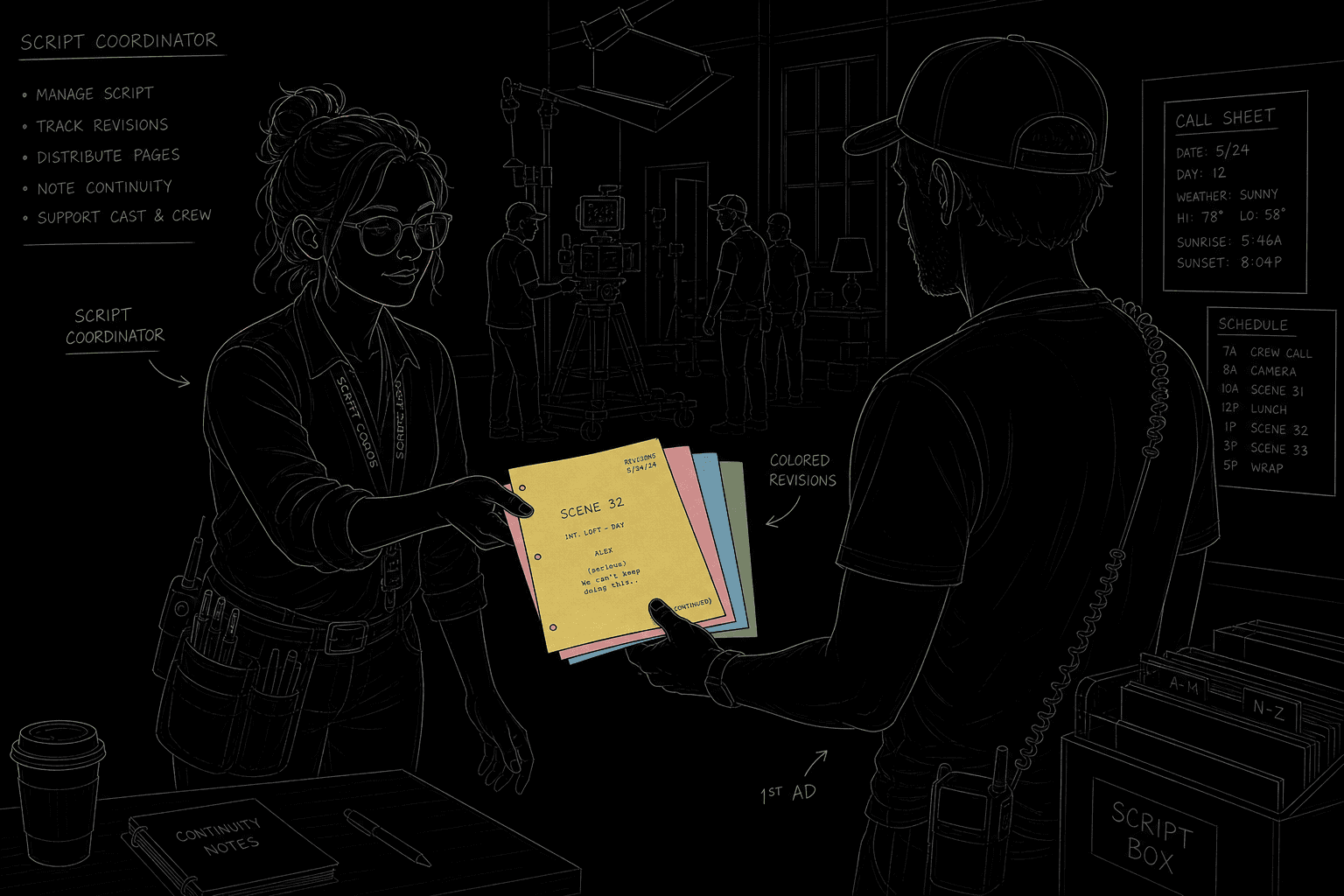
Television lives in revision colors during production week. A script coordinator tracks which cast got which pages, which background actors need sides only, and which colors are current for the episode number. A table read might be on pink while the office still has white PDFs in an old email thread. Chaos comes from email, not from the color system itself.
Features often stay white longer, then jump to blue during prep when stunts need rewriting. A feature might issue full script blues once, then partial pinks for daily changes during a hard location.
Indie shorts sometimes never print colors. They should still understand them. If you join a WGA-signatory show as a writer's assistant, you will file colored pages on day one.
When you are also managing page count while colors fly, keep length logic separate from color logic. A blue page that adds four pages changes schedule. Color does not erase that fact. The screenplay runtime guide still applies under pink paper.
[YOUTUBE VIDEO: Script coordinator demonstrates filing a white script binder and swapping in blue revision pages with dated revision marks]
Granular Workflow: Issuing a Clean Blue (Or Pink) From Your Draft
Step 1: Lock white explicitly. Name the file with date and WHITE in the filename if your office uses that habit. Note page count from the PDF, not from the app's live counter.
Step 2: Track changes in software. Use revision mode or compare documents so you know every altered line. If you cannot list changes, you are not ready to color.
Step 3: Choose full issue vs changed pages only. Ask the coordinator or production office. Television often wants changed pages with asterisks in margins. Features may want full script PDFs.
Step 4: Apply color in PDF export. Many tools add colored headers or watermarks for revision drafts. Print a test page. Confirm asterisks appear where required.
Step 5: Date and version the cover. REVISED [DATE] BLUE should appear on the cover or title page. Episode number and draft number if television.
Step 6: Distribute with a one-line email. "Blue pages issued for pages 42-44, 51-53. Supersedes white." No poetry. No buried lede.
Step 7: Archive white and blue in separate folders. Never delete white. Never assume everyone threw white away.
Step 8: When pink arrives, repeat. Pink supersedes blue on the same page numbers. File blue in an archive subfolder labeled SUPERSEDED.
Relatable Scenario: The Actor Who Memorized White on a Green Day
Tessa plays a supporting role on a one-hour drama. She prepped from a white PDF emailed three weeks ago. She arrives on set with highlights on white. The coordinator hands green pages for her scene. She insists her lines "felt better" on white. The director has green in hand. The take stalls. Tessa is not vain. She was never told green existed because her manager forwarded white.
The fix is procedural, not artistic. Production sends color alerts to reps. Tessa learns to ask "what color are we on?" in every email. The writers' room learns that silent PDF uploads are how trust breaks.
Relatable Scenario: The Feature That Printed Blue for Notes, Not Changes
Marcus, a first-time producer on an indie feature, hears that blue pages look professional. He prints the whole script on blue cardstock before lock. The crew thinks the script changed. Calls go out for revised schedules. Marcus wasted a day because he confused color as sequence with color as cool paper.
Marcus reissued white after lock, then blue only for the six pages that changed. The AD stopped yelling. Marcus added a cover note: WHITE LOCK 3/12, BLUE REV 3/18 PAGES 12-14 ONLY.
Try it free
Try Screenweaver for free on your script
It is free. Import your existing project, get a clearer view of your outline, and regain control of your story structure in minutes.
Start FreeRelatable Scenario: The Writers' Room With Two "Current" Colors
A room on episode seven has writers on yellow for act two while the coordinator issued pink for act four after a table read. Background actors still have white sides. The script supervisor merges colors in a binder with tabs. The showrunner thought everyone was on pink because pink was latest globally.
The room adopted a color board on the wall: episode number, date, color, pages affected. Slack messages repeat the same line. Writers stop guessing. Background gets sides pulled from the correct color only.
Operational Section: Marks, Pagination, and PDF Handoff
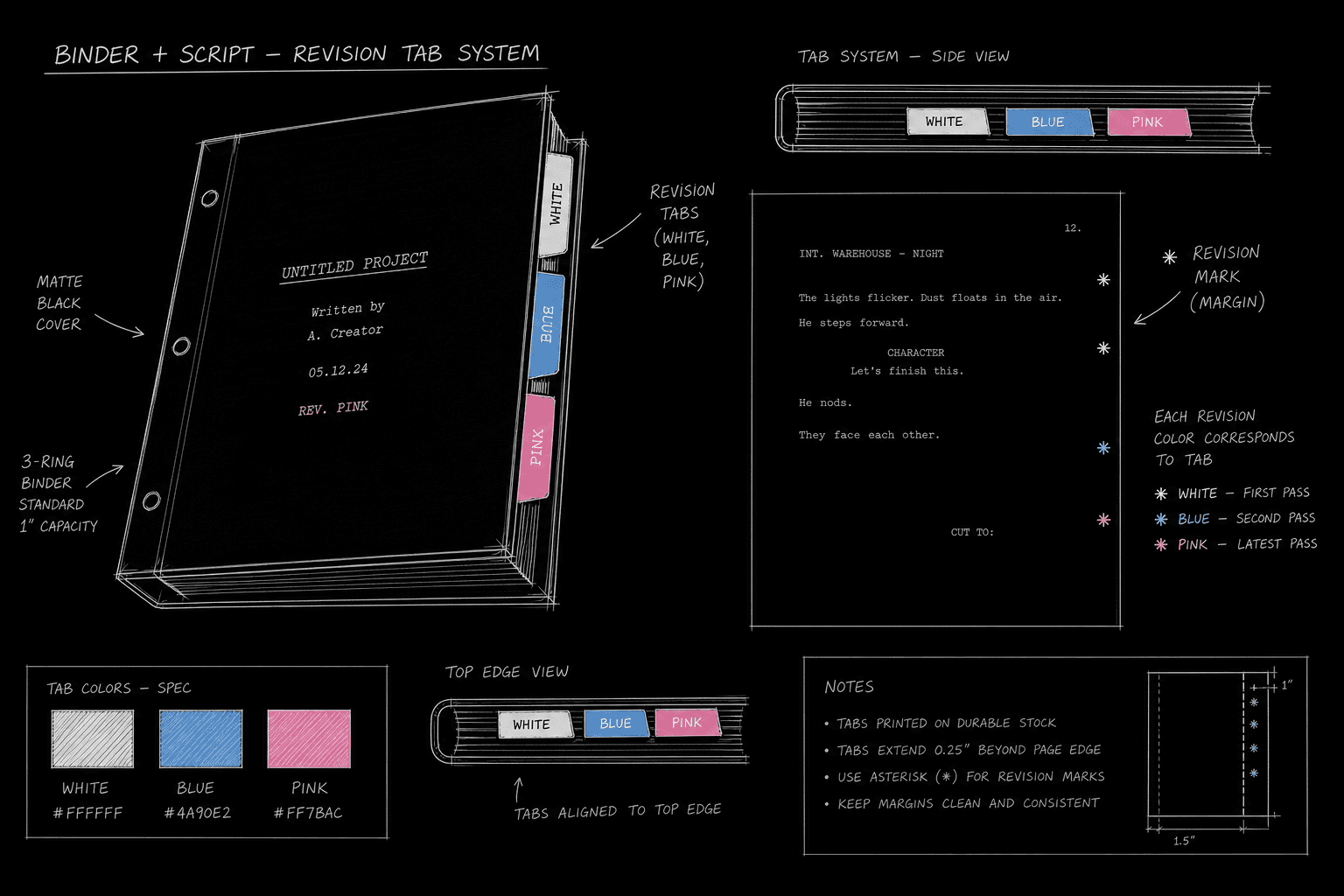
Revision asterisks usually appear in the margin next to changed lines. Some offices use a star in the header of changed pages. The script supervisor transfers those marks into their breakdown software. If your PDF export flattens margins, marks vanish. That is a production emergency dressed as a tech glitch.
Pagination must stay stable across colors unless the whole scene moves. If blue page forty-five becomes pink page forty-seven because you inserted two pages earlier, everyone needs a page change memo. Do not sneak inserts without telling the office.
When you export, run the same checklist you would for white: scene headings consistent, character names stable, dialogue margins intact. For slugline discipline while colors fly, the slugline formatter helps keep headings uniform even when dialogue is chaos.
External guild reference for screenwriting standards and member resources lives at the <a href="https://www.wga.org" rel="nofollow">Writers Guild of America</a> site. Use it for contract context, not for guessing what your specific production office wants today. Always ask the coordinator.
Outcomes: What You Gain When Colors Are Honest
Honest revision color discipline shrinks on-set arguments. Actors prep the right lines. ADs build call times from the right scenes. Editors log takes against the right script version. Lawyers compare notes to the right page.
You also protect writers. When a note lands on green, everyone sees that the note arrived after lock, not buried in white from month one. Credit conversations and blame conversations both get cleaner.
A revision without a color is a rumor. A color without a mark is a guess.
Why It Matters: Paper Chaos vs Controlled Change
The old way is emailing "updated script" with no color, no page list, and no date. Everyone opens the attachment, searches randomly, and half the room never updates. The improved way treats color as version control you can touch. White is baseline. Blue is first change. Pink is second. The sequence tells you what to throw away.
The old way prints cool colors because it looks like Hollywood. The improved way prints the next color in the sequence only when pages change, with marks and a cover note. The old way assumes actors heard about pink in a group chat. The improved way puts pink in their hand with their name on the envelope.
The Trench Warfare Section: Revision Color Mistakes Beginners Make
Mistake: skipping white. You go straight to blue because you "never locked." Production hears lock differently. Fix: declare white lock in writing, then move to blue.
Mistake: reusing a color. Issuing a second blue week later because you like blue paper. Fix: move to pink. Colors are single-use steps in the sequence.
Mistake: partial blue without saying which pages. Fix: list page ranges in email subject lines and on the cover.
Mistake: changing page numbers without announcement. Fix: page change memo with old-to-new map.
Mistake: no revision marks. Fix: learn your office's mark style and apply it in export.
Mistake: mixing PDF colors that do not print. On set, someone prints black and white. Fix: confirm whether your production prints color or uses colored paper manually.
Mistake: keeping white in the active binder after blue supersedes those pages. Fix: tab white as archive, insert blue in the live section.
Mistake: sending actors white sides when cast is on pink. Fix: sides pulled from current color for that episode.
Mistake: renaming files without color in the title. Script_final2.pdf is a trap. Fix: SHOW_EP107_PINK_2026-03-18.pdf.
Mistake: assuming digital readers do not need colors. They do. PDF headers should say BLUE. Fix: watermark or header text even when paper is dead.
Mistake: rewriting sluglines only on colored pages without telling locations. A blue slugline change moves a scout. Fix: flag location changes in the distribution email.
Mistake: treating revision color as quality judgment. Pink is not worse writing. It is later writing. Fix: separate craft ego from production sequence.
Mistake: forgetting background and day players. They often get sides late. Fix: same color discipline for every printed page they receive.
Mistake: not archiving superseded colors. Fix: keep a superseded folder per episode. Writers' rooms get sued on memory. Folders do not.
Mistake: issuing colors from uncontrolled templates. Margins shift, page six moves. Fix: export test against white before wide send. Use the production export guide as your mechanical checklist.
Mistake: arguing on set instead of checking color. Fix: teach everyone the question: "What color are we on?"
Colors do not fix bad writing. They fix bad communication about writing.
Closing: Thumb the Edge, Know the Draft
Screenplay revision colors look like folklore until you are the person holding the wrong page on a soundstage. Learn the order. Respect white. Issue blue when post-lock changes exist. Move to pink when blue is old news. Mark changes. List pages. Date the cover. Archive superseded paper like it matters, because it does.
You do not need every color in your career on day one. You need the habit of asking which color is current before you rehearse, before you email, before you tell an actor their line changed. That habit costs nothing and saves more than one shoot day.
When your pages are true, go back to the scene. The colors are for the crew's hands. The story is still for the room's breath.
A Note on Digital-Only Rooms
More rooms never touch paper. The color system still applies as a filename and header convention. Slack uploads that say "latest script" without color are how pilots lose a day. Train the room to repeat the color word in every file name and every message. Digital natives sometimes skip colors because paper feels vintage. Production still thinks in sequence. Meet them where they work, not where you wish they worked.
If you are a writer without a coordinator yet, practice the sequence on your own spec anyway. When you sell, you will speak the language on the first call. White lock. Blue change list. Pink when blue is dead. The habit costs you nothing at home and buys calm on set.
Final Step
Build your next script with Screenweaver
Move from ideas to production-ready pages faster with timeline-native writing and AI-assisted story flow.
Try Screenweaver