
Prompt: Dark Mode Technical Sketch, three layered passes over a script page suggesting structure, clarity, dialogue, thin white lines on black; no 3D renders --ar 16:9
People search script editing, editing a script, and screenplay development when the draft exists but the read feels mushy. Proofreading is not the same job. Our proofreading with AI article targets typos, homophones, and format micro-errors. Ten mistakes that get scripts tossed is the reader’s gate. This article is the middle layer: three passes you do in order so you are not “fixing dialogue” on a scene you should delete.
How it works
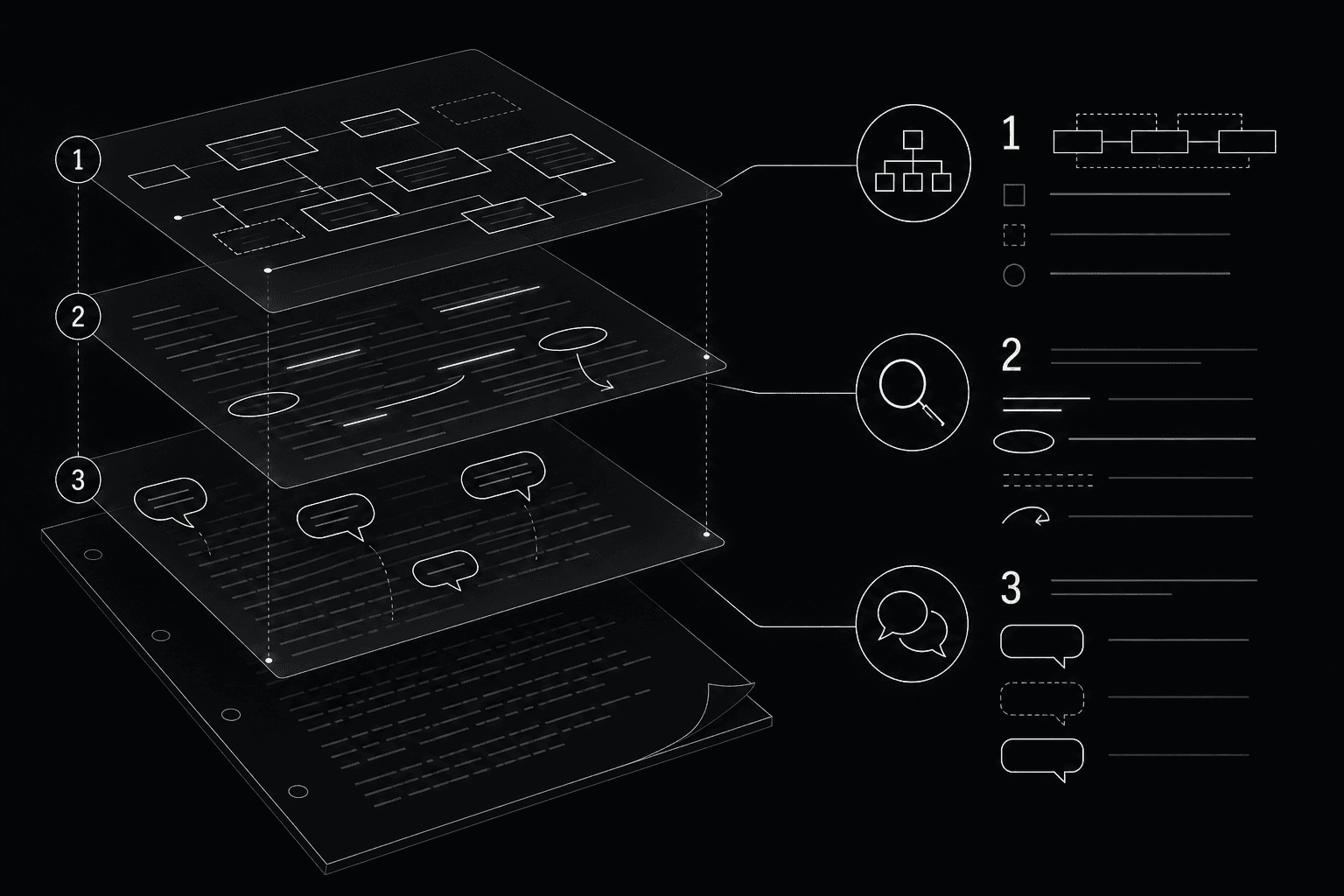
Pass A - Structure: causality, scene order, act pressure. If the story spine is wrong, new jokes are just faster drowning.
Pass B - Clarity: can a tired reader track who wants what in each scene? Action lines earn most of this pass.
Pass C - Dialogue: subtext, mouthfeel, trimming on-the-nose lines. Now dialogue without exposition and subtext in noir earn their keep.
Where this applies
Features
Midpoint and “all is lost” are structure checks before line edits. Mastering the midpoint and dark night of the soul are deep dives you invoke when Pass A finds a sag.
TV
Act breaks and B-stories need their own clarity pass. Structuring the B plot is a satellite link when Pass B keeps confusing threads.
Shorts
Passes shrink; order does not. Short film and vertical video reminds you clarity beats cleverness on tight clocks.
Step-by-step revision flow
Step 1 - Read once without touching
Note “huh?” moments only. If you rewrite line one, you are avoiding Pass A.
Step 2 - Pass A: outline vs script
Does every scene earn its slug? Merge or cut before dialogue surgery. Beat boards vs outlines if you think visually.
Step 3 - Pass B: scene goals on paper
One sentence per scene: want, obstacle, turn. If you cannot write the sentence, the scene is still draft zero. Logline workshop discipline applies inside scenes too.
Step 4 - Pass C: dialogue polish
Read aloud. Cast counts: balancing dialogue across ensemble when one voice eats the room.
Step 5 - Micro proof pass
Now run format and typo tools. Proofreading with AI belongs after structure is stable.
Step 6 - Export sanity
Production PDF and FDX catches pagination surprises readers blame on “tone” when it is really layout.
Try it free
Try Screenweaver for free on your script
It is free. Import your existing project, get a clearer view of your outline, and regain control of your story structure in minutes.
Start FreeOperational requirements
- Versioning: never revise on the only file named
final_FINAL_v9. Snapshots and version control. - Notes from others: translate “I didn’t connect” into Pass A/B/C labels before you rewrite. How to take feedback.
Outcome
A revision that respects order finishes faster even when it cuts hard. You spend fewer nights “polishing” scenes that should die in Pass A.
Why three passes beat one soup pass
One soup pass mixes structure anxiety with comma anxiety. You get pretty sentences and a broken clock. Separating hats is how screenplay development work stays sane in professional rooms, even when you are alone at 1 a.m.
Conclusion
Do Pass A → Pass B → Pass C → proof tools → export check. Link craft where the pass fails, not before. For the earlier pipeline, idea to first draft. For software friction during rewrites, affordable TCO. For ethics when AI suggests cuts, algorithmic assistance vs intuition.
External reference (dialogue craft): John August’s blog hosts years of practical scene-level advice from a working screenwriter; useful sanity check after Pass C.
Final Step
Build your next script with Screenweaver
Move from ideas to production-ready pages faster with timeline-native writing and AI-assisted story flow.
Try Screenweaver