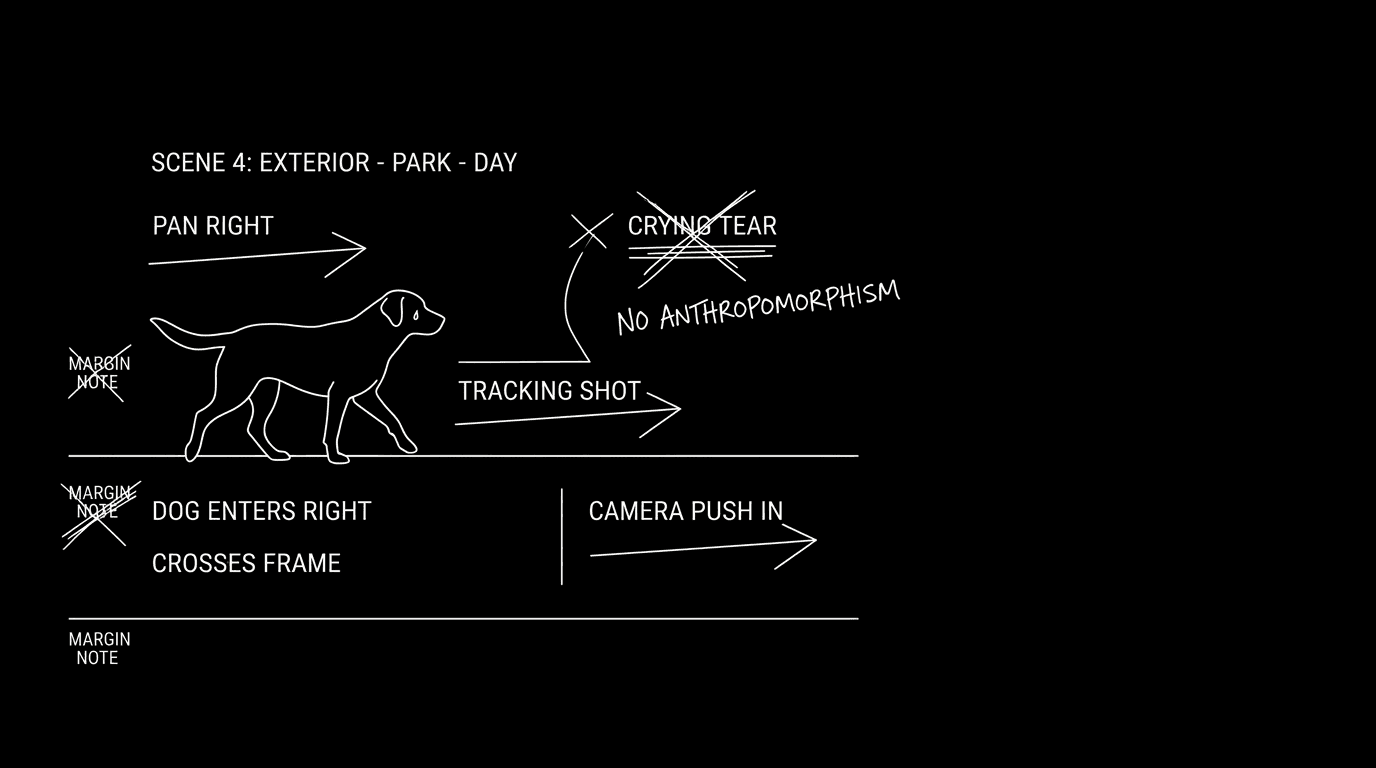

The script reads: "Max the dog looks up at Sarah, understanding everything. A single tear rolls down his cheek."
Stop. Dogs don't cry. Dogs don't "understand everything" in a way that can be filmed. This animal action is unfilmable, and if it were filmable, it would require CGI.
Writing animal characters presents unique challenges. Animals can't be directed like human actors. They can't read the script. They can't adjust their performance based on notes. And yet, some of the most beloved characters in cinema are animals: Lassie, Beethoven, Marley, the velociraptors of Jurassic Park.
This guide covers how to script animal action effectively: what animals can actually do, how to convey emotion without anthropomorphizing, and how to work within the limitations of working with real animal performers.
Cinematic workflow frames
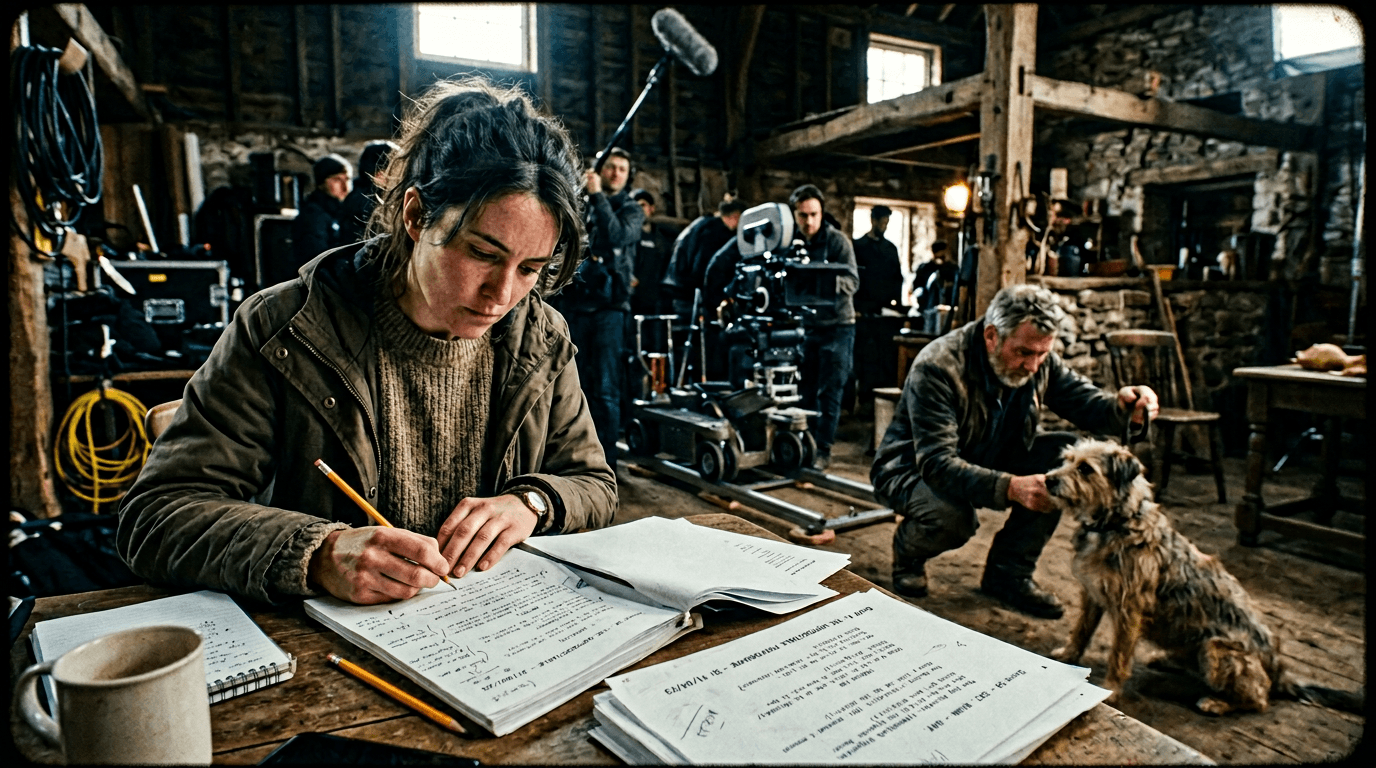
These two visuals work as a pair: the first shows Cinematic workflow still, first angle, 35mm film grain, and the second shifts to Cinematic workflow still, second angle, 35mm film grain - compare them briefly, then move on.
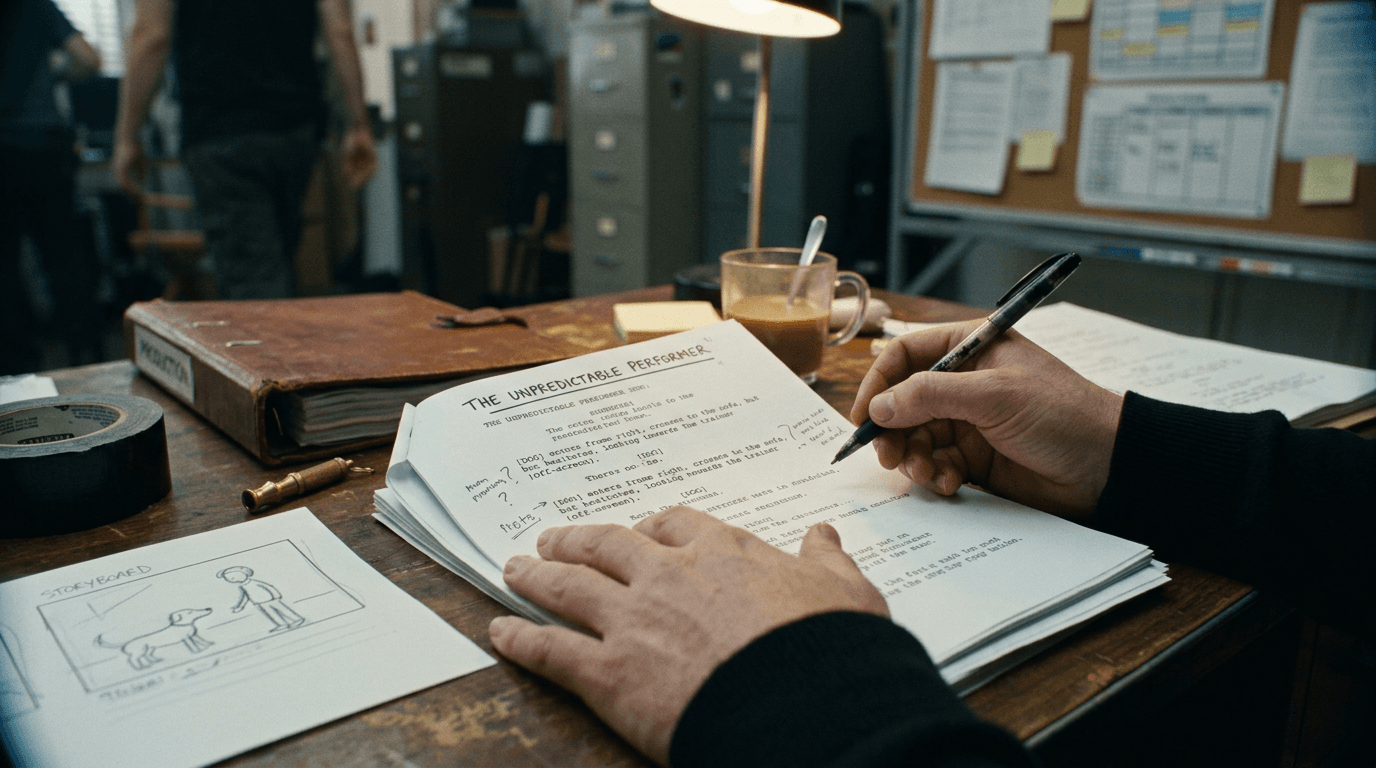
The Core Challenge: Animals Don't Take Direction
Human actors read the script, discuss motivation, rehearse, and adjust. Animals do none of these things. An animal on set follows trained behaviors, responds to handlers, and does what it's been conditioned to do.
This means:
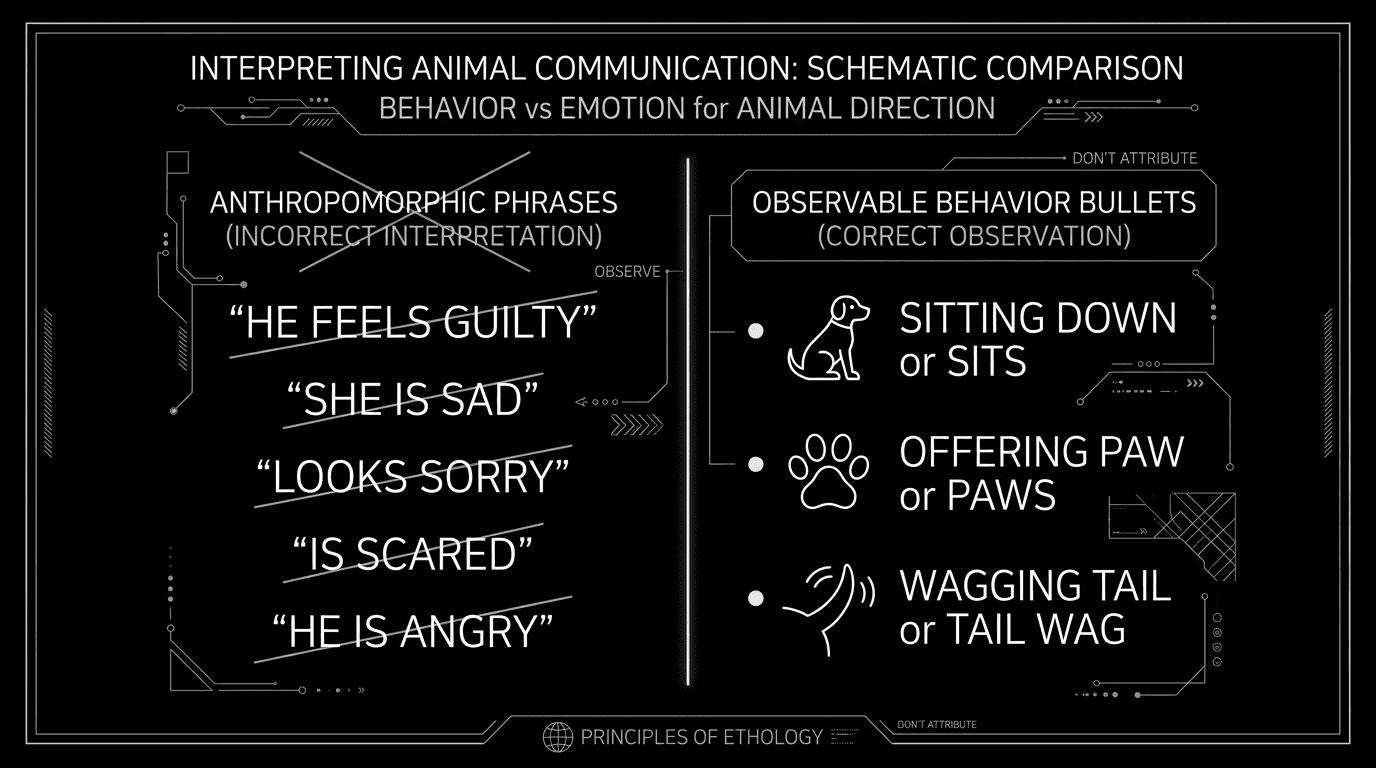
Simple actions work. Sit. Stay. Walk from A to B. Bark on cue. These are trainable behaviors.
Complex emotions don't work. "Looks guilty." "Shows fear of abandonment." "Realizes the truth." These require internal states that animals can't perform on demand.
Consistency is limited. An animal might do something perfectly in one take and refuse in the next. Production adapts.
Your script must account for these realities.
What Animals Can (Realistically) Do
| Animal | Trainable Behaviors | Limitations |
|---|---|---|
| Dogs | Sit, stay, come, bark, hold objects, walk/run on cue, look at points | Cannot sustain prolonged expression; no crying |
| Cats | Limited: walk in direction, sit, look at target (with patience) | Notoriously independent; expect multiple takes |
| Horses | Run, stop, rear on cue, stand calmly | Require expert handlers; unpredictable with noise |
| Birds | Fly from A to B, sit on shoulder/hand | Fragile; startle easily |
| Exotic | Varies widely; consult trainers | May require animatronics or CGI supplements |
If your script requires behavior outside these norms, expect the production to use CGI, animatronics, or creative editing.
Technique #1: Write Behavior, Not Emotion
Instead of:
Max looks at Sarah with regret for all the times he wasn't there.
Write:
Max sits beside Sarah. He rests his head on her knee, doesn't move.
The first line describes an internal emotional state that can't be performed. The second describes a behavior, resting head on knee, that can be trained and filmed. The audience infers the emotion.
More examples:
Unfilmable: "The cat glares at her, full of judgment."
Filmable: "The cat stares, unblinking. Sarah looks away first."
Unfilmable: "The horse senses danger and alerts the rider."
Filmable: "The horse's ears swivel. It stamps, restless. Tom tightens the reins."
The behavior is filmable. The interpretation, judgment, sensing danger, is left to audience inference.
Technique #2: Use Reaction Shots
Much of animal "emotion" in film comes from editing. The animal does something neutral; the editor cuts to a human reaction; the audience reads emotion into the animal.
Your script can set this up:
Example:
Sarah kneels beside Max.
SARAH I'm sorry, boy. I didn't mean it.
Max's tail WAGS, just once.
Sarah smiles through tears.
The wag is simple behavior. The emotional weight comes from Sarah's line and reaction. Max doesn't need to "act."
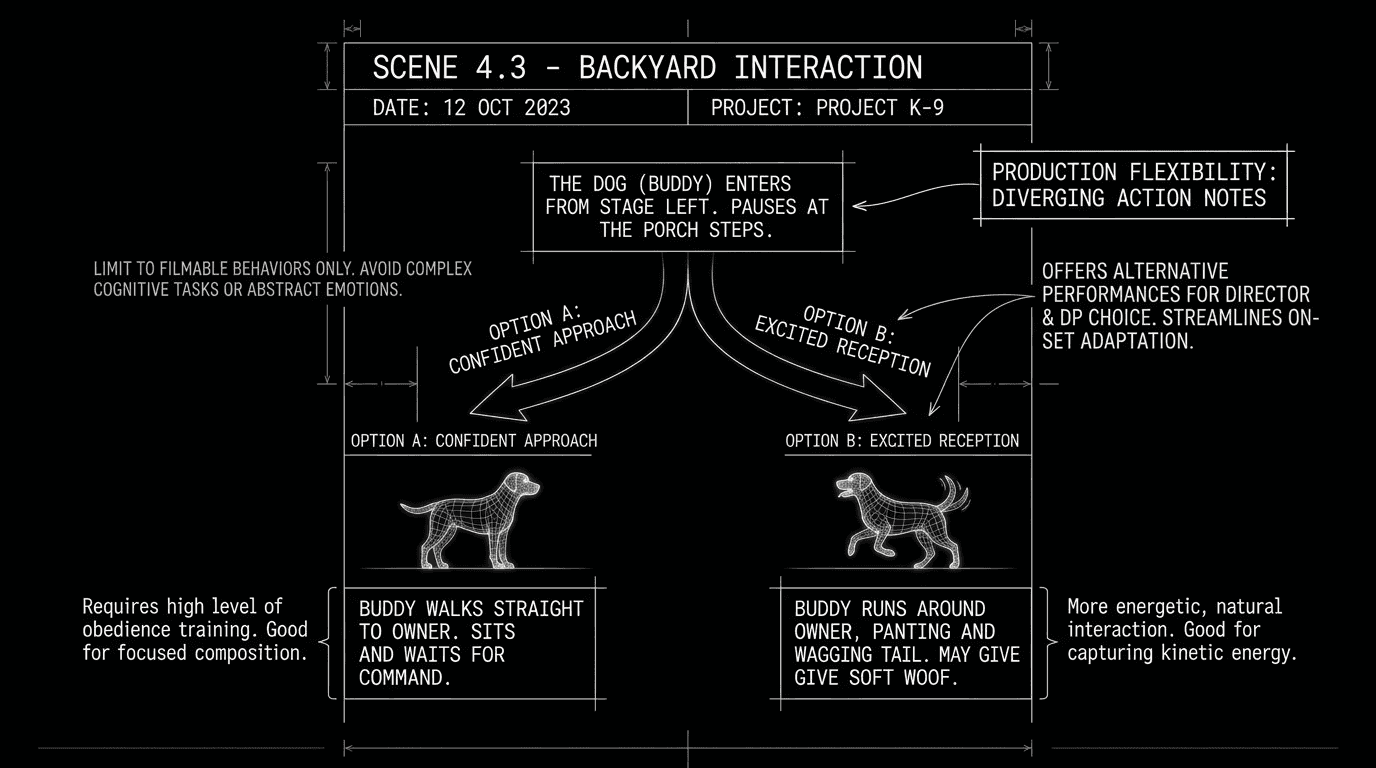
Technique #3: Write Multiple Options
Because animals are unpredictable, it can help to script alternatives:
Example:
Max either approaches the door or stays put, watching. Either way, he's alert.
This gives the production flexibility. Whatever Max actually does, the scene works.
The "Trench Warfare" Section: What Goes Wrong
Failure Mode #1: Anthropomorphizing
The script treats the animal like a human actor: "He realizes she's lying." "She forgives him with a look."
How to Fix It: Strip internal states. Write only what the animal can physically do. Realization and forgiveness are human concepts; movement and sound are animal behaviors.
Failure Mode #2: Over-Choreographing
"The dog runs to the door, pauses, looks back, runs three steps, pauses again, barks twice, then runs out."
How to Fix It: Simplify. Dogs can be trained for complex sequences, but every added beat increases difficulty and shooting time. Ask: what's essential?
Failure Mode #3: Ignoring Species Behavior
The script has a cat running to its owner excitedly, like a dog. Or a snake "hissing in warning" repeatedly on cue.
How to Fix It: Research animal behavior. Write within species norms. Consult a trainer early if the animal has significant screen time.
Failure Mode #4: Relying on a Single Animal
The script has one dog in every scene. That dog gets tired, unfocused, or sick, production halts.
How to Fix It: Production often uses multiple identical animals. Your script doesn't need to specify this, but writing simpler animal action makes this easier.
Failure Mode #5: No Backup Plan
The crucial plot point requires the parrot to say a specific phrase, on cue, looking at the camera. If the parrot doesn't cooperate, the scene fails.
How to Fix It: Write around dependence. Can the phrase come through a recording? Can the moment work without the parrot perfectly performing?
Try it free
Try Screenweaver for free on your script
It is free. Import your existing project, get a clearer view of your outline, and regain control of your story structure in minutes.
Start FreeCGI and Animatronics: When to Expect Them
Some animal action is impossible with real animals:
- Talking with lip-sync
- Sustained facial expressions
- Dangerous interactions (attacks, bites)
- Extinct or fantastical species
For these, expect CGI or animatronics. Your script can indicate the action without specifying the execution method:
The velociraptor tracks her movement with its head, patient, predatory.
The script describes the action. Production determines if it's animatronic, CGI, or practical.
Writing Dangerous Animal Encounters
Safety regulations limit what can be done with real animals in proximity to actors. If your scene involves:
- Attacks
- Close biting/clawing
- Large predators near humans
- Unpredictable wild animals
Expect the animal and actor to be shot separately and composited, or CGI replacement of the animal.
Example:
The wolf LUNGES at Tom. He falls back, arm raised,
The lunging wolf and the falling Tom can be filmed separately. The script just needs to describe the action; production finds the method.
Case Study: Marley & Me
Marley & Me features a dog in nearly every scene. The script works because:
- Dog behaviors are simple: running, playing, chewing, sitting.
- Emotional content comes from the human characters.
- Editing creates the impression of Marley's "personality."
- Multiple dogs played Marley across the production.
The screenwriter didn't need to specify "Marley looks sad." They wrote "Marley lies by the door, waiting" and let the audience, and the editor, feel the sadness.
Animal POV and Subjectivity
If the scene is from an animal's perspective:
Example:
DOG'S POV: The world is a blur of colors. A SQUIRREL darts across the yard. The dog BOLTS after it.
This works: you're describing what the dog perceives and how it reacts. You're not claiming the dog thinks in narrative; you're showing behavior.
Avoid:
The dog thinks: I have to catch that squirrel. It's my purpose.
Animals don't have voiceovers (unless your story explicitly uses them, like Homeward Bound).
The Perspective: Writing Instinct
Animals remind us that not all communication is verbal. A dog's posture, a horse's movement, a cat's stillness, these convey meaning without words. Writing animals well means trusting in behavior as language.
Your job isn't to make the animal speak or emote on command. Your job is to place the animal in situations where its natural behavior creates meaning for the audience. The sit. The wag. The bark. The stillness.
These are simple actions. But in context, with the right human reactions, the right editing, they become profound.
Write what animals can do. Trust what audiences can feel.
[YOUTUBE VIDEO: An animal trainer and screenwriter discussing how to write realistic animal behavior for film, with behind-the-scenes examples of trained animal performances.]
Further reading:
- For writing non-verbal human behavior, see playing drunk: directing through subtle stage directions.
- If you're indicating internal states in action lines, see the unfilmable action line: writing the invisible.
- American Humane monitors animal safety in film; see resources at humanehollywood.org{:rel="nofollow"}.
Final Step
Build your next script with Screenweaver
Move from ideas to production-ready pages faster with timeline-native writing and AI-assisted story flow.
Try Screenweaver