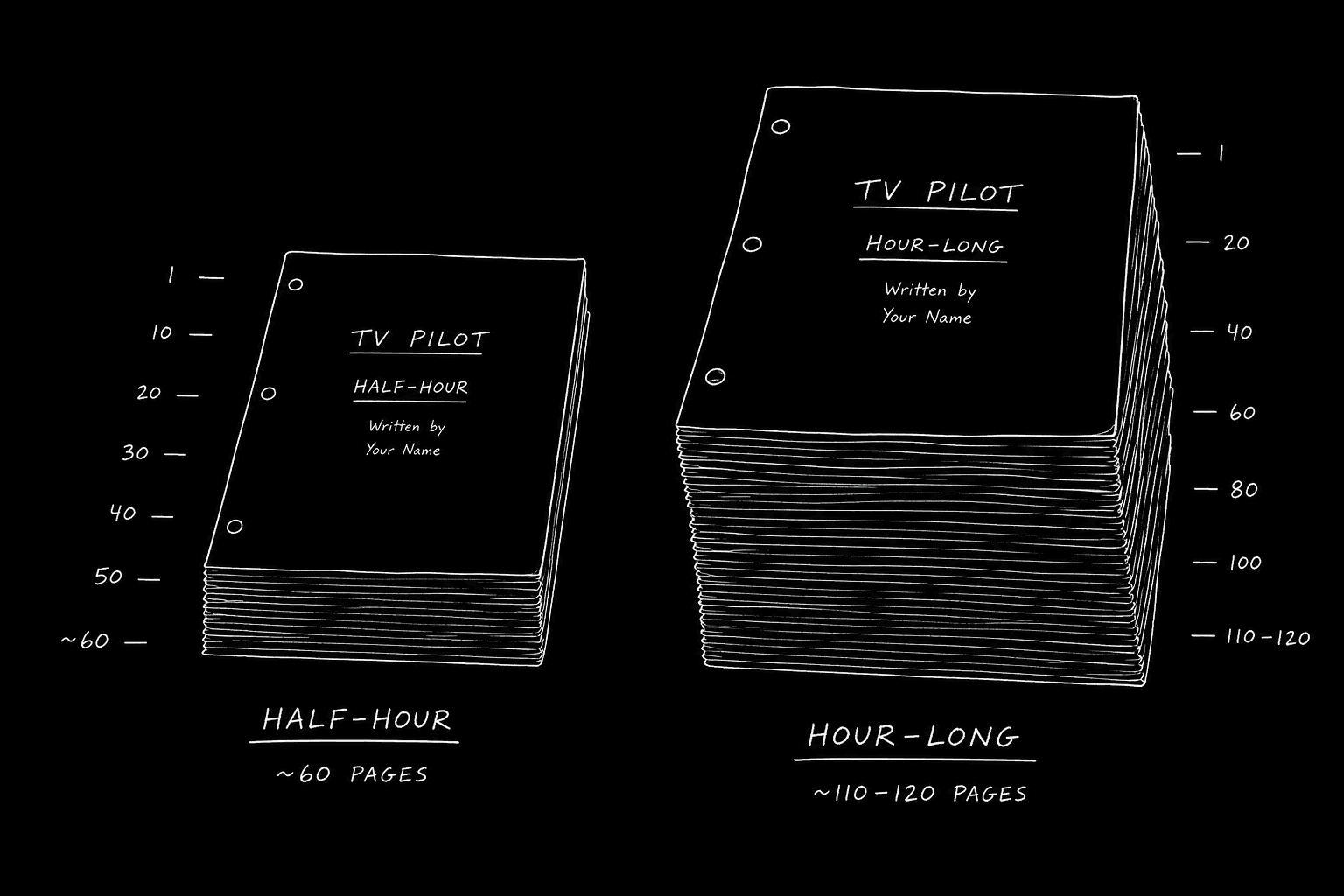

You open a pilot draft. The software footer says forty-seven pages. Your friend says that is perfect for a half-hour. A showrunner on Twitter says half-hours are twenty-two to twenty-six pages now. A coverage reader emails that your hour drama at fifty-four pages "reads short." Nobody is lying on purpose. They are speaking different dialects of the same budget language. Page count for TV pilots is not a trophy number. It is a handshake between your story appetite and the room that has to shoot five days, feed a crew, and hit a slot that still matters even when the slot is a streamer interface instead of a Tuesday at nine.
If you are coming from features, the first shock is that pilot pages are modular. Teasers, tags, act breaks, and sometimes a second story thread all eat paper without eating the same amount of screen time. If you are coming from theatre, the shock is the opposite: paper looks thin while performance time balloons. This guide is the 2026 map for half-hour and hour-long pilot targets, how to measure honestly, and how to stop arguing about a number that was never meant to be a personality test.
A pilot page count answers "will this fit the contract of the format?" It does not answer "is it good." Good still has to happen on its own.
Why Page Targets Exist at All (And What They Are Not)
Television production runs on calendars. A half-hour comedy block on a stage might still be a four-camera day with audience energy baked in. An hour drama might be eight to ten days with location moves that hate your ambition. Writers' rooms pitch specs with page counts because scheduling starts before cameras. Development executives use page count as a proxy for cost, cast load, and whether you understand the form you are asking them to buy.
The target is not moral. Forty-four pages does not make you virtuous. Sixty-two pages does not make you edgy. It makes you either inside the band the buyer expects or outside it with a reason. Outside can work. Outside without awareness reads like you have never watched the format you claim to love.
For how those pages translate into minutes once actors speak, pair this piece with our guide on screenplay runtime and the one-page-per-minute rule. Pilot math sits on top of minute math, not instead of it.
The 2026 Band Table (Half-Hour vs Hour-Long)
| Format | Common pilot page band (2026 specs) | Typical produced runtime feel | What the band is really measuring |
|---|---|---|---|
| Half-hour multi-cam comedy | 22-26 pages | ~22 minutes content + ads on broadcast | Joke density, audience pauses, cast load |
| Half-hour single-cam comedy | 28-34 pages | ~22-26 minutes streaming | More scene description, fewer stage resets |
| Half-hour dramedy / premium half | 30-38 pages | ~26-32 minutes | Hybrid pacing, longer scenes |
| Hour-long network drama | 52-60 pages | ~42-44 minutes content + ads | Act breaks, teaser/tag real estate |
| Hour-long cable / premium | 55-65 pages | ~48-58 minutes | Fewer act constraints, more scenes |
| Hour-long streaming "hour" | 48-58 pages | ~50-60 minutes (varies by platform) | Platform notes trump blog folklore |
Read the table once, then forget the edges. Your buyer's note beats the band. If a streamer sends a one-pager that says "pilot target fifty pages," that document outranks a forum post. If a network showrunner says "we live at fifty-eight," believe them over your college professor.
Half-Hour Pilots: The Two Species Problem
Beginners treat "half-hour" like one animal. Production treats it like two species that share a kitchen timer.
Multi-cam pilots still exist because economics still love them on certain networks. The page band stays tight because the camera geography is tight. Jokes land in rhythm. Swings between sets cost time. Writers leave air on the page because performance will fill it. If you have never read a produced multi-cam script, grab one before you judge your page count against a single-cam sample.
Single-cam half-hours look closer to mini-movies. Scene headers multiply. Action lines carry more geography. Page count rises while runtime stays locked. That is not bloat by default. It is format truth.
Here is the workflow mistake I see every January in fellowship piles: a writer drafts a single-cam half-hour with multi-cam spacing because the template defaulted wrong. They hit twenty-four pages and think they are done. The read feels like a trailer for an episode that never arrives. Fix the template first. Courier 12, standard margins, correct element spacing. Our screenplay formatting guide is the baseline before you argue about forty versus thirty-two pages.
Hour-Long Pilots: Modules Beat Totals
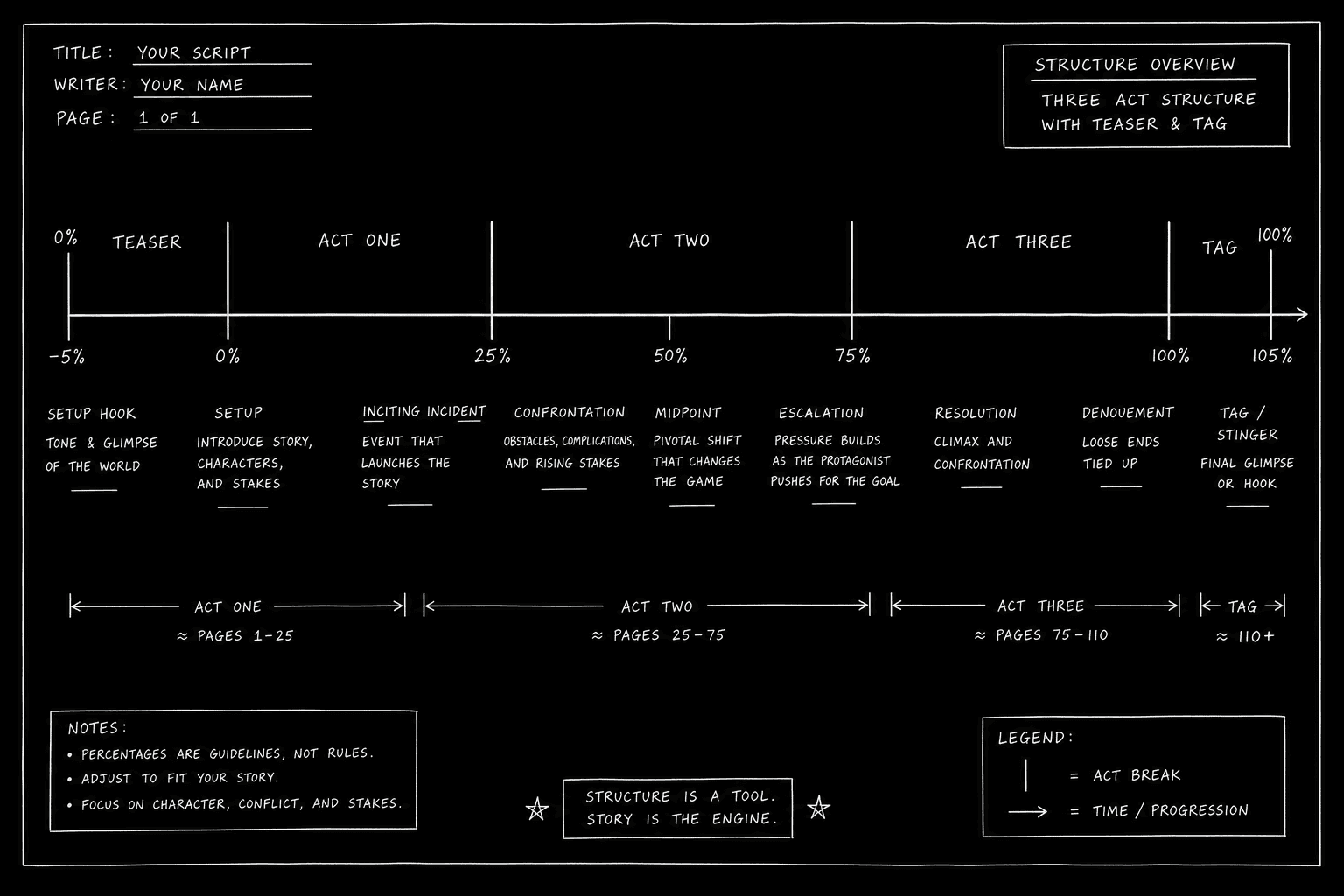
Hour drama pilots are built from modules: cold open, acts, tag, sometimes a second plotline that needs its own oxygen. Coverage readers scan for whether your act breaks earn their white space. Fifty-four pages with soft act outs reads short emotionally even if the footer number looks "fine."
When you outline, think in modules before you think in totals. If you are staring at a blank document, the outline for a 60-minute drama pilot walkthrough gives you act functions without replacing page discipline. Outline in beats, draft in scenes, then audit pages per act instead of only at the end.
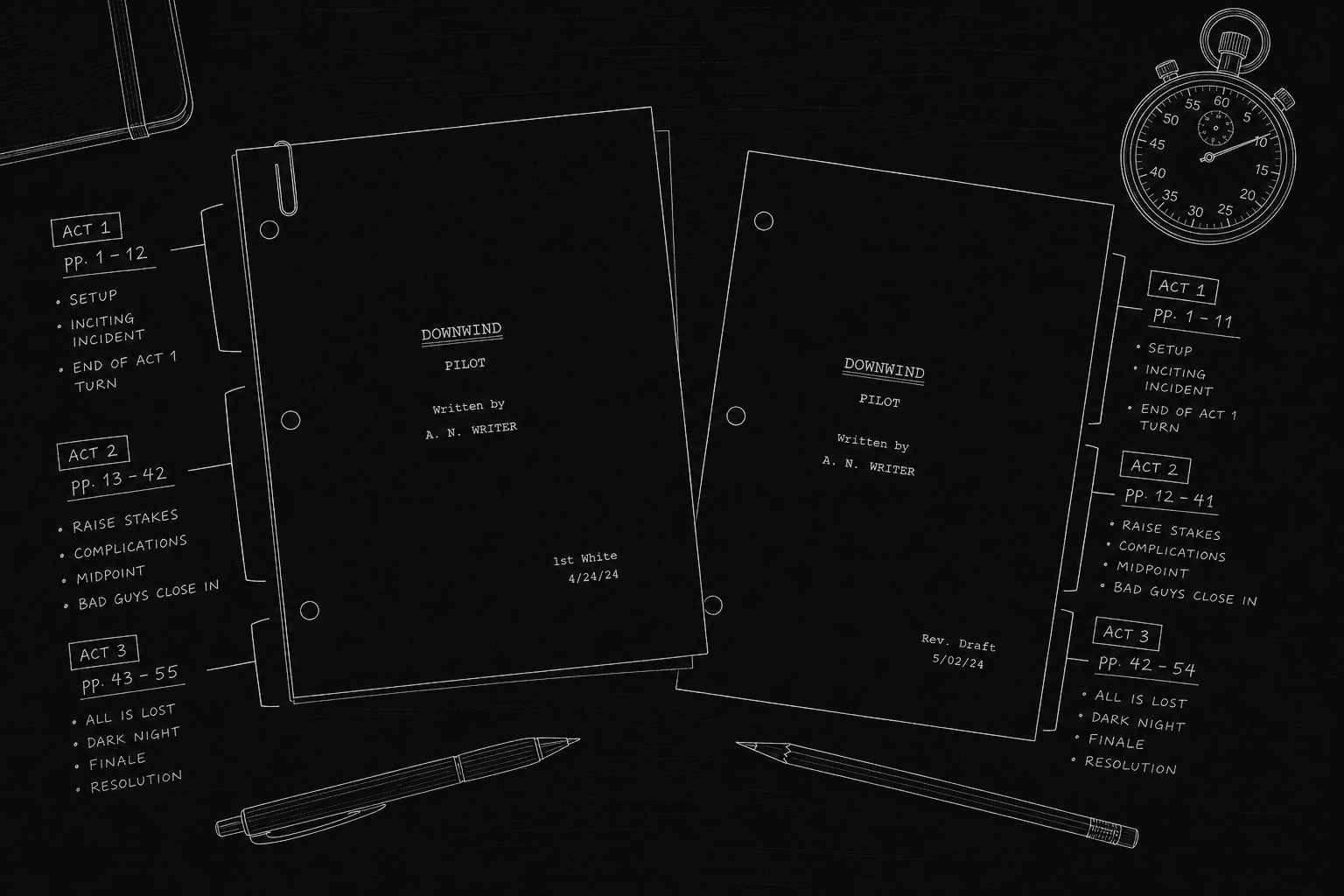
A practical audit looks like this. After your first draft, print or PDF export with stable pagination. Mark the cold open end, each act break, and the tag. Note page ranges. Compare to samples in the same lane (network vs premium). If your act two is eighteen pages and your act three is nine, the problem is not "add six pages." The problem is structural weight. Padding act three with exposition is how pilots die polite deaths.
Relatable Scenario: The Forty-Seven Page "Half-Hour" That Was Never One
Priya drafts what she calls a half-hour pilot for a streaming comedy with single-cam bones. The footer says forty-seven pages. She is proud. Her writing group cheers because the read "feels full." A development reader at a small prodco sends a one-line note: "This is an hour pilot wearing a half-hour hat."
Priya's mistake was label drift. She watched twenty-six minute episodes on a streamer and assumed twenty-six pages because a blog post said so. Her scenes were rich. Her B-story had room to breathe. Nothing was wrong with the writing quality. The format contract was wrong. She had two choices: cut to the thirty-low band with ruthless scene combination, or reclassify and pitch hour-long development if the story demanded it.
Priya chose honesty. She rebuilt the outline as eight tight sequences instead of twelve roomy ones. She moved a B-story beat into a later episode sketch in her series bible so she could stop paying page rent in the pilot. Final count: thirty-one pages. The read finally felt like the show she intended to sell.
Relatable Scenario: The Fifty-Eight Page Hour That "Reads Short"
Marcus has a network-leaning hour drama at fifty-eight pages. Conventional wisdom says he is in range. His manager loves the voice. A showrunner pass says the pilot "reads short" and asks for more depth in the middle acts without changing the ending.
Marcus almost added six pages of investigation filler. That would have been the wrong medicine. The showrunner's note was about turn density, not paper. Marcus mapped act two and found two scenes that repeated the same emotional beat: hero doubts partner, partner snaps back, hero doubts again. He combined those into one confrontation with a clearer reversal. He added a scene that paid off a clue from the cold open instead of adding "more case." Page count went to sixty-one. More importantly, act two gained a midpoint that pulled.
The lesson: "reads short" often means insufficient pressure per act, not insufficient pages. Fix pressure first. Count pages second.
Relatable Scenario: The Spec That Ignores Teaser and Tag Real Estate
Elena writes a premium hour pilot that jumps straight into act one on page one because she hates "TV gimmicks." Her draft is fifty-six pages of solid drama. Buyers like the voice. Everyone asks where the teaser is. Elena insists the story should start clean.
She is not wrong artistically. She is wrong for this handoff. Many buyers still want a pilot that demonstrates you can write the show they sell, including the machinery audiences recognize. Elena wrote a clean movie opening. The fix was not a cheesy stunt. She filmed-on-paper a cold open that posed a question her act one could not answer yet, three pages, then ran the pilot she already had with one scene trimmed for air. Total pages: fifty-nine. Same soul. Better job interview.
For craft on those first pages without turning them into a circus, see cold opens that hook in the first three pages. Teasers are not decoration. They are proof you understand episode grammar.
[YOUTUBE VIDEO: Split-screen markup of a network hour pilot PDF: highlighting teaser, act breaks, and tag with page ranges compared to a streaming hour pilot]
Try it free
Try Screenweaver for free on your script
It is free. Import your existing project, get a clearer view of your outline, and regain control of your story structure in minutes.
Start FreeGranular Workflow: Set Targets Before You Draft
Lock your lane on paper. Write one sentence at the top of your outline doc: "Half-hour single-cam streaming" or "Hour network drama with act breaks." If you cannot name the lane, you are not ready to obsess over page count.
Pull two comparable pilots in the same lane. Not pilots you love from childhood. Pilots that sold recently in the lane you want. Count their pages in PDF. Mark act breaks. Notice teaser and tag length. This takes an afternoon. It saves a month of wrong drafts.
Build a module map with page budgets. Example for an hour network drama: teaser 2-4, act one 10-12, act two 12-14, act three 10-12, act four 8-10, tag 1-2. These ranges flex. They force you to argue with yourself early.
Draft without looking at the footer until act two is done. Premature page panic creates thin first acts and bloated third acts. Story first. Footer second.
Run a timed read with act stops. Stopwatch each module. Compare to runtime expectations from the runtime guide. If act two is long on the clock and thin on turns, pages will not save you.
Cross-check with structure tools as a second opinion. A beat sheet calculator helps you see percentage placement for a sixty-minute shape. Percentages are not pages, but they catch a midpoint that landed at minute fifty in your head while sitting on page twenty-two.
Export a stable PDF before you send. Pagination shifts break trust. For handoff hygiene while notes fly, keep formatting stable using the same discipline we describe in exporting production PDFs.
Streaming vs Broadcast: The Same Words, Different Contracts
"Hour-long" on a streamer is not always sixty minutes of fiction. Sometimes it is fifty-two. Sometimes it is sixty-three with credits you forgot to budget mentally. Writers treat streaming as freedom from act breaks. Sometimes that is true. Often development still wants act-shaped storytelling because executives were raised on broadcast grammar and because act shape helps rooms break stories.
Half-hours on streamers can run longer in produced time while page bands drift up for single-cam. The mistake is assuming runtime freedom equals page freedom. Production still has cast contracts, child labor rules, and location permits. Pages still buy days.
When you pitch, pitch a runtime band and a page band together. Say: "Single-cam half-hour pilot, low-thirties pages, targets mid-twenties produced minutes plus room for cold open in series order." That sentence sounds like a professional who has been in a room. "It's forty pages" sounds like a student.
If you are choosing software for TV workflows, page targets are only half the battle. Collaboration, revision color, and outline linking matter once your pilot enters a room. Our roundup on screenwriting software for TV writers in 2026 stays comparative without replacing craft rules like the ones here.
The Trench Warfare Section: What Beginners Get Wrong About Pilot Page Count
Wrong: using feature page instincts on TV. Ninety pages is a feature conversation. Fifty-eight is an hour pilot conversation. Fix: stop converting. Learn two bands.
Wrong: picking a format because the story "feels cinematic." Your pilot might be cinematic. The buyer might still need a half-hour proof. Fix: choose lane from market path, then sculpt story. If the story only works at hour density, pitch hour.
Wrong: cheating margins to hit a number. Readers notice. Fix: standard format, real count. Cut scenes, not typography.
Wrong: assuming one template fits all half-hours. Multi-cam and single-cam are not interchangeable footers. Fix: template match, then draft.
Wrong: writing an hour pilot without act breaks because "streaming has no ads." Development readers still want shape. Fix: write act outs even if they vanish in production. Shape helps you.
Wrong: stuffing act four to fix act two. Endings do not cure middles. Fix: midpoint pressure, combine redundant beats, add a reversal not a speech.
Wrong: ignoring the tag. Tags train the series promise. A missing tag is a missing handshake. Fix: write the tag as part of the pilot job, not as optional frosting.
Wrong: comparing your page count to a pilot from 2008. Room taste moves. Fix: compare recent comps in your lane.
Wrong: treating page count as substitute for voice. Fix: voice first within band. Band without voice is empty calories.
Wrong: forgetting that staffing samples differ from sell pilots. A staffing sample might be a clean episode, not your buzzy pilot draft. Fix: read the room request. Send what they asked for.
Page count is the envelope. Story is the letter. Development rejects empty envelopes and letters they cannot deliver on schedule.
Before You Send: A Final Sanity Pass Without Superstition
Read your pilot once for module shape, once for scene economy, once aloud for clock. If module shape fails, fix outline. If scene economy fails, combine or cut. If clock fails, do not margin-trick your way out. Adjust performance density: dialogue speed, action compression, or honest extra pages with a note that explains why.
External craft references still help when you calibrate expectations against working writers' foundations. The <a href="https://www.wga.org/writers-room/101/writing-for-television" rel="nofollow">WGA's writing for television overview</a> is a useful reality check on how professional paths think about format even when your immediate buyer is a streamer startup with a logo made in an afternoon.
Your pilot is a job application for a machine that turns paper into days. Half-hour and hour-long page targets are how that machine asks if you understand the job before it offers you a chair in the room. Learn the bands. Measure modules. Tell the truth about what your footer says. Then make the footer matter less than what happens when people read your scenes out loud.
Final Step
Build your next script with Screenweaver
Move from ideas to production-ready pages faster with timeline-native writing and AI-assisted story flow.
Try Screenweaver