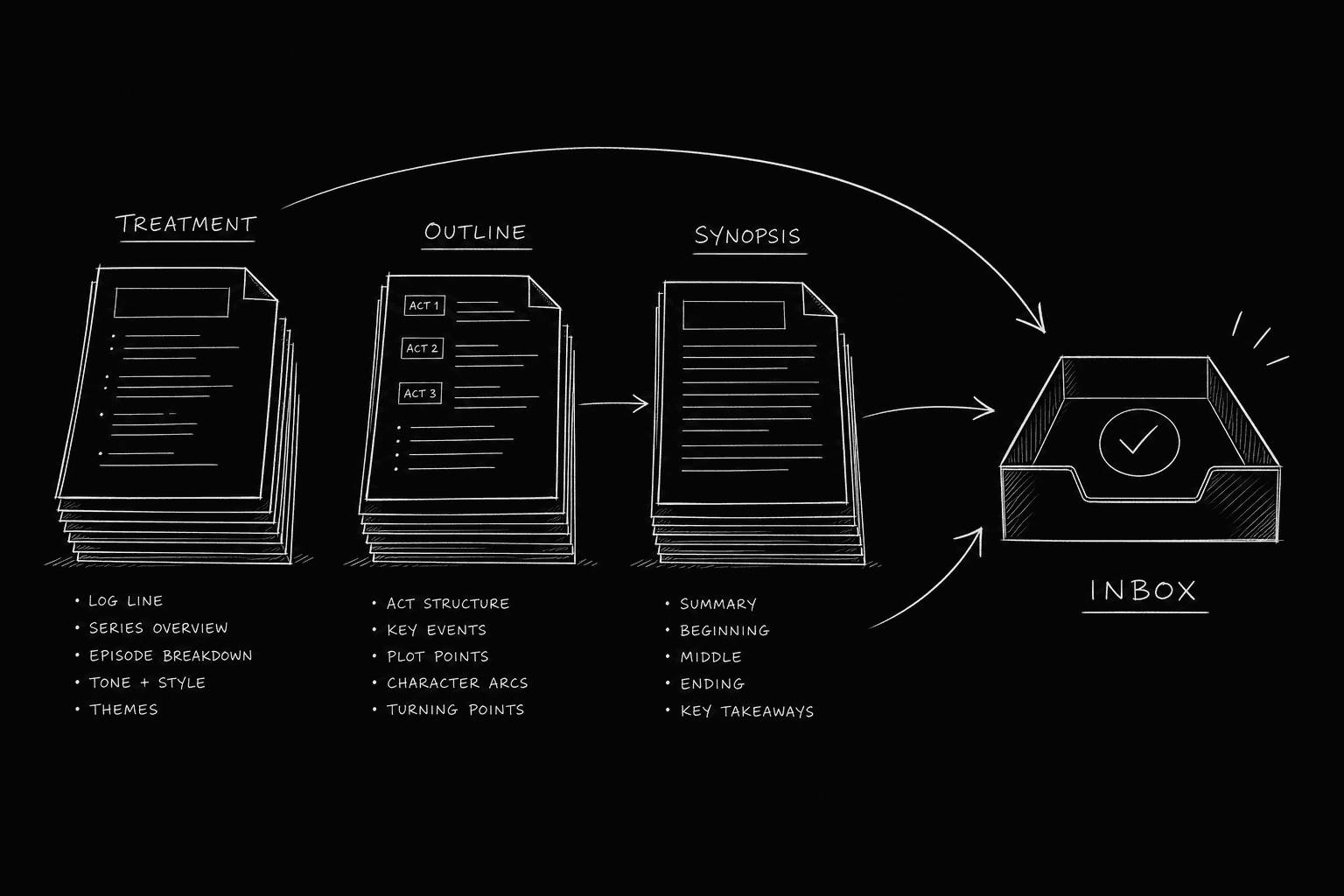

You are in a hallway after a good conversation. Someone says send me something. Your brain offers three files you have been nursing for six months. A treatment that reads like a novel. An outline that is actually a beat sheet with feelings. A synopsis you wrote at two in the morning that sounds like a Wikipedia plot summary written by a nervous intern. You nod. You go home. You attach the wrong one because the word something is not a format.
This guide is not about which document is morally superior. It is about which document earns the next step with the person in front of you. A development exec at a streamer does not want the same packet as a producer who already read your pilot. A manager who asked for a take does not want a twelve-page treatment when they meant a one-page synopsis. The craft is matching intent, length, and spoil level to the relationship stage. Get that right and your script gets opened. Get it wrong and you become the writer who cannot follow a simple ask.
The ask is never "send your best writing." The ask is "send the artifact that lets me decide the next meeting."
How the Three Documents Actually Differ (Stop Using Them Interchangeably)
A synopsis is the short version of the story for someone who needs orientation fast. Think one to three pages for features, often shorter for TV if it is embedded in a packet. It tells what happens in order with enough character and stakes that a reader can picture the movie or pilot. It is not a sales essay. It is not a mood piece. It is the map.
An outline is the structural spine. Scene or sequence level, usually for your own work or for collaborators who will help you break story before pages exist. Outlines can be bullet beats, numbered sequences, or prose blocks per act. They change daily. They are allowed to be ugly. They are how you prove the second act is not a fog bank.
A treatment is prose-forward pitch material. It sells tone, theme, character voice, and set pieces. It can read like a short story about your movie. Length varies wildly by market and by who asked. Treatments are for belief: belief that you can write, belief that the tone is coherent, belief that the big moments land on the page even before they land in Final Draft.
If you only remember one sentence: synopsis explains, outline engineers, treatment seduces. Send the one that matches the job.
When to Send What (The Relationship Timeline)
Cold or early interest. They do not know your voice yet. They have five minutes. Send a synopsis or a tight one-pager that includes logline and premise, not a twelve-page treatment unless they asked for it by name. If you are building the longer treatment anyway, see our guide on how to write a feature film treatment for length and voice targets before you blast it into a stranger's inbox.
Warm meeting after a good pitch. They want to circulate internally. Send a synopsis plus logline. Attach the script only if they asked for the script. Many writers lose deals by sending the script too early and too heavy while the champion is still fighting for a read.
Producer or showrunner already on board for development. They need an outline or a revised outline before they pay for pages. This is where sequence clarity matters. If you are TV, pair the outline logic with a one-pager that summarizes the show so buyers see series engine and episode engine in one breath.
Financier, director, or star considering attachment. They often want a treatment that conveys tone and set pieces, plus a synopsis for their team. Do not send an outline alone unless they are writers too. Non-writers rarely fall in love with bullet beats.
Agent or manager intake. Follow their template. If they did not give a template, send synopsis plus sample pages or pilot, not every document you have ever drafted.
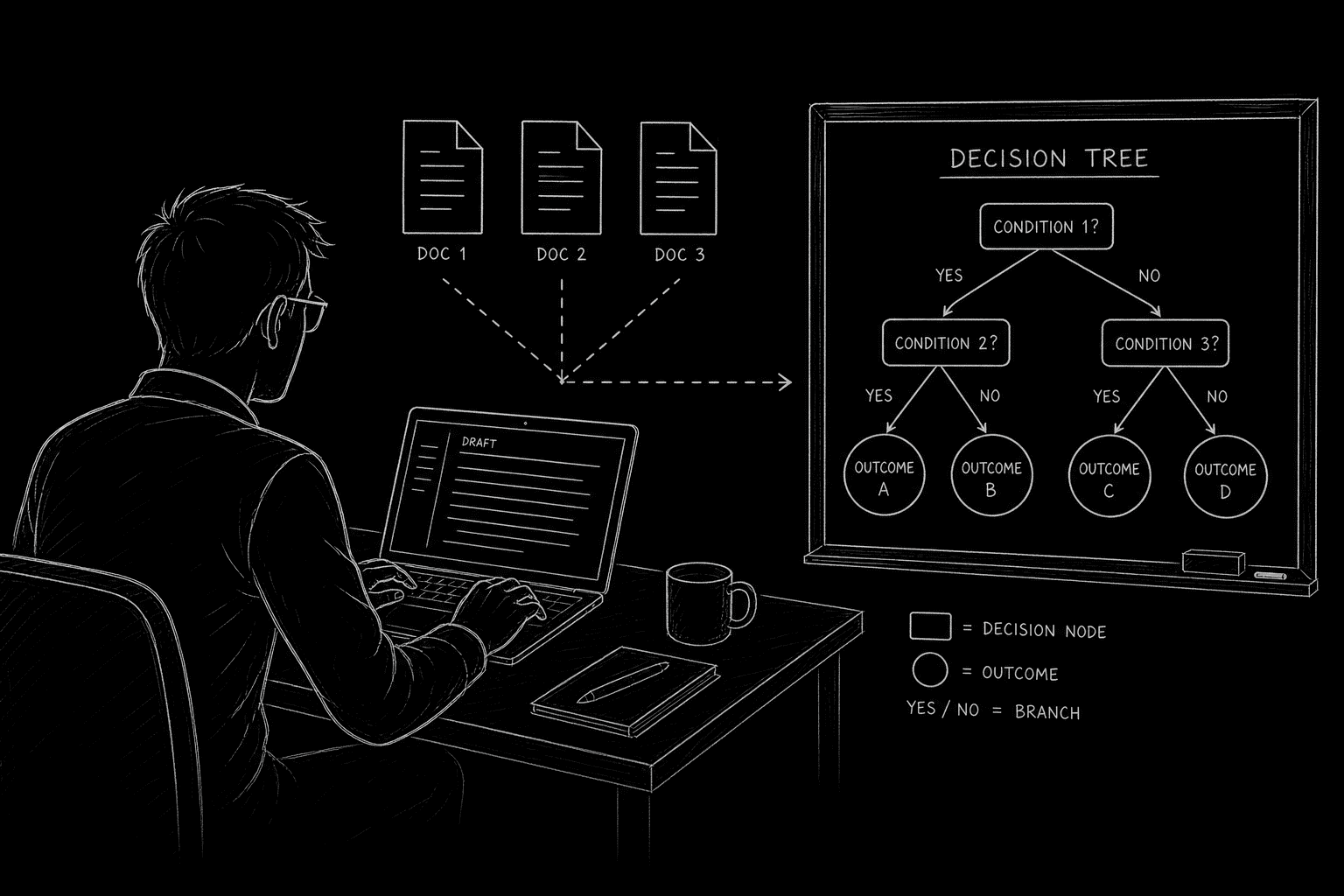
A Send-Decision Table (Print This, Tape It Near Your Router)
| Situation | Send first | Usually do not send yet | Why |
|---|---|---|---|
| First email after query | Synopsis or one-pager | Full treatment | They need a fast yes/no to open |
| Post-pitch "send materials" | Synopsis + logline | Outline unless TV room | Internal forwarding favors short |
| TV writer's room prep | Outline + pilot if ready | Treatment only | Rooms buy structure and voice on page |
| Indie producer dating funds | Treatment + synopsis | Rough outline | Money people need tone and scope |
| Director considering attach | Treatment or script | Beat outline | Directors hear movies, not bullets |
| Rewrite partnership | Outline | Synopsis | You are building, not pitching |
The table is blunt on purpose. Exceptions exist. The exception is always they told you exactly which file name they want.
Relatable Scenario: The Twelve-Page Treatment That Killed a Warm Lead
Jin had a strong Zoom pitch for a contained thriller. The exec said send something I can share. Jin sent a treatment that was technically gorgeous. It was also twelve pages of prose POV and metaphor. The exec's assistant printed it for three people. Nobody finished it. The internal email said "interesting but dense." Jin did not get the read.
Jin did not fail because treatments are bad. Jin failed because the ask was circulation, not literature. The fix was a two-page synopsis with the same set pieces, clearer stakes, and one paragraph on tone. The script request came a week later. Same project. Different front door.
Relatable Scenario: The Outline That Was Really a Beat Sheet in Disguise
Morgan sent an "outline" that was forty numbered beats with no act breaks and no sense of screen time. The showrunner liked Morgan's voice in the room but could not see the episode. Morgan thought more beats meant more professionalism. The showrunner thought Morgan could not structure.
Morgan rebuilt the outline as eight sequences with slugline-style headers and a line of purpose per sequence. One page per act for a pilot. The room invite followed. The lesson: outlines are for navigation, not for proving you had every idea ever.
How to Start Building Each Document (Without Tripling Your Work)
Step 1: Write the logline once. If you cannot say it out loud without apologizing, fix that before any document. Your logline is the seed for synopsis opening and treatment hook.
Step 2: Expand to a synopsis from the logline outward. Act one turn, midpoint, low point, climax. One paragraph per act for features. For TV, add series engine paragraph then pilot A-story paragraph.
Step 3: Derive the outline from the synopsis, not the other way around. Break each act into sequences. Mark where the protagonist makes a choice that costs something. If a sequence has no cost, cut it before you write the treatment.
Step 4: Write the treatment from the outline's greatest hits. Choose three scenes you can describe in cinematic present tense. Choose one thematic sentence you believe. Stop when you hit the length your target reader actually reads.
Step 5: Maintain a single names-and-spelling sheet. Treatments and synopses die when a secondary character changes names between documents. Readers assume sloppiness in the script.
[YOUTUBE VIDEO: Side-by-side teardown of a two-page synopsis versus a bloated treatment for the same thriller, marking what executives skim versus what they forward]
Platform and Use-Case Sections (Feature vs TV vs Indie)
Feature film packaging. Synopses travel. Treatments persuade individuals with taste. Outlines stay between you and your writing partner until someone is paying for structure work. When you are ready to go deep on treatment craft, the feature treatment guide linked above is the longform companion to this send-decision piece.
Television. Rooms think in pilot plus series. Your one-pager is the executive synopsis of the show. Your outline is the pilot's sequence map and, separately, season one shape if asked. Do not send a feature-style treatment when the buyer needs to see episodic engine.
Indie and festival path. Festivals often want the script. Investors often want treatment plus comparables plus budget range. Synopses still matter for grant forms with character limits. Build a packet ladder: one sentence, one paragraph, one page, three pages, twelve pages. Stop when the form says stop.
International and translation handoffs. Synopses translate cleaner than voice-heavy treatments. If your project crosses languages, keep a neutral synopsis without idioms and keep the lyrical treatment for domestic pitches.
Try it free
Try Screenweaver for free on your script
It is free. Import your existing project, get a clearer view of your outline, and regain control of your story structure in minutes.
Start FreeOperational Section: Submission Hygiene That Saves Embarrassment
Filename discipline sounds petty until you receive fourteen files named draft_final_REAL.pdf. Use Title_Synopsis_2026-05.pdf style names. Put your contact email in the footer of synopses and treatments, not only in the cover email.
Version headers belong in small type, not in the title. "Synopsis v3" in the filename is fine. "FINAL FINAL" in the title is not.
PDF for outward sends unless they asked for Word. PDF locks layout. Word invites track changes from people who should wait for the script.
Spoiler policy: synopses spoil. That is the job. Treatments spoil big turns if the turn is the sell. Outlines spoil everything because they are internal. Match spoiler level to reader role.
If they asked for both synopsis and treatment, send two files, not one megadoc. Assistants split packets.
Never apologize in the cover email for length. Cut the document instead.
Outcome Section: What "Good" Looks Like After You Send
A good outcome is not "they loved every word." A good outcome is the next ask. Script request. Meeting with a junior exec who read the synopsis. Notes on the outline. A pass that is specific.
Specific passes are gifts. "The treatment is strong but the second act set piece feels small on the page" tells you what to fix. "Not for us" without detail tells you nothing except timing.
Track responses in a simple log: date, recipient role, document sent, next step. Writers who do this stop resending treatments to people who already asked for the script.
Why It Matters (Old Way vs Better Way)
The old way is document hoarding. You wrote everything, so you send everything. The reader drowns. The old way also confuses your process with their decision. Your outline is process. Their inbox is decision.
The better way is one door at a time. Synopsis opens the door. Script proves the door was worth opening. Outline invites collaboration behind the door. Treatment makes someone want to stand in the doorway and listen to how you talk about rain.
Writers who match document to moment look professional even when they are unpublished. Writers who mismatch look like they cannot read the room even when they are brilliant.
Trench Warfare: Mistakes That Waste Good Projects
Mistake: sending a treatment when they asked for a synopsis. Fix: cut to three pages max, present tense, plot-forward.
Mistake: sending an outline to a non-writer financier. Fix: synopsis plus tone paragraph, hold outline for later.
Mistake: different endings in synopsis and treatment. Fix: one story bible line for ending and stick to it.
Mistake: hiding the ending in a synopsis because you fear spoilers. Fix: executives need endings to assess structure. Spoil responsibly.
Mistake: no logline on page one. Fix: logline header, then synopsis body.
Mistake: treatment voice that never appears in the script. Fix: treatment is a promise. Sample pages must sound like the treatment.
For external context on professional writing packets and industry expectations, see the <a href="https://www.wga.org/" rel="nofollow">Writers Guild of America</a> resource hub on industry standards. Then come back and delete the extra document from your attachment.
Relatable Scenario: The TV Writer Who Sent a Feature Treatment to a Room
Lena had a half-hour pilot with a sharp ensemble engine. A showrunner asked for "materials." Lena sent a feature-style treatment because it was the most polished thing on her drive. The showrunner read three pages and still could not tell how episode two differs from episode six. Lena was not unqualified. She was format-mismatched.
Lena rebuilt the packet: one-page one-pager logic, pilot synopsis, and a season spine outline with eight episode loglines. The treatment stayed in her folder for film meetings. Same writer, two doors, two keys. The room meeting happened two weeks later.
Granular Workflow: The Cover Email That Does Not Sabotage the Attachment
Keep the email shorter than the attachment. Subject line: Title - Synopsis - Your Name. First sentence: what you are sending. Second sentence: what you want back. Third sentence: thank you.
Do not summarize the entire plot in the email body if the synopsis is attached. That is duplication, and duplication makes busy readers feel you do not trust the document.
If you are sending after a verbal pitch, reference one image or line from the pitch so their memory clicks. "Following up on the hallway pitch about the locksmith who cannot lie" beats "attached please find."
If they do not respond in ten business days, a one-line bump is fine. Do not attach a new treatment version with a different ending and pretend it is the same send.
Why the "Send Everything" Impulse Feels Safe (And Fails)
Writers bundle documents because anxiety loves volume. Volume signals effort. Effort is not legibility. An inbox with four attachments and no hierarchy forces the assistant to guess. They guess wrong, or they open nothing.
The professional move is confidence in sequence. You are saying: this one file is the correct next test. If they want more, they will ask, and you will look responsive instead of overwhelming.
When you are developing a feature treatment from scratch, work the long prose in the dedicated feature film treatment guide, then strip a synopsis from that work for circulation. One source story, multiple lengths, zero contradictions.
Closing: One Ask, One File, One Clear Next Step
Before you hit send, say out loud what you want back. If you want a read, send the shortest honest synopsis and ask for the read. If you want a room, send the outline that proves you know episodic shape. If you want someone to feel the movie in their chest before pages exist, send the treatment that sounds like you.
The industry runs on forward motion. Treatments, outlines, and synopses are not homework genres. They are levers. Pull the right lever for the person in front of you. When the lever works, stop pulling the other levers until someone asks.
Build your feature treatment with intention, sharpen your show summary on a one-pager, and treat every send as a test of whether you understood the room. The room always answers. Sometimes the answer is yes. Sometimes it is "send the other thing." If they say that, you are already closer than the writer who sent everything at once.
Final Step
Build your next script with Screenweaver
Move from ideas to production-ready pages faster with timeline-native writing and AI-assisted story flow.
Try Screenweaver