
Coverage arrives like weather. You did not order it. You cannot argue with the sky. You open the PDF, see a grade you did not want, skim three paragraphs that feel personal, close the laptop, and tell yourself the reader was tired. Maybe they were. You still have a script and a clock. The skill is not winning the coverage fight. The skill is mining coverage for a rewrite order that makes the next reader encounter a different movie.
Script coverage is a compressed opinion with institutional habits. Readers repeat words because their templates repeat words. "Passive protagonist" might mean ten different diseases. "Uneven tone" might mean one scene in a karaoke bar. Your job after coverage is triage: separate structural fractures from surface scratches, separate consensus notes from one reader's taste, and build a pass list you can finish before you lose the thread of why you wrote the thing.
Coverage is a map drawn by someone who walked your script once. It is not the territory. It is still worth reading with a compass.
How Coverage Is Built (So You Stop Mystifying It)
Most coverage follows a skeleton: logline recap, synopsis, comments, character notes, market thoughts, recommendation. The recommendation is what assistants use to sort piles. The comments are what you rewrite from, if you rewrite at all.
Readers are often freelancers or development staff working fast. They mark what they can defend in a meeting. They lean on vocabulary their boss recognizes. That does not make them right about your art. It makes them predictable.
Predictability is your advantage. If you collect five coverage reports on the same draft and three say the midpoint is soft, you have a midpoint problem. If one says "too commercial" and one says "too niche," you have a positioning argument, not a scene fix.
How to Start Reading Without Destroying Your Week
Step 1: Read the logline and synopsis first. If their synopsis misses your third act turn, your turn is not landing on the page. That is structural signal even before you read their adjectives.
Step 2: Read the recommendation last. You are not in court. You are in a workshop with one very tired classmate.
Step 3: Highlight only actionable sentences. Actionable means you could change a scene this weekend. "I did not care" is not actionable until you ask what scene failed to make them care.
Step 4: Sort highlights into three buckets: structure, character, presentation. Structure is act turns, escalation, clarity of goal. Character is motivation, voice, relationships. Presentation is formatting, typos, confusing sluglines, on-the-nose dialogue.
Step 5: Pick one bucket for this pass. Multi-pass rewriting beats mega-pass chaos. Structure before dialogue polish is the default order unless presentation issues make the script unreadable.
[YOUTUBE VIDEO: Analyst walks through a real coverage PDF, color-coding structural vs taste notes and building a one-page rewrite priority list]
A Priority Matrix Table (What to Fix First)
| Coverage signal | Likely meaning | Rewrite priority | Typical fix type |
|---|---|---|---|
| "Slow start" | Late inciting incident or repetitive setup | High | Cut or combine opening scenes |
| "Passive protagonist" | No choices, or choices without cost | High | Add decision scenes with consequences |
| "Confusing" | Geography, time jumps, or unclear goals | High | Clarify sluglines, plant turns earlier |
| "Uneven tone" | One scene breaks genre contract | Medium | Rewrite or cut the outlier scene |
| "Dialogue on the nose" | Exposition spoken aloud | Medium | Subtext pass on flagged scenes |
| "Formatting issues" | Reader distraction | Low unless severe | Clean export, standard margins |
| "Not for me" | Taste | Low | Note for targeting, not automatic rewrite |
Use the table as triage, not gospel. Your western might get "not for me" from someone who does not buy westerns. That note is market, not craft.
Relatable Scenario: Five Readers, One Third-Act Problem
Aisha sent her thriller to a contest, a paid service, a peer group, and two friends who work in development. Four of five mentioned that the villain's plan becomes clear too late. One reader loved the mystery of it. Aisha wanted to keep the mystery because the mystery was her favorite part.
The consensus was not "ruin the mystery." The consensus was clarify intention earlier without revealing the twist. Aisha planted a false assumption in scene twelve that made the late reveal feel fair. She did not move the reveal. She moved evidence. The next coverage round still had notes. None of them used the phrase "unclear antagonist."
Relatable Scenario: The Dialogue Note That Was Actually Structure
Ben received "dialogue feels flat" on a family drama. He spent three weeks polishing lines. The script felt prettier. Reads were still lukewarm. A mentor read the coverage and the script together. The real issue was that every scene had the same argument about the same secret without escalation.
Ben's fix was not wittier dialogue. It was new information per act about the secret. Scene ten could not repeat scene three with better jokes. Coverage vocabulary mislabeled a structure stall. When you see dialogue notes stacked on the same relationship beat, ask if the beat should exist twice.
Use-Case Sections: Contest vs Manager vs Showrunner Notes
Contest coverage tends toward template language and comparables. Useful for market positioning and fatal flaw detection. Weak for subtle character work unless you advanced far enough that a human wrote long comments.
Paid professional coverage varies by provider. Treat it like hiring a consultant. One report is one opinion with credentials. Stack three before you rebuild act one unless the note is undeniably clear.
Manager or agent notes are business-weighted. They think about what they can sell. If they say "make the lead more active," they often mean "I can pitch this to Actor X if she drives scenes."
Showrunner or room notes are production-weighted. They think about what actors will play and what sets you can afford. "Can we do this in one location?" is coverage too, just spoken.
Peer group notes are high variance. Weight peers who read the whole draft over peers who skimmed because they were tired.
Operational Section: Building Your Rewrite Pass List
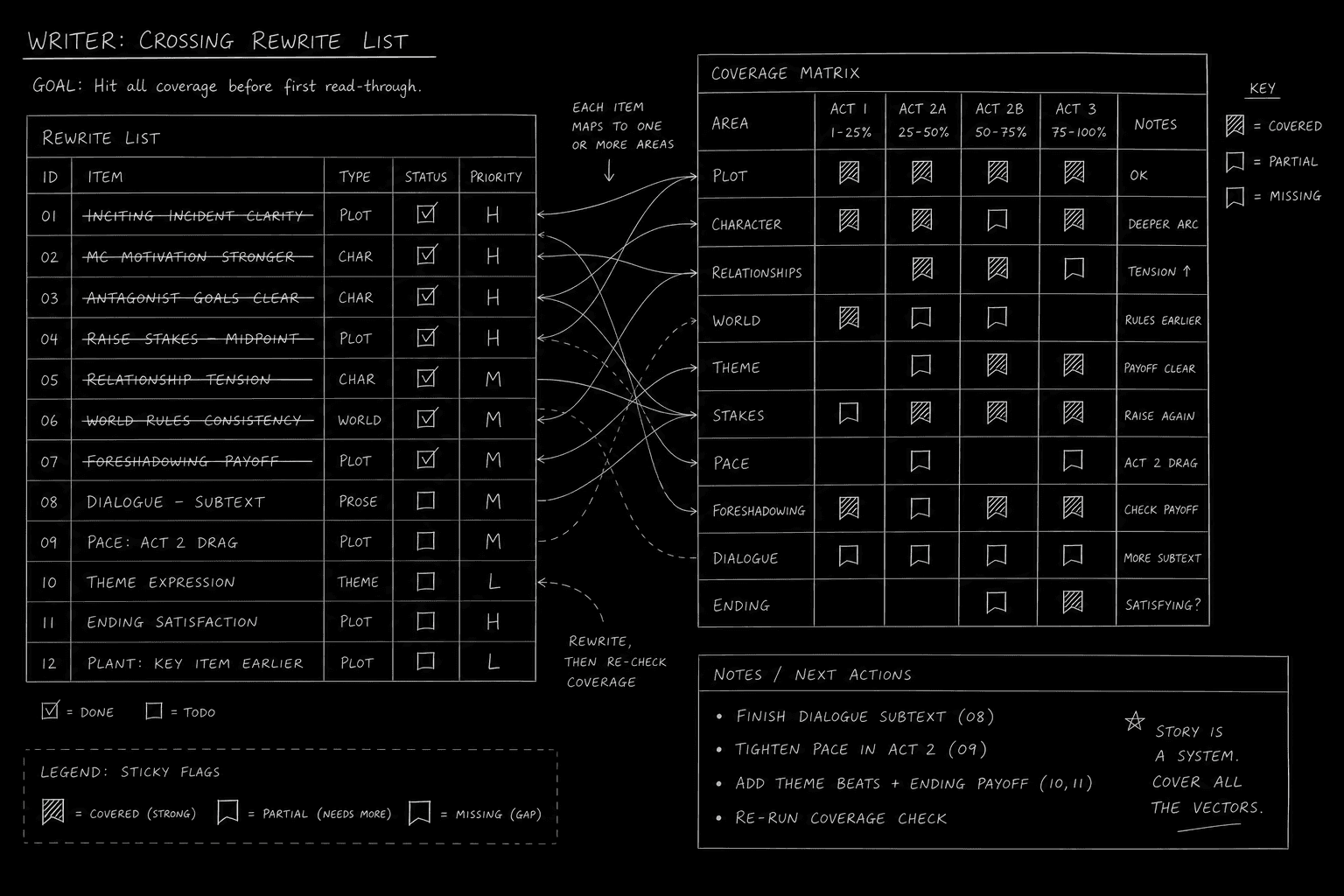
Open a fresh doc. Title it Rewrite Pass - Draft X. Copy only actionable lines from coverage. Under each line, write one scene number you will touch. If you cannot name a scene, the note is not ready for rewriting. It is ready for diagnosis.
Cap your pass list at seven items. More than seven and you will spin. Rank by how many reports mentioned the issue. Rank by whether fixing it changes the ending. Rank by whether you believe it.
For each item, write done when in plain language. Example: "Done when the protagonist refuses the heist in scene eight for a reason we saw in scene two." Done-when language prevents endless tinkering.
Schedule passes: structure week, character week, dialogue week, polish week. Mixing them creates scripts that change voice every ten pages.
When you export for re-submission, stabilize format so pagination matches your prior send. Readers notice when page forty suddenly became page fifty because margins changed. For export discipline while you revise, see exporting production PDF and FDX.
A rewrite pass without a done-when sentence is a mood, not a plan.
Outcome Section: What Improved Coverage Looks Like
Improved coverage rarely says "perfect." It says different problems. You want new specific notes, not the same vague ones. If three readers still say "slow second act," your second act is still slow on the page, no matter how you feel about it.
Sometimes the win is recommendation tier movement: from pass to consider, from consider to recommend with reservations. Track that if you are submitting repeatedly to the same gatekeepers.
Sometimes the win is one champion sentence in the comments. "If the opening were as strong as the climax, I'd push this." That is a rewrite order with a spotlight.
Try it free
Try Screenweaver for free on your script
It is free. Import your existing project, get a clearer view of your outline, and regain control of your story structure in minutes.
Start FreeWhy Prioritization Beats Reactivity
Reactive rewriting chases the last note you read. You fix a karaoke scene because reader four hated karaoke. Reader two hated the father subplot. You fix the father. Reader three hated the opening. You die at page one forever.
Prioritized rewriting treats coverage like injury triage. Stop the bleeding first. Structural bleeding is scenes that do not turn, stakes that do not rise, protagonists who do not choose. Cosmetic bleeding is a repeated word and a slugline typo. Both matter. Not in the same afternoon.
The old way is emotional archaeology. You dig through coverage looking for proof you are good. The better way is engineering. You build a list, you execute the list, you re-test with a table read or a trusted reader before you pay for more coverage.
Trench Warfare: Coverage Myths That Waste Months
Myth: a Pass grade means throw the script away. Reality: Pass often means "not this quarter" or "not this reader's taste." Ask whether notes are fixable before you shelve a project you still believe in.
Myth: you must obey every note. Reality: obey consensus on structure, negotiate taste.
Myth: coverage replaces a table read. Reality: coverage is one reader. A room is physics.
Myth: rewriting the opening fixes everything. Reality: opening fixes help when the opening is the problem. If coverage hates the midpoint, an opening polish is perfume.
Myth: new draft should be unrecognizable. Reality: radical reinvention sometimes works. Often it erases what was already working. Surgical cuts beat nuclear rewrites unless the synopsis itself is wrong.
For external craft grounding on revision discipline, see the <a href="https://www.oscars.org/nicholl/about/screenwriting-resources" rel="nofollow">Nicholl Fellowship screenwriting resources</a> collection. Then apply one structural fix and re-read aloud.
Granular Workflow: From Coverage PDF to Scene Cards
Print the coverage if you can. Paper lets you mark without scrolling the script side by side. For each structural note, write an index card: scene affected, current function, new function. Spread cards on a table. If two cards say the same function, you found duplication.
For character notes, track want, fear, lie per act for the lead. Coverage that says "unlikable" sometimes means the lie is not playing, not that the character needs to be nicer.
For presentation notes, batch fix in software last. Do not let a week of margin tweaking delay a story fix you already know you need.
Re-run a self-coverage after your pass. Write your own one-page coverage of the new draft. If you cannot write a fair negative paragraph, you are not ready to re-submit.
Link your dialogue pass to a separate resource when you are ready: revision passes for structure, clarity, and dialogue keeps passes from colliding.
Relatable Scenario: The "Consider" That Was Really a Structure Pass
Tomas got Consider on a contest read with comments that sounded gentle. "Promising voice." "Some pacing concerns." He almost filed the script. His mentor translated: Consider with pacing comments on a thriller usually means second act stall, not "almost there on prose."
Tomas mapped every scene between pages thirty and sixty-five. He found three scenes that repeated the same debate about trust without new facts. He cut one, compressed one, and moved a reveal earlier. The next submission moved to Recommend with reservations on structure but praise on voice. Tomas did not become a different writer. He became a clearer escalator.
Reading Coverage Like a Showrunner (Questions to Ask Out Loud)
When you read a paragraph of comments, ask five questions before you touch the keyboard:
Does this note name a scene or only a vibe? If vibe, can I name the scene myself?
Would fixing this note change the ending? If yes, priority rises.
Did this reader understand the genre contract? A note that says "too dark" on a horror script might be taste, not craft.
Is this note contradicted elsewhere in the same report? Internal contradictions often mean the script sent mixed signals in two acts. Find the act break.
If I fixed only this note, would the movie be better or just different? Better is worth doing. Different is a fork, not a fix.
Write answers in the margin. Marginalia is how professionals stay calm.
The Two-Week Rewrite Sprint (Operational Calendar)
Days one to two: coverage triage only. No rewriting. Build the seven-item pass list.
Days three to five: structure pass. Scene cards on the wall. Move, cut, combine.
Days six to eight: character pass. Motivation and relationship turns per act.
Days nine to ten: dialogue pass on flagged scenes only.
Days eleven to twelve: presentation and format export. PDF proof.
Days thirteen to fourteen: self-coverage and one trusted reader. Adjust list if needed.
The calendar is not law. It is a container. Containers beat mood.
When to Ignore Coverage (The Narrow Exceptions)
Ignore taste notes that conflict with intentional genre choices you will not abandon. Ignore notes that ask you to become a different writer. Ignore notes from readers who clearly wanted a different movie than the one you wrote, if three other readers did not share that note.
Do not ignore three readers who say the same thing in different words. That is not taste. That is pattern.
Closing: Coverage Is Input, Not Verdict
The script is yours. The career is yours. Coverage is a cheap-ish way to simulate a reader before money and reputation are on the line. Read it like a craftsperson reads a diagnostic report: calm, curious, ruthless about priorities, gentle about your future self who has to execute the list.
Send the next draft when the pass list is done, not when the anxiety spikes. The readers who matter respect writers who can translate notes into visible change on the page. That translation starts with knowing which note wins the week.
When coverage stings, walk around the block. When you sit back down, open the comments section with a highlighter, not a grudge. The movie you want is still in there. Coverage is just one loud voice telling you which hallway to try next.
Final Step
Build your next script with Screenweaver
Move from ideas to production-ready pages faster with timeline-native writing and AI-assisted story flow.
Try Screenweaver