
The draft is due in twelve hours. The network note arrived thirty minutes ago. Your co-EP wants Act Two rebalanced, your showrunner wants a sharper teaser button, and production needs page counts to stop moving.
This is television writing in 2026.
And software choice is no longer a preference question. It is a systems question.
TV writers live inside constraints that feature writers often underestimate: episode architecture, cadence pressure, room dynamics, continuity across arcs, and revision protocols that touch every department. If your screenwriting tool handles formatting but breaks under room velocity, you are paying hidden tax every day. If it supports collaboration but blurs revision authority, you lose time in decision noise. If it feels great for one script but collapses when your season document stack grows, you are building a production bottleneck right in pre-production.
Here’s why that matters: TV is iteration at industrial speed. You are not delivering one polished screenplay and resting. You are designing an ongoing narrative machine where every episode influences the next, and where documentation quality directly affects production stability.
The best software for TV writers in 2026 is not the fanciest interface. It is the environment that protects story quality while surviving room-level operational load.
Cinematic workflow frames
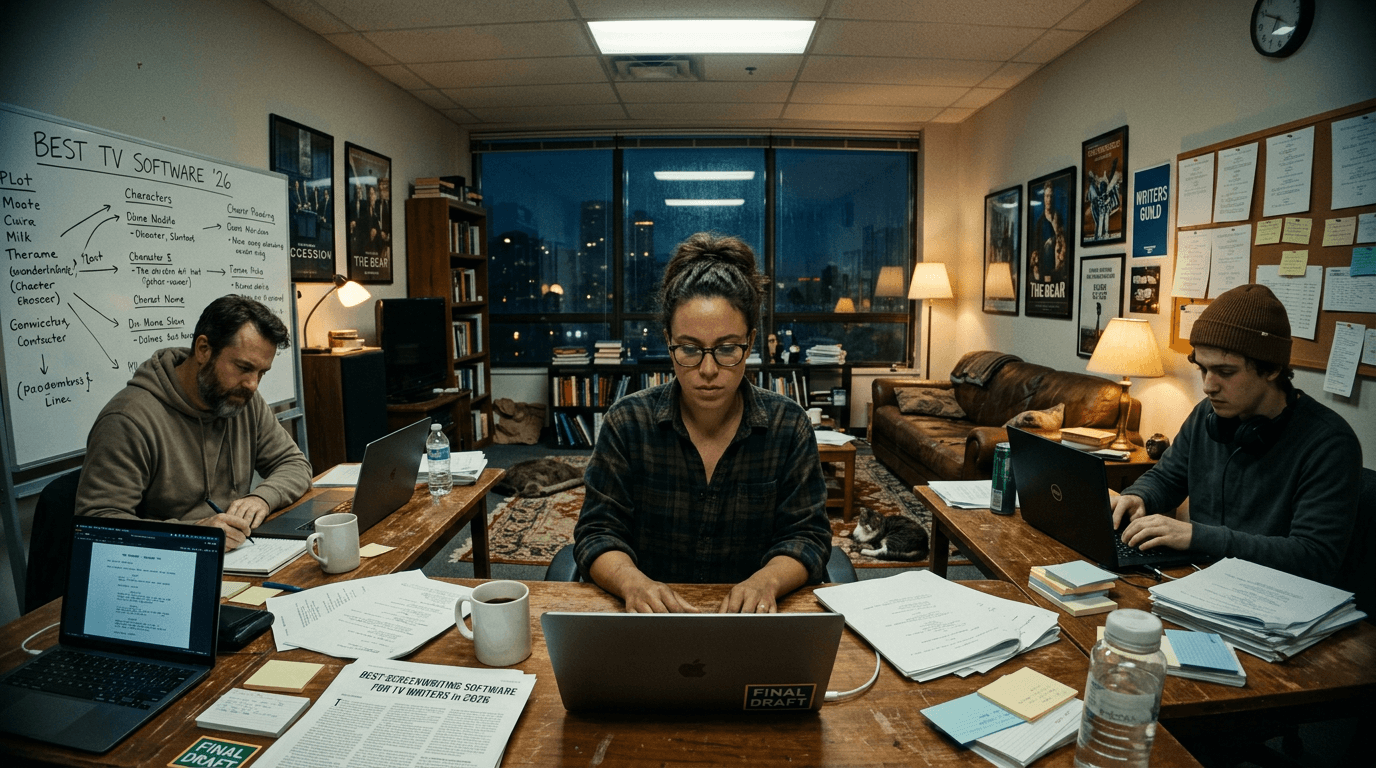
These two visuals work as a pair: the first shows Cinematic workflow still, first angle, 35mm film grain, and the second shifts to Cinematic workflow still, second angle, 35mm film grain - compare them briefly, then move on.

TV Writing Is Not Just "Longer Screenwriting"
A lot of software advice still treats TV as feature writing with act breaks. That is outdated.
Television writing has structural pressure at multiple scales simultaneously. You are solving scene rhythm in one episode while protecting seasonal momentum across many episodes. You are balancing character continuity, production practicalities, and network expectations inside the same revision cycle. You are often writing with many voices in the process: staff writer, story editor, co-producer, showrunner, network, studio, line production.
Think about it this way: in a feature, your draft is usually a central narrative artifact. In TV, your draft is also a node in an active ecosystem of outlines, beat sheets, series bibles, continuity trackers, room notes, cast availability constraints, and schedule adjustments. Software that ignores this context forces writers to compensate manually. Manual compensation feels manageable in week one. By week eight, it becomes chaos with polished typography.
In TV, "good formatting" is entry-level competence. Workflow resilience is the real differentiator.
What TV Writers Need Their Software to Do
Before naming tools, clarify functions. TV writing software must support five non-negotiables:
continuity memory across episodes, room-safe collaboration, reliable revision discipline, fast navigation through long and numerous documents, and exports that survive handoff without drama.
The tools that win in TV circles are rarely perfect everywhere. They win because they fail gracefully under pressure.
| TV Workflow Need | Why It Matters in a Writers Room | What Strong Software Behavior Looks Like | Failure Pattern |
|---|---|---|---|
| Episode/Season Continuity | Character, prop, and timeline drift kills credibility | Fast cross-script search, reference links, note traceability | Contradictory details discovered late |
| Collaboration Cadence | Multiple writers and decision-makers touch pages daily | Clear role boundaries, comments, version history, merge safety | Competing drafts and ownership confusion |
| Revision Control | Production relies on stable revision history | Color/page revision protocols, locked snapshots, clean comparison | "Which version is current?" debates |
| Room-Scale Performance | Multi-episode workflow is heavy | Smooth operation with notes, tags, and long scripts open | Lag, stutter, delayed save behavior |
| Handoff Reliability | ADs, coordinators, actors, and directors need trustable pages | Clean PDF/FDX/Fountain outputs with minimal drift | Reformatting at the last minute |
That table should sit beside your keyboard while evaluating any tool.
The 2026 Field: Which Profiles Serve TV Writers Best
Some platforms still lead because they map to how rooms actually run.
Final Draft remains deeply entrenched in production-facing pipelines, mostly due to institutional familiarity and predictable output behavior for teams that grew up on its conventions. In many rooms, that still reduces friction with coordinators and production partners who expect specific revision flows.
WriterDuet is often favored when real-time collaboration is central, especially for distributed rooms and writing pairs that alternate ownership quickly. Its strength is not merely simultaneous typing. It is shared context visibility.
Fade In continues to attract practical TV writers who want robust drafting without excessive ecosystem weight. It often performs well as a dependable core tool in stacks where room process discipline is already strong.
Arc Studio Pro has built a strong following among writers who want modern ergonomics and a less legacy-heavy drafting experience. It can accelerate individual writing flow when the team aligns around its approach.
Fountain-centered workflows still appeal to minimalist power users and teams that prioritize text portability, git-based versioning, or custom scripting around documents. But in rooms with mixed technical comfort, that path can become operationally expensive unless standards are tightly enforced.
The strongest TV teams in 2026 are often tool-agnostic in principle and ruthlessly specific in practice. They standardize where it protects handoffs, and stay flexible where it protects speed.
Scenario One: First-Year Staff Writer Entering a Real Room
Nina lands her first staff writer job on an eight-episode streaming drama. She has talent, discipline, and panic-level imposter syndrome. On day three, she discovers the room moves faster than any workshop environment she has known.
The room breaks story in broad strokes, then rapidly drills to scene-level beats. Notes from the showrunner arrive in tight bursts. Script coordinator requests clarifications. Episode links become essential because callback lines and world rules keep resurfacing.
Nina’s first instinct is to over-document in disconnected apps. She has one tool for scene cards, another for script pages, and chat threads for notes. She quickly loses traceability.
Her fix is simple and transformative: she moves to a workflow where scene-level notes are tied directly to script artifacts, she standardizes naming conventions for episodes and beat passes, and she uses one canonical comment trail for actionable changes.
Within two weeks, she stops firefighting retrieval and starts contributing at story level.
The lesson: first-year room success is rarely blocked by writing talent alone. It is blocked by process fragility amplified by software mismatch.
Scenario Two: Mid-Level Writer Running Episode While Showrunner Is in Prep
Carlos, a co-producer, is effectively running Episode 5 while the showrunner is in location prep for Episode 3. He receives notes from multiple directions: showrunner voice memos, network comments, actor concerns, and production constraints.
He does not need software that inspires him. He needs software that makes decisions legible.
His setup includes strict revision windows, tagged notes by source, and locked export snapshots at specific checkpoint times. When a conflict appears between a network note and production reality, he can trace when and why each line changed.
The room still debates. Debates are healthy. What disappears is ambiguity.
Without this discipline, Carlos would spend half his day proving which draft was authoritative. With it, he spends his day shaping episode quality.
Scenario Three: Mini-Room Building Limited Series Bible and Pilot Together
A three-writer mini-room develops a six-episode limited series while simultaneously rewriting the pilot for financiers.
The dangerous trap is obvious: they treat the pilot like a standalone script while the series architecture is still moving. By week two, character motivations conflict between pilot dialogue and bible summaries.
They solve it by building a dual-track workflow. The pilot remains in a production-trusted drafting tool, while season logic and continuity anchors live in an indexed companion system connected by episode/character tags.
Now when the midpoint reveal shifts in Episode 4 planning, they can audit affected pilot foreshadowing quickly instead of discovering mismatches during exec review.
As discussed in our guide on [limited series architecture and pilot integrity], this synchronization layer is often the difference between "promising concept" and "buyable package."
Step-by-Step Workflow TV Writers Can Implement This Week
Step 1: Define Your Room Topology Before You Pick the Tool
Is your room centralized and in-person, distributed and asynchronous, or hybrid with heavy prep-side communication? The answer changes your tool priorities immediately.
Distributed rooms need superior comment/version visibility. In-person rooms with strong coordinator support can tolerate less native collaboration and rely more on protocol.
Step 2: Build an Episode Stress Test, Not a Single Script Test
Do not evaluate software with one polished sample. Use:
one pilot script segment, one second-episode segment, one continuity note list, one simulated network note pass, and one export package requirement.
If the tool survives this composite test, it has a chance.
Step 3: Simulate a Revision Day With Real Constraints
Create a fake but realistic change request:
trim Act Two by two pages, preserve teaser hook, move one key exposition beat to Act One, and maintain existing scene numbers for production docs.
Run this in each candidate tool and log elapsed time plus error count.
Step 4: Validate Handoff Behavior Across Team Roles
Export your revised draft and hand it to someone playing script coordinator, AD, and actor. Ask each person to flag friction in under five minutes.
If they cannot parse changes quickly, your software or process is failing operationally.
Step 5: Lock Naming, Versioning, and Note Taxonomy
Most room friction comes from semantic chaos, not missing features. Define draft naming, note labels, and revision checkpoints before episode pressure peaks.
Software can support this. It cannot invent it for you.
Try it free
Try Screenweaver for free on your script
It is free. Import your existing project, get a clearer view of your outline, and regain control of your story structure in minutes.
Start FreePractical Settings TV Writers Should Tune Early
Autosave behavior is not a trivial preference in room context. Aggressive sync with unstable connectivity can create merge turbulence; delayed sync can create confidence gaps. Tune for your environment and test under weak network conditions.
Enable revision visualization only during true revision phases. Leaving dense markups always-on desensitizes writers to important changes.
Set up template consistency for act-break notation, scene headings, and location naming. TV rooms bleed time when the same concept appears under five labels across episodes.
If your software supports tags or custom metadata fields, define a minimal schema for character arc checkpoints, timeline anchors, and production-sensitive flags. Keep it lightweight. Keep it strict.
As discussed in our workflow note on [episode continuity tracking without spreadsheet overload], minimal consistent metadata beats ambitious inconsistent metadata every time.
The Trench Warfare Section: What Beginners in TV Get Wrong
This is where rooms quietly lose days.
They Confuse Collective Energy With Collective Editing
In an active room, everyone has ideas. That does not mean everyone should touch pages at once.
Beginner rooms often treat collaborative software like a shared whiteboard. Pages become crowded, intent blurs, and no one is sure which line reflects final story decisions.
Fix: define edit authority windows by sequence or act. During windows, non-owner input enters as structured notes, not direct line edits.
They Over-Rely on Memory for Continuity
A character says she cannot drive in Episode 1, then casually drives in Episode 4. The room notices late. Confidence drops.
Fix: maintain continuity anchors tied to script references, not isolated spreadsheets. If an anchor changes, flag affected episodes immediately.
They Use Software Features Without Decision Protocols
Comments, tags, and reactions are useful. Without policy, they become noise.
Fix: classify note types by actionability: decision note, exploration note, blocked by production, blocked by approval. Review only decision notes in revision meetings.
They Treat Exports as End-of-Week Tasks
By Friday, your room should not discover that exports introduced formatting drift.
Fix: run daily export checks during active rewrite windows. Validate page integrity and dialogue formatting in an independent viewer.
They Ignore Script Coordinator Reality
Writers optimize for writing comfort. Coordinators optimize for delivery precision. If those worlds diverge, the whole pipeline slows.
Fix: involve coordinator perspective in software evaluation from day one. Their friction signals are early warnings of production pain.
They Create Infinite Draft States
Draft-v3-final-v6-showrunner-notes-FINAL2 is not versioning. It is entropy.
Fix: adopt immutable checkpoint naming with timestamp and status labels. Keep one authoritative active draft pointer at all times.
They Forget Actor Readability Under Time Pressure
Actors often review pages quickly between commitments. Dense, unstable pages undermine performance prep.
Fix: review exports in actor-read mode. Focus on clarity, whitespace rhythm, and predictable scene identifiers.
They Keep Strategic Notes in Chat Threads
Chat is fast and context-rich. It is also a graveyard for critical decisions.
Fix: any decision that changes pages must be mirrored into the script system or a canonical decision log within one hour.
They Choose Software Based on Demo Polish
Demo environments are designed for first impressions, not cumulative load.
Fix: evaluate with realistic room artifacts: multiple open episodes, heavy notes, revision history, and handoff simulations.
They Lack a Lock Definition
"Locked" should mean specific operational conditions are met, not merely that everyone is tired.
Fix: define lock criteria for each phase: story lock, production lock, revision lock. Tie each to explicit checks.
TV writing teams do not fail because they debate story. They fail when software and process make those debates untraceable.
Cost Strategy for TV Teams: The Hidden Budget Line
Subscription pricing seems straightforward until collaboration seats, storage caps, and export dependencies scale across a season.
A cheaper per-user tool can cost more if it adds handoff labor. A pricier platform can save budget if it prevents coordinator overtime and revision confusion. Cost evaluation must include operational burden, not just license fee.
For indie TV teams, the smartest move is usually staged commitment: short trial cycle, stress tests with room-like artifacts, then a season-level decision with explicit fallback plans.
Do not underestimate migration costs mid-season. Switching tools during active production is like changing engines in traffic.
One External Anchor That Actually Helps
If you want a useful standards reference while setting up revision and script handling expectations, the WGA materials remain practical context, especially for understanding professional documentation rigor: <a href="https://www.wga.org/contracts/credits/manuals/screen-credits-manual" rel="nofollow">WGA Screen Credits Manual</a>.
Recommended 2026 Setup Pattern for Most TV Writers
Use a drafting core that your room can trust under deadline. Pair it with a continuity/series-layer system that keeps long-arc intelligence accessible. Keep handoff exports routine, not heroic.
Do not chase a perfect all-in-one promise unless your tests prove it in your exact room conditions.
[YOUTUBE VIDEO: A practical walkthrough of a one-day TV room revision cycle showing how to process showrunner notes, preserve revision clarity, and deliver clean pages to production]
The Ending That Matters
TV writing in 2026 is a speed-and-precision profession. You can write brilliant scenes and still lose trust if your workflow produces confusion. You can write decent scenes and gain trust if your process is clear, stable, and collaborative in the right ways.
The best screenwriting software for TV writers is the one that keeps creative momentum high while making operational truth obvious.
Not glamorous. Essential.
Pick the tool that helps your room think clearly at 10:45 p.m. when the notes pile is ugly and the deadline is real.
That is the only test that counts.
Final Step
Build your next script with Screenweaver
Move from ideas to production-ready pages faster with timeline-native writing and AI-assisted story flow.
Try Screenweaver