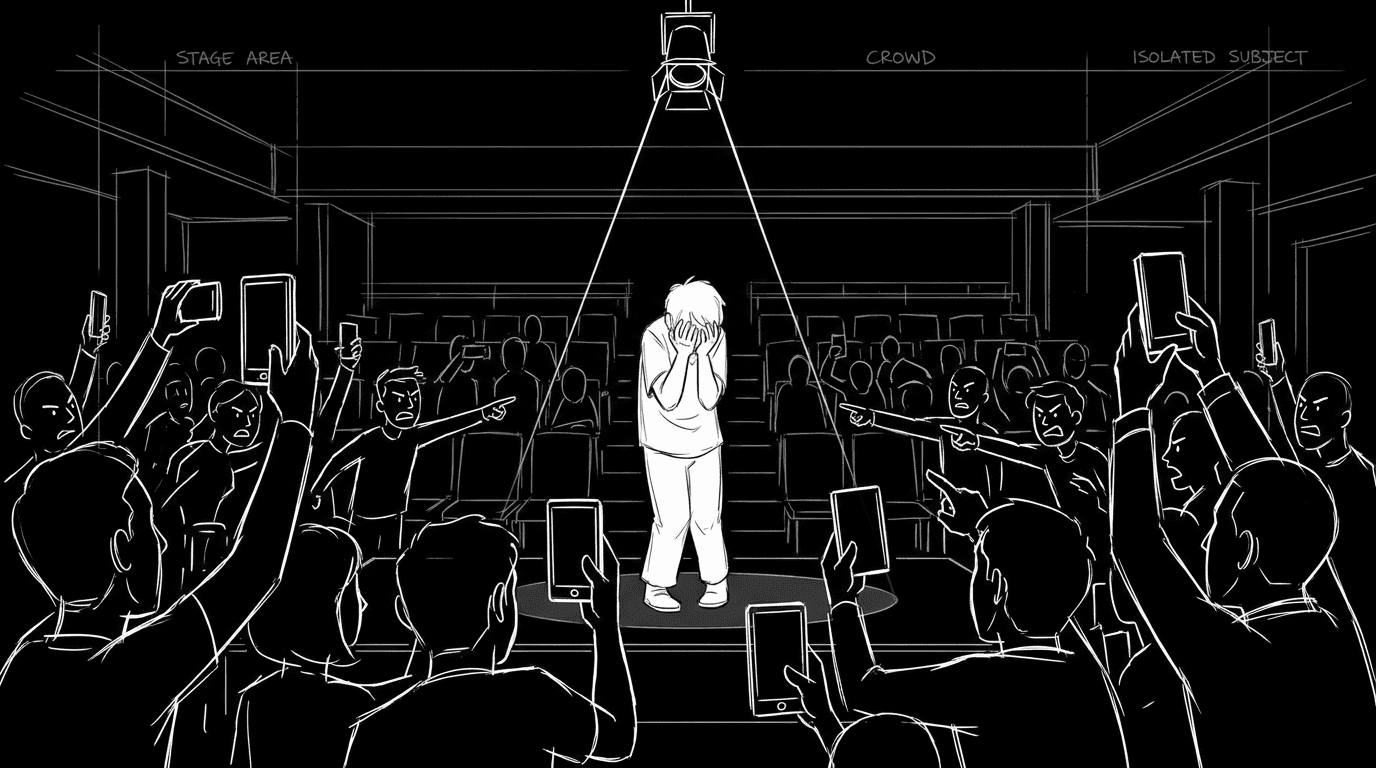

Public humiliation scenes are brutal to write well.
Too soft, and they feel like minor embarrassment.
Too loud, and they become melodrama or cruelty spectacle.
Most scripts land in one of those two failures.
A strong humiliation scene is not simply "character gets shamed in public." It is a status collapse event where social identity is damaged in front of witnesses, and that damage changes what the character can do next.
That is the key.
Humiliation is social. It exists because someone sees it, interprets it, and carries that interpretation forward. The crowd matters. The power structure matters. The channel of exposure matters. The aftermath matters most of all.
Here is why that matters: in film and television storytelling, public humiliation scenes can trigger major arc turns - revenge, withdrawal, radical honesty, moral collapse, political shift, class conflict, relationship rupture. If the scene is written as one isolated cringe beat, you waste the dramatic leverage.
Why Public Humiliation Scenes Feel Cheap
Weak scenes usually fail for three reasons.
First, they mistake humiliation for insult. A character gets mocked, but no real social stakes are attached.
Second, they overfocus on the humiliator and underwrite witness behavior. Without witness economy, there is no true public consequence.
Third, they skip aftermath architecture. Character is humiliated, cut to next day, everything normal.
That is not humiliation. That is a temporary awkward moment.
Think about it this way: humiliation scenes are about social memory. If no one remembers, no one repositions, and no systems react, the event had no narrative weight.
Humiliation is not the line that hurts. It is the new social position that line creates.
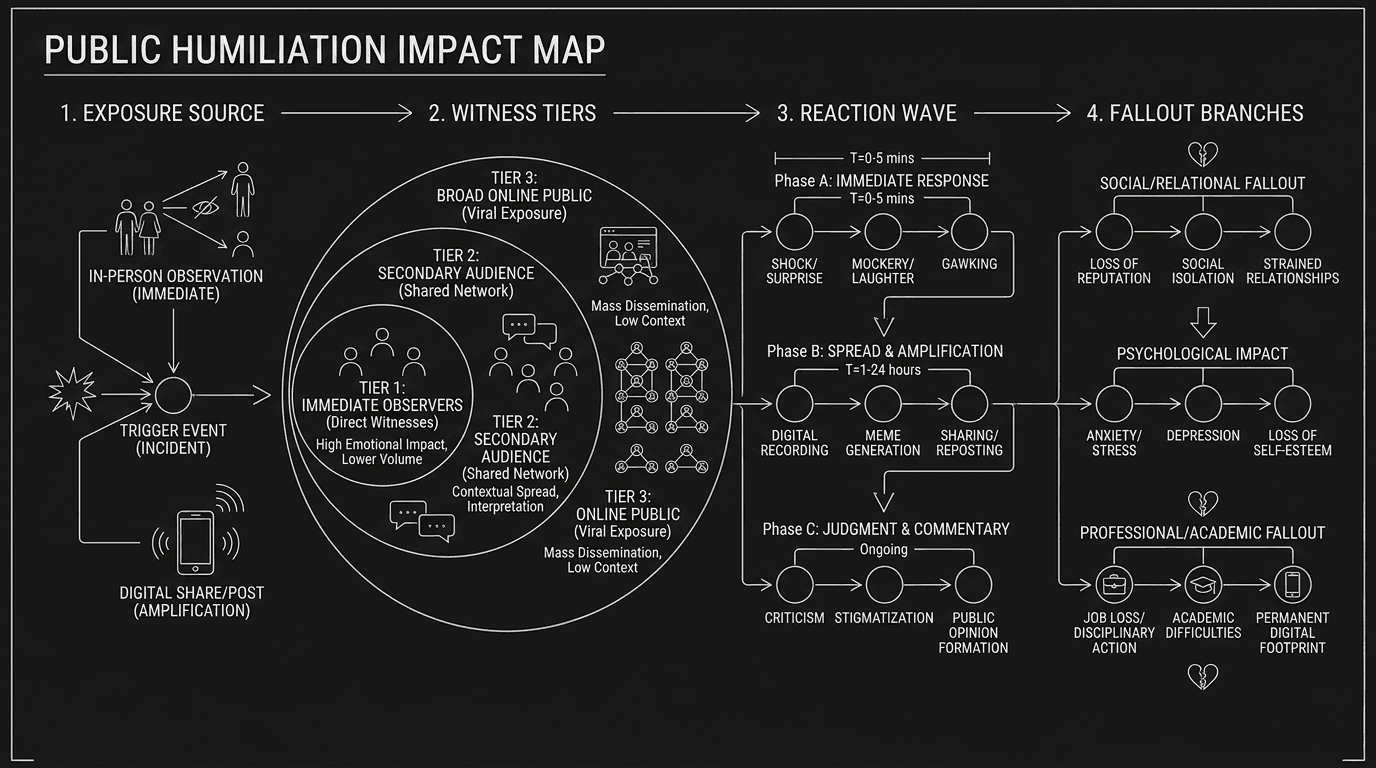
The Core Model: Exposure, Audience Reaction, Internal Rupture, External Repercussion, Strategic Response
A high-functioning public humiliation scene runs on five linked beats.
Exposure: damaging information/action becomes public in a high-stakes context.
Audience Reaction: witnesses process, amplify, deny, exploit, or avoid.
Internal Rupture: the humiliated character's self-concept destabilizes.
External Repercussion: status, opportunity, or relationships shift concretely.
Strategic Response: the character chooses adaptation path.
Skip External Repercussion and the scene feels hollow.
Skip Strategic Response and the scene feels cruelly static.
Scenario One: Workplace Humiliation in Front of Leadership
Beginner version: boss insults employee in meeting, employee looks hurt, scene ends.
Common.
Thin.
A stronger version writes hierarchy and witness behavior precisely. Who speaks first after insult? Who avoids eye contact? Who takes notes? Who pretends not to hear? Who later forwards meeting clip?
Now the humiliation is institutional, not personal.
Then add consequence: project reassigned, promotion path damaged, ally goes quiet, one junior employee starts mirroring the humiliator's tone. Social order has shifted.
That is narrative value.
Scenario Two: Romantic/Public Social Media Humiliation
Humiliation scenes often use social media exposure with no mechanics.
Better approach: specify channel, velocity, and interpretation battle.
Did the clip go to private group first or public feed?
Is context removed?
Who posts rebuttal?
Who weaponizes "just joking" defense?
Humiliation in digital contexts is rarely one moment. It is a wave pattern.
Writing that wave creates realism and escalating tension.
Scenario Three: Family Event Humiliation with Cultural Pressure
Family humiliation scenes are often written as shouting matches.
You can get stronger drama by writing ceremonial politeness under pressure. At wedding, funeral, religious event, or milestone dinner, one revelation or accusation can degrade status while everyone still obeys ritual behavior.
This contrast - formal decorum with social destruction - is extremely cinematic on the page when done with restraint.
Step-by-Step Workflow for Writing Humiliation Scenes That Matter
Step 1: Define What Social Currency Is Lost
Before writing dialogue, specify what exactly the character loses:
credibility,
authority,
desirability,
moral standing,
belonging,
professional legitimacy.
Humiliation is specific loss, not generic shame.
Step 2: Define Witness Hierarchy
All witnesses are not equal.
Rank witness types:
high-impact decision-makers,
peer amplifiers,
silent bystanders,
hostile opportunists,
potential defenders.
This hierarchy determines fallout intensity.
Step 3: Choose Exposure Mechanism
Direct accusation?
Leaked message?
Mic malfunction?
Presentation sabotage?
Public correction?
Choose one primary mechanism and make it clear.
Step 4: Script Reaction Wave, Not Single Reaction
Immediate gasp is only beat one.
Then:
silence,
nervous laughter,
deflection attempts,
someone changing topic,
someone doubling down.
Waves feel real and keep scene dynamic.
Step 5: Write Internal Rupture Through Behavior
Avoid over-explaining humiliation feelings in dialogue.
Use behavior:
speech errors,
over-calm performance,
frozen response,
misfired joke,
premature exit,
aggressive overcompensation.
Step 6: Add Concrete External Repercussion
What changes by next scene?
Access revoked.
Invitation withdrawn.
Role reduced.
Relationship status altered.
Rumor institutionalized.
No repercussion, no scene value.
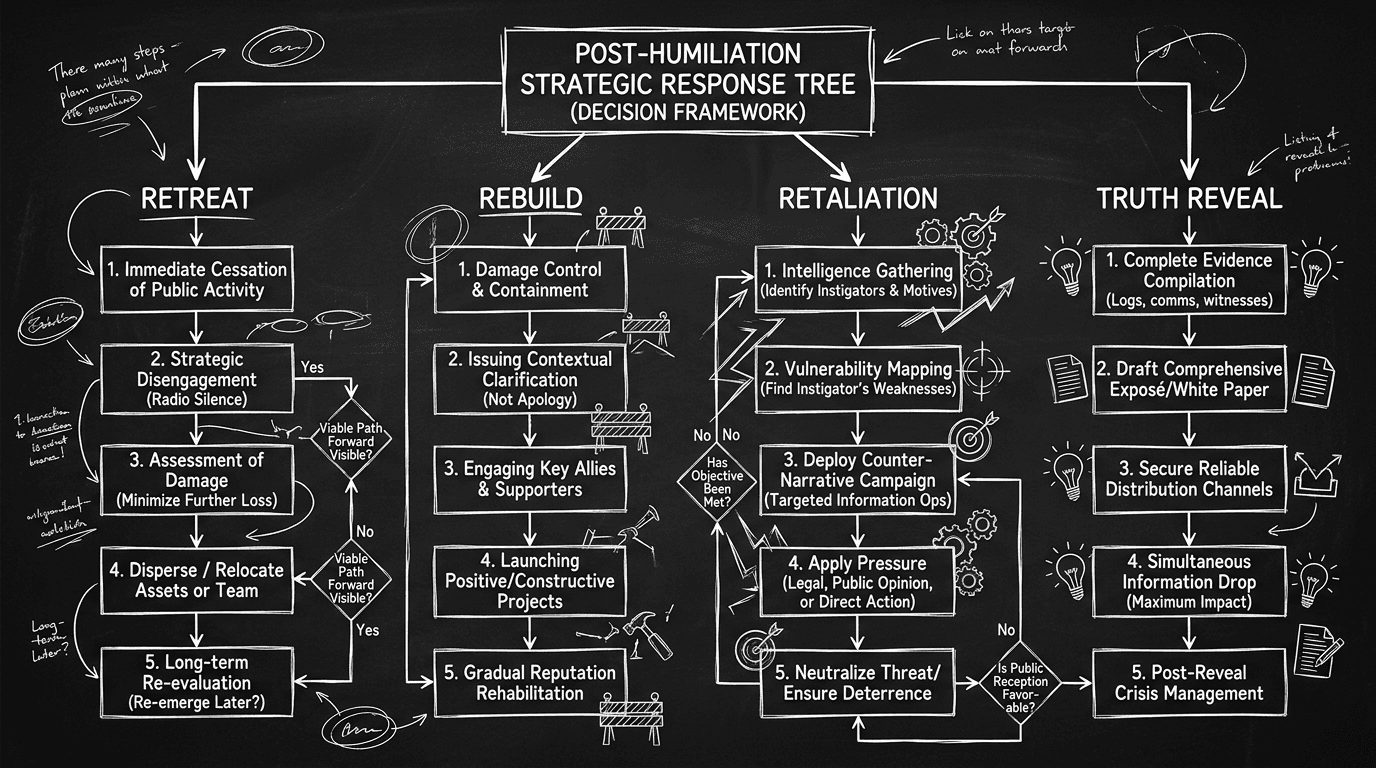
Step 7: End with Strategic Response
Humiliated character must choose a path:
retreat,
counterattack,
truth reveal,
reputation rebuild,
self-sabotage,
reinvention.
This response drives arc forward.
Table: Cringe Beat vs Dramatic Humiliation Scene
| Dimension | Cringe Beat Version | Dramatic Humiliation Version |
|---|---|---|
| Stakes | Social awkwardness only | Tangible status/role loss |
| Witnesses | Generic crowd reaction | Structured witness hierarchy |
| Emotion | One-note embarrassment | Complex rupture + adaptation |
| Outcome | Momentary discomfort | Lasting social consequence |
| Narrative function | Shock for tone | Arc pivot and strategy shift |
| Aftermath | Forgotten quickly | Carried into future scenes |
The Trench Warfare Section: What Beginners Get Wrong (and Exact Fixes)
This is where most scene improvements happen.
Mistake one: humiliation without social stakes.
Fix by defining what currency is lost and to whom.
Mistake two: overreliance on insults.
Fix by writing power shifts and witness behavior, not just words.
Mistake three: no witness hierarchy.
Fix by tracking which observers matter most.
Mistake four: humiliation as random cruelty.
Fix by connecting event to established conflict logic.
Mistake five: immediate emotional monologue.
Fix with behavioral rupture first, reflective language later.
Mistake six: no aftermath.
Fix by adding concrete next-scene consequence.
Mistake seven: humiliator is pure cartoon villain.
Fix by giving humiliator believable motive and context.
Mistake eight: humiliated character instantly recovers.
Fix with residue across multiple scenes.
Mistake nine: no strategic response.
Fix by ending scene on adaptation choice.
Mistake ten: everyone reacts the same way.
Fix with mixed reactions: complicity, discomfort, opportunism, defense.
Mistake eleven: tonal mismatch.
Fix by aligning humiliation intensity with genre contract.
Mistake twelve: no channel specificity in digital humiliation.
Fix by defining platform, spread, and interpretation dynamics.
Mistake thirteen: humiliation scene hijacks story theme.
Fix by tying scene to central moral question.
Mistake fourteen: over-formatting emotional emphasis.
Fix with precise action beats and concise dialogue.
Mistake fifteen: no power before scene.
Fix by establishing pre-humiliation status clearly so fall is legible.
Mistake sixteen: no relational consequences.
Fix by showing ally withdrawal, enemy mobilization, or support fracture.
Mistake seventeen: humiliation played as comedy by accident.
Fix with tonal control and witness realism.
Mistake eighteen: repeated humiliation with no evolution.
Fix by varying pattern and increasing strategic complexity.
Mistake nineteen: no agency for humiliated character.
Fix by writing active response path even in defeat.
Mistake twenty: humiliating content is vague.
Fix by making exposure specific and verifiable enough to matter.
Public humiliation scenes are strongest when they expose not only a person, but the social system that decides what is shameful.
Try it free
Try Screenweaver for free on your script
It is free. Import your existing project, get a clearer view of your outline, and regain control of your story structure in minutes.
Start FreeBody Image: Humiliation Impact Map
Practical 45-Minute Rewrite Drill
Take your current humiliation scene and run this pass.
First ten minutes: define lost social currency and key witnesses.
Next ten minutes: rewrite exposure beat with clear mechanism.
Next ten minutes: add mixed reaction wave (at least three distinct witness responses).
Next ten minutes: write one concrete external repercussion.
Final five minutes: end on strategic response choice.
This pass usually converts embarrassment scenes into arc-defining events.
Advanced Calibration: Shame, Guilt, and Narrative Direction
Humiliation scenes become richer when you distinguish shame from guilt.
Guilt says, "I did something wrong."
Shame says, "I am seen as wrong."
Public humiliation tends to activate shame dynamics, which drive concealment, rage, compliance, or reinvention differently across characters.
Write this distinction behaviorally.
Another advanced move: encode counter-narrative opportunities. If humiliation is socially constructed, characters can fight interpretation. A scene can end with social defeat but narrative opening, where one character begins reclaiming meaning.
For external script-study references, the Writers Guild Foundation Library is useful and should be treated as nofollow in publishing workflows.
As discussed in our guide on [how to write a party scene that does more than look fun], witness economy and social momentum are key in crowded public settings.
If humiliation emerges from hidden civility conflict, the framework in [how to write a dinner party scene with hidden conflict] helps stage coded aggression.
And when humiliation triggers direct showdown, the principles in [how to write a final confrontation scene that feels earned] support escalation and payoff.
Body Image: Strategic Response Paths After Humiliation
YouTube Placeholder
[YOUTUBE VIDEO: A scene rewrite clinic transforming a one-note public embarrassment beat into a layered humiliation sequence with witness dynamics and lasting fallout.]
Extra Deep Dive: Writing Humiliation in the Age of Perpetual Recording
Public humiliation scenes have changed because "public" is now layered.
There is the immediate room.
There is the captured clip.
There is the edited repost.
There is the algorithmic audience who never saw the context.
If your scene uses digital spread, map those layers explicitly.
Who records first?
Who captions first?
Who reframes first?
Who contests first?
The first narrative often wins, at least temporarily.
This creates dramatic urgency beyond the original incident itself.
Another critical distinction is platform behavior. Different digital spaces reward different forms of humiliation: outrage clips, irony memes, moral pile-ons, private-group leaks. You do not need platform essays in-scene, but you should know the mechanics in your notes so character response feels believable.
Scenario Layer: Accidental Humiliation vs Engineered Humiliation
Not all humiliation is planned.
Accidental humiliation can be just as damaging:
mic left on,
wrong attachment sent,
name confusion in public speech,
private joke misheard.
Engineered humiliation involves intent: targeted reveal, baited question, edited clip, timed leak.
These require different narrative ethics and response pathways. In accidental cases, conflict may focus on repair and responsibility ambiguity. In engineered cases, conflict often includes motive, power, and retaliation architecture.
Write which one you are doing.
Repair Attempts as Dramatic Action
After humiliation, characters often attempt immediate repair:
clarify statement,
reclaim framing,
issue apology,
shift topic,
seek ally intervention.
Do not skip this.
Repair attempts can fail, backfire, or partially work, and each outcome generates distinct arc possibilities.
Designing Secondary Victims
Humiliation rarely damages only one person.
Partners, children, employees, collaborators, and friends can experience collateral fallout. Sometimes the original humiliator is surprised by secondary harm and loses control of narrative. Sometimes they are not surprised at all.
By writing secondary victim effects, you elevate scene stakes from personal insult to social system damage.
Practical Rewrite Pattern: Three-Layer Response
When revising humiliation aftermath, draft three response layers for the humiliated character:
external response (what they do publicly),
relational response (what they do with close allies),
private response (what they do alone).
If all three layers are identical, the writing is probably thin. Real people split presentation across contexts under shame pressure.
Extended Craft Layer: Humiliation, Dignity, and Audience Alignment
The biggest risk in humiliation scenes is accidental audience cruelty.
If writing invites viewers to enjoy suffering without moral framing, dramatic intent can collapse unless that is explicitly the point and thematically justified.
To maintain dignity while preserving intensity:
focus on consequence and agency, not spectacle;
avoid fetishizing breakdown;
let humiliated character remain psychologically complex;
show system participation, not just one bad actor.
Audience alignment should be intentional.
Do you want viewers to empathize, judge, feel complicit, feel conflicted?
Pick one primary alignment and support it through witness behavior and camera-equivalent writing choices.
Dialogue Compression for High-Heat Social Scenes
Humiliation scenes often improve when dialogue is shortened.
Long speeches can feel defensive or didactic under acute public stress. Try compressed lines followed by reaction beats. Let social atmosphere do part of the work.
A useful compression test:
If the same meaning can be delivered in half the words with stronger behavior cues, cut.
Rebuilding Status Without Fake Redemption
Post-humiliation arcs often rush redemption.
Avoid instant social reset unless your genre deliberately stylizes reality. Credible recovery usually involves:
time,
new evidence,
consistent action,
selective allies,
changed strategy.
You can still move quickly in plot terms by choosing high-leverage recovery actions rather than montage apologies.
Five-Question Final Check
Before locking your scene, ask:
Is the humiliating exposure specific and legible?
Are key witnesses differentiated by power?
Does the scene produce concrete external repercussion?
Does the humiliated character make a strategic response choice?
Does this event alter future scene behavior credibly?
If yes, your scene is likely doing real dramatic work.
Micro-Exercise: Rebuild a Flat Humiliation Beat in 8 Moves
Take one flat humiliation scene from your draft and rebuild it in this sequence:
Move 1: identify the exact social currency at risk.
Move 2: identify the highest-impact witness in the room.
Move 3: write exposure in one clear, specific action.
Move 4: write three different witness reactions.
Move 5: write one immediate failed repair attempt.
Move 6: write one concrete repercussion before scene end.
Move 7: write one strategic response choice by the humiliated character.
Move 8: write one next-scene behavior that proves status changed.
This drill forces causality and removes ornamental embarrassment.
Run it twice, once from the victim perspective and once from the witness-power perspective, to catch blind spots in consequence design.
Ending Perspective: Humiliation Scenes Are Social Earthquakes
If your humiliation scene feels shallow, do not make it louder.
Make it more structural.
Who sees it.
Who believes it.
Who profits from it.
Who is damaged by it.
Who decides to respond, and how.
When you write those vectors clearly, public humiliation stops being cringe content.
It becomes a social earthquake that redraws character power and narrative direction in one scene.
Final Step
Build your next script with Screenweaver
Move from ideas to production-ready pages faster with timeline-native writing and AI-assisted story flow.
Try Screenweaver