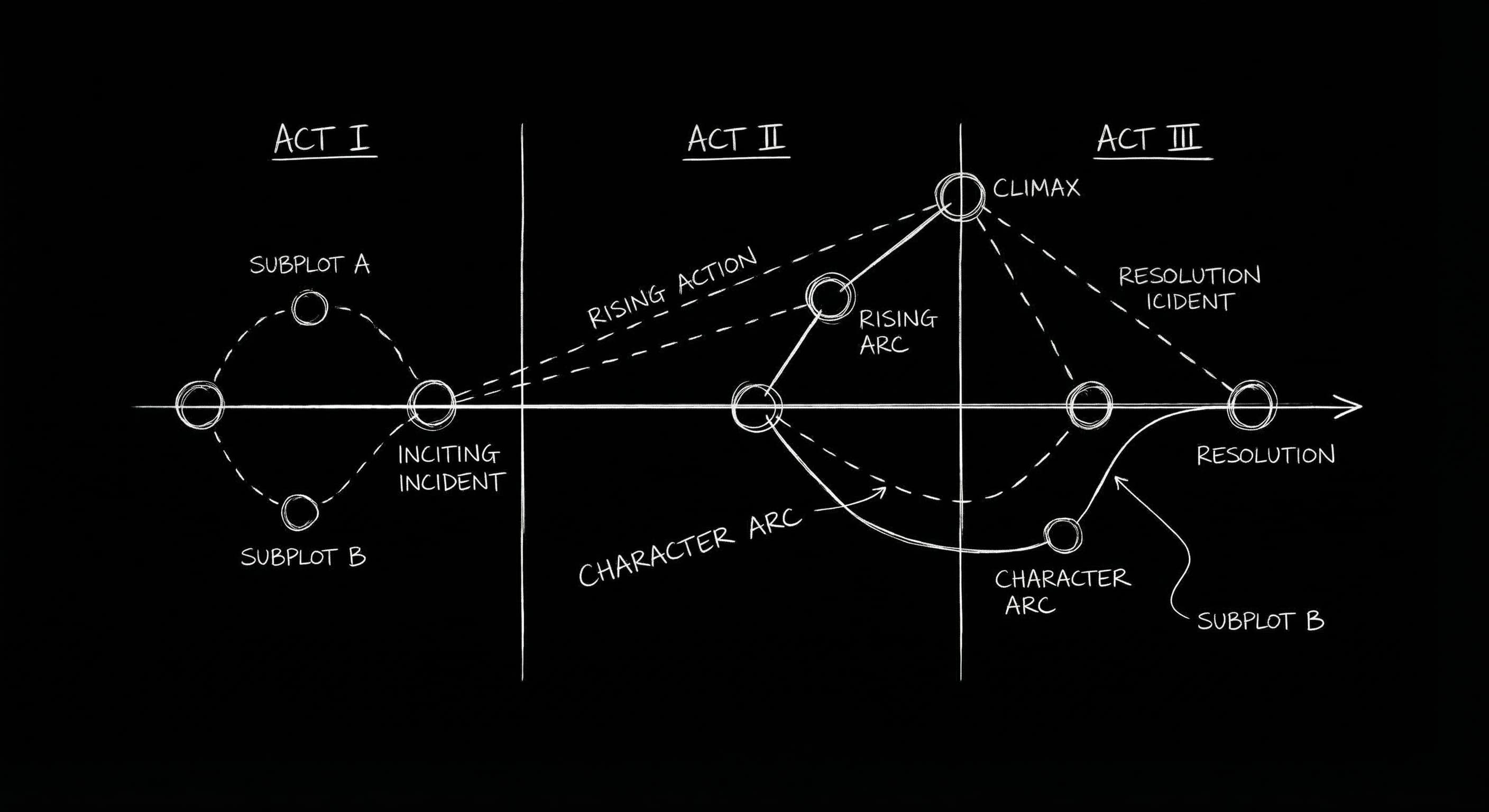

You have a world. You have a character. You have an idea that could run for years. The pilot is where you prove it in fifty-five pages. Not by writing the script first,by building the spine. An outline for a 60-minute drama pilot isn't a vague list of "stuff that happens." It's a map of act breaks, emotional turns, and the one question the audience has to want answered by the time the credits roll. Skip the outline and you'll hit page thirty wondering why the middle sags. Build it right and the script has something to lean on when the writing gets hard.
Television structure is different from features. Commercial breaks (or streamer act breaks) aren't interruptions. They're hinges. Each act has to land with a reason to keep watching. The outline is where you design those hinges.
What a 60-Minute Pilot Is Really Doing
A pilot has two jobs. Introduce the world and the people in it. And create a central tension or question that can sustain a series. If the pilot resolves everything, there's no show. If it resolves nothing, the audience feels cheated. The outline is where you balance that. You're deciding what gets answered in the pilot and what gets deferred,the mystery, the relationship, the threat,so that episode two has somewhere to go.
Think about the pilots that stuck with you. Breaking Bad. Walter White's choice to cook meth is the pilot. The consequences unfold for seasons. The Wire. We meet the cops and the corner. The game is established. We don't need to "finish" the drug trade; we need to understand the rules. Your outline should name that central series question and then plot how the pilot sets it up without closing it.
Act Structure: The Breaks That Hold the Hour
Most one-hour dramas are built in five acts (roughly 12–15 pages each) or six acts with a teaser. Streamers may not have ad breaks, but the act structure remains. It's pacing. It's rhythm. Each act has a mini-arc: a goal, a complication, a turn. The act break is the turn. Something changes. A secret is revealed. A character commits. A threat escalates. The audience has to feel that the story has moved,and that they need to see what happens next.
In the outline, you don't just list "Act 2: More stuff happens." You write one to three sentences per act that answer: What is the primary action? What is the emotional shift? What is the act-out (the last beat before the break)? If you can't state the act-out in a single line, the act isn't ready. Sharpen it.
| Act | Function in pilot | Typical page range |
|---|---|---|
| Teaser / Cold open | Hook; establish tone or inciting incident | 2–5 |
| Act One | World and protagonist; status quo disrupted | 12–15 |
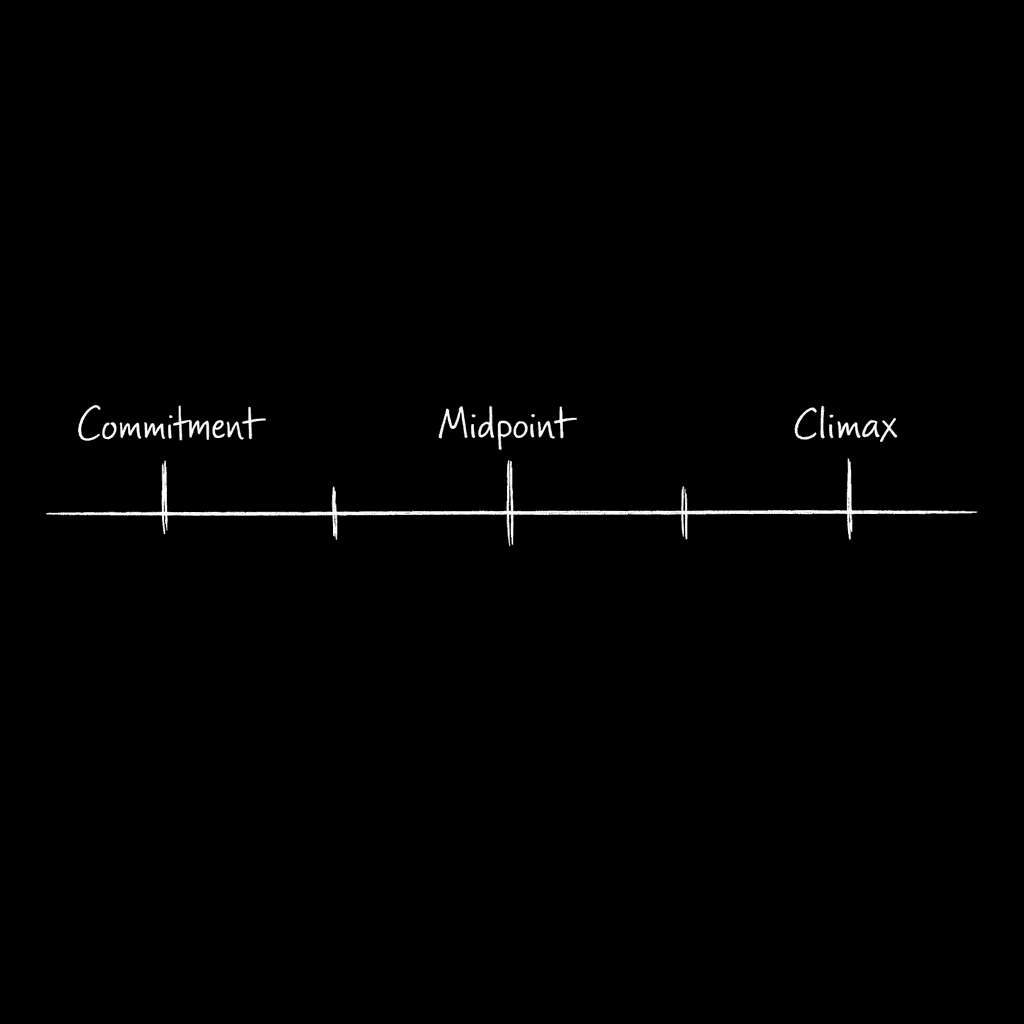
| Act Two | Complication; stakes rise; first act break = commitment or point of no return | 12–15 |
| Act Three | Midpoint; new information or reversal | 12–15 |
| Act Four | Escalation; lowest point or biggest obstacle | 12–15 |
| Act Five | Climax and pilot resolution; series question locked in | 12–15 |
The numbers are guidelines. Some shows use a long teaser. Some compress the middle. The outline is where you decide your version. For more on how the people running the room think about structure, see our guide on what a showrunner is and how you become one.
Relatable Scenario: The Legal Drama Pilot
You're outlining a show about a public defender who used to work for the other side. Teaser: She loses a case she thought she could win; the client is sent away. We see her doubt. Act One: We meet the office, the boss, the caseload. We see her past,one line from a colleague, or a flash,enough to know she's an outsider. Act break: She's assigned a case that mirrors something from her old life. She can't say no. Act Two: She digs in. The client is difficult. The system pushes back. Act break: She discovers a piece of evidence that implicates someone powerful. Act Three: She follows the thread. Midpoint: She's threatened,career or safety. Act Four: She has to choose between backing off or going all in. Act break: She chooses. Act Five: The immediate case reaches a pilot resolution (win, loss, or draw), but the larger conspiracy,or the cost of her choice,is clearly the series engine. The outline makes sure each of those beats is a decision, not a vague "she investigates."
Relatable Scenario: The Family Drama Pilot
A patriarch's death. Siblings reunite. Old resentments surface. The outline has to answer: What is the pilot's story, not just the premise? Maybe it's the reading of the will. One sibling is disinherited. That's the act-one disruption. Act Two: They start to ask why. Secrets emerge. Act break: They learn the will can be challenged,but only if they work together. Act Three: Uneasy alliance. Midpoint: A hidden letter or witness suggests the death wasn't natural. Act Four: One of them is hiding something. Act break: We (or they) find out who. Act Five: The pilot ends with the family fractured in a new way,and a shared goal (find the truth, protect the estate, protect each other) that can drive the series. The outline forces you to assign the twist and the emotional low to specific acts so the script doesn't meander. When your pilot uses non-linear storytelling, the outline is even more important,see writing non-linear narratives for how to map time jumps without losing the spine.
The Teaser: Your First Ninety Seconds
The teaser is the promise. It tells the audience what kind of show this is. Tone, scale, danger, or humor. It doesn't have to be the chronological start of the story. It can be a flash-forward,we see a crisis, then the pilot shows how we got there. It can be a character in action. It can be a mystery. What it can't be is slow. The outline should state the teaser in one or two sentences. What do we see? What question does it raise? If the teaser doesn't raise a question, rewrite it.
The Central Series Question
Before you go deep into acts, name the series question. What is the show about week to week? "Can this family survive each other?" "Will she bring down the firm or be consumed by it?" "Can he keep his double life secret?" The pilot doesn't answer that. It installs it. Every act in your outline should feed that question. If an act is only "cool stuff" with no connection to the series engine, cut it or reframe it. The outline is the place to catch that.
What Beginners Get Wrong (The Trench Warfare Section)
Outlining in vague strokes. "Act 2: Things get worse." Worse how? For whom? What specific event? The outline is for you. Put in the concrete beat. "Maria finds the second body; it's someone she knew." Now you have something to write toward.
Resolving the series in the pilot. The pilot should close a chapter, not the book. One case ends. One relationship is defined. One secret is out. But the engine of the show,the ongoing tension,should be stronger at the end than at the beginning. If your outline has the villain caught and the romance sealed, you've written a movie. Scale back. Leave the big question open.
Too many characters in act one. The audience can't hold ten names. The outline should identify the core group: protagonist, antagonist or central obstacle, and two or three key relationships. Everyone else can appear later or in smaller doses. Introduce in service of the pilot story, not the whole series bible.
No clear protagonist throughline. Even in an ensemble, one character usually carries the pilot. Whose choice drives the story? Whose emotional arc do we follow? The outline should name that character and their pilot arc in one sentence. "Jake goes from 'I'm done with this family' to 'I'll stay to protect them.'" If you can't state it, the script will drift.
Act breaks that don't break. A soft act-out ("They continue talking") gives the audience permission to leave. Every break should feel like a turn. New information. A decision. A threat. A cliffhanger. In the outline, write the act-out as a separate line. If it doesn't sting or surprise, sharpen it.
Try it free
Try Screenweaver for free on your script
It is free. Import your existing project, get a clearer view of your outline, and regain control of your story structure in minutes.
Start FreeStep-by-Step: Building the Outline
Start with the series question and the protagonist's pilot arc. One sentence each. Then write the teaser: what we see, what question it raises. Next, act by act. For each act, write two to four sentences: what happens, whose POV, and the act-out. Don't write dialogue. Don't describe every scene. Hit the beats. When all acts are done, read them in sequence. Does the story build? Do the act-outs land? Does the pilot end with the series question planted, not solved? Revise until the spine is clear. Then you can break each act into scenes,again, one line per scene. Now you have a roadmap. The script has something to follow.
The B-Plot and the Ensemble
Many pilots have a B-plot: a secondary story that comments on or complicates the A-plot. The outline should give the B-plot its own mini-arc. It doesn't need five acts, but it needs a beginning, a turn, and a connection to the main story (thematic or literal). Same for key supporting characters. They don't all need full arcs in the pilot, but they need a function. The outline is where you assign that. "In Act 3, the brother's subplot crosses the main plot when he withholds information from the protagonist." One line. Now you know why he's there.
How Long Should the Outline Be?
Long enough to be useful. Short enough to stay flexible. A typical outline for a 60-minute pilot might run three to eight pages. Scene-by-scene breakdowns can go longer. The goal is that when you sit down to write any given scene, you know what it has to accomplish. If the outline is so detailed it feels like a first draft, you'll resist changing it when the script wants to go somewhere else. If it's so thin that you're inventing structure on the fly, you'll hit the dreaded middle. Find the level where you have security without handcuffs.
The outline is not the script. It's the argument for why the script will work.
When you're stuck in the middle of the draft, the outline is what you return to. Not to copy it line by line, but to remember what this act was supposed to do. The outline is the promise you made to the story. Keep it close.
[YOUTUBE VIDEO: A walkthrough of breaking down a famous drama pilot (e.g., Breaking Bad or The West Wing) act by act, showing how act-outs and series questions are planted in the outline.]
Pilot Endings That Launch a Series
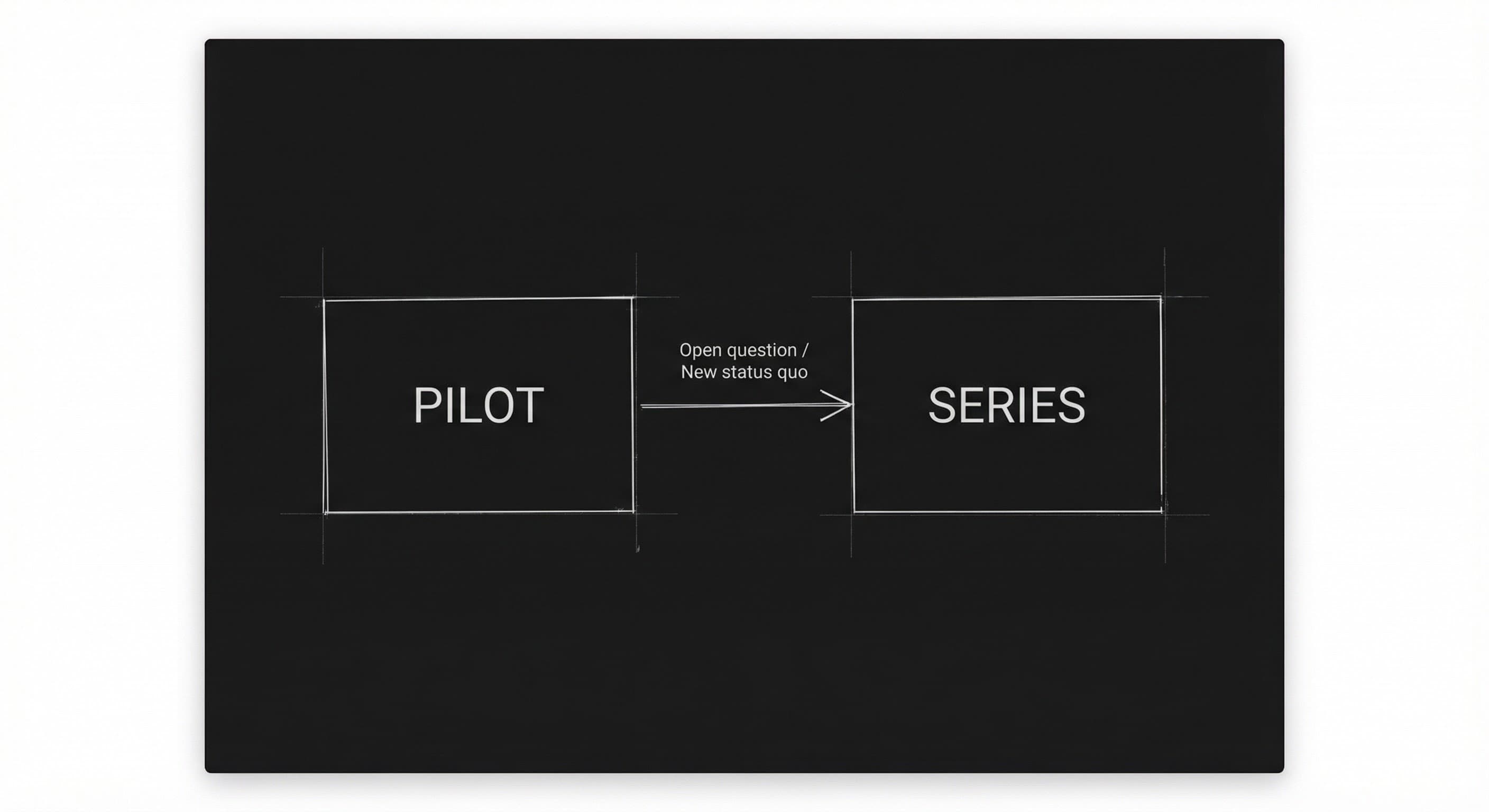
The last beat of the pilot is the handoff to episode two. It can be a new question (who was that?), a new commitment (now she's all in), or a new status quo (they're stuck together). The outline should name that final beat explicitly. "We end on Maria receiving a photo: the person she thought was dead is alive." Or "We end on the family standing in the burned house, no going back." The final image or line is the bridge. Get it wrong and the next episode has to invent momentum. Get it right and the series has a clear next step.
From Outline to First Draft
The outline is not the script. It's the argument for the script. When you sit down to write the first draft, you'll discover things. A character will say something you didn't plan. A scene will want to be longer or shorter. That's normal. The outline is your map. You can deviate when the draft demands it,but when you're lost, the outline is what you return to. Some writers outline in great detail (scene-by-scene) and then write quickly. Others outline in broad strokes and find the scene work in the draft. There's no single right way. The right way is the one that gets you to the end of the pilot without collapsing in the middle. If you find yourself stuck, go back to the outline. Ask: what was this act supposed to do? What was the act-out? Sometimes the block is that you've drifted from the spine. The outline brings you back. Other times the block is that the outline was wrong. Then you revise the outline and keep writing. The outline is a tool. Use it.
The Perspective
Outlining a 60-minute pilot is designing the hour. Not every scene,the beats. The act breaks. The series question. The pilot arc. Do that work before you write dialogue. The script will thank you. And when a producer or executive asks "What happens in act three?" you'll have an answer. That's not just preparation. That's the job.
Final Step
Build your next script with Screenweaver
Move from ideas to production-ready pages faster with timeline-native writing and AI-assisted story flow.
Try Screenweaver