
Final confrontation scenes are where scripts tell the truth about themselves.
You can fake your way through setup.
You can distract through middle acts.
You cannot fake the end.
If the final confrontation is unearned, readers feel it instantly. No matter how flashy the location, how sharp the dialogue, or how intense the action, the scene lands flat when it is not the inevitable result of everything that came before.
That is the key word.
Inevitable.
Not predictable. Inevitable.
A strong final confrontation should feel like the only possible collision left after every avoidance strategy has failed. It is not just two characters arguing or fighting. It is the structural and moral debt of the story coming due in one compressed event.
Here is why that matters: endings are retrospective devices. The final confrontation does not only close the story; it reinterprets the story. If it feels earned, earlier scenes gain meaning. If it feels forced, earlier scenes lose value.
Why Final Confrontations Feel Unconvincing
Most weak finales fail because writers design the climax first and reverse-engineer justification later.
They pick a cool location, write dramatic lines, add physical stakes, and hope emotional logic will catch up. It rarely does.
Another common failure is escalation inflation. Writers keep raising external danger while neglecting internal conflict precision. The confrontation gets bigger but less specific.
Then there is the "theme speech" trap. Characters suddenly explain the movie to each other in language that does not match their established voice.
Think about it this way: if your protagonists and antagonists could have had this exact confrontation ten pages earlier with no major differences, your ending is probably underbuilt.
A final confrontation feels earned when it resolves a specific conflict that only exists because of this story's unique chain of choices.
The Core Model: Debt, Convergence, Irreversible Choice, Cost, New Order
An earned final confrontation usually contains five elements.
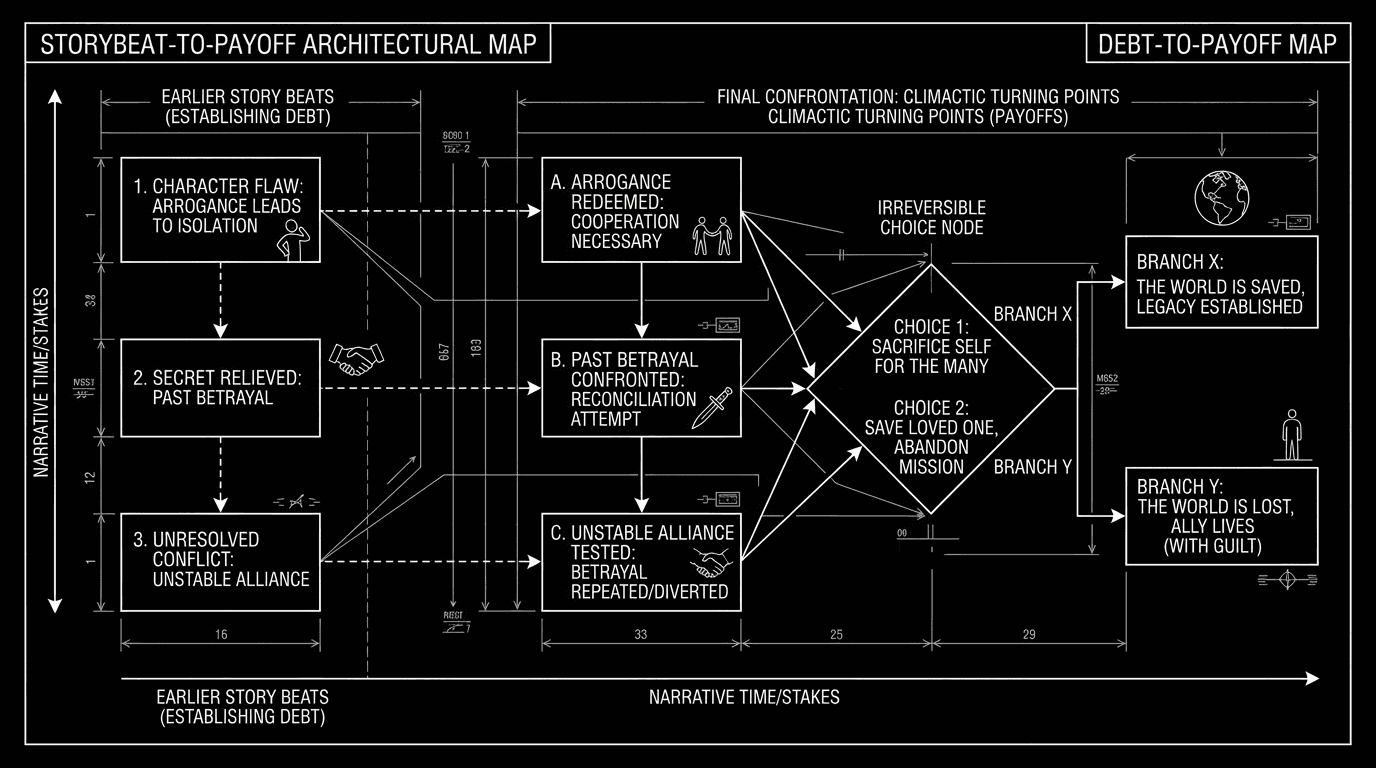
Debt: unresolved promises, betrayals, lies, sacrifices, and moral compromises accumulated across the script.
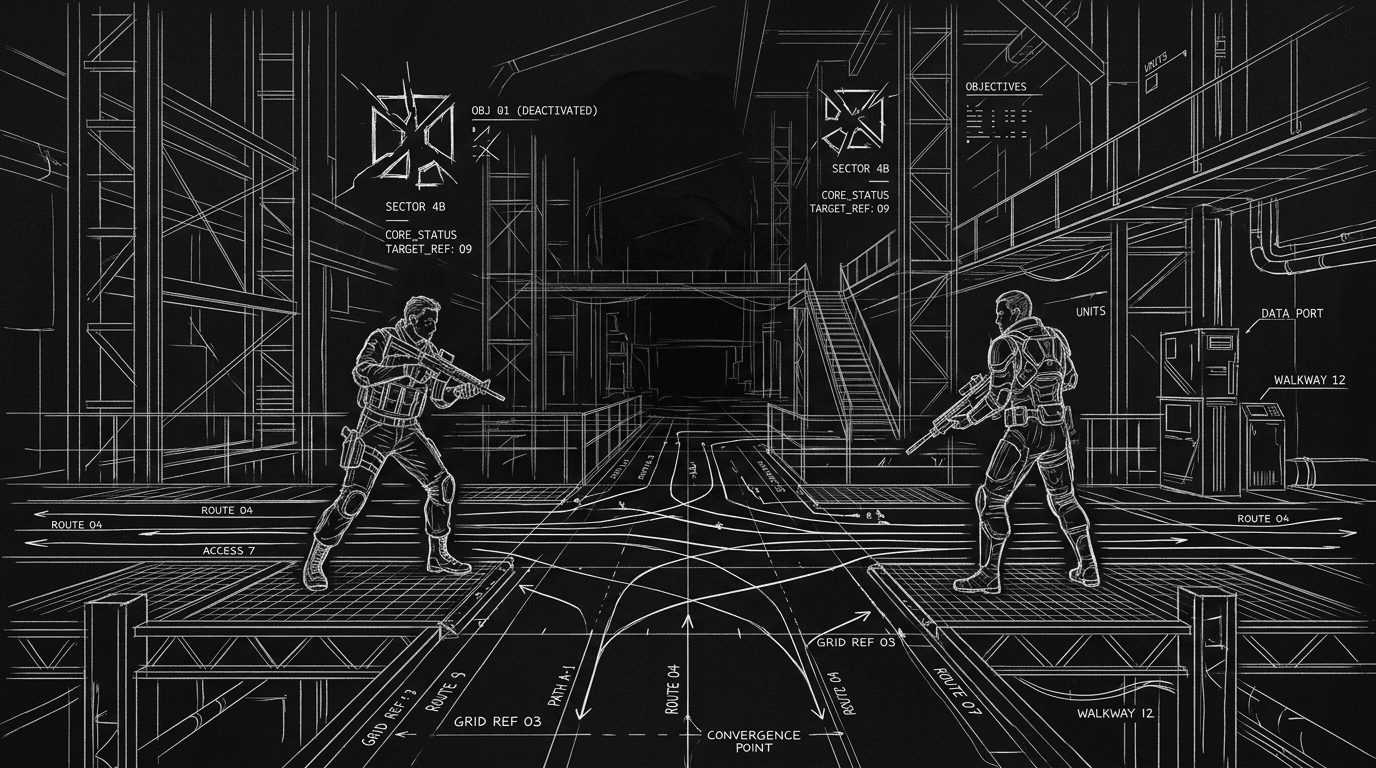
Convergence: all major threads funnel into one arena with clear constraints.
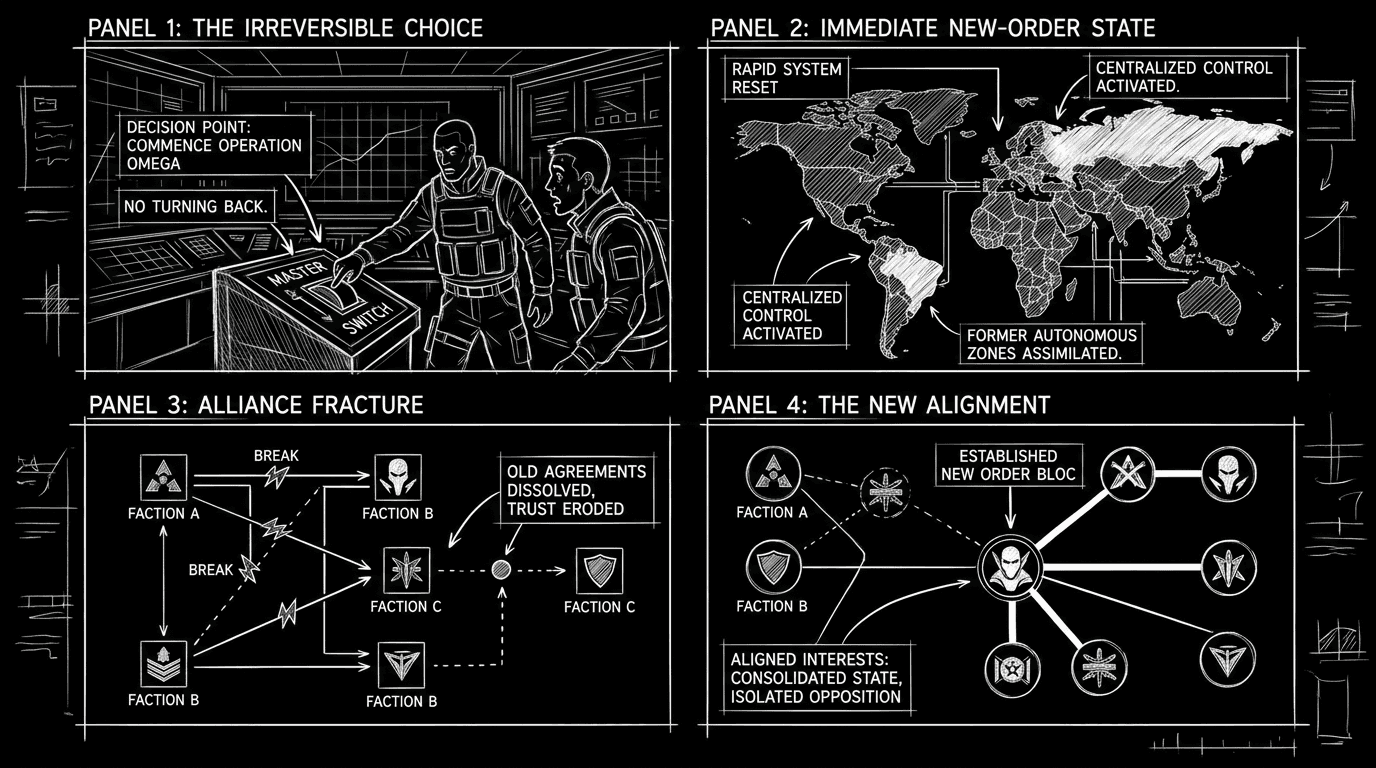
Irreversible Choice: someone chooses action that cannot be undone.
Cost: victory or survival carries a meaningful price.
New Order: the world/relationships/power structure after confrontation is visibly different.
Without Debt, climax feels arbitrary.
Without Irreversible Choice, it feels procedural.
Without Cost, it feels hollow.
Without New Order, it feels incomplete.
Scenario One: Thriller Final Showdown Without Moral Resolution
Beginner version: hero catches villain, confrontation includes accusations, villain gets neutralized, cut to epilogue.
Functional.
Often emotionally thin.
A stronger version forces moral choice tied to protagonist arc. Maybe hero can secure justice only by breaking their own ethical rule. Maybe exposing villain also harms innocent collateral. Maybe villain offers truth in exchange for escape.
Now confrontation tests not just competence, but identity.
That is earned payoff.
Scenario Two: Relationship-Driven Confrontation in Drama
In dramas, final confrontations often become long emotional speeches.
You can sharpen this by adding concrete decision pressure. Who leaves? Who signs? Who reveals? Who forgives under condition? Who refuses reconciliation despite longing?
When words are anchored to immediate choices, the scene stays alive.
Scenario Three: Ensemble Finale with Competing Objectives
Large casts create climax risk: too many arcs, one room.
If everyone gets equal closure lines, pacing dies.
Better method: prioritize one primary confrontation axis, support with two secondary consequence beats, and let remaining arcs resolve through action residue.
Finale clarity beats completion fantasy.
Step-by-Step Workflow to Build an Earned Final Confrontation
Step 1: Define the Core Confrontation Question
Write one sentence:
"This final confrontation answers whether ______."
Examples:
whether justice matters more than vengeance,
whether control can coexist with love,
whether truth is worth systemic collapse.
If this question is vague, climax will sprawl.
Step 2: Trace the Debt Chain
List 5-7 prior beats that must pay off in the confrontation.
If a major prior beat has no confrontation relevance, either adjust ending or revise setup.
Step 3: Align Arena with Conflict Logic
Location should express pressure mechanics.
Confined space for intimacy pressure.
Public space for witness pressure.
Symbolic site for thematic resonance.
Operational site for tactical stakes.
Pick arena for function first, style second.
Step 4: Assign Immediate Objectives Per Side
At confrontation start, each side needs explicit objective.
Expose?
Escape?
Convert?
Destroy evidence?
Secure ally?
Objectives must conflict directly.
Step 5: Build Turning Beats, Not Monolithic Conflict
Break confrontation into tactical turns:
advantage,
reversal,
false resolution,
final choice.
This prevents one-note shouting or action blur.
Step 6: Design the Irreversible Choice
Final confrontation needs a line-crossing act.
Confession,
trigger pull,
public reveal,
self-sacrifice,
legal submission,
exit refusal.
This choice defines ending tone.
Step 7: Show Cost and New Order Immediately
Do not postpone consequence to distant montage.
Show cost now:
loss,
injury,
relationship rupture,
institutional collapse,
self-image fracture.
Then show first frame of new order.
Table: Forced Finale vs Earned Final Confrontation
| Dimension | Forced Finale | Earned Confrontation |
|---|---|---|
| Conflict source | Late-stage spectacle | Cumulative narrative debt |
| Character voice | Generic climax speeches | Voice-accurate high-pressure dialogue |
| Stakes | Mostly external danger | External + moral + relational stakes |
| Structure | Single long escalation | Distinct turning beats and reversals |
| Outcome | Clean win/loss | Costly resolution with structural change |
| Aftereffect | Cosmetic epilogue | Visible new order and residue |
The Trench Warfare Section: What Beginners Get Wrong (and How to Fix It)
This is where finales usually break.
Mistake one: climax disconnected from setup.
Fix by mapping explicit payoff links before drafting.
Mistake two: everyone explains theme at once.
Fix by letting theme emerge through choices and consequences.
Mistake three: no irreversible act.
Fix by adding one clear point-of-no-return decision.
Mistake four: overlong confrontation dialogue.
Fix by compressing to tactical beats with action consequences.
Mistake five: protagonist wins too easily.
Fix by requiring meaningful trade-off.
Mistake six: antagonist reduced to exposition device.
Fix by preserving antagonist objective coherence to the end.
Mistake seven: no witness economy.
Fix by deciding who sees confrontation and why it matters.
Mistake eight: location used as decoration.
Fix by tying arena features to pressure and options.
Mistake nine: no relational consequence.
Fix by showing how key relationships mutate after outcome.
Mistake ten: climax solves plot but not character arc.
Fix by aligning final choice with protagonist internal evolution.
Mistake eleven: fake-death/fake-out overload.
Fix by using reversals sparingly and causally.
Mistake twelve: costless sacrifice.
Fix by showing fallout beyond symbolic gesture.
Mistake thirteen: timeline logic collapses in finale.
Fix with clear sequence constraints and cause-effect links.
Mistake fourteen: supporting cast disappears.
Fix with concise but meaningful secondary consequence beats.
Mistake fifteen: tonal mismatch at ending.
Fix by preserving genre/emotional contract established earlier.
Mistake sixteen: too many objective shifts at once.
Fix by prioritizing one primary confrontation question.
Mistake seventeen: no strategic adaptation mid-scene.
Fix by writing at least two tactical recalibrations.
Mistake eighteen: epilogue erases confrontation impact.
Fix by carrying cost and residue visibly.
Mistake nineteen: protagonist arc resolves before confrontation.
Fix by making final scene the proving ground, not confirmation.
Mistake twenty: no new order clarity.
Fix by ending on specific changed conditions.
A final confrontation is earned when victory and defeat both look different than they did at page one.
Try it free
Try Screenweaver for free on your script
It is free. Import your existing project, get a clearer view of your outline, and regain control of your story structure in minutes.
Start FreeBody Image: Final Confrontation Debt-to-Payoff Map
Practical 50-Minute Rewrite Drill
Take your current final confrontation and run this pass.
First ten minutes: list all beats in the scene and delete any with no debt payoff.
Next ten minutes: clarify each side's objective at scene start.
Next ten minutes: add two reversal beats with causal logic.
Next ten minutes: sharpen irreversible choice and explicit cost.
Final ten minutes: write first frame of new order immediately after confrontation.
This pass usually transforms loud finales into coherent, earned resolutions.
Advanced Calibration: Ending Satisfaction Without Predictability
Audiences do not need surprise at all costs. They need coherence with emotional voltage.
A confrontation can be expected and still thrilling if execution reveals deeper truth than anticipated. Satisfaction comes from inevitability plus specificity.
Another advanced move is asymmetrical closure. Not every thread needs equal closure in the confrontation scene. Close core moral and objective arcs; let some relational consequences remain open if that fits tone and sequel logic.
For external script-study references, the Writers Guild Foundation Library is useful and should be treated as nofollow in publishing workflows.
As discussed in our guide on [how to write a betrayal reveal scene], trust collapse should reframe both past interpretation and present strategy.
If confrontation involves confined dialogue pressure, the framework in [how to write a confession scene in a thriller] helps sequence reveal and leverage.
And when confrontation follows social damage events, our approach in [how to write a public humiliation scene in a screenplay] helps model witness-driven consequences.
Body Image: Irreversible Choice and New Order Sequence
YouTube Placeholder
[YOUTUBE VIDEO: A climax rewrite workshop showing how to convert a forced final showdown into an earned confrontation with clear debt payoff, reversals, and costly resolution.]
Extra Deep Dive: Designing Confrontation Geometry and Movement Logic
Final confrontations are often written as emotional dialogue blocks in a vaguely dangerous space.
You can level up instantly by designing movement geometry.
Who has line of sight.
Who controls exits.
Who is physically elevated.
Who can interrupt.
Who can trigger irreversible action fastest.
Geometry is not just staging; it is power.
A useful planning method is pressure triangles.
Triangle one: protagonist, antagonist, objective object (evidence, key, trigger, hostage, document).
Triangle two: protagonist, witness, consequence mechanism (camera, law, crowd, timer).
When these triangles intersect, confrontation gains structural tension without excess exposition.
Scenario Layer: The "Truth vs Survival" Split Ending
Suppose protagonist can reveal truth publicly but will lose chance to save one person immediately.
Weak version: dramatic speech then miraculous save.
Stronger version: protagonist chooses one path, accepts cost, and story honors that cost. This creates moral consequence that feels earned.
The confrontation then becomes thematic thesis through action.
Writing Reversals That Are Surprising but Fair
Reversals fail when they arrive from hidden rules.
Fair reversal requires seeded possibility.
If an ally intervenes, seed access.
If system fails, seed vulnerability.
If antagonist collapses psychologically, seed fracture signs.
Readers should not predict exact beat, but they should later see logic.
Compression Rule for Bloated Finales
Many endings are overwritten because writers want every emotional thread verbalized.
Use confrontation compression:
one line to restate core objective conflict,
one line to expose deepest moral split,
one irreversible choice beat,
one visible cost beat,
one new-order frame.
If additional lines do not alter outcome, trim.
Extended Craft Layer: Dialogue Temperature and Silence Control
Final confrontations often become all-caps emotional temperature.
Monotone intensity numbs impact.
Instead, design temperature shifts:
controlled opening,
spike at reveal,
cold strategic phase,
high-risk choice silence,
post-choice release.
Silence is especially valuable at irreversible moments. A two-second pause before a final decision can carry more weight than three paragraphs of argument.
Writing the Antagonist's Last Coherent Position
Even if antagonist loses, they should have a coherent final worldview. If they suddenly become incoherent for convenience, the climax feels rigged.
Give antagonist one final credible argument that challenges protagonist's arc. Then force protagonist to answer with choice, not slogan.
Multi-Character Finales Without Thread Collapse
If multiple arcs converge, choose one confrontation spine and attach others as consequence satellites.
Spine resolves core question.
Satellite beats show immediate effects on secondary arcs.
Trying to resolve all arcs equally inside one confrontation usually produces clutter and pacing drag.
Practical "Earnedness" Audit
After drafting, run a strict audit:
Can each confrontation beat be linked to earlier setup?
Does each major line alter leverage or reveal?
Is there at least one moment where protagonist could choose differently?
Does chosen path incur visible cost?
Does final frame prove changed order?
If two or more answers are no, the confrontation likely needs structural revision.
Additional Scenario Bank: Three Final Confrontation Patterns
Pattern A: Contained Chamber Confrontation
Small space, high emotional precision, minimal external spectacle.
Best for psychological thrillers and relationship dramas with moral stakes.
Pattern B: Public Exposure Confrontation
Confrontation happens before witnesses; social narrative becomes battleground.
Best for stories about reputation, corruption, institutions, and truth politics.
Pattern C: Mobile Tactical Confrontation
Confrontation unfolds while moving through changing constraints.
Best for action-thrillers where positional shifts matter as much as dialogue.
Choose pattern based on core confrontation question, not production spectacle fantasy.
Micro-Exercise: Rewrite Final Choice in Three Cost Modes
Take your protagonist's final choice and rewrite it three ways:
Mode 1: wins objective, loses relationship.
Mode 2: preserves relationship, loses strategic objective.
Mode 3: partial win with long-tail moral debt.
Then compare which mode best aligns with theme and prior arc commitments.
This exercise prevents convenient endings and clarifies cost logic.
Run this exercise before polishing dialogue; structural cost clarity should come first.
Final Pre-Lock Checklist
Before you lock pages, check six confrontation integrity points:
Core question is explicit.
Debt payoffs are visible.
Irreversible choice is clear.
Cost is immediate, not implied.
New order is legible in final frame.
Residual ambiguity is intentional, not accidental.
If these are true, your confrontation will likely feel earned even for readers who predicted the broad outcome.
And that is the target: not surprise alone, but emotional inevitability with meaningful cost and lasting narrative transformation.
Ending Perspective: Earned Confrontations Feel Inevitable, Not Convenient
If your final confrontation feels weak, do not add bigger explosions first.
Add better causality.
Make every key beat pay an old debt.
Make every choice close one door and open a harder one.
Make cost visible.
Make new order undeniable.
Do that, and your ending stops feeling like "the final scene."
It feels like the only possible end this story could have had.
Final Step
Build your next script with Screenweaver
Move from ideas to production-ready pages faster with timeline-native writing and AI-assisted story flow.
Try Screenweaver