

She's thinking something she doesn't say. Is that inner monologue or voiceover? On the page they can look similar, we're in the character's head. Structurally they're different. Inner monologue is thought in the present of the scene. We're with them in the moment. Voiceover is a voice from later, someone telling the story, reflecting, or addressing us. The difference shapes how you write it, how you format it, and what the audience is allowed to know. Here's how to tell them apart and use each.
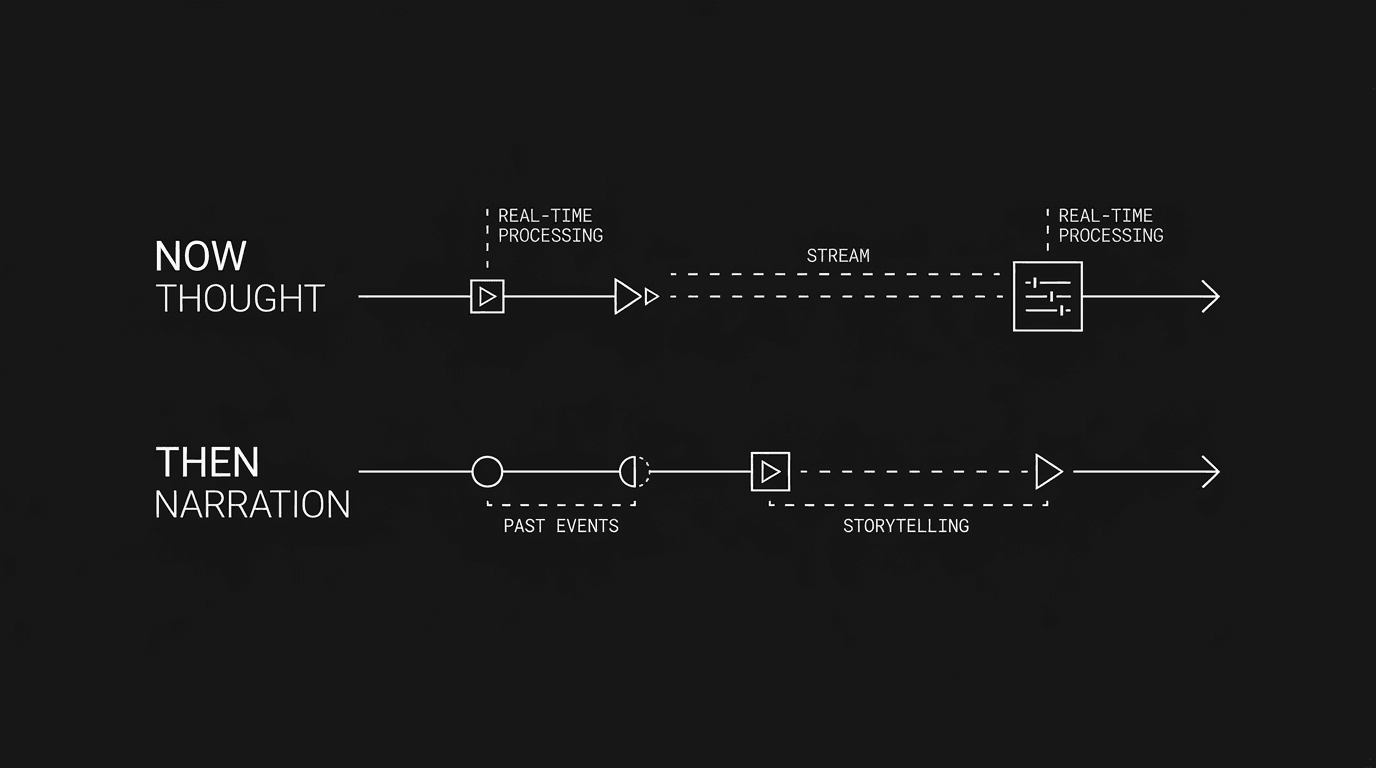
Inner monologue is live. Voiceover is recorded. One is the character thinking now. The other is the character (or narrator) speaking from the other side of the story.
Think about it this way. In inner monologue we're inside the moment. We hear what they're thinking as the scene plays. We don't know what happens next. In voiceover we're often outside the moment, someone is looking back, or guiding us, or commenting. They may know how it ends. So inner monologue creates intimacy and present-tense tension. Voiceover can create irony, context, or the feeling of a story being told. Our guide on dialogue and exposition is about keeping meaning without spelling it out; both inner monologue and voiceover can carry meaning, but they work differently. This piece is about the structural choice. For unreliable narrators, see unreliable narrator, voiceover is often where unreliability lives.
Inner Monologue: Thought in the Present
What it is: The character's thoughts as the scene happens. We're in their head. We don't leave the moment. They might be wrong. They might not know what's coming. The thought is reactive, to the line just said, to the look, to the room. Format: Usually (V.O.) with a cue that it's thought, e.g. "INTERNAL" or "THOUGHT" in the character element, or a convention your script establishes. Some scripts use italics for inner monologue in dialogue blocks; others use a separate element. The key is that the reader and the production know: this is not spoken. When to use it: When we need to know what the character is thinking but not saying. When the gap between thought and speech is the point. When we're in a tight POV and the thought is part of the present moment. For subtext, the inner monologue can contrast with what they say; see subtext.
Voiceover: Voice from Later (or Outside)
What it is: A voice outside the present moment. It can be the same character looking back. It can be a narrator who's not in the scene. It can be the character addressing the audience or the future. The voiceover often knows more than the character in the scene did, or it's telling us the story. Format: (V.O.) is standard. The difference from inner monologue is context. If the same character is in the scene and we're hearing their thoughts in the moment, that's inner monologue. If we're hearing them from a later time or from a narrating position, that's voiceover. Some scripts use "NARRATOR" or "CHARACTER (V.O.)" and the tone (reflective, ironic) tells us it's voiceover. When to use it: When you want reflection, irony, or the feeling of a story being told. When the narrator has information the character in the scene didn't have. When you're using a framing device (they're telling the story from the end). For V.O. vs O.S., see voice over vs off screen.
Relatable Scenario: The Thriller Where We're in Their Head
The protagonist is in a meeting. They're saying one thing. We need to know they're thinking another, they're suspicious, they're scared, they're planning. That's inner monologue. We're in the moment. We don't know what happens next. The thought is reactive. Format it as internal/thought and keep it in the present. For subtext when they're not thinking on the page, see subtext.
Relatable Scenario: The Frame Story Where They're Telling It Later
The film opens with the character's voice: "I didn't know it then, but that was the last time I saw her." We're in voiceover. The character is speaking from the other side of the story. They know how it ends. The voiceover can comment, foreshadow, or reframe. It's not thought in the moment, it's narration. Format it as (V.O.) and make the tone (reflective, ironic) clear. For circular narratives that call back to the start, see circular narratives.
Relatable Scenario: The Comedy Where the Character Comments on the Action
They're in the scene. We hear their voice commenting on what's happening, "Of course he said that." "Here we go." That can be inner monologue (they're thinking it) or voiceover (they're telling us from later). The difference: if it's in the moment and we're not sure they'll make it out, it's inner monologue. If it's from later and the tone is "let me tell you what happened," it's voiceover. Choose one and be consistent. For comedy structure, see rule of three.
The Trench Warfare Section: What Beginners Get Wrong
Mixing inner monologue and voiceover without distinction. Sometimes we're in the moment, sometimes we're from later, and the script doesn't signal which. Fix: Decide per scene (or per script). If it's thought in the moment, keep it present-tense and reactive. If it's from later, give it the tone of reflection or narration. Format and tone should make the difference clear. For unreliable narrators, see unreliable narrator, voiceover is often the unreliable layer.
Using voiceover for exposition. The narrator tells us the backstory. We're in a lecture. Fix: Use voiceover for attitude and context, not for dumping information. If you need to explain, hide it in conflict or action. See exposition dump.
Overusing inner monologue. We're in their head for every beat. The subtext becomes text. Fix: Use inner monologue when the gap between thought and speech matters. When we could get the same from a look or an action, cut the thought. For silence and reaction, see writing silence.
Letting voiceover repeat what we see. The image shows it. The voiceover says it. Redundant. Fix: Voiceover should add, commentary, irony, information we don't see, or a perspective from later. If it's just describing the image, cut it. For visual storytelling, see epiphany.
Forgetting that V.O. and O.S. are different. V.O. is voice over (non-diegetic or from another time/space). O.S. is off screen (same scene, we don't see them). Don't use V.O. for someone in the next room. Use O.S. See voice over vs off screen.
Try it free
Try Screenweaver for free on your script
It is free. Import your existing project, get a clearer view of your outline, and regain control of your story structure in minutes.
Start FreeInner Monologue vs. Voiceover at a Glance
| Inner monologue | Voiceover | |
|---|---|---|
| When | Present of the scene | Later, or outside the scene |
| Knowledge | Character doesn't know the future | Narrator may know the end |
| Tone | Reactive, in-the-moment | Reflective, telling, commenting |
| Use | Gap between thought and speech; POV | Frame, irony, story being told |
| Format | (V.O.) or INTERNAL/THOUGHT; present | (V.O.); often past or reflective |
Choose based on whether we're in the moment or outside it.
Step-by-Step: Choosing and Formatting
First: Ask if we're in the moment (thought as it happens) or outside it (someone telling or reflecting). Second: If in the moment, write inner monologue. Present tense. Reactive. No future knowledge. Third: If outside, write voiceover. Reflective or narrative tone. Can have hindsight. Fourth: Format clearly. Inner monologue: (V.O.) with "internal" or "thought" if your template allows; or a note at first use. Voiceover: (V.O.) and let the tone distinguish. Fifth: Don't overuse either. Inner monologue when the gap matters. Voiceover when the frame or commentary matters. For more on V.O. and O.S., see voice over vs off screen. For unreliability, see unreliable narrator.
[YOUTUBE VIDEO: Same scene with inner monologue vs. same scene with voiceover from later; comparison of what the audience knows and feels.]
The Perspective
Inner monologue is thought in the present, we're in their head as the scene plays. Voiceover is voice from later or outside, reflection, narration, or commentary. Use inner monologue when the gap between thought and speech matters and we're in the moment. Use voiceover when you want frame, irony, or the sense of a story being told. Format both clearly. Don't mix them without signaling. And don't use either to dump exposition, use conflict or action for that. When you know which one you're writing, the structure does the work. So pick the moment. Then write the voice.
Final Step
Build your next script with Screenweaver
Move from ideas to production-ready pages faster with timeline-native writing and AI-assisted story flow.
Try Screenweaver