

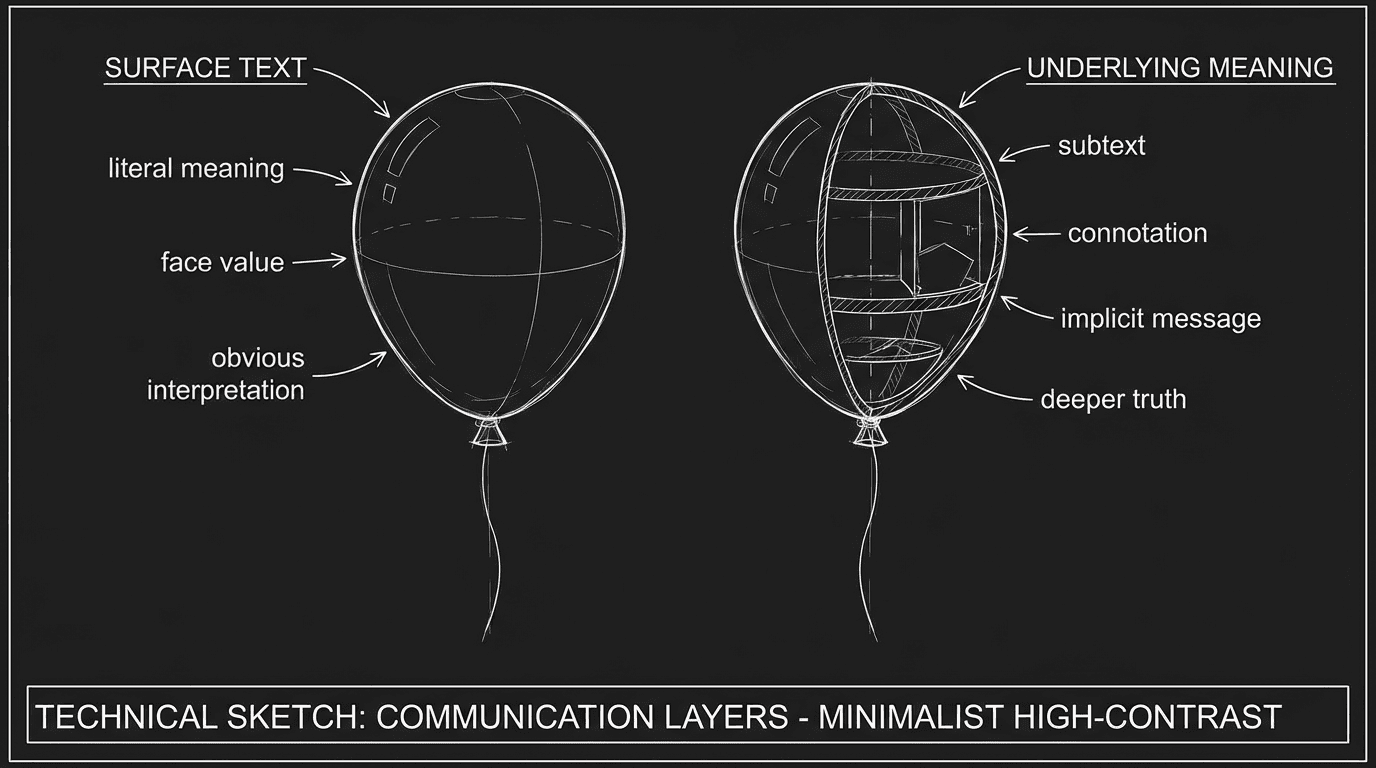
They're talking about the weather. They're really talking about the divorce. She says she's fine. She's not. He asks about the meeting. He's asking if she still loves him. Subtext is the gap between what's said and what's meant. When it's working, the audience leans in. They're not listening to information, they're decoding it. When it's missing, dialogue feels flat. Characters say exactly what they feel and the scene has nowhere to hide. Here's how to write dialogue that hides the truth without hiding it from the audience.
The best dialogue gives the audience the real conversation. The characters don't have to know they're having it.
Think about it this way. In life we rarely say the thing. We talk around it. We test. We deflect. We ask a small question when we mean a big one. On the page, subtext is that same dance, but you're designing it so the audience can hear both levels. They hear the surface (the weather, the meeting) and they hear the real subject (the divorce, the love). The characters might not name it. The audience does. That's the contract. Our guide on dialogue that doesn't sound like exposition goes deeper on keeping meaning without spelling it out. This piece is about the mechanics of the gap: how to create it, how to sustain it, and when to close it.
Why Subtext Works (And When to Drop It)
Subtext works because it activates the audience. They're not passive receivers. They're putting the pieces together. They feel smart when they get it. They feel the tension when two people are saying one thing and meaning another. The scene has a surface and a depth. The surface is safe. The depth is where the stakes live. So the scene isn't "two people arguing about the divorce." It's "two people arguing about who left the milk out", and we know they're really arguing about who left. The trivial becomes the container for the vital. That's subtext.
But subtext can't hold forever. At some point someone has to say the thing. Or the audience has to be sure they've understood. If every scene is subtext with no release, the script becomes exhausting. The audience needs moments where the mask drops, where the character says what they mean, or where the subtext is confirmed by action. So you're not writing subtext all the time. You're writing scenes that earn a subtextual read and moments that pay it off. The payoff might be a line. It might be a look. It might be one character walking out. But the audience has to feel that they've been let in on something. For how noir and other genres use subtext, see our guide on subtext in film noir.
Relatable Scenario: The Breakup Scene That Never Says "Breakup"
Two people in a kitchen. One is leaving for a job in another city. They're talking about the move. The boxes. The flight. Underneath: this is the end of the relationship and they both know it. Neither says it. She asks if he wants to keep the plant. He says he'll kill it. She says she'll take it. The plant is the relationship. Nobody says "us." The audience hears "us." That's subtext. The scene works because we have a surface subject (the move, the plant) and a real subject (the end). The surface is concrete. The real subject is emotional. When she finally says "I'll call when I land," and he doesn't say "please do," the subtext pays off. We didn't need them to say "we're over." We felt it. For scenes where silence does the work, see writing silence.
Relatable Scenario: The Power Meeting Where No One Says "No"
A executive is shutting down a project. The room has the project lead and two others. The executive doesn't say "you're done." They talk about priorities. Resources. The big picture. Everyone in the room knows what's happening. The subtext is "you're fired" or "your project is dead." The dialogue is all plausible deniability. That's how power often speaks. The scene works when the audience sees the real decision underneath the corporate language. The lead might try to make it explicit, "So we're pausing this?", and the executive might never quite answer. The evasion is the point. Subtext here isn't gentle. It's structural. For hiding information inside conflict, our guide on the exposition dump applies: the "Pope in the Pool" trick works because the audience is distracted by conflict or activity while they absorb info; subtext distracts with surface so they absorb meaning.
Relatable Scenario: The Confession That Never Uses the Word
One character has to tell another something terrible. They don't say "I did it" or "I'm sorry." They tell a story. They talk about someone else who made a mistake. They ask "what would you do if..." The listener might not get it at first. The audience does. We're waiting for the moment the listener catches up. The subtext is the confession. The surface is the story or the hypothetical. When the listener's face changes, when they understand, we don't need the character to spell it out. The subtext has landed. For unreliable narrators who hide the truth, see unreliable narrator: subtext can be the tool the character uses to hide from themselves.
The Trench Warfare Section: What Beginners Get Wrong
Writing subtext that's too obscure. The audience never gets it. They leave the scene confused. Fix: Give at least one clear signal, a reaction, a line that could mean two things but one meaning is obvious in context, or a visual (they're packing; they're not looking at each other). The audience should be able to name the real subject even if the characters don't.
Using subtext for every line. Every exchange is a code. It's exhausting. Fix: Let some dialogue be direct. Let characters say what they mean sometimes. Subtext is a tool for key scenes or key relationships. Not every scene needs a gap.
Letting the subtext be arbitrary. They're talking about the weather and we're told they're really talking about the divorce, but there's no link. The surface could be anything. Fix: The surface subject should connect to the real subject. The plant = the relationship. The move = the end. The weather = the mood between them. The connection doesn't have to be spelled out. It has to be feelable.
Explaining the subtext in action lines. "(She's really asking if he still loves her.)" That kills it. Fix: Write the dialogue so the subtext is clear from context. If you need to explain it in a parenthetical, the dialogue isn't doing its job. Cut the stage direction. Rewrite the line.
Never paying off the subtext. We spend the whole scene decoding. Nothing ever lands. Fix: At least one moment in the scene, or later in the script, should confirm or release the subtext. A line. A look. An action. The audience needs to feel they were right to read between the lines.
Try it free
Try Screenweaver for free on your script
It is free. Import your existing project, get a clearer view of your outline, and regain control of your story structure in minutes.
Start FreeSubtext: Surface vs. Depth
| Surface (what they say) | Depth (what they mean) | How the audience gets it |
|---|---|---|
| "Did you eat?" | "Are you okay? Do you still care?" | Context: they're estranged; the ask is tentative |
| "The project's on hold." | "You're done. I'm not saying it." | Tone, evasion, what isn't said |
| "I'll take the plant." | "I'm taking what's left of us." | Object = relationship; she's leaving with it |
| "When do you fly?" | "When do I lose you?" | They're separating; the question is about the end |
Design both layers. The surface should be playable. The depth should be inferable from situation and tone.
Step-by-Step: Building a Subtextual Scene
First: Name the real subject. What are they really talking about? (The end of the relationship. The fact that one of them lied. The power shift.) Second: Choose a surface subject that connects. Something they can literally say, the move, the project, the plant, the weather. Third: Write the scene so every line works on the surface. If an actor said only the lines, they'd make sense. Fourth: Make sure the situation (who they are, what's at stake, what just happened) makes the depth clear. The audience has context. Fifth: Add one moment where the subtext almost breaks through, a line that could be the real subject, or a reaction that gives it away. Sixth: Decide the payoff. Does someone say the thing? Does someone leave? Does the audience get a look that confirms it? One of those. For more on dialogue that avoids on-the-nose exposition, see writing dialogue that doesn't sound like exposition.
[YOUTUBE VIDEO: Same scene written two ways, on-the-nose vs subtextual, with beat-by-beat breakdown of what the audience infers.]
Subtext and Genre
In thriller and noir, subtext is often about danger or deception. People say safe things while meaning threat or lie. In romance and drama, subtext is often about vulnerability, they can't say the feeling, so they say the thing next to it. In comedy, subtext can be the gap between what the character claims and what we see. Match the subtext to the genre's engine. For comedy rhythm and callbacks, see our guide on the rule of three in comedy: subtext and comic structure can work together when the third beat undercuts what was said.
The Perspective
Subtext is the gap between what's said and what's meant. Design both layers. Give the audience a surface they can hear and a depth they can infer. Connect the surface subject to the real subject. Don't explain the subtext in action lines. And pay it off, one moment where the mask drops or the meaning lands. When the audience is doing the work of decoding, they're in the scene. When everything is said, they're just listening. So hide the truth. But let them find it.
Final Step
Build your next script with Screenweaver
Move from ideas to production-ready pages faster with timeline-native writing and AI-assisted story flow.
Try Screenweaver