

A character stares at their phone, thumb hovering over a saved message.
They already know the voice.
They still press play.
The voice starts warm, then cracks, then says the one line that detonates the entire third act.
If that voicemail is formatted weakly, the moment dies on the page before it ever has a chance on screen.
That sounds dramatic. It is also true.
Voicemail scenes live at a strange intersection of dialogue, sound design, time control, and emotional memory. They can deliver exposition, reveal betrayal, trigger grief, and compress backstory in seconds. They can also become unreadable blocks of transcript that flatten pacing and confuse source logic.
Here’s why that matters: a script reader has no actor voice, no score, no sound mix. The page must carry the scene’s full logic by itself. If your voicemail formatting is unclear, the reader will spend attention decoding mechanics instead of feeling the emotional impact.
A voicemail is not just “audio from phone.” It is delayed presence.
Think about it this way: live dialogue is a knife fight. Voicemail is a ghost with perfect timing.
This guide gives you a practical, professional way to format voicemail moments so they read cleanly, hit hard, and survive revision pressure.
Cinematic workflow frames

These two visuals work as a pair: the first shows Cinematic workflow still, first angle, 35mm film grain, and the second shifts to Cinematic workflow still, second angle, 35mm film grain - compare them briefly, then move on.

What Makes Voicemail Scenes Different from Regular Dialogue
Beginners often treat voicemail as either plain dialogue or plain action description. Both approaches fail when used alone.
Voicemail has three layers running simultaneously:
The recorded voice content.
The present-time listener reaction.
The narrative function of delay (message sent earlier, heard now).
If your formatting ignores any one of these layers, the scene feels thin or confusing.
The delayed nature is the key distinction. A voicemail line is spoken in one emotional context and received in another. That gap can create irony, dread, tenderness, or devastating reversal.
Your formatting choices should make that temporal and emotional split legible fast.
Great voicemail scenes do not just deliver information; they weaponize timing.
Core Formatting Patterns That Work in Practice
There is no single global standard, but there are reliable patterns that keep professional readers oriented.
Pattern 1: Source Cue as Character Name
Use a cue like VOICEMAIL - MOM or MOM (VOICEMAIL) for playback lines.
This works well when message voice identity matters and appears more than once.
Pattern 2: Action Setup + Compact Playback Block
Establish playback in action, then run voice lines under a clean cue.
Example setup line: “He taps PLAY. Her voice fills the quiet kitchen speaker.”
Then use stable cue naming for readability.
Pattern 3: Intercut Listener Reactions Between Message Beats
For dramatic sequences, do not dump the full message in one uninterrupted block. Interleave message beats with reaction actions to preserve cinematic rhythm and emotional escalation.
This often reads best in thrillers, family drama, and grief-heavy scenes.
Pattern 4: Timestamp or Metadata Sparingly
If timestamp matters to plot logic, include it once at playback entry (11:43 P.M. - SAVED MESSAGE).
Do not clutter each line with technical metadata unless transcript detail is the point of the scene.
Quick Comparison Table
| Approach | Best For | Strength | Risk |
|---|---|---|---|
MOM (VOICEMAIL) cue | Character-centric emotional scenes | Clear source identity | Can feel repetitive if over-tagged |
VOICEMAIL - [NAME] cue | Procedural clarity, multiple message voices | Fast visual parsing | Looks mechanical if scene is intimate |
| Single transcript dump | Expository recap | Efficient info transfer | Kills dramatic rhythm and reaction texture |
| Intercut message + reaction | High emotional stakes | Strong cinematic pacing on page | Requires disciplined beat design |
Three Beginner Scenarios That Usually Go Wrong
Scenario 1: The Breakup Message That Reads Like a Wall of Text
A writer pastes an 18-line voicemail monologue with no interruption. The receiving character is absent until the final action line: “She cries.”
Technically valid.
Dramatically inert.
The fix is to cut the voicemail into meaningful beats and intercut present-time behavior. Hand tremor. Play/pause hesitation. Rewind one sentence. Delete attempt aborted.
Now the scene is alive because reception becomes action.
Scenario 2: The Thriller Clue Voicemail With Source Confusion
A detective plays an unknown message. The script cues lines as VOICE (V.O.) with no identifier, and several other off-screen voices appear in the same sequence.
Readers lose track instantly.
Fix: name the source explicitly (UNKNOWN MALE VOICE (VOICEMAIL)), then stabilize that label through the scene.
Ambiguity of identity can remain narrative. Ambiguity of source mechanics cannot.
Scenario 3: The Family Drama Voicemail Used as Exposition Dump
A parent leaves a long informational message explaining everything the audience needs to know.
This is tempting and often fatal.
Fix: let voicemail deliver one emotional or plot pivot, not the entire history. Move secondary context into behavior, later dialogue, or visual consequences.
A voicemail is strongest when it creates pressure, not when it performs your screenplay synopsis.
Step-by-Step Workflow for Writing Voicemail Scenes
Step 1: Define the Voicemail’s Single Narrative Job
Before writing text, answer one question: what is this message doing to the story right now?
Is it triggering action?
Reframing a relationship?
Confirming betrayal?
Delivering a final goodbye?
If the voicemail has two or three jobs, split functions across scenes.
Step 2: Decide What the Listener Knows Before Pressing Play
Tension comes from expectation collision.
Does the listener think this is routine and get blindsided?
Do they fear exactly what they hear?
Do they replay a known message for emotional punishment?
State this in your own notes first. It shapes reaction beats.
Step 3: Choose a Consistent Source Label
Pick one cue schema for the sequence and do not drift.
DAD (VOICEMAIL)
or
VOICEMAIL - DAD
Both can work. Inconsistency cannot.
Step 4: Break the Message Into Dramatic Units
Do not write one giant speech first.
Draft three to five units, each with a distinct function:
Opening tone.
Core reveal.
Emotional turn.
Tail line that lingers.
Intercut listener reaction between units where stakes shift.
Step 5: Control Playback Mechanics Deliberately
Voicemail scenes are inherently mechanical: play, pause, rewind, delete, save, speaker toggle.
Use only the mechanics that affect dramatic movement.
If a rewind changes interpretation, include it.
If a pause marks avoidance, include it.
If a speaker toggle changes who else hears, include it.
Do not annotate device behavior that does no story work.
Step 6: Run the “Audio-Only Logic” Pass
Read only source cues and voicemail lines.
Can a cold reader identify who is speaking and when message playback starts/ends?
Now read only action lines around those beats.
Can they track listener reaction arc?
If either pass fails, revise structure before polishing dialogue language.
Step 7: Trim for Aftershock
Strong voicemail scenes end with aftershock, not immediate explanation.
After playback, resist instant explanatory dialogue unless necessary. One precise action often lands harder than a paragraph of processing.
A phone set face-down can do more than ten lines of “What just happened?”
Try it free
Try Screenweaver for free on your script
It is free. Import your existing project, get a clearer view of your outline, and regain control of your story structure in minutes.
Start FreeBody Image: Playback + Reaction Architecture
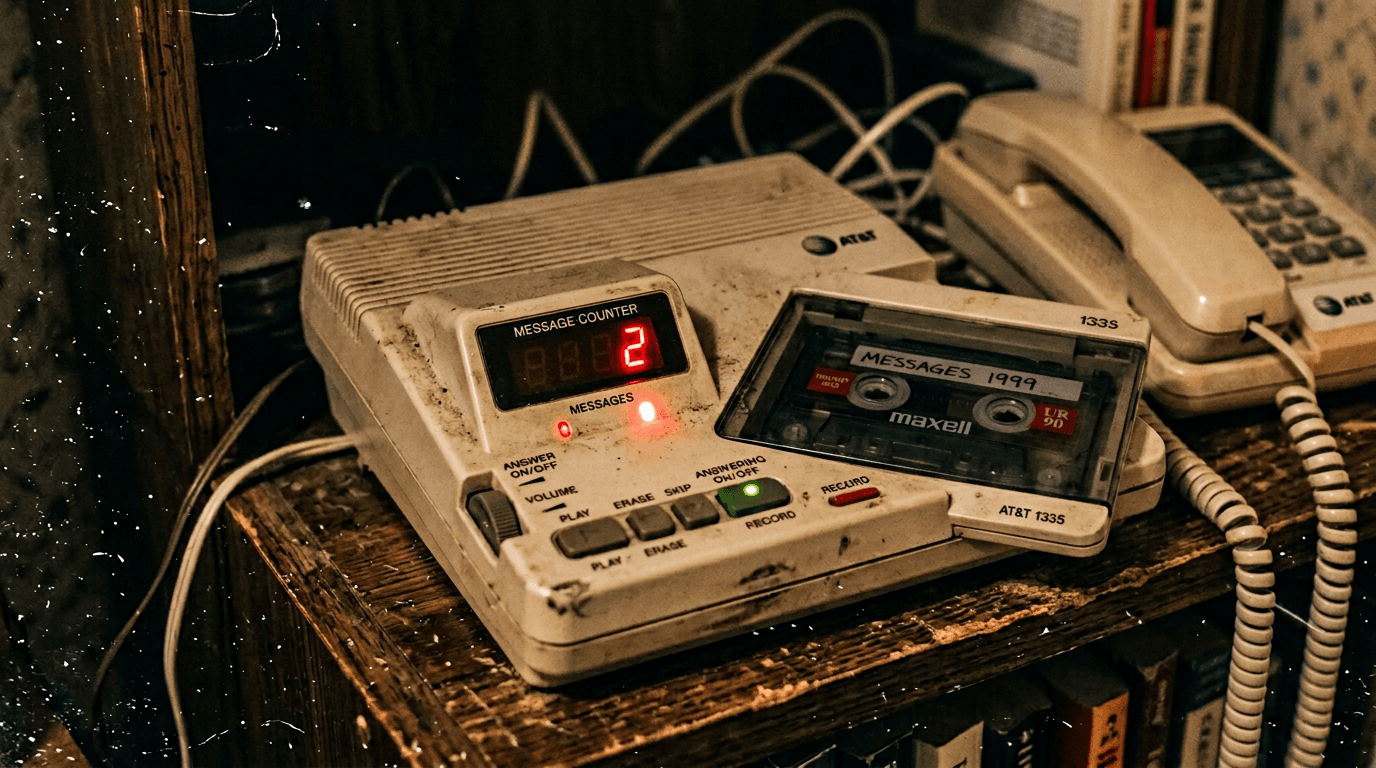
The Trench Warfare Section: What Beginners Get Wrong (and Exactly How to Fix It)
This is where most voicemail scenes fail in notes.
Failure 1: Writing the Entire Message as One Paragraph
Readers see a dense block and brace for exposition.
Fix: split into short dialogue units and interleave reaction actions at turning points.
Failure 2: Generic Source Labeling (VOICE, MAN, WOMAN)
If multiple disembodied voices appear in sequence-heavy scripts, generic labels cause misattribution.
Fix: use stable, distinctive source cues tied to role or identity.
Failure 3: Confusing Voicemail with Voice-Over
A voicemail is diegetic playback in scene world. Voice-over may be non-diegetic commentary or narrative device.
Fix: mark source explicitly as voicemail in cue or action setup when first introduced.
Failure 4: No Listener Behavior During Playback
Message plays, listener is emotionally invisible until end.
Fix: write reaction as active behavior: pacing, pausing, replaying, deleting, forwarding, hiding phone.
Failure 5: Over-technical Device Annotation
Writers include every UI action and timestamp line, creating procedural noise.
Fix: keep only mechanics that change stakes or interpretation.
Failure 6: Exposition-Heavy Message Language
Voicemail says things people would never naturally say in a message, just to inform audience.
Fix: write message voice as actual human communication under emotional constraints. Let implication carry weight.
Failure 7: No Temporal Anchor
Reader cannot tell whether message was left minutes ago or months ago.
Fix: include one precise temporal hint if timing affects meaning.
Failure 8: Ending the Scene on Immediate Explanation
Character hears devastating line and instantly explains theme to another character.
Fix: land scene on behavior or silence where possible. Let impact breathe.
Failure 9: Inconsistent Cue Naming Across Drafts
MOM (VOICEMAIL) becomes VOICEMAIL MOM then MOTHER VOICE across revisions.
Fix: create a canonical source-cue list and normalize with search before submission.
Failure 10: Using Voicemail as a Lazy Plot Device
Message appears exactly when needed, says exactly what plot needs, with no grounded character logic.
Fix: justify who sent it, why they phrased it that way, and why it was unheard until now.
A voicemail should feel inevitable in retrospect, surprising in the moment.
Advanced Craft: Voicemail as Time Compression and Emotional Counterpoint
The best voicemail scenes often do two contradictory things at once.
They compress time by delivering information from another moment.
They stretch emotion by forcing present characters to sit inside delayed presence.
That contradiction is pure dramatic fuel.
If a character hears a loving message from someone now dead, the words carry one meaning when sent and another meaning when heard. You do not need heavy explanation for this to land. You need clean formatting and precise line selection.
Likewise in thrillers, a voicemail can create asymmetry: the sender did not know they were already compromised when they spoke. The audience learns this while listening, producing dread that live dialogue could not create as efficiently.
Use this asymmetry intentionally.
Do not waste it on generic recap.
Practical Software and Rewrite Hygiene
In Final Draft, WriterDuet, and similar tools, label drift and parenthetical bloat are common during iterative rewrites.
Set up a short style key in project notes before dialogue polish:
VOICEMAIL - [NAME] for playback source
[NAME] for live dialogue
One action line anchor on first playback entry
No more than one technical metadata line per message unless plot-critical
Run search for VOICEMAIL, V.O., and speaker variants near lock draft. Ensure playback source lines are formatted intentionally, not accidentally inherited from voice-over habits.
For produced script readability baselines, the <a href="https://johnaugust.com/library" rel="nofollow">John August script library</a> is useful for studying scene clarity in audio-driven moments, but your own internal consistency rules matter more than copying one writer’s exact typography.
As discussed in our guide on [how to format a radio broadcast in a script], source clarity and audibility logic should be obvious in a quick page skim.
If your voicemail contains legal or forensic content, pair this with [how to format a courtroom transcript in a script] to avoid collapsing distinct document voices into one undifferentiated block.
And if the voicemail triggers parallel action elsewhere, [how to show simultaneous action in two locations in a script] helps preserve timeline coherence while tension escalates.
Body Image: Before/After Readability Pass

YouTube Placeholder for This Section
[YOUTUBE VIDEO: A practical rewrite session transforming a clunky voicemail scene into a tight cinematic sequence, including cue naming, reaction intercuts, and pacing adjustments.]
A Concrete Before-and-After Micro Example
Before:
“INT. CAR - NIGHT
She checks her phone.
VOICE (V.O.) Hey it’s me I know it’s late I just wanted to say I’m sorry about earlier and also I found the envelope in dad’s desk and I think you should not trust Mark call me when you get this.
She starts the engine.”
Readable at surface level.
But it is flat, overpacked, and dramatically under-structured.
After:
“INT. CAR - NIGHT
Nina opens a saved message. Speaker on.
UNKNOWN FEMALE VOICE (VOICEMAIL) Hey. It’s me.
Nina freezes, key half-turned.
UNKNOWN FEMALE VOICE (VOICEMAIL) I’m sorry about earlier.
A beat. Nina almost stops playback.
UNKNOWN FEMALE VOICE (VOICEMAIL) I found Dad’s envelope. Don’t trust Mark.
Nina kills the speaker. Silence.
Then she starts the engine.”
Same core information.
Better pacing, stronger reaction arc, cleaner source logic, sharper end beat.
The Ending Perspective: Treat Voicemail Like a Scene Partner
A voicemail is easy to underestimate because no live character is physically present while it plays.
That is exactly why it is powerful.
It lets the absent character enter the scene with surgical timing and no possibility of real-time negotiation. The listener cannot interrupt history. They can only react to it.
When formatted carelessly, voicemail becomes exposition spill.
When formatted with discipline, it becomes one of the most precise tools you have for delayed revelation, emotional ambush, and story acceleration.
Anchor source clearly.
Write in dramatic units.
Intercut reaction where stakes turn.
Cut technical noise.
End on aftershock.
Do this consistently, and voicemail stops being a formatting headache and starts becoming a reliable engine for high-impact screenplay moments.
That is the difference between a message your reader skims and a message they hear in their head long after the page turn.
One final tactical lens can push these scenes from good to exceptional.
Ask what the voicemail does to power in the scene, not just what facts it delivers.
Before playback, one character may hold control through certainty, denial, or social leverage. During playback, that control can crack in public or private depending on who hears the message. After playback, someone else may gain tactical advantage without saying a word. If you write those three phases deliberately, your voicemail sequence feels like a live confrontation with an absent person still exerting force.
That is cinema.
You can emphasize this by choosing one post-message behavior that is impossible to misread: forwarding the message to an enemy, deleting it and then recovering it, locking the phone as someone enters, or replaying only the final line. Each choice externalizes internal conflict without blunt exposition.
The craft point is simple. A voicemail scene should not end when audio ends. It should end when power settles into a new shape the audience can feel.
When you treat delayed audio as active dramatic pressure, formatting decisions become obvious. Cues stay clean. Reaction beats stay specific. And your reader never wonders why the message exists.
Final Step
Build your next script with Screenweaver
Move from ideas to production-ready pages faster with timeline-native writing and AI-assisted story flow.
Try Screenweaver