

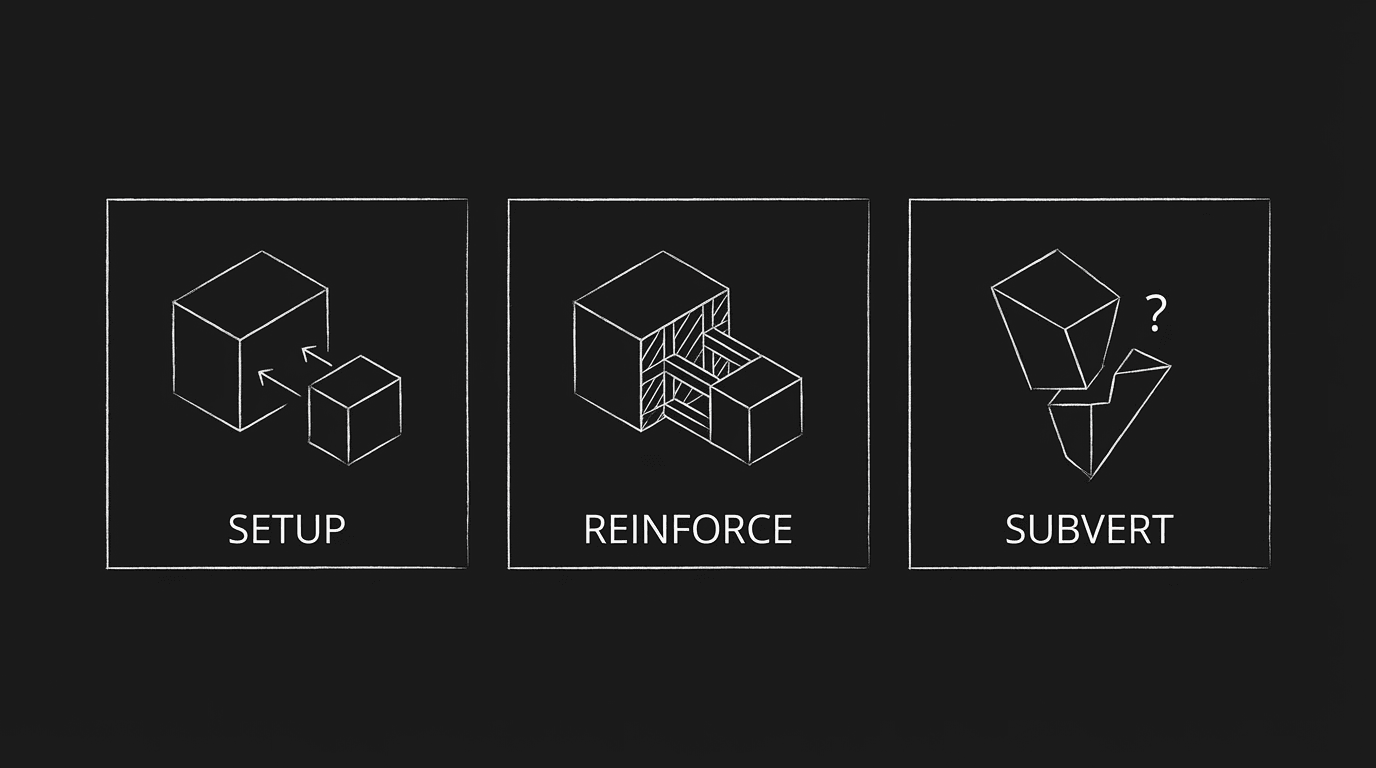
First time: we get it. Second time: we recognize the pattern. Third time: we expect the pattern, and you break it. That's the rule of three. Setup. Reinforce. Subvert. The rhythm is so ingrained in comedy that audiences feel it in their bones. When you use it, the laugh comes from the violation of expectation. When you skip it or do it wrong, the joke lands flat or doesn't land at all. Here's how the mechanic works and how to use it on the page.
The third beat isn't "another one." It's the one that shouldn't be there, and that's why it's funny.
Think about it this way. Jokes need a pattern. Two beats establish it. The third beat is where you either pay it off (callback, escalation) or break it (twist, subvert). If you stop at two, the audience hasn't had time to lock in the expectation. If you go to four without a turn, the pattern feels repetitive. Three is the minimum for pattern + payoff. Comedy on the page can't control timing or delivery, but it can control structure. You put the setup where the reader (and later the viewer) can see it. You put the reinforce where they think "here we go again." You put the subvert where they're ready to laugh. Our guide on comedy timing on the page goes into rhythm and spacing; this piece is about the three-beat shape and the subvert. For subtext in dialogue, see subtext, comedy and subtext can combine when the third beat undercuts what was said.
Why Three (And Why Subvert on the Third)
One beat is a moment. Two beats are a pattern. Three beats give the audience expectation. They think they know what's coming. The laugh happens when what comes is different, or when it's the same in a way that's wrong, bigger, or reframed. So the rule of three isn't just "do it three times." It's "set it up, reinforce it, then subvert or escalate on the third." The third beat does the work. The first two prepare. If the third beat is just a repeat, you get a sigh. If the third beat breaks or escalates, you get a laugh. Callbacks work the same way: you set something up early, you might nod to it again, and the third time you pay it off or flip it. The audience has been waiting. You deliver.
Another use of three: lists. Character lists three things. The first two are normal. The third is wrong, absurd, or too honest. The structure is list of three; the punch is the third item. You see it in stand-up and in scripts. On the page, you're building the list so the third item is on its own line or its own beat, the reader's eye lands on it and the subvert is clear. For dialogue that doesn't sound like exposition, see dialogue and exposition: comedy lists can also carry info if the third beat is the one that reveals character or plot.
Relatable Scenario: The Running Gag That Pays Off
Character A has a habit. They always say the same wrong thing, or they always do the same thing at the wrong time. First time: we see it. Second time: we recognize it. Third time: the context is different, maybe the stakes are higher, or someone calls them on it, or the habit causes a disaster. The third beat is the payoff. The pattern was setup and reinforce. The subvert (or escalation) is the third. If you do the same gag four or five times without a payoff or a turn, it becomes background. If you pay it off on the third (or the third in a scene), the audience gets the joke. For keeping character voice consistent so the gag stays recognizable, see distinct voices.
Relatable Scenario: The Meeting Where the Third Answer Is the Punch
Three people give an answer. Or one person gives three answers. The first two are serious or expected. The third is absurd, honest, or wrong. The structure is the list of three. The punch is the third. On the page, you might write the first two as straight dialogue and give the third its own beat, maybe a pause, maybe an action line, so the reader (and the actor) know the third is the turn. For comedy that lives in timing, see comedy timing: the rule of three gives you the architecture; timing on the page is about where you place the beat.
Relatable Scenario: The Callback That Reframes
Something happens in Act 1. It's funny or odd. It happens again (or is referenced) in Act 2. In Act 3, it happens again, but the context has changed. Now it's sad, or dark, or it reveals something. The third use reframes the first two. The audience thought it was a gag. Now they see it as character or theme. That's a callback with a subvert. The rule of three isn't only for one scene, it can span the script. For structure that supports callbacks, see our guide on circular narratives: the third beat can be the ending that calls back to the opening.
The Trench Warfare Section: What Beginners Get Wrong
Stopping at two. You have a setup and a reinforce. No third beat. The audience never gets the payoff. Fix: Add the third. Either subvert (break the pattern) or escalate (same pattern, bigger or worse). The joke lives in the third beat.
Making the third beat a repeat. The third time is the same as the first two. No twist. No escalation. The audience expected a turn and didn't get it. Fix: The third beat must do something. Subvert, escalate, or reframe. If it's just "again," cut it or change it.
Using three when two would do. Sometimes the joke is the second beat, the first was setup, the second is the punch. Adding a third can dilute. Fix: Not every joke needs three beats. Use three when you're building a pattern and the laugh is in the violation of expectation. Use two when the punch is in the contrast (setup vs punch).
Burying the third beat. The subvert is in the middle of a long line or a dense block. The reader doesn't see it as the turn. Fix: Give the third beat space. Its own line. Maybe a beat before it. The eye and the ear need to land on it.
Overusing the same structure. Every joke in the script is setup-reinforce-subvert. It gets predictable. Fix: Vary. Some jokes are two beats. Some are three. Some are callbacks that pay off later. The rule of three is a tool, not the only tool. For variety in comedy stakes, see whiff of death: comedy can hold the three-beat structure and still have real stakes.
Try it free
Try Screenweaver for free on your script
It is free. Import your existing project, get a clearer view of your outline, and regain control of your story structure in minutes.
Start FreeRule of Three: Options for the Third Beat
| Third beat | Effect | Example |
|---|---|---|
| Subvert | Break the pattern; surprise | First two: normal. Third: absurd or wrong. |
| Escalate | Same pattern, bigger or worse | First two: small. Third: huge or disastrous. |
| Callback | Pay off something from earlier | Third use reframes the first two. |
| List punch | Third item in a list is the joke | "I need calm, focus, and a time machine." |
Pick one per joke. Don't mix subvert and escalate in the same three-beat unit, one clear job for the third.
Step-by-Step: Building a Three-Beat Joke on the Page
First: Identify the pattern. What's the setup? (A habit. A line. A situation.) Second: Write the first beat. Clear. Playable. Third: Write the second beat. Same pattern. The reader should think "here we go again." Fourth: Write the third beat. Subvert (break the pattern), escalate (same pattern, bigger), or reframe (callback). Fifth: Give the third beat space, its own line or a beat before it so it lands. Sixth: Read it out loud. Does the laugh live in the third beat? If the punch feels early or late, adjust. For more on comedy structure, see comedy timing. For stakes in comedy, see whiff of death.
[YOUTUBE VIDEO: Same premise written as two-beat, three-beat (no subvert), and three-beat (with subvert), with read-through so you hear where the laugh lands.]
Callbacks and the Long Game
The rule of three can span the script. Something in Act 1. Nod in Act 2. Payoff or reframe in Act 3. The audience remembers the first time. The second time they think "oh, that again." The third time they get the full joke or the full meaning. Plant the first beat where it feels like a one-off. The second can be brief, a reference, a visual. The third is where you commit. For structural callbacks, see circular narratives.
The Perspective
Setup. Reinforce. Subvert (or escalate). The third beat is where the joke lives, in the break of expectation or the escalation. Use it when you're building a pattern. Don't repeat the same thing three times without a turn. Give the third beat space on the page so the reader and the actor can land on it. And vary your comedy so not every joke is the same three-beat shape. When the structure is clear and the third beat does its job, the laugh is in the script. When it's fuzzy or the third is a repeat, it isn't.
Final Step
Build your next script with Screenweaver
Move from ideas to production-ready pages faster with timeline-native writing and AI-assisted story flow.
Try Screenweaver