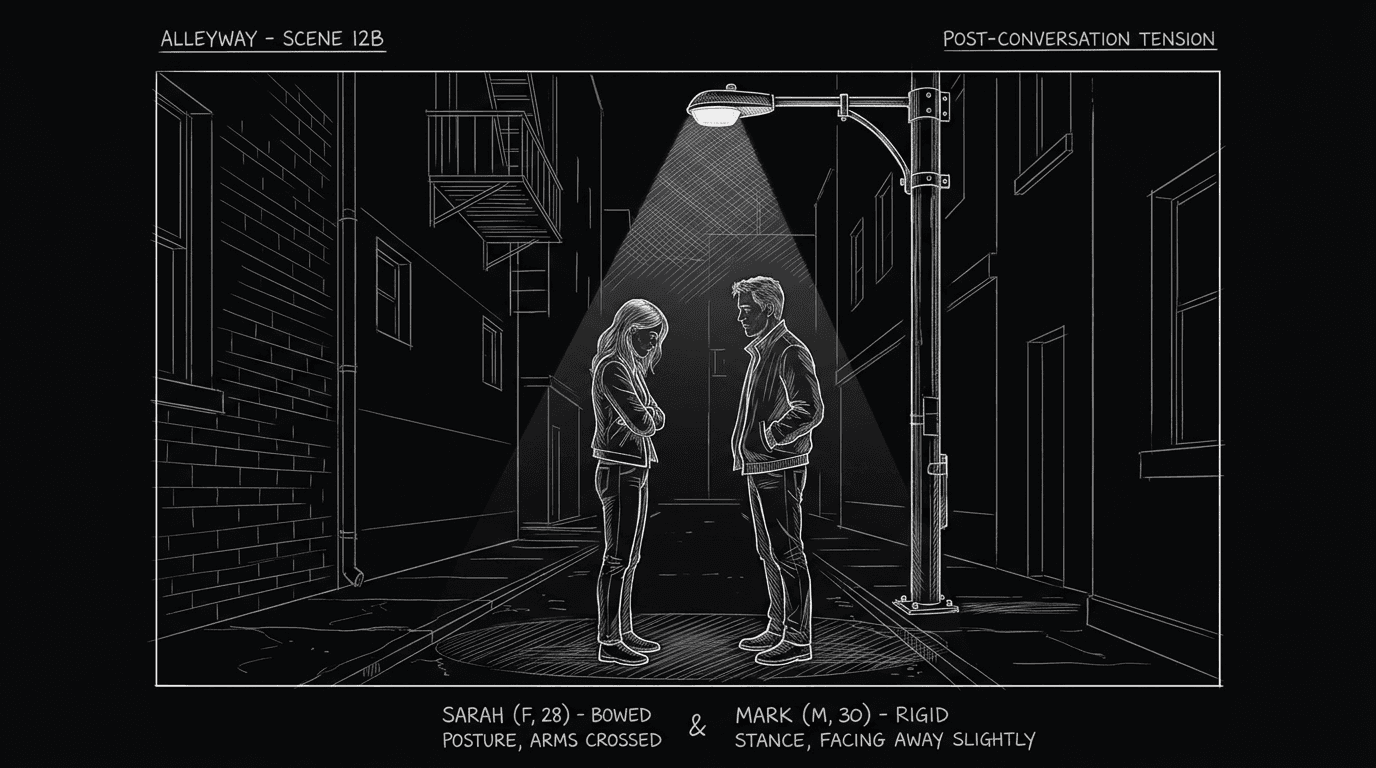

The scene is almost there.
Two characters have chemistry. The story has been building. The audience wants it.
Then the kiss happens, and the page suddenly feels like fan fiction.
That drop is brutal, and almost every writer has felt it. You write the build beautifully, then hit the kiss beat and default to awkward purple prose, over-explained body mechanics, or dialogue that sounds like people auditioning for a perfume commercial.
Here is the uncomfortable truth: first-kiss scenes do not fail because of the kiss. They fail because of everything around the kiss.
If the emotional architecture is weak, no amount of lyrical line editing will save it. If the emotional architecture is strong, the actual kiss can be written with surprising restraint and still hit like a truck.
That is your target.
A non-cringe first kiss is not a decorative romance moment. It is a decision under risk. Someone makes themselves vulnerable. Someone chooses uncertainty over safety. Someone crosses a threshold that changes how every future interaction is interpreted.
Once you write the scene as threshold rather than ornament, cringe starts disappearing.
Why First-Kiss Scenes So Often Feel Embarrassing on the Page
Most awkward first-kiss writing makes one of three mistakes.
First, writers confuse sensual detail with emotional specificity. They describe lips, breath, hands, and eye contact in microscopic detail, but none of those details connect to character psychology or story stakes. The result feels generic, even if the wording is elaborate.
Second, writers skip consent choreography because they are rushing toward payoff. They jump from banter to contact with no readable uncertainty beat. This makes the moment feel forced, not electric.
Third, writers flatten voice. Characters who sounded distinct for seventy pages suddenly speak in polished romantic language neither of them would ever use.
Think about it this way: if the scene could be swapped into ten different scripts with minor name changes, it is not your scene yet.
Cringe is rarely about romance itself. Cringe is about inauthenticity.
A first kiss lands when the audience feels two characters choosing risk in real time, not when the prose tries to sound poetic.
The Core Principle: Tension Before Contact, Consequence After Contact
A good first-kiss scene has two obligations.
Before contact, it must generate credible tension. Not generic "will they/won't they," but specific tension based on these people in this moment with these stakes.
After contact, it must generate consequence. The relationship state changes, and the script must acknowledge that change in behavior, power, and expectation.
Many beginner scenes do only one side. They either build tension forever and cut away before impact, or they jump to a kiss without proper setup. Both versions can feel unsatisfying.
The scene becomes strong when it behaves like a hinge. One door closes. Another opens.
Scenario One: The Friends-to-Lovers Kiss That Feels Scripted
Classic setup: two best friends realize hidden feelings.
Classic failure: one character suddenly gives a perfect monologue about secretly loving the other for years, then they kiss in cinematic slow motion.
It reads artificial because people under that much emotional risk rarely speak in clean thesis statements.
A stronger version uses fragmented admission under pressure. Maybe one friend starts a sentence, aborts it, tries humor, fails, then says something small but irreversible. Not "I have always loved you." Something like: "I keep planning my week around when I might see you, and I do not know what to do with that."
That line is less grand. More dangerous.
Then the kiss does not appear as reward. It appears as a mutual test: are we really doing this?
Now the scene breathes.
Scenario Two: The Enemies-to-Lovers Kiss That Turns Cartoonish
Another common issue: writers confuse hostility with chemistry and think yelling can pivot directly into kissing.
Sometimes that works in heightened genres. Often it feels unearned.
For enemies-to-lovers, the key is not anger intensity. It is respect emergence. There must be a beat where one character sees the other clearly in a new light, and that perception shift has to happen before physical contact.
Without this perceptual beat, the kiss reads like genre imitation.
With it, the kiss reads like a narrative breakthrough.
Scenario Three: The Quiet Slow-Burn Kiss That Never Quite Lands
Slow-burn writers often fear overstatement, so they underwrite the payoff. The kiss happens in one line and the scene immediately exits. No emotional processing, no behavioral shift, no consequence.
Restraint is good.
Absence is not.
A quiet first kiss still needs a reaction beat architecture. One character might laugh from nerves. One might pull back first and search the other's face for regret. One might say nothing and still communicate panic and relief at the same time.
If you skip these beats, the scene can feel like a placeholder rather than a turning point.
Step-by-Step Workflow for Writing a Non-Cringe First Kiss
Step 1: Define the Threshold in Story Terms
Before writing dialogue, write a one-sentence threshold statement: "After this kiss, X can no longer pretend Y."
Examples:
After this kiss, they can no longer pretend they are only professional partners.
After this kiss, she can no longer hide that she chose him over family expectations.
After this kiss, he can no longer weaponize sarcasm to avoid intimacy.
If your threshold sentence is vague, the scene will be vague.
Step 2: Build a Pre-Kiss Tension Ladder
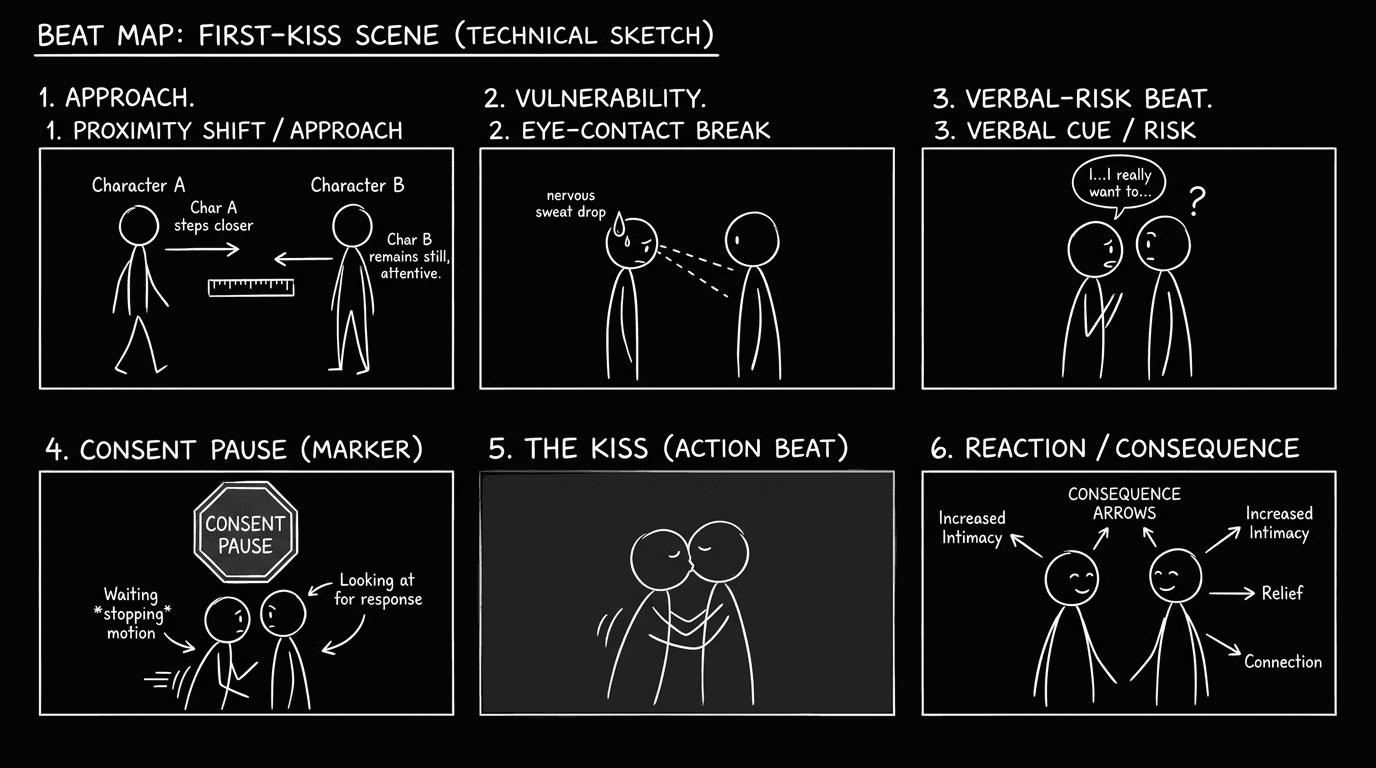
In your scene planning tool, map five mini-beats before contact:
proximity shift, eye-contact break, verbal risk, uncertainty pause, micro-consent cue.
Do not skip the uncertainty pause. That beat is where anticipation and consent both become legible.
In practical drafting terms, force at least one line or action between the verbal risk and the kiss. This small buffer prevents abruptness and gives actors playable tension.
Step 3: Write Voice-Accurate Dialogue, Not "Romance Dialogue"
Take each character's existing speech pattern from earlier scenes and keep it. If one character is concise and dry, let them stay concise and dry under pressure. If one is verbose when nervous, let that pattern intensify.
Do not suddenly upgrade them into poetic strangers.
When rewriting, run a simple check: could this line be spoken by this character in scene 12? If not, adjust.
Step 4: Stage Consent Through Action Clarity
Consent beats do not need legalistic dialogue, but they do need readable mutuality.
Use concrete cues:
one character leans in and stops,
the other closes distance,
a hand reaches and is reciprocated,
an explicit "okay?" or equivalent look-and-wait beat.
This is not only ethically important. It is dramatically richer because uncertainty and choice are what create tension.
Step 5: Keep Physical Description Functional
You do not need a paragraph of anatomy.
Use selective detail tied to emotional meaning. A shaky exhale can reveal fear. A missed first attempt can reveal nerves. A forehead touch before contact can reveal care. Pick details that communicate character state, not generic sensuality.
In revision, cut any physical description that does not change interpretation.
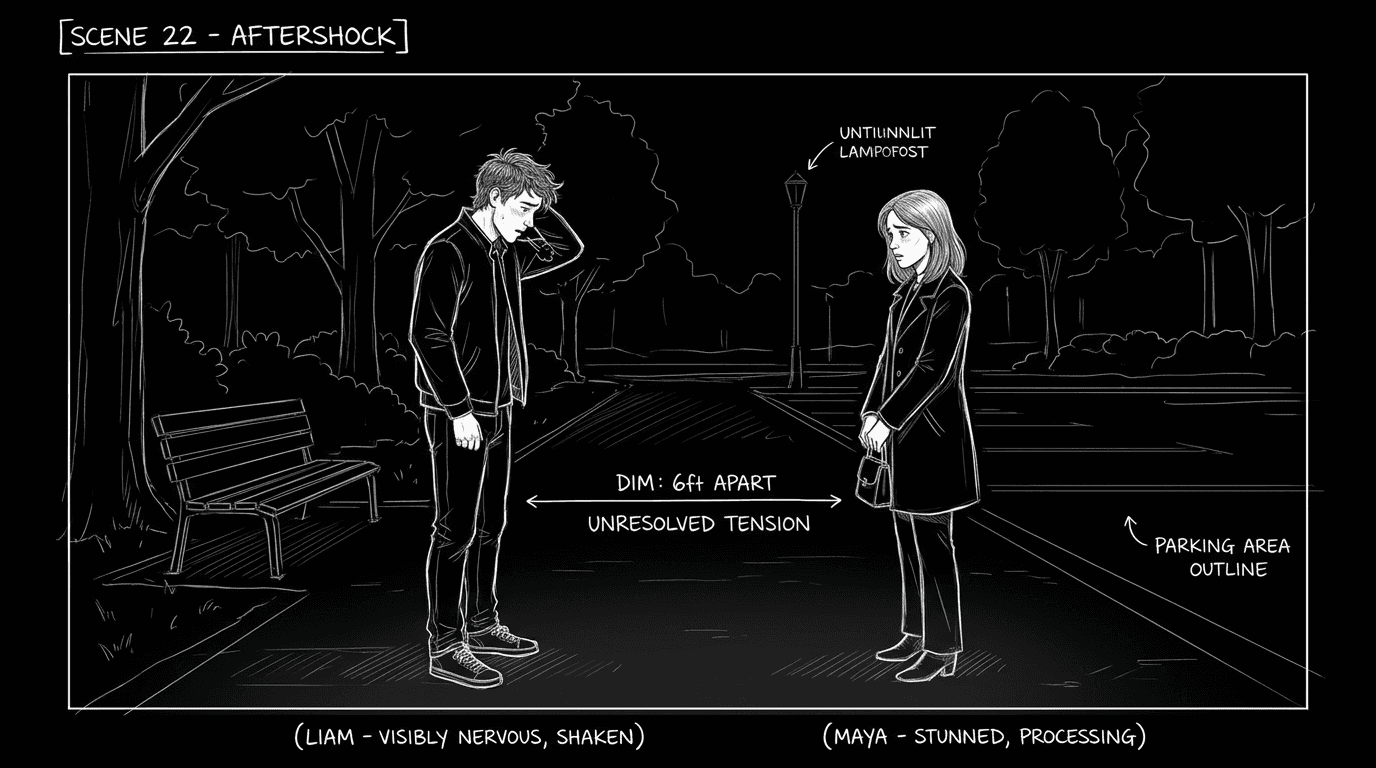
Step 6: Write the Immediate Aftermath
This is where many scenes collapse.
The kiss happens, then the script cuts away as if embarrassed by its own intimacy. Do the opposite. Stay for three to eight lines after the kiss and show behavior under new reality.
Do they joke to deflect?
Do they panic and over-explain?
Do they become suddenly quiet because language fails?
Do they renegotiate boundaries?
This aftermath makes the scene feel authored rather than copied.
Step 7: Connect to the Next Scene's Objective
A first kiss should alter tactical behavior in the next scene. Add a small bridge note in your outline: "Because of kiss scene, next scene objective shifts from A to B."
If no objective shifts, your kiss may be emotionally pleasant but structurally optional.
Optional scenes often read as cringe because readers sense they are decorative.
Try it free
Try Screenweaver for free on your script
It is free. Import your existing project, get a clearer view of your outline, and regain control of your story structure in minutes.
Start FreeTable: Cringe Patterns vs Professional Alternatives
| Cringe Pattern | Why It Fails | Professional Alternative |
|---|---|---|
| Sudden poetic confession dump | Feels out-of-character and prewritten | Fragmented admission with tactical hesitation |
| Instant kiss after argument spike | No perceptual bridge or consent pause | Add respect/perception shift beat before contact |
| Overwritten sensual description | Generic and interchangeable prose | Minimal detail tied to emotional state |
| Immediate scene cut post-kiss | No consequence processing | Stay for reaction and behavior shift |
| Identical romantic voice for both | Character specificity disappears | Preserve each character's stress-language pattern |
| No next-scene impact | Moment feels ornamental | Link kiss to changed goals and stakes |
The Trench Warfare Section: What Beginners Get Wrong (and Exact Fixes)
Let us get practical and blunt.
First mistake: writing the kiss like a music video.
Writers pile on moonlight, breathless adjectives, and slow-motion metaphors, hoping atmosphere will carry emotion. It rarely does. Fix it by reducing visual ornament and increasing decision clarity. Who acts first, who pauses, who confirms, who responds. Action logic beats lyric overload.
Second mistake: skipping emotional preconditions.
The scene has chemistry but no vulnerability risk. Characters banter, then kiss, with no exposed stake. Fix by inserting one irreversible verbal or behavioral reveal before contact. The reveal can be tiny. It must still carry risk.
Third mistake: writing consent as an afterthought.
Without readable mutuality, scenes can feel coercive or tonally off, especially to modern audiences. Fix with a clear pause-and-response beat. This does not kill tension. It amplifies it.
Fourth mistake: over-explaining feelings mid-moment.
A character interrupts the kiss to narrate their emotional thesis in full. Usually awkward. Fix by moving most emotional exposition to pre-kiss or post-kiss beats and keeping in-moment language minimal.
Fifth mistake: treating nervous humor as tone-breaking.
Beginners often delete awkward laughter, stumbles, and verbal glitches because they seem "unromantic." In reality, those beats often make scenes feel true. Fix by allowing one imperfect human beat that fits character voice.
Sixth mistake: writing body mechanics that are either vague or clinical.
Too vague and readers cannot stage the scene. Too clinical and the scene feels sterile. Fix by choosing two or three high-signal actions and writing them clearly. No choreography novel required.
Seventh mistake: forcing symmetry.
Both characters confess equally, move equally, and react equally. That reads engineered. Fix by embracing asymmetry. One may be bolder physically but more emotionally afraid. The other may be verbally open but physically hesitant.
Eighth mistake: no social context pressure.
A first kiss in a vacuum can work, but many scenes need contextual pressure to feel charged: workplace policy, friendship circles, family norms, danger proximity, reputational risk. Fix by making one external pressure legible in-scene.
Ninth mistake: copying iconic film beats.
Writers unconsciously replicate famous first-kiss templates: rain stop, hand-to-face pause, interrupted almost-kiss, final rush. These can work, but if used uncritically they feel derivative. Fix by deriving blocking from your characters' habits and location constraints.
Tenth mistake: forgetting aftermath logistics.
Who leaves first? Who texts first? Do they tell anyone? Do they pretend it did not happen at work tomorrow? Fix by writing at least one concrete post-kiss logistic beat.
Eleventh mistake: collapsing character voice into generic tenderness.
Characters who are normally sharp, guarded, funny, or blunt suddenly become smooth and lyrical. Fix by preserving idiolect under stress. Tenderness can exist inside rough language.
Twelfth mistake: mistaking intensity for volume.
Yelling and dramatic declarations are not mandatory. Many of the strongest first-kiss scenes are quiet and precise. Fix by focusing on micro-decisions and subtext rather than decibel level.
Thirteenth mistake: using too many adverbs and emotional labels.
"Softly," "passionately," "tenderly," "desperately." These labels tell instead of showing. Fix by replacing adverbs with observable behavior and paced line breaks.
Fourteenth mistake: no meaningful obstacle before payoff.
If nothing genuinely blocks the kiss, payoff can feel cheap. Fix by placing one real obstacle right before threshold: misunderstanding, moral conflict, timing risk, unresolved trust issue.
Fifteenth mistake: ending with perfect certainty.
Great first kisses often produce new ambiguity. "What are we now?" can be explicit or silent, but it should exist. Fix by letting one unresolved tension survive the moment.
If your first-kiss scene feels cringe, do not start by rewriting adjectives. Start by rewriting stakes, consent beats, and consequence architecture.
Body Image: Pre-Kiss Tension Map
Practical Rewrite Drill: Fix a Cringe Kiss Scene in 50 Minutes
Take your current first-kiss scene and duplicate it into a scratch draft.
First ten minutes: remove every adjective modifying physical contact. Keep only action and dialogue.
Next ten minutes: mark where risk appears. If risk appears only after the kiss, insert a pre-kiss reveal beat.
Next ten minutes: add one clear uncertainty pause with mutual response.
Next ten minutes: trim dialogue so each line does one job only: reveal, deflect, invite, resist, confirm.
Final ten minutes: write six lines of aftermath behavior and connect it to the next scene objective.
When you run this pass honestly, scenes usually improve fast because you move from ornamental romance writing to tactical emotional writing.
Advanced Calibration: Tone by Genre
A first kiss in a thriller should carry surveillance, timing, or danger pressure. A first kiss in a workplace drama should carry professional consequence. In a comedy, embarrassment and rhythm control are often central. In period drama, social protocol and reputation can dominate physical choreography.
Genre does not change emotional truth. It changes friction sources.
If your scene feels generic, check whether you wrote a "default romance beat" instead of a genre-specific threshold.
For script-study references across genres, the Writers Guild Foundation Library is useful and should be treated as a nofollow external source in publication settings.
As discussed in our guide on [how to write a seduction scene with subtext], attraction becomes dramatically interesting when intent and language are not perfectly aligned.
If you are balancing intimacy with unresolved conflict, the framework in [how to write an argument scene without repetitive dialogue] helps keep tactical movement alive.
And if your first kiss is followed by confession pressure, our piece on [how to write a confession scene in a thriller] gives practical methods for timing truth beats after emotional thresholds.
Body Image: Post-Kiss Consequence Beat
YouTube Placeholder
[YOUTUBE VIDEO: A practical rewrite breakdown where a generic first-kiss scene is transformed into a non-cringe version using threshold statements, consent choreography, and post-kiss consequence beats.]
Ending Perspective: Write the Choice, Not the Fantasy
A first kiss scene does not need to be perfect to be powerful.
It needs to be true to character, clear in consent, rich in risk, and alive with consequence.
When writers chase fantasy language, cringe appears. When writers stage choice under pressure, authenticity appears.
So if you are revising one right now, do not ask, "How do I make this more romantic?"
Ask better questions.
What risk does each person take here?
What changes because of this contact?
What cannot go back to normal after this moment?
Answer those on the page with precision, and the scene stops feeling like imitation.
It starts feeling inevitable.
And that is exactly what a great first kiss should be: surprising in the moment, obvious in hindsight, and structurally impossible to remove from the story.
Final Step
Build your next script with Screenweaver
Move from ideas to production-ready pages faster with timeline-native writing and AI-assisted story flow.
Try Screenweaver