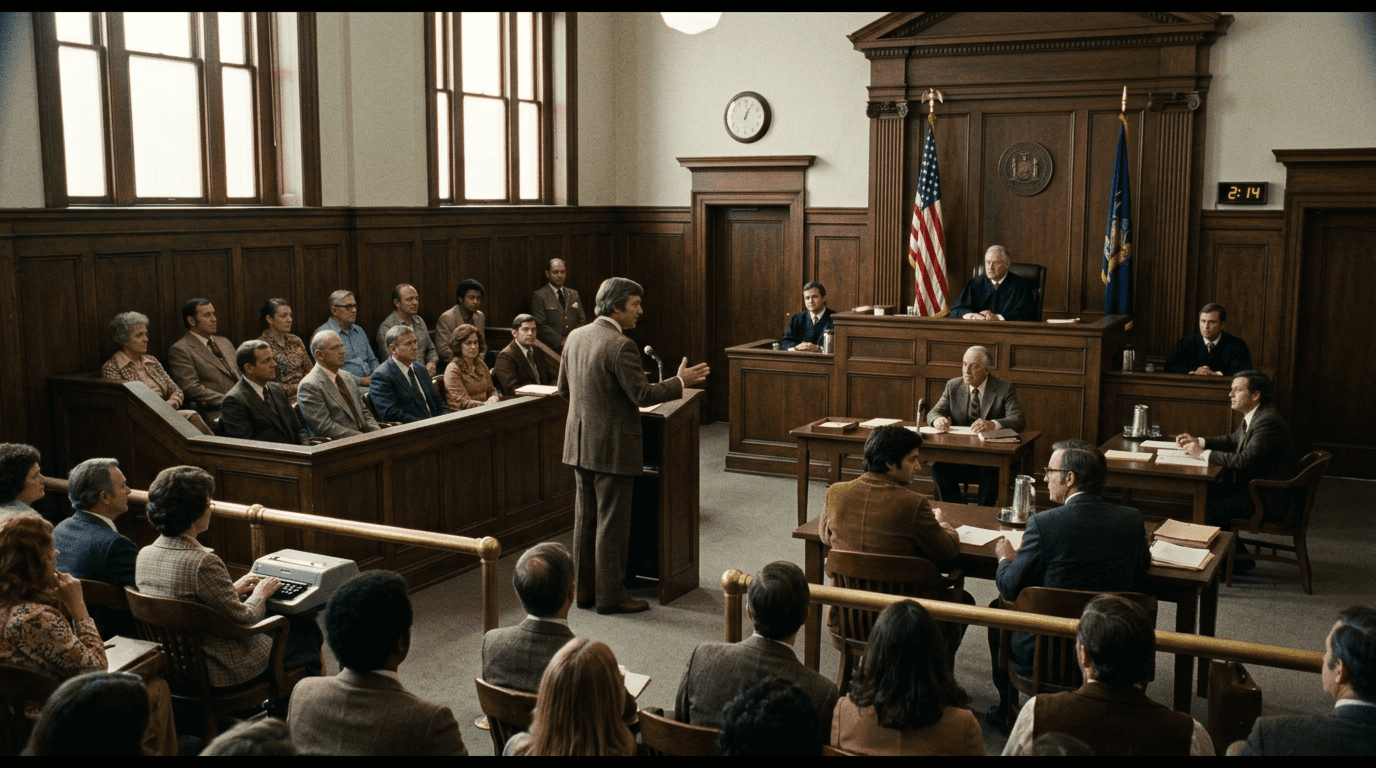

The witness says one sentence under oath.
Later, the transcript reveals they never said it.
That discrepancy can blow open your whole story.
It can also flatten your script if transcript sections read like legal paperwork pasted into a screenplay.
Courtroom transcript material is one of the easiest devices to misuse. Writers often overestimate realism and underestimate readability. They either transcribe too much and lose pace, or simplify too much and lose procedural credibility.
Here’s why that matters: transcripts inside a screenplay are not neutral evidence blobs. They are narrative instruments. They frame truth, memory, authority, and manipulation.
Think about it this way: when you insert transcript text, you are choosing what the record says and what the audience feels about the record.
This guide shows how to format transcript material so it stays legible, cinematic, and dramatically active.
Cinematic workflow frames
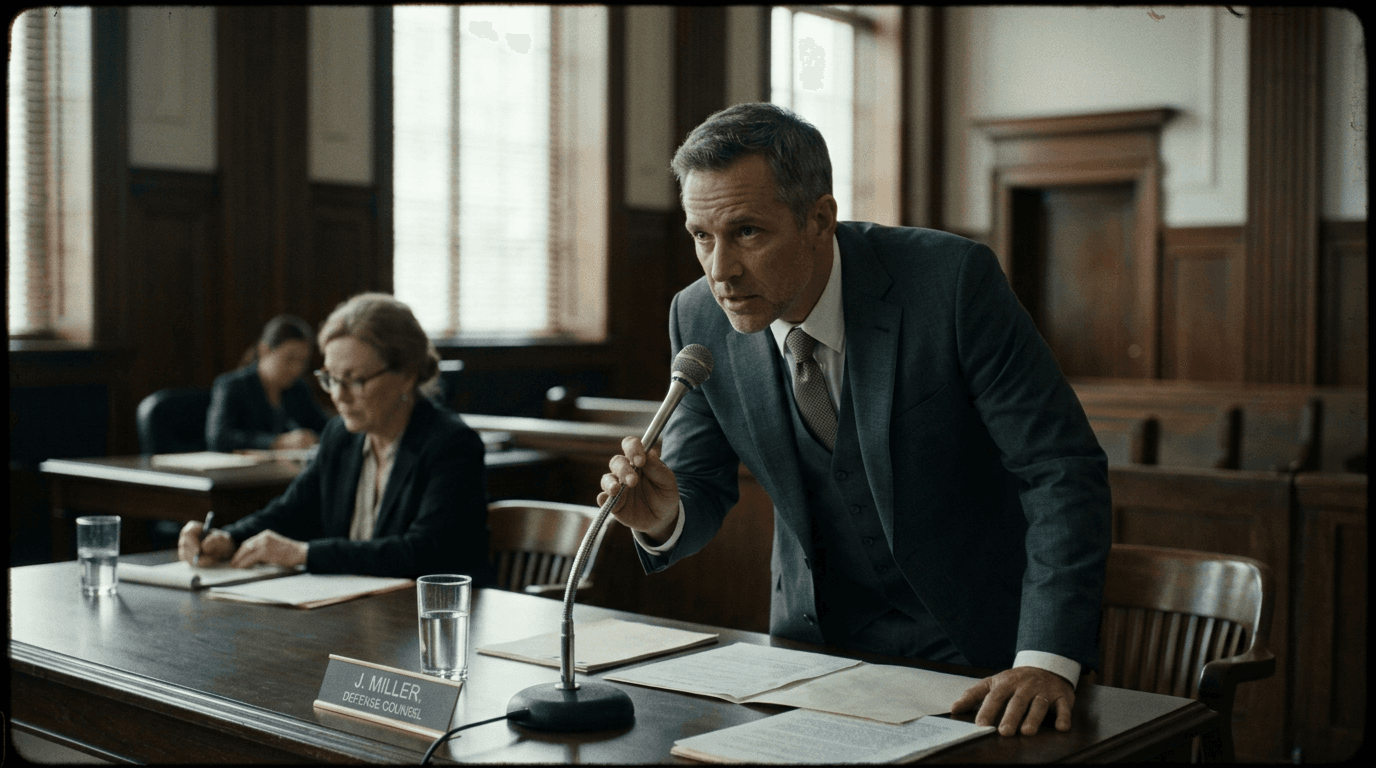
These two visuals work as a pair: the first shows Cinematic workflow still, first angle, 35mm film grain, and the second shifts to Cinematic workflow still, second angle, 35mm film grain—compare them briefly, then move on.
What “Courtroom Transcript in a Script” Usually Means
In screenplay practice, transcript material can appear in several forms:
verbatim hearing excerpts,
deposition snippets,
trial testimony read in another location,
document review scene with quoted record lines,
intercut transcript and dramatized contradiction,
voiceover reading from official transcript.
All of these require source clarity.
Reader must know whether words are live courtroom speech, retrospective record, or edited excerpt.
Transcript text should clarify evidentiary stakes, not replace scene construction.
Core Formatting Patterns That Work
Pattern 1: Document-Scoped Action Intro + Excerpt Block
Set context first:
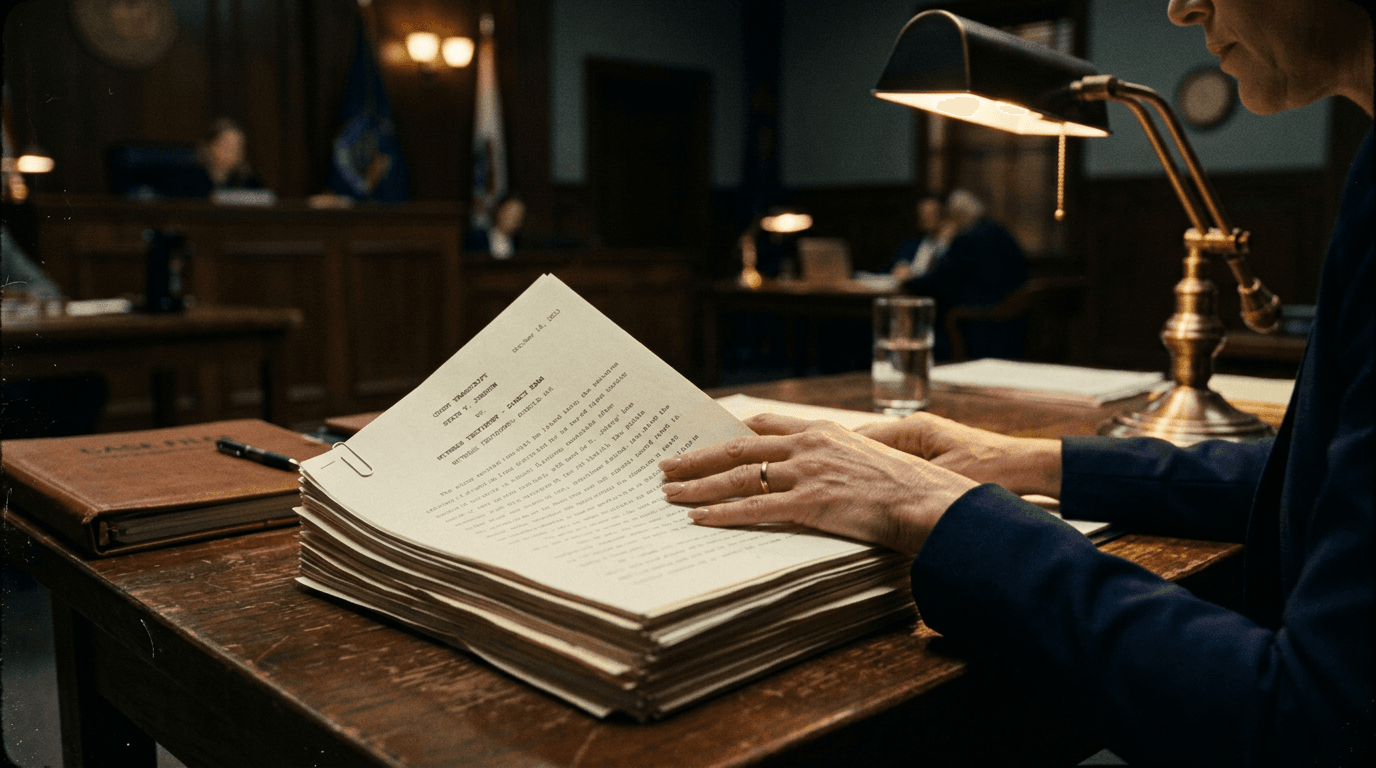
“On the page: OFFICIAL TRIAL TRANSCRIPT, DAY 14.”
Then provide concise excerpt lines with clear speaker IDs.
Pattern 2: Transcript Speaker Label Format
Use compact legal-style speaker tags only where necessary:
PROSECUTOR:
WITNESS:
THE COURT:
Avoid excessive stenographic clutter unless plot demands it.
Pattern 3: Intercut Transcript with Reactions/Contradictions
Best for drama: transcript line lands, then character reaction or contradictory visual beat reframes it.
Pattern 4: Quotation Fragments Instead of Full Blocks
In fast scenes, extract key lines rather than dumping entire exchange.
Comparison Table: Transcript Integration Choices
| Approach | Best Use Case | Strength | Risk |
|---|---|---|---|
| Full excerpt blocks | Procedural/legal-heavy scenes | Strong evidentiary authenticity | Pacing drag if overlong |
| Key-line excerpts | Narrative thrillers/dramas | Fast momentum, selective focus | Under-context if too sparse |
| Intercut record + action | Contradiction and reveal sequences | High dramatic impact | Confusion without clear source anchors |
| Voiceover from transcript | Reflective or investigative framing | Efficient exposition + mood | Feels inert if unsupported by action |
Three Beginner Scenarios That Commonly Fail
Scenario 1: The Wall-of-Transcript Scene
Writer inserts two pages of verbatim Q&A without action, stakes update, or reaction.
Result: screenplay turns into legal document.
Fix: compress transcript to lines that materially alter interpretation.
Scenario 2: The “Fake Transcript” Tone Problem
Transcript language reads like modern casual dialogue, not legal record style.
Result: credibility breaks.
Fix: adjust diction and formality while preserving readability.
Scenario 3: Contradiction Reveal With Weak Source Clarity
Scene jumps between “what happened” and “what transcript says” but reader cannot tell which is which.
Result: accidental confusion.
Fix: hard source labels + disciplined intercut markers.
Step-by-Step Workflow for Transcript Scenes
Step 1: Define Transcript Function
What is this record doing now?
confirming,
challenging,
withholding,
weaponizing,
or reframing truth.
If function is vague, transcript inclusion is likely decorative.
Step 2: Choose Scope Level
Full exchange, selected lines, or single quote?
Default to smallest scope that delivers consequence.
Step 3: Set Source Container Clearly
Before any quoted line, identify document type, context, and relevance.
Step 4: Standardize Speaker Labels
Use consistent tags across all transcript moments.
Do not drift between styles mid-script.
Step 5: Pair Every Key Transcript Beat With Story Movement
A line should trigger decision, doubt, strategy shift, or emotional turn.
No movement, no need for inclusion.
Step 6: Preserve Legal Flavor Without Overload
Use concise legal cadence and selective procedural markers.
Avoid stenography fetishism.
Step 7: Run Record-vs-Reality Pass
If script contrasts transcript and lived events, ensure each mismatch has explicit narrative purpose.
Body Image: Transcript-to-Action Impact Map
The Trench Warfare Section: What Beginners Get Wrong and Exact Fixes
Failure 1: Over-Transcription
Too much verbatim legal text.
Fix: include only consequence-driving lines.
Failure 2: No Source Cueing
Reader unsure if words are live or recorded.
Fix: explicit document/source anchors at entry.
Failure 3: Label Drift
Speaker tags inconsistent across scenes.
Fix: lock and normalize label schema.
Failure 4: Transcript as Info Dump
Record used to explain everything at once.
Fix: stagger revelations through selective excerpts.
Failure 5: Legal Flavor Missing
Transcript sounds like casual chat log.
Fix: tighten diction and formal structure lightly.
Failure 6: Legal Flavor Overload
Procedural jargon overwhelms narrative.
Fix: trim non-essential legal verbiage.
Failure 7: No Character Reaction Layer
Transcript appears, no one changes behavior.
Fix: tie record beats to immediate action shifts.
Failure 8: Contradictions Without Intent
Mismatch between record and flashback feels accidental.
Fix: define whether mismatch signals lie, error, edit bias, or memory distortion.
Failure 9: Repeated Structural Shape
Every transcript scene plays same rhythm.
Fix: vary insertion mode (quote, intercut, fragment, readout).
Failure 10: Unresolved Record Stakes
Transcript evidence introduced but never paid off.
Fix: ensure final act resolves record impact on outcome.
A transcript should increase pressure, not pause the film.
Advanced Craft: The Record as Battlefield
In courtroom narratives, the record is often treated as objective truth. Dramatically, it is closer to contested territory.
Who controls what enters record?
What gets stricken?
What is paraphrased in recap?
What is omitted from excerpts shown to public?
When you write transcript scenes with this mindset, evidence becomes active conflict.
A transcript can protect power or expose it.
It can preserve truth or bury it in procedural language.
That gives your script thematic force beyond case mechanics.
Workflow and Revision Discipline
Maintain a record ledger:
document source,
speaker,
claim,
counter-evidence,
scene consequence.
Run final search for transcript markers and label consistency.
Read transcript sections alone: do they form coherent evidentiary progression?
Then read only surrounding action: do consequences escalate?
For broad script-reference browsing, the <a href="https://imsdb.com/" rel="nofollow">IMSDb archive</a> can offer pacing comparisons, but your own source clarity and consequence mapping should govern format decisions.
As discussed in our guide on [how to format a documentary interview inside a narrative film script], mediated records work only when authority and reliability are clearly framed.
If transcript excerpts are paired with low-volume strategy conversations, cross-reference [screenplay formatting for whispered dialogue and hushed scenes] for audibility precision.
And when transcript revelations trigger split-location maneuvers, [how to show simultaneous action in two locations in a script] helps preserve chronology under pressure.
Try it free
Try Screenweaver for free on your script
It is free. Import your existing project, get a clearer view of your outline, and regain control of your story structure in minutes.
Start FreeBody Image: Record Reliability Ladder
YouTube Placeholder
[YOUTUBE VIDEO: A practical rewrite turning a dense courtroom transcript block into a cinematic sequence with selective excerpts, clear source labels, and escalating narrative impact.]
Before-and-After Micro Example
Before:
“INT. OFFICE - NIGHT
She reads the transcript.
PROSECUTOR: Where were you.
WITNESS: At home.
PROSECUTOR: Are you sure.
WITNESS: Yes.
She realizes it is important.”
Low clarity, low consequence.
After:
“INT. DEFENSE OFFICE - NIGHT
A highlighted page: OFFICIAL TRIAL TRANSCRIPT, DAY 14.
WITNESS: I was home by nine.
Mara checks the security feed timestamp on her laptop: 9:27 PM.
WITNESS: I never left the house.
Mara circles the line, then dials her investigator before the ink dries.”
Same core material.
Now transcript drives action.
Ending Perspective: Format the Record, Trigger the Turn
Courtroom transcript material can add authority and precision to your screenplay.
It can also suffocate momentum if handled like pasted legal text.
The difference is selective integration.
Clear source.
Consistent labels.
Minimal but meaningful legal flavor.
Immediate consequence after key lines.
When those pieces align, transcript scenes stop feeling documentary-heavy and start functioning as high-pressure narrative pivots.
That is where evidence becomes drama.
There is a deeper structural opportunity here that many scripts miss: transcript scenes can create dramatic tension not only through what was said, but through what the official record refuses to capture.
Court records can flatten tone.
They can omit gesture.
They can sanitize threat language into procedural phrasing.
They can lose sarcasm, fear, intimidation, and context.
That gap between lived moment and recorded wording is dramatic gold if you frame it intentionally.
For example, a transcript may show a witness answer as calm and direct, while your intercut dramatized memory reveals visible coercion, interruption pressure, or power imbalance in the room. The words are identical. The truth experience is not.
When you exploit this, transcript inserts stop being inert legal artifacts and become contested narrative territory.
Another advanced move is transcript chronology tension.
A transcript is chronological in one sense, but stories rarely reveal it chronologically. You can reorder excerpts to create discovery arcs as long as source context remains clear. Strategic ordering allows you to stage progressive reinterpretation:
first excerpt seems exculpatory,
second introduces inconsistency,
third reframes motive,
fourth reveals omission,
fifth changes legal risk entirely.
This layered reveal style keeps procedural material cinematic.
Practical Drill: Record Gap Pass
For each key transcript excerpt, write one line describing what the record cannot capture in that moment (tone, fear, coercion, physical cue, timing pressure).
Then decide whether to dramatize that gap in action around the excerpt.
If every excerpt is treated as self-sufficient truth, your hybrid potential is underused.
Practical Drill: Compression Integrity Test
Take one long transcript block and compress it to 40% length. Then verify whether legal meaning changes.
If meaning breaks, restore only the minimum lines required for legal clarity.
If meaning survives, keep compressed version.
This prevents legal verbosity from swallowing pace.
Practical Drill: Speaker Priority Mapping
Map who dominates transcript excerpts by page share: judge, prosecutor, defense, witness, clerk/record voice.
If one role dominates unintentionally, your evidentiary framing may be skewed. Rebalance where needed to reflect intended power dynamics.
Practical Drill: Consequence Delay Audit
After each transcript reveal, mark how many beats pass before a tangible consequence appears.
If delays are consistently long, transcript scenes risk feeling disconnected from narrative engine. Aim for visible reaction or strategy shift quickly, even if full payoff arrives later.
One more strategic technique is contradiction scaling by category.
Category A: factual contradiction (time, location, sequence). Category B: intent contradiction (why action occurred). Category C: identity contradiction (who knew what, when).
Escalating through categories often feels more satisfying than stacking repetitive factual mismatches.
This progression mirrors how real investigations evolve: first timeline cracks, then motive cracks, then institutional or personal accountability cracks.
Operationally, keep a transcript style key in your draft notes:
how you label transcript source,
speaker tag format,
how you denote omitted text,
how you indicate excerpts vs full record,
how you transition back to live action.
Consistency here prevents reader fatigue in complex legal narratives.
Another practical production-facing note: transcript authenticity can attract legal-savvy feedback late in development. Write with enough formal credibility to pass smell test, but keep the primary objective cinematic readability. You are not filing court documents; you are designing emotional and strategic movement.
That balance can be maintained with a simple question for each transcript insertion:
Does this line increase pressure now?
If yes, keep. If no, cut or relocate.
From a character standpoint, transcript scenes are also opportunities to reveal relationship to truth systems.
Some characters trust the record absolutely.
Some treat it as manipulated text.
Some weaponize selective quoting.
Some fear what is “on the record” more than what is true.
These stances can shape scene conflict as strongly as the evidence itself.
When you write those stances into behavior — highlighting, redacting, reading aloud, skipping lines, refusing to sign, quoting out of context — transcript material becomes active character drama.
One final sequence-level framework helps avoid repetition:
Use transcript scenes for different purposes across acts.
Act One: orientation and baseline facts. Act Two: contradiction and pressure. Act Three: accountability and irreversible consequence.
If every transcript scene performs the same function, pace dulls.
If function evolves, the record feels alive.
And that is the real craft point: courtroom transcript formatting is not about making your script look legal. It is about making legal record material emotionally legible, structurally sharp, and dramatically consequential at every insertion point.
One more sequence-level tactic can improve transcript scenes immediately: evidence cadence control.
Not every reveal should come from transcript lines. Alternate transcript evidence with physical evidence, witness behavior, and strategic interpretation errors. This prevents “record fatigue” and gives your legal material more punch when it appears.
A practical cadence model:
record line,
reaction beat,
contradicting artifact,
strategy debate,
new record line.
That pattern creates motion without reducing legal credibility.
Practical Drill: Misread Injection Test
Introduce one intentional character misread of a transcript line in a draft pass.
Then track consequences for two scenes.
If misread creates no meaningful ripple, your transcript layer may not be integrated deeply enough into decision logic.
Practical Drill: Plain-Language Echo Pass
For each key legal line, write one plain-language paraphrase in notes (not in script).
If paraphrase reveals no dramatic shift, that line may be technically accurate but narratively inert.
Only keep legal lines that survive this test.
Practical Drill: Transcript Scene Endings Audit
Ensure each transcript scene ends with one of the following:
new action plan, trust shift, legal risk increase, moral reframing, public consequence trigger.
If a scene ends on mere understanding, tension often drops.
From a production collaboration standpoint, transcript scenes also benefit from actor-director readability. Keep record inserts clean enough that performance teams can quickly identify emotional leverage points inside procedural language. Dense legal text without emotional waypoints is hard to perform and easy to flatten.
You can support this by placing one clear emotional pivot line inside each major excerpt block. Not melodrama. Just a line where power turns.
Finally, if your screenplay uses transcripts repeatedly, reserve one late-stage scene where the record itself is challenged as incomplete, biased, or strategically curated. This can prevent procedural determinism and restore human stakes at the exact moment legal machinery feels most rigid.
That move is often the difference between a competent legal narrative and one that lingers.
When the record itself becomes contested, your courtroom transcript scenes stop being documentation and start being destiny.
Final Step
Build your next script with Screenweaver
Move from ideas to production-ready pages faster with timeline-native writing and AI-assisted story flow.
Try Screenweaver