

No one speaks. The look does the work. The gesture. The way they don't look. Silence on the page isn't empty, it's built. You're not leaving a hole; you're writing the action and the beat so the reader (and the actor and the director) see what happens when the words stop. Formatting nonverbal beats clearly keeps the scene from feeling like a void and gives performance something to play. Here's how to put silence, looks, and gesture on the page without directing the actor into the ground.
Silence isn't the absence of dialogue. It's a beat with its own content. You have to write what's in the beat.
Think about it this way. In life, the pause often carries more than the line. The glance. The turn away. The thing they don't say. On the page, that has to be written. You don't write "silence." You write what happens in the silence, the look, the movement, the reaction. The action line is where that lives. You're not choreographing every blink. You're giving enough so the reader and the performer know that this moment is intentional and what it's doing. Our guide on writing for actors says to avoid directing from the page; with silence, you're describing the beat, not every micro-gesture. This piece is about how much to put in and how to format it. For scenes that are entirely or mostly silent, see writing a silent scene.
Why Silence Has to Be Written
If you leave a blank space or just write "Beat." the reader doesn't know what's in the beat. The actor doesn't know what to play. The moment becomes vague. When you write the silence, "She doesn't answer. Looks at him. Then at the door.", you've given the beat content. The reader sees the moment. The actor has something to do. The director can block it. Silence is a choice. Write the choice. Not every second of the pause. The key look, the key gesture, the key absence of response. That's enough. For subtext, the silence is often where the real meaning lands; see subtext.
Relatable Scenario: The Confrontation Where One Character Doesn't Answer
He's asked the question. The one that matters. She doesn't speak. You could write "Beat." You could write "Long pause." Better: write what she does. "She doesn't answer. Looks down. Then back at him. Something in her face gives." Now we have a beat with content. The reader sees the shift. The actor has a throughline. The silence is doing story work. For confession scenes that could be monologue or dialogue, see monologue, sometimes the power is in the silence before or after the speech.
Relatable Scenario: The Goodbye Without Words
They're at the door. Or the station. Everything that could be said has been said, or can't be said. The moment is the look. The touch. The turn away. You write the action: "She reaches for his hand. Holds it. Doesn't let go until he does." No dialogue. The silence is the beat. Format it as action. Give it its own lines so the reader and the performer feel the weight. For visual storytelling without dialogue, see silent scene.
Relatable Scenario: The Meeting Where the Reaction Is the Point
Someone delivers bad news. Or a verdict. The important beat isn't what they say next. It's the reaction, the face, the stillness, the one small movement. You write: "He doesn't move. Doesn't speak. Then his hand goes to his mouth. Slowly." The dialogue might come later. The silence is the beat we remember. Format it as action between or instead of dialogue. For emotional beats that visualize internal shift, see epiphany scene.
The Trench Warfare Section: What Beginners Get Wrong
Writing only "Beat" or "Pause." The reader doesn't know what's in the beat. Fix: Replace with a short action. What do they do? Look away? Nod? Nothing, and that's the point? "She doesn't respond." "He waits. She doesn't fill it." That's content.
Over-choreographing the silence. Every blink, every breath. The page becomes a dance notation. Fix: One to three key actions. The look. The gesture. The moment they don't speak. Leave the rest to the actor and the director. For not directing from the page, see writing for actors.
Putting silence in parentheticals. "(Pause.)" "(Looks away.)" under dialogue. Fix: Silence and reaction belong in action lines. Parentheticals are for how a line is delivered. Action is action. See writing for actors.
Using silence to avoid writing. Something should happen, a line, a decision, and you put a beat instead. Fix: If the moment needs words, write the words. Use silence when the absence of words is the point. Don't use it as a placeholder.
Forgetting that silence has length. "She looks at him." One second? Five? If the length matters, give a cue: "She looks at him. A long moment." Or "She looks at him. Doesn't look away." The reader and the director need to feel the weight. For pacing on the page, see micro-pacing.
Try it free
Try Screenweaver for free on your script
It is free. Import your existing project, get a clearer view of your outline, and regain control of your story structure in minutes.
Start FreeFormatting Silence: Where It Goes
| Element | Where it goes | Example |
|---|---|---|
| Reaction (look, gesture) | Action line | "She doesn't answer. Looks at the door." |
| Length of beat | Action line | "A long moment. She doesn't speak." |
| Silence instead of dialogue | Action line only; no dialogue block | "He waits. She says nothing. Turns and leaves." |
| Pause before/after a line | Action line before or after the dialogue | Action: "She doesn't answer." Then her line. Or her line, then action: "He waits. She doesn't add anything." |
Keep silence and reaction in action. Don't put them in parentheticals under dialogue.
Step-by-Step: Writing a Non-Verbal Beat
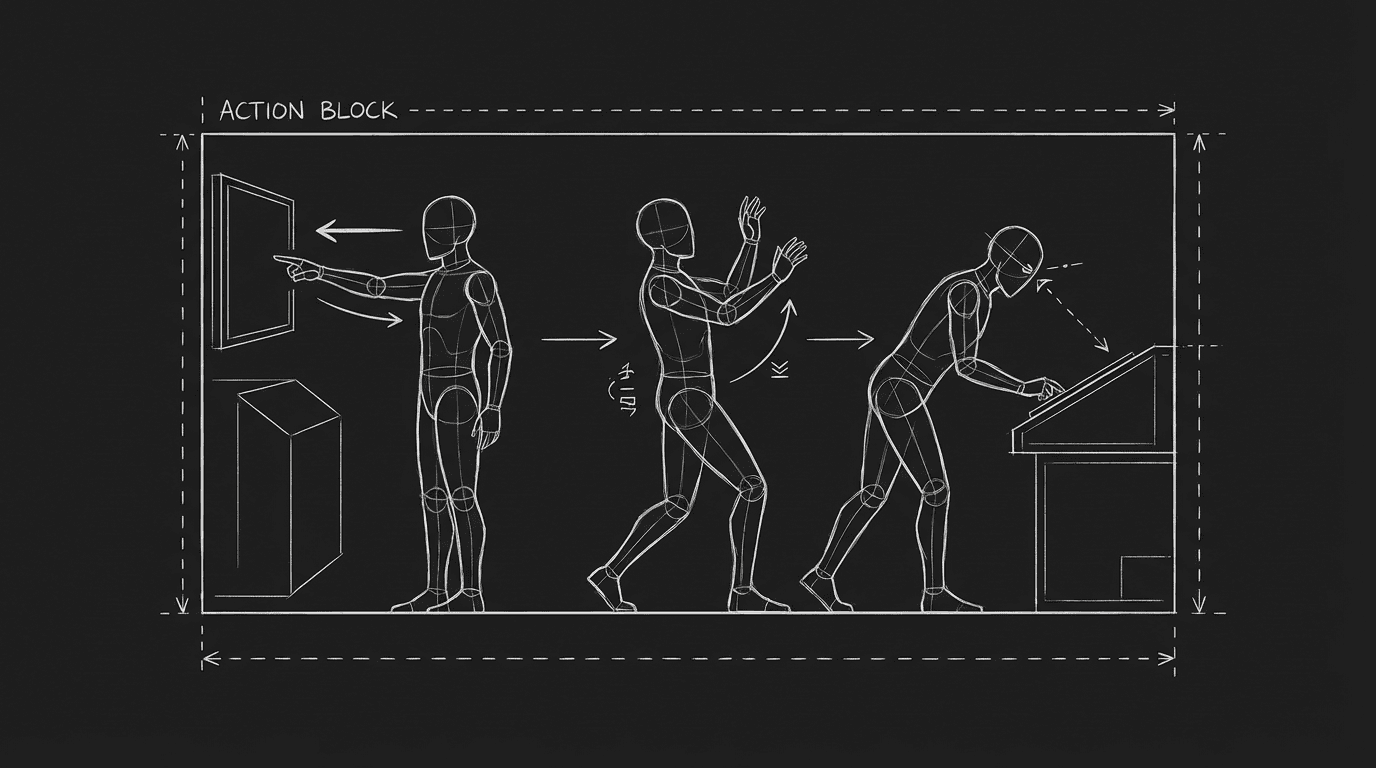
First: Decide what the silence does. What does the audience get from the beat? (Realization. Refusal. Fear. Connection.) Second: Choose one to three concrete actions. A look. A gesture. A non-response. Third: Write them as action lines. Full width. Clear. Fourth: If the length of the beat matters, add a phrase: "A long moment." "She doesn't fill it." Fifth: Read it. Can the reader see the beat? Can the actor play it? If it's vague, add one more specific action. If it's overloaded, cut. For more on action and white space, see micro-pacing. For full silent scenes, see silent scene.
[YOUTUBE VIDEO: Same scene with "Beat" vs. same scene with specific action for the silence; table read so you see what the actor plays.]
When the Whole Scene Is Silent
Sometimes there's no dialogue at all. A character alone. Two characters who don't speak. The story is in action, image, and rhythm. You're still writing it, every significant look, movement, and beat. Format is all action. No character names with dialogue. The reader and the director need to see the sequence. For building a full silent scene, see writing a silent scene.
The Perspective
Silence on the page is written. Not "Beat.", what happens in the beat. The look. The gesture. The non-response. Put it in action lines. Give the moment one to three key actions so the reader and the actor have something to play. Don't over-choreograph. Don't put silence in parentheticals. When the silence has content, the scene holds. When it's a hole, it doesn't. So write what's in the pause. Then the pause does its job.
Final Step
Build your next script with Screenweaver
Move from ideas to production-ready pages faster with timeline-native writing and AI-assisted story flow.
Try Screenweaver