

"She realizes, in this moment, that she's been wrong about everything."
Stop. How do you film "realizes"? What does wrong-about-everything look like on camera? This line tells the reader exactly what the character is thinking, but a camera can't shoot thought.
This is the unfilmable action line: description that communicates something the audience can never literally see. Internal states. Backstory. Motivation. Meaning.
The rule you've probably heard: Don't write unfilmables. If it can't be seen or heard, it shouldn't be on the page.
But the rule is wrong, or at least incomplete. Professional scripts are full of unfilmable lines. The question isn't whether to use them, but when and how.
Cinematic workflow frames
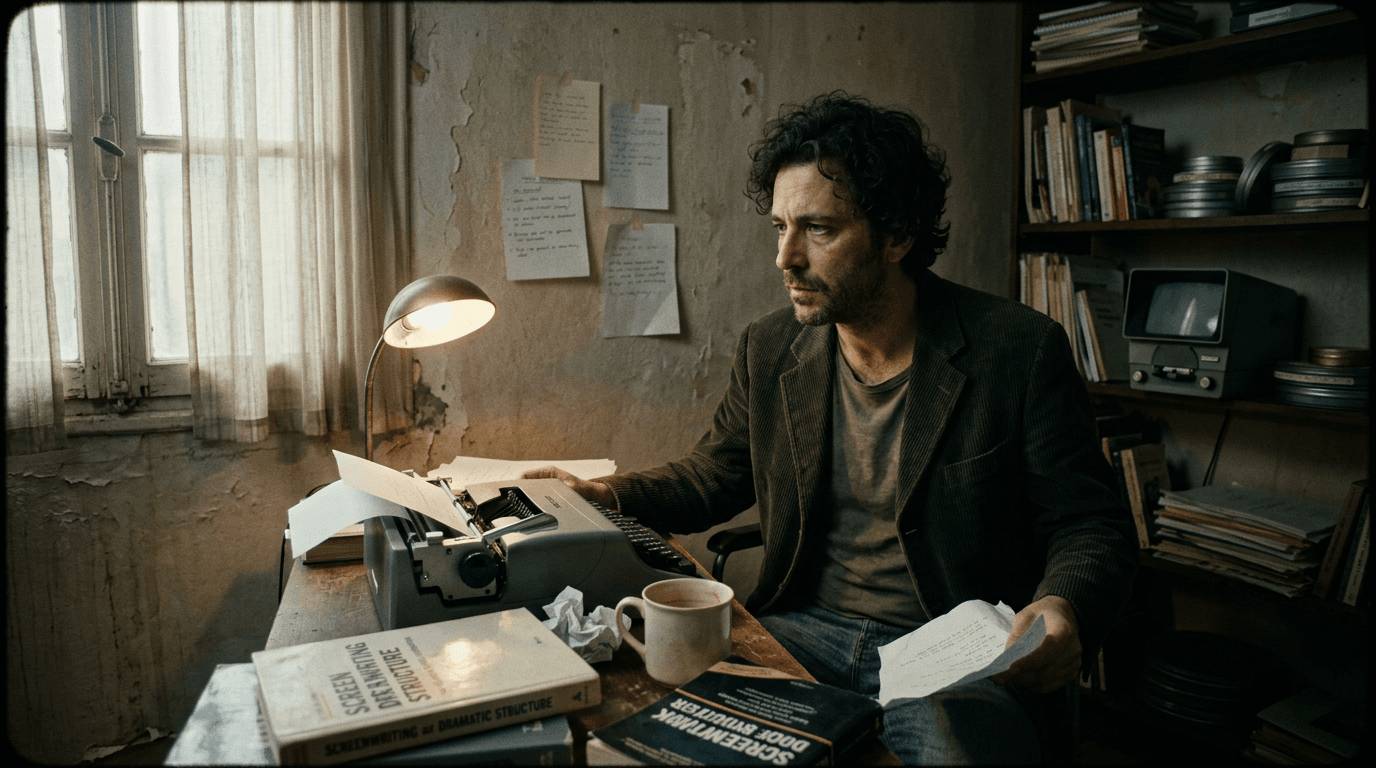
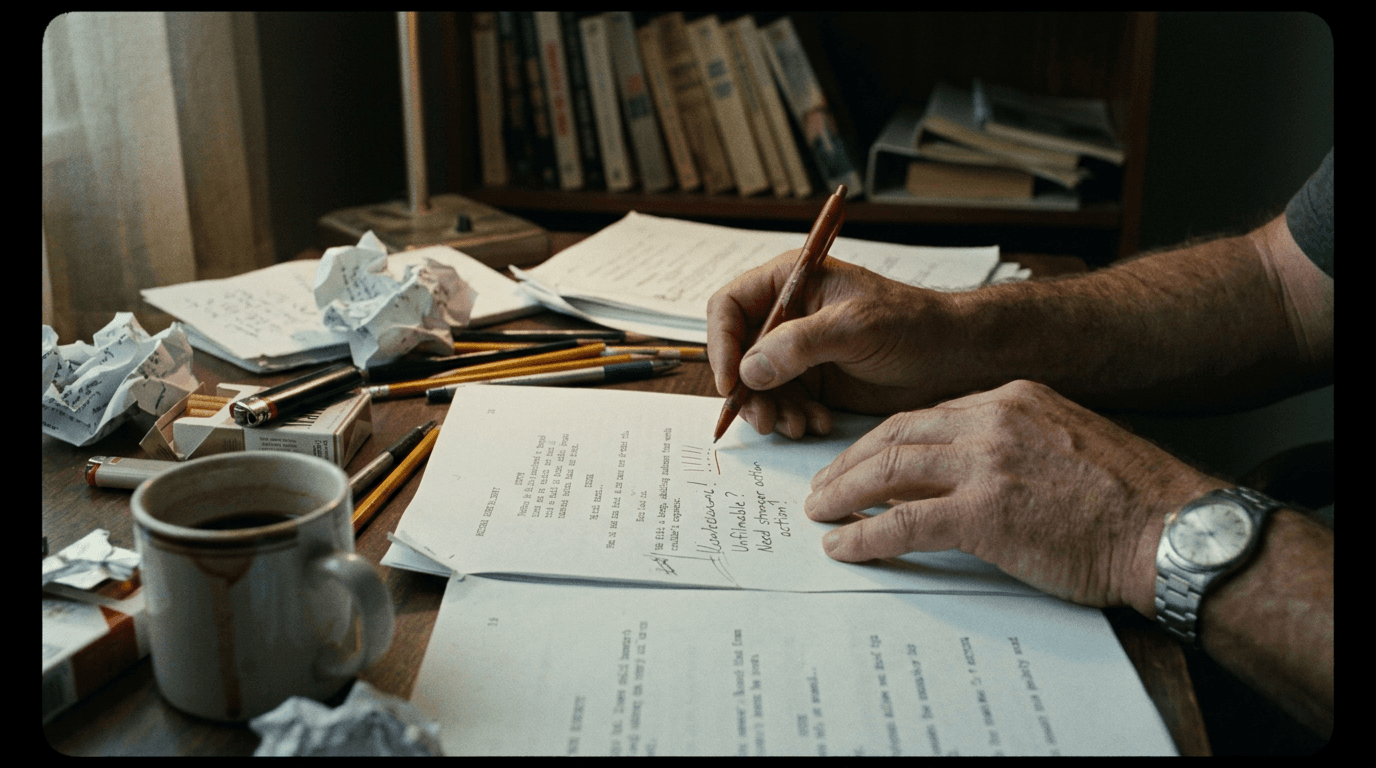
These two visuals work as a pair: the first shows Cinematic workflow still, first angle, 35mm film grain, and the second shifts to Cinematic workflow still, second angle, 35mm film grain - compare them briefly, then move on.
What Makes an Action Line "Unfilmable"?
An unfilmable action line describes something invisible:
Internal states: "She feels a pang of guilt." "He knows this is a mistake." "Terror grips her."
Backstory: "He hasn't seen his father since the divorce." "This is the car that killed her sister."
Abstractions: "Everything changes in this moment." "The weight of history presses down."
Future knowledge: "This is the last time they'll see each other." "She doesn't know it yet, but..."
Interpretation: "He's clearly lying." "She's obviously in love."
A camera records light and sound. It doesn't record emotion, history, or meaning. Those things must be performed, inferred, or understood through context.
The Case Against Unfilmables
The argument is compelling: Screenwriting is a visual medium. If you write "She realizes her mother was right," you're telling instead of showing. You're doing the director's job (deciding how to convey realization) and the actor's job (performing the internal moment). A skilled reader knows to flag this as overwriting.
There's also a practical argument: Unfilmables don't appear on screen. The reader who imagines the character's thoughts will have a different experience than the audience who sees only the actress's face. The script and the film diverge.
If you write "He thinks about Sarah," the actor can only stare. The audience sees staring. The reader saw thinking.
The Case For Unfilmables
Here's the counter-argument: Scripts are not just blueprints. They're also reading experiences. They must communicate to readers, executives, producers, actors, directors, what the final film should feel like.
A script that avoids all unfilmable lines can feel sterile. "He looks at her. He looks away." What's happening? Why should we care? The reader is left to infer, and they might infer wrong.
Professional scripts use unfilmable lines strategically:
- To clarify intent when action alone is ambiguous.
- To ensure the reader experiences the correct emotion.
- To prime the actor for what they need to convey.
- To communicate theme or meaning efficiently.
The goal isn't never using unfilmables. It's using them when they add value, and cutting them when they're redundant.
A Table: When to Use vs. Avoid Unfilmables
| Situation | Use Unfilmable? | Example |
|---|---|---|
| Action conveys emotion clearly | No | "He slams the door." (Anger is visible.) |
| Action is ambiguous | Yes | "He hesitates, does he want to stay?" (Clarify intent.) |
| Establishing backstory efficiently | Yes | "This was their mother's house." (One line replaces exposition.) |
| Telling instead of showing emotion | No | "She's sad." → Instead: "She stares at the photo, eyes wet." |
| Priming the actor for internal beat | Yes | "He realizes she's been protecting him all along." |
| Overexplaining what's visible | No | "He walks to the window, walking because he's restless." |
Technique #1: The Filmic Unfilmable
The best unfilmable lines suggest a visual even when describing something invisible.
Weak: "She feels dread."
Strong: "Dread crawls up her spine."
The second version is still unfilmable, you can't film "crawling dread", but it creates a physical sensation in the reader. It's evocative. The actor reading this knows what to play: something creeping, something bodily.
Weak: "He remembers his childhood."
Strong: "His father's voice echoes, 'You'll never be good enough.'"
The second version suggests a flashback, a sound design choice, a performance of haunting. It's filmable in spirit if not in letter.
Technique #2: The Action Bridge
Combine the unfilmable with a filmable action:
Example:
She stares at the phone. She knows she should answer. But her hand won't move.
"She knows she should answer" is unfilmable. But it's bridged by filmable action: staring at the phone, hand not moving. The reader understands the internal state through the external behavior.
The unfilmable line becomes interpretation of what we see, guidance for the reader, not replacement for the visual.
Technique #3: The Resonant Detail
When conveying backstory or meaning, attach it to something concrete:
Example:
On the wall, a faded photograph: Sarah at age eight, before the accident.
"Before the accident" is unfilmable, the camera can't show "before" anything. But it cues the reader (and potentially a set designer or director) about what this photograph means. When we see Sarah look at it, we understand her grief.
The unfilmable line adds meaning to a visible object.
Try it free
Try Screenweaver for free on your script
It is free. Import your existing project, get a clearer view of your outline, and regain control of your story structure in minutes.
Start FreeThe "Trench Warfare" Section: What Goes Wrong
Failure Mode #1: Telling When Showing Is Better
"She's angry." The actor can play anger. The reader can infer anger. The line is unnecessary.
How to Fix It: Delete it. Or, if context isn't clear, replace with specific action: "Her jaw tightens. She grips the knife."
Failure Mode #2: Interior Monologue
"He wonders if this is what love feels like. He thinks about all the times he failed, all the chances he missed, all the ways he let people down. Maybe, he thinks, it's not too late."
This is a novel, not a screenplay. We're deep in his head, and we can't film any of it.
How to Fix It: If his interiority is essential, use voiceover. Otherwise, find visual correlatives: what he looks at, how he moves, what he does.
Failure Mode #3: Redundancy
"Tears stream down her face. She's devastated."
We know she's devastated. The tears showed us.
How to Fix It: Delete the redundant line. Trust the image.
Failure Mode #4: Contradicting the Visual
"She smiles, but inside she's dying."
The line tells us to distrust the visual. That's a legitimate technique, but the actor must play both. Better:
"She smiles. It doesn't reach her eyes."
Now the contradiction is performable.
Failure Mode #5: Directing the Director
"He walks toward her, camera tracking slowly behind him, as he realizes the truth."
The "realizes" is unfilmable. But worse, "camera tracking slowly" is directorial. Cut both.
"He walks toward her. Stops. The truth hits him."
When Unfilmables Are Essential
Scene openings. A quick unfilmable can set context:
INT. PRISON VISITATION ROOM – DAY
The first time he's seen his daughter in five years.
"First time in five years" can't be filmed, but it primes everything that follows.
Character introductions. First impressions matter for readers:
MARCUS JONES (50s), the kind of cop who's seen too much and forgotten how to care.
We can't film "seen too much" or "forgotten how to care." But this line tells the reader who Marcus is, and tells the actor what to play.
Thematic emphasis. Sometimes you want the reader to understand meaning:
She burns the letter. The last connection to her old life, gone.
"Last connection to her old life" is unfilmable, but it ensures the reader feels the significance.
Professional Scripts Use Unfilmables
Look at produced scripts:
From The Social Network (Aaron Sorkin):
"Mark is a computer-programming genius with a chip on his shoulder."
You can't film "genius" or "chip on his shoulder." But the line communicates character.
From Little Miss Sunshine (Michael Arndt):
"This is a family that's forgotten how to be a family."
Entirely unfilmable. Entirely necessary for the reader.
From No Country for Old Men (Coen Brothers):
"Chigurh stares at him. Is he going to kill him? We don't know. Neither does Moss."
"We don't know" is unfilmable, it's about audience experience, but it perfectly captures the tension.
The rule isn't "never write unfilmables." The rule is "write them well."
Guidelines for Unfilmable Lines
Use them to clarify, not replace. An unfilmable should add meaning to a visual, not substitute for one.
Keep them short. A quick phrase works; a paragraph of internal thought doesn't.
Make them evocative. Even if unfilmable, they should create sensation: "Dread crawls" is better than "She feels dread."
Delete them if redundant. If the action already conveys the emotion, the unfilmable adds nothing.
Trust the reader sometimes. Not every moment needs interpretation. Some silences speak for themselves.
The Perspective: Writing Between the Lines
Screenwriting is a medium of implication. The camera shows surfaces; meaning lives beneath. The unfilmable action line is the writer's way of pointing to depth, saying, "Here's what this moment means. Here's what's really happening."
Used badly, unfilmables are crutches: avoiding the hard work of finding visual correlatives for internal states. Used well, they're essential tools: guiding the reader's experience, priming the actor's performance, ensuring the story's emotional truth survives the transition from page to screen.
The goal isn't to write only what's filmable. The goal is to write so well that even the unfilmable becomes vivid, to create a script that feels like a movie, even when it describes things a camera cannot see.
That's the craft: writing between the lines.
[YOUTUBE VIDEO: A screenwriting teacher analyzing professional scripts, identifying unfilmable lines and explaining why they work despite breaking the "rule."]
Further reading:
- For guidance on character introductions, see introducing a character: writing descriptions that attract A-list actors.
- If you're balancing action with visual storytelling, see the oner: describing a continuous shot without clutter.
- The Academy's Screenwriters Lecture series features discussions on craft at youtube.com/@BAFTA{:rel="nofollow"}.
Final Step
Build your next script with Screenweaver
Move from ideas to production-ready pages faster with timeline-native writing and AI-assisted story flow.
Try Screenweaver