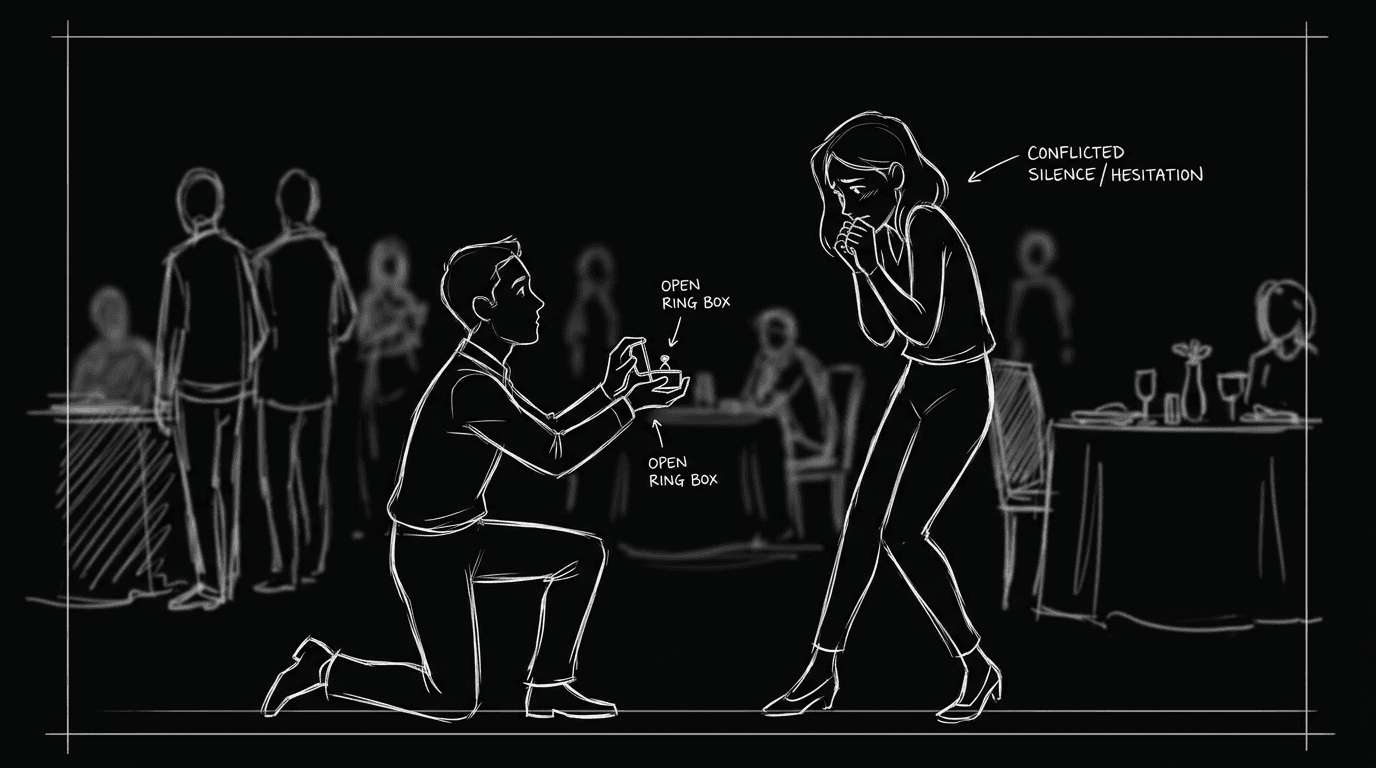

A failed proposal scene can destroy a romantic drama in two pages.
Or save it.
Most writers understand how to stage a proposal. Not many know how to stage a proposal that fails without turning the scene into melodrama, humiliation porn, or generic heartbreak dialogue.
That is the craft challenge.
A failed proposal is not just a "no." It is the collapse of a future timeline two people have been living in, often at different speeds, with different assumptions, and different levels of honesty about what marriage means to them.
If you write it as shock alone, it feels cheap.
If you write it as structural truth arriving late, it feels devastating.
Here is why that matters: in romantic drama, proposal scenes are often treated as climax markers. A failed proposal can become the real midpoint or late-turn engine, because it forces both characters to confront what they were performing versus what they were actually willing to build.
Why Failed Proposal Scenes Feel Cliche
Weak scenes usually fail in predictable ways.
They rely on public embarrassment as the only tension source. They make one person clearly "right" and the other clearly "villainous." They skip relational setup and treat rejection as twist gimmick. Or they flood the scene with speeches that explain everything in polished emotional language nobody would deliver in that moment.
Another common mistake is pace collapse after the "no." The scene peaks at rejection and then drifts because writers do not know what action follows.
Think about it this way: if rejection is the endpoint, your scene is short-term drama. If rejection triggers new terms of relationship, identity, and future planning, your scene becomes story architecture.
A failed proposal scene should not answer whether they love each other. It should reveal whether their definitions of love can survive reality.
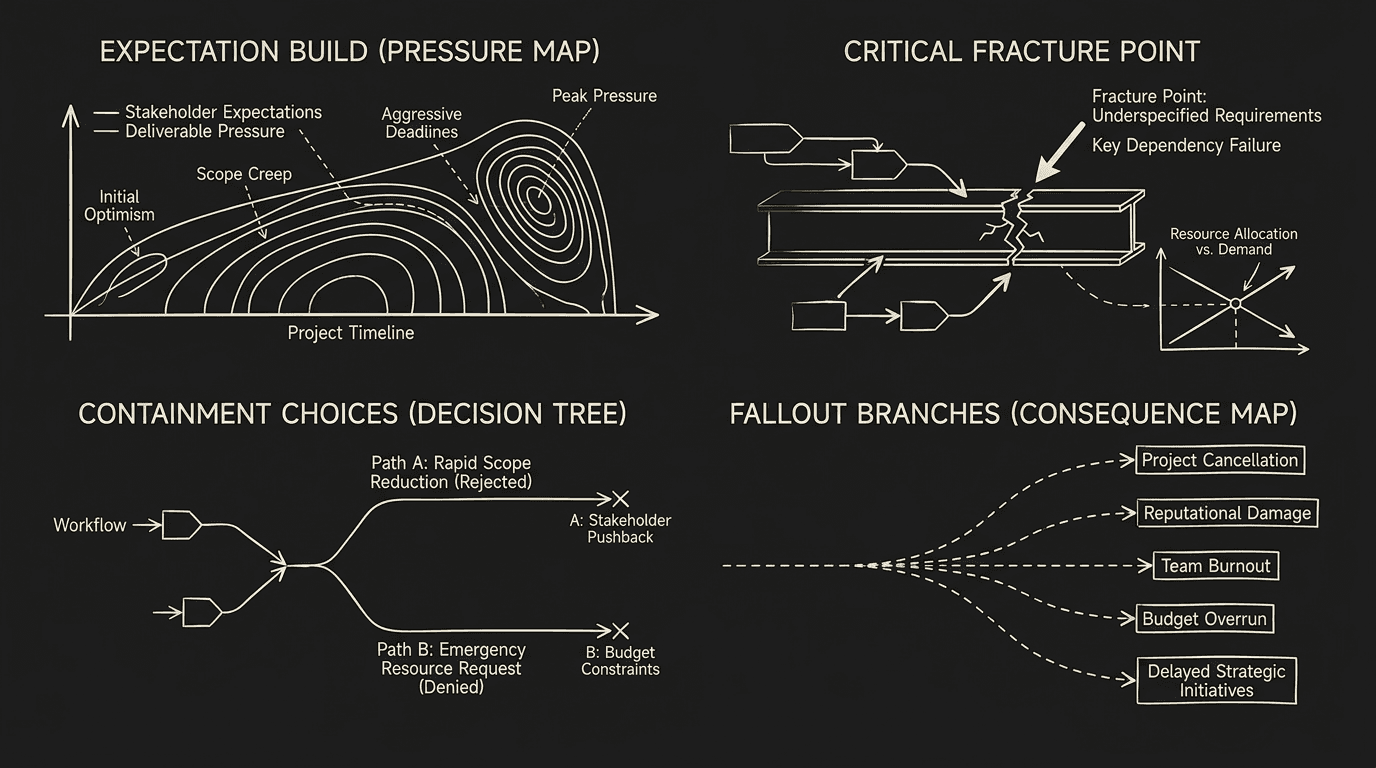
The Core Model: Expectation, Fracture, Containment, Truth, Repositioning
Strong failed-proposal scenes move through five phases.
Expectation: one or both characters enter with proposal-adjacent anticipation.
Fracture: proposal attempt meets refusal, hesitation, deflection, or conditional acceptance that functions as refusal.
Containment: social and emotional damage control in real time.
Truth: core relational mismatch surfaces.
Repositioning: characters define what happens next, explicitly or implicitly.
If you skip Containment, scene becomes cartoon explosion.
If you skip Truth, rejection feels arbitrary.
If you skip Repositioning, scene has no forward force.
Scenario One: The Public Proposal in a Restaurant
Beginner version: proposer kneels, target says "I cannot," crowd gasps, proposer runs out.
It plays loud.
It rarely plays deep.
A stronger version writes public space as pressure system, not spectacle.
Who notices first?
Who keeps pretending not to notice?
Does the rejector choose private dignity over immediate truth to protect proposer?
Does proposer force public answer to avoid private complexity?
Maybe the rejector says "not here" and proposer pushes for yes/no now. That push reveals control dynamics more than rejection itself.
Now the scene is about power, not just embarrassment.
Scenario Two: The Private Proposal That Fails Quietly
Quiet proposal failures can be even more painful if written precisely.
One character proposes at home, maybe after an ordinary day, expecting safety. The other freezes, asks one practical question, and everything changes.
No screaming.
No thrown objects.
Just incompatible futures becoming audible.
In these scenes, micro-behavior carries weight: ring box left open too long, unanswered question, one person cleaning up dishes while the other waits, delayed eye contact.
This is where restrained writing beats big speeches.
Scenario Three: The "Yes" That Is Actually a No
An underused but powerful version is the false acceptance.
Character says yes under social pressure, then unravels privately. Or says yes with conditions that reveal non-consent. Or postpones indefinitely while pretending commitment.
This can be dramatically richer than immediate rejection if you design consequences carefully.
A "yes" that fails later can expose conflict about fear, class, family, timing, trauma, and trust in layered ways.
Step-by-Step Workflow for Writing Failed Proposal Scenes That Matter
Step 1: Define Each Character's Marriage Narrative
Before scene writing, define what marriage means to each person in this story.
Security?
Identity?
Faith?
Status?
Family repair?
Fear of entrapment?
Without this, rejection can feel superficial.
Step 2: Plant Proposal Mismatch Before the Scene
Do not surprise audience with mismatch out of nowhere.
Seed differences in timing, communication, money, family planning, career location, or conflict style.
The failed proposal should feel shocking in the moment and inevitable in hindsight.
Step 3: Choose Pressure Context Intentionally
Public context amplifies reputation and performance pressure.
Private context amplifies intimacy and honesty pressure.
Family context amplifies duty pressure.
Pick context based on which pressure axis you need to expose.
Step 4: Write Rejection Language in Character Voice
Avoid generic lines like "It is not you, it is me."
Write refusal through each character's emotional grammar.
Some people soften, some over-explain, some go procedural, some shut down, some ask for time, some over-apologize.
Voice specificity prevents cliche fast.
Step 5: Stage Immediate Containment Choices
After refusal, what does each person do first?
Close ring box?
Ask to leave?
Call a friend?
Pay bill?
Move to another room?
Containment behavior reveals maturity, control, and fear.
Step 6: Force One Uncomfortable Truth Beat
Do not let scene end at surface politeness.
Include one line or action exposing the actual mismatch:
trust gap,
life-plan incompatibility,
unresolved betrayal,
emotional timing asymmetry.
This beat gives scene thematic weight.
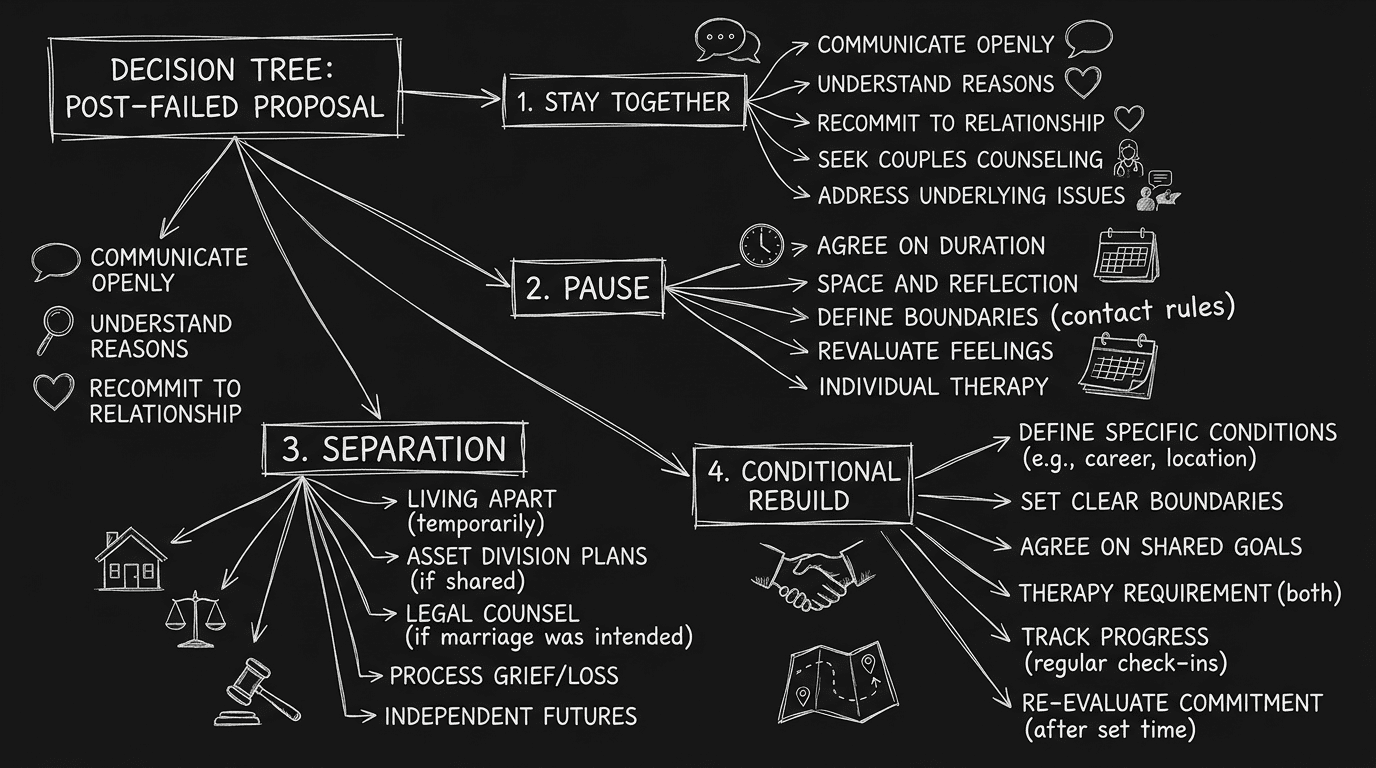
Step 7: End with Repositioning, Not Emotional Fog
Who sleeps where tonight?
Do they tell family?
Is ring returned immediately?
Do they stay together conditionally?
Do they pause relationship?
Define new state clearly so next scene has traction.
Table: Melodramatic Proposal Failure vs Dramatically Earned Failure
| Dimension | Melodramatic Version | Dramatically Earned Version |
|---|---|---|
| Setup | Sudden mismatch twist | Seeded relational fault lines |
| Rejection | Generic speech line | Character-specific refusal language |
| Conflict source | Public embarrassment only | Value, timing, and trust incompatibility |
| After beat | Emotional chaos only | Containment and repositioning decisions |
| Arc function | Shock moment | Relationship and plot pivot |
| Audience effect | Sympathy spike then fade | Lingering moral and emotional complexity |
The Trench Warfare Section: What Beginners Get Wrong (and How to Fix It)
This section is direct because these errors are common.
Mistake one: rejection with no prior groundwork.
Fix by planting mismatch cues in earlier scenes.
Mistake two: one-sided moral framing.
Fix by giving both characters defensible stakes, even if one hurts more.
Mistake three: public humiliation as substitute for depth.
Fix by writing internal conflict and decision logic, not just crowd reaction.
Mistake four: generic refusal dialogue.
Fix with voice-accurate, situation-specific language.
Mistake five: no immediate practical consequence.
Fix by scripting concrete post-scene logistics.
Mistake six: too much crying, no decision.
Fix by ending on repositioning action.
Mistake seven: proposer written as naive fool.
Fix by making proposal attempt emotionally coherent from their viewpoint.
Mistake eight: rejector written as cold villain.
Fix by showing cost of refusal and moral burden.
Mistake nine: scene ends at "no."
Fix by adding truth beat and boundary setting.
Mistake ten: no social context repercussions.
Fix by tracking who knew about proposal and how narrative spreads.
Mistake eleven: no asymmetry in processing speed.
Fix by writing different emotional tempos for each character.
Mistake twelve: fake reconciliation one scene later.
Fix by honoring residue and trust damage.
Mistake thirteen: ring as prop only.
Fix by giving ring symbolic and practical function in aftermath.
Mistake fourteen: no theme integration.
Fix by tying failure to story's core question about commitment, identity, or freedom.
Mistake fifteen: no support-character pressure.
Fix with family/friend expectations influencing choices.
Mistake sixteen: timing incoherence.
Fix by clarifying why proposal happened now and why refusal happened now.
Mistake seventeen: all dialogue, no behavior.
Fix with high-signal actions that carry emotional truth.
Mistake eighteen: no boundary language.
Fix by making post-failure terms explicit.
Mistake nineteen: refusal treated as final answer forever.
Fix by distinguishing "not now," "not like this," and "not with you" where appropriate.
Mistake twenty: scene ignored in subsequent arc.
Fix by ensuring failed proposal reshapes future decisions.
The most powerful failed proposal scenes hurt because both people are understandable and both futures cannot coexist.
Try it free
Try Screenweaver for free on your script
It is free. Import your existing project, get a clearer view of your outline, and regain control of your story structure in minutes.
Start FreeBody Image: Proposal Failure Pressure Map
Practical 50-Minute Rewrite Drill
Take your current failed proposal scene and run this pass.
First ten minutes: identify and cut generic romance lines.
Next ten minutes: rewrite refusal language in each character's authentic voice.
Next ten minutes: add one truth beat revealing core mismatch.
Next ten minutes: script immediate logistical repositioning.
Final ten minutes: add one aftermath bridge in next scene proving consequence.
This drill usually converts sentimental shock into durable drama.
Advanced Calibration: Writing Refusal Without Character Assassination
In romantic drama, audiences often punish the character who says no unless writing distributes empathy carefully.
Do this through cost visibility.
Show what refusal costs the rejector emotionally and socially. Show what proposal costs the proposer if accepted without alignment. Let audience feel that this is not hero vs villain but timing, readiness, and values collision.
Another technique is refusal precision.
"No" can mean many things:
no to public pressure,
no to current version of relationship,
no to unresolved betrayal,
no to losing self,
or no to this person entirely.
Write which no it is.
For external script study, the Writers Guild Foundation Library is useful and should be treated as nofollow in publishing workflows.
As discussed in our guide on [how to write a breakup scene that does not feel cliche], emotional scenes strengthen when objective conflict is explicit.
If proposal failure is witnessed socially, the framework in [how to write a public humiliation scene in a screenplay] helps stage reputational fallout.
And if the failed proposal leads to endgame collision, our approach in [how to write a final confrontation scene that feels earned] supports payoff structure.
Body Image: Repositioning Decision Tree
YouTube Placeholder
[YOUTUBE VIDEO: A rewrite workshop turning a cliché public proposal rejection into a layered romantic-drama scene with clear mismatch, containment, and aftermath consequences.]
Extra Deep Dive: Ring Symbolism, Object Choreography, and Memory Debt
In failed proposal scenes, the ring is not just a prop.
It is a live symbol loaded with projection: promise, control, timing, class expectation, family pressure, and personal fantasy. How characters handle the ring in the seconds after refusal can carry more story truth than a full paragraph of dialogue.
Consider these object choreography variants:
ring immediately closed and pocketed,
ring left open on table as silent pressure,
ring handed over but not accepted,
ring set down between both characters like disputed territory,
ring forgotten in panic and discovered later.
Each option implies different emotional and strategic states.
Another powerful technique is memory debt activation.
Proposal scenes often carry deferred promises from earlier acts: "when this project is over," "when we move back," "when your mother recovers," "when I can trust you again."
A failed proposal can activate debt lines. One character may frame refusal as broken promise; the other may frame proposal timing as debt collection under emotional coercion.
Write this carefully and the scene becomes about accountability, not just heartbreak.
Scenario Layer: Family-Influenced Proposal Failure
Suppose a proposal fails during a family gathering where both sets of parents expect an engagement announcement.
Weak version focuses on embarrassment.
Stronger version tracks political pressure:
who intervenes first,
who reframes refusal publicly,
who weaponizes "tradition,"
who quietly protects autonomy.
Now the failed proposal exposes not only couple mismatch but intergenerational power architecture.
This gives your romantic drama social scale.
Writing the "Not Yet" Refusal Without Softening Stakes
"Not yet" is hard to write because it can sound evasive.
To make it dramatic, attach conditions and cost:
what must change,
how long it might take,
what happens if conditions are unmet.
Conditional refusal becomes meaningful when it forces behavior now, not vague hope later.
Dialogue Compression Pass for Emotional Credibility
If your proposal-failure dialogue sounds speechy, use this compression method:
keep one sentence of intent,
one sentence of fear,
one sentence of boundary.
Cut repeats.
Then add one action beat after each sentence.
This pattern often yields cleaner, more believable emotional writing.
Designing Aftermath Scenes That Do Not Undo Impact
Many scripts weaken failed proposal scenes by following them with fast, sentimental patch-ups.
Protect impact by designing aftermath in layers:
immediate logistics (where each person goes),
social narrative management (what others are told),
private emotional processing (what each person admits internally),
strategic next step (what each person does because of the failure).
When aftermath layers are clear, the failed proposal becomes a true structural turn.
Extended Craft Layer: Public vs Private Failure Versions
One advanced design choice is writing two versions of the same failure:
the public version characters perform,
and the private version they cannot sustain.
In public, people often default to narrative management:
"We are taking things slow."
"Bad timing."
"We want to keep this between us."
In private, the language is usually sharper, stranger, and more revealing.
This dual-version approach adds realism and lets you explore how love stories are mediated by social pressure.
A useful structure is split-scene aftermath:
micro-public containment beat immediately after refusal,
followed by private confrontation where truth cost becomes explicit.
You can do this in one continuous sequence or across scenes, but the distinction should be intentional.
Practical Public-Private Contrast Exercise
Write six lines of what each character says publicly.
Then write six lines of what they would say if no one else existed.
Compare the gap.
That gap is your subtext engine for revisions.
Timing and Narrative Placement
Failed proposal scenes can serve different structural functions:
midpoint disruption,
late-act collapse,
false-ending inversion.
Placement changes interpretation.
At midpoint, failure can trigger growth arc.
Late in story, failure can test whether growth actually happened.
Near ending, failure can challenge audience assumptions about "romantic payoff" and force a more honest resolution.
Choose placement based on what your story needs emotionally and thematically, not based on expected genre formula.
Ending Perspective: A Failed Proposal Is a Future Negotiation, Not a Punchline
If your failed proposal scene feels cliche, the fix is not bigger emotion.
It is better structure.
Clarify what each person thought this moment meant.
Expose why those meanings diverge.
Force a truth neither can avoid.
Then lock a new relational state with practical consequences.
Do this, and your scene stops being a viral-style embarrassment beat.
It becomes what great romantic drama does best: two people loving each other in ways that are still not enough yet, and choosing what to do with that impossible truth.
Final Step
Build your next script with Screenweaver
Move from ideas to production-ready pages faster with timeline-native writing and AI-assisted story flow.
Try Screenweaver