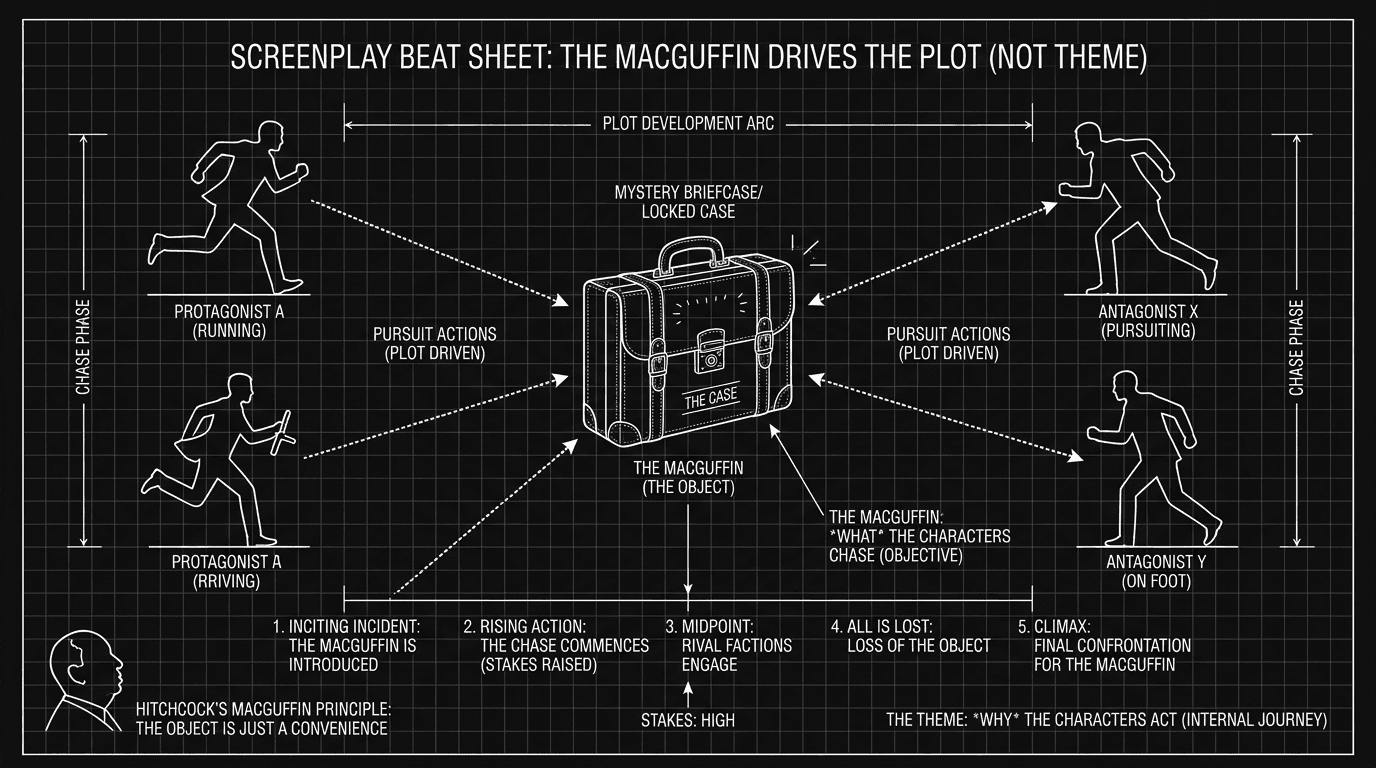

Alfred Hitchcock explained it simply: "The MacGuffin is the thing the characters care about, but the audience doesn't."
The stolen government secrets. The glowing briefcase. The Maltese Falcon. The One Ring. The Infinity Stones. These objects drive plots, motivate characters, and create conflict, but what they are often matters less than what they do to the story.
The MacGuffin is one of storytelling's most useful (and most misunderstood) tools. Done well, it creates urgency and stakes without getting in the way of character. Done poorly, it becomes either irrelevant (why do we care?) or overexplained (now we care too much about the wrong thing).
This guide explores how to write MacGuffins that work: objects, secrets, or goals that motivate your characters while serving your story.
Cinematic workflow frames

These two visuals work as a pair: the first shows Cinematic workflow still, first angle, 35mm film grain, and the second shifts to Cinematic workflow still, second angle, 35mm film grain - compare them briefly, then move on.
What Is a MacGuffin?
The term comes from Alfred Hitchcock, though the concept is ancient. A MacGuffin is:
An object, goal, or piece of information that characters pursue.
The engine of plot that creates conflict and drives action.
Interchangeable in content but not in function. The specific MacGuffin could be different, what matters is that characters want it.
Hitchcock's example: In a spy film, the MacGuffin might be "the government secrets." It doesn't matter what the secrets are. What matters is that everyone wants them, some will kill for them, and our hero is caught in the middle.
MacGuffin vs. Meaningful Object
Not every important object is a MacGuffin:
MacGuffin: The stolen microfilm. What's on it? Who cares. Everyone's chasing it.
Meaningful Object: The protagonist's father's watch. What it is matters; it represents legacy, love, time.
The distinction: A MacGuffin is about function (driving plot). A meaningful object is about meaning (deepening theme or character).
Some objects are both. The One Ring in Lord of the Rings drives the plot (everyone wants it) AND has thematic weight (corruption, power, temptation). This hybrid is powerful when executed well.
A Table: MacGuffin Examples Across Genres
| Film/Story | MacGuffin | What It Actually Is | Why It Works |
|---|---|---|---|
| Pulp Fiction | The briefcase | Never explained | Mystery enhances mystique |
| The Maltese Falcon | The statue | A jewel-encrusted falcon | Characters' obsession drives drama |
| North by Northwest | Government secrets | Never detailed | Plot moves fast; details would slow it |
| Raiders of the Lost Ark | The Ark | Biblical artifact | Explained enough to justify pursuit |
| Avengers: Infinity War | Infinity Stones | Cosmic power objects | Detailed because they're used in the plot |
Hitchcock's Rules for MacGuffins
Rule 1: The characters must care deeply.
Even if the audience doesn't care about the MacGuffin itself, they care about characters who care. The villain's desperation, the hero's sacrifice, these emotions come from pursuing the MacGuffin.
Rule 2: The audience doesn't need to care about the content.
"What are the government secrets?" doesn't matter. "Will the hero survive getting them?" does.
Rule 3: Keep it simple.
Complex MacGuffins require explanation. Explanation slows the story. The best MacGuffins are graspable in a sentence: "the stolen diamonds," "the microfilm," "the briefcase."
Rule 4: It can be anything, but not nothing.
The MacGuffin must exist. Characters can't chase nothing. But what it is can be arbitrary, as long as the pursuit is real.
When to Explain the MacGuffin
Explain when the MacGuffin has consequences that matter:
If the MacGuffin will be used in the story, not just retrieved, the audience needs to understand it. The Infinity Stones must be explained because Thanos actually uses them.
Don't explain when the pursuit is everything:
If the MacGuffin is simply the goal, get it before the bad guy, explanation is unnecessary. We don't need to know what's in the briefcase in Pulp Fiction because no one opens it with narrative consequence.
The test: Ask: "Would the story change if this were a different object?" If yes, explain it. If no, don't.
The "Trench Warfare" Section: What Goes Wrong
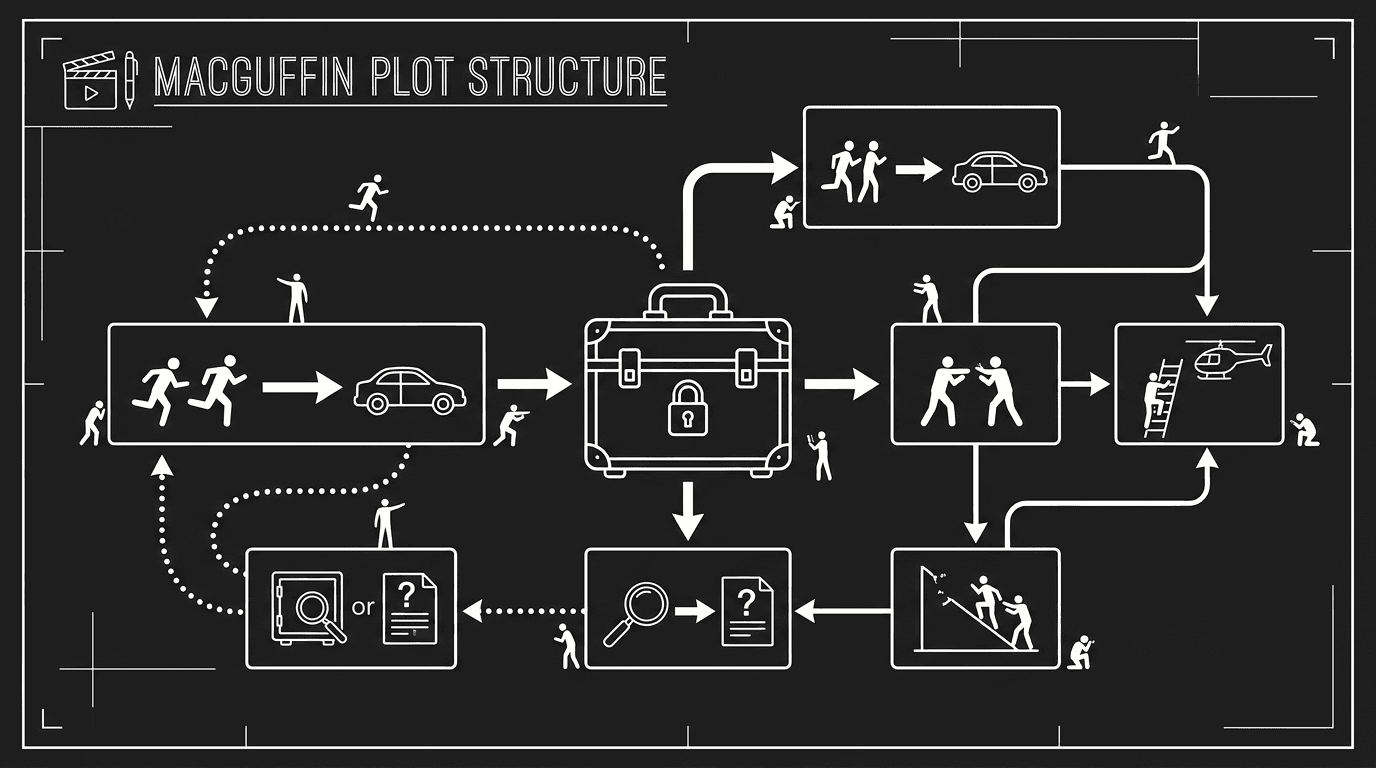
Failure Mode #1: The MacGuffin Is Too Complicated
The script spends three scenes explaining the technical properties of the quantum device. The audience's eyes glaze.
How to Fix It: Simplify. "It's a weapon that could destroy cities." That's enough. Let the pursuit carry the weight.
Failure Mode #2: Nobody Seems to Want It
The MacGuffin exists, but the characters don't urgently pursue it. The villain could get it anytime; the hero's not rushing. Stakes collapse.
How to Fix It: Create urgency. Deadline. Competition. Consequence for failure. The MacGuffin should be contested.
Failure Mode #3: The MacGuffin Disappears
The first act establishes the chase; by the third act, the MacGuffin is forgotten. The story drifts to something else.
How to Fix It: Keep the MacGuffin in play throughout. Even if the final confrontation is about character, the MacGuffin should be present or resolved.
Failure Mode #4: The MacGuffin Overshadows Character
The story becomes so focused on the object that characters feel like delivery mechanisms. No arcs, no depth.
How to Fix It: The MacGuffin is scaffolding, not the building. Character change, relationship, theme, these are the story. The MacGuffin creates pressure; it shouldn't replace substance.
Failure Mode #5: The Audience Knows Too Much
The MacGuffin is explained so thoroughly that the audience starts poking holes. "Wait, why don't they just...?"
How to Fix It: Less detail = fewer logic problems. Mystery protects MacGuffins from scrutiny.
Try it free
Try Screenweaver for free on your script
It is free. Import your existing project, get a clearer view of your outline, and regain control of your story structure in minutes.
Start FreeCreating Effective MacGuffins
Make it visual. The best MacGuffins are objects: a briefcase, a statue, a glowing orb. Visual MacGuffins photograph well and are instantly graspable.
Make it unique. There's only one Maltese Falcon. Scarcity creates stakes.
Make it desired by multiple parties. The hero wants it. The villain wants it. Maybe a third party wants it. Conflict comes from competition.
Make retrieval difficult. The MacGuffin shouldn't be easy to get. Obstacles, locations, guardians, the pursuit is the story.
Consider its absence. What happens if no one gets it? If the answer is "nothing much," the MacGuffin isn't strong enough.
The Anti-MacGuffin: When the Object Matters
Sometimes the story is about the object:
Citizen Kane: "Rosebud" isn't a MacGuffin, it's the thematic answer to the entire film.
The Lord of the Rings: The Ring isn't just a MacGuffin; it corrupts, tempts, and defines characters.
Toy Story: Woody isn't chasing an arbitrary object; the relationship with Buzz and Andy is the point.
In these cases, the object has meaning beyond function. It isn't interchangeable. The story couldn't work with a different object.
Know which you're writing. If your object needs meaning, give it meaning. If it's a MacGuffin, let it be one.
Case Study: The Briefcase in Pulp Fiction
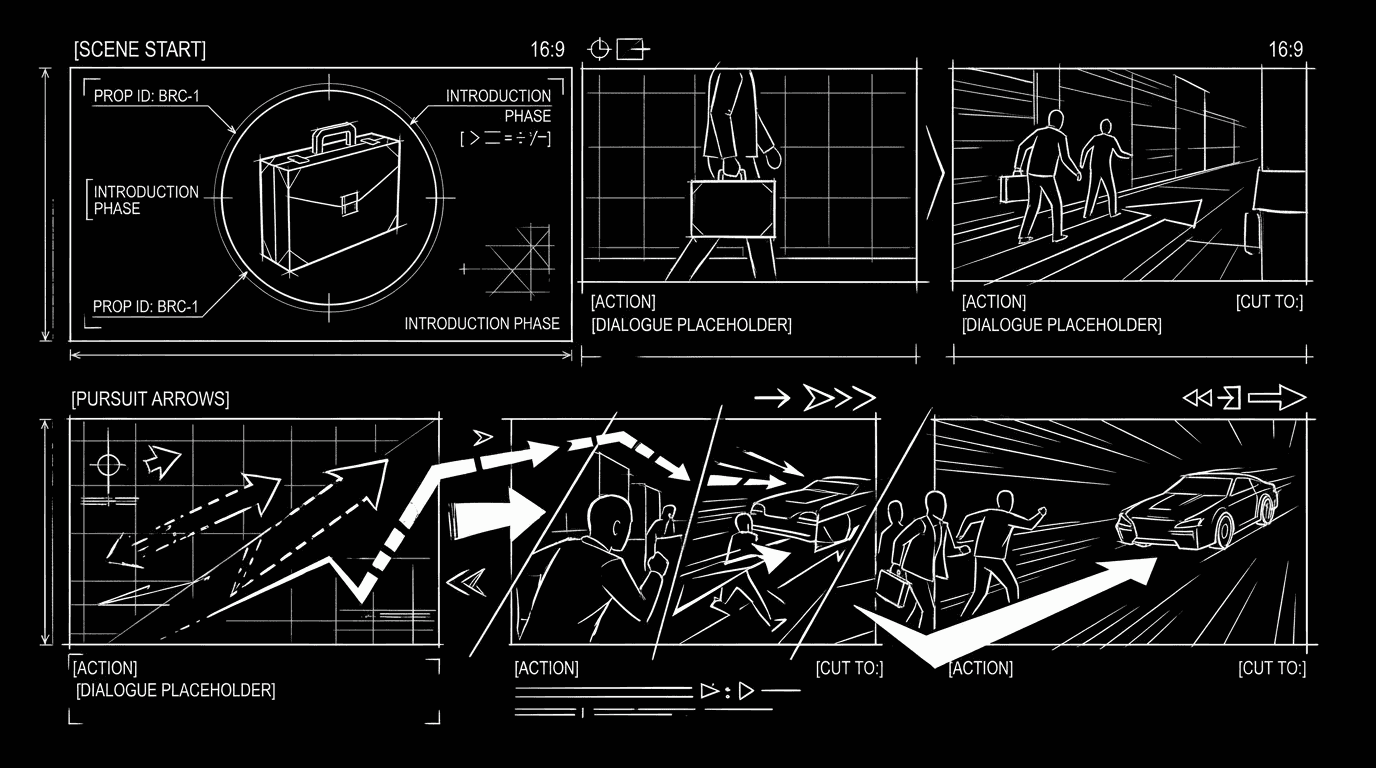
Tarantino's glowing briefcase is perhaps cinema's most famous unexplained MacGuffin:
- We never learn what's inside.
- Characters react with awe when it opens.
- It drives multiple storylines, retrieval, betrayal, violence.
Why does it work? Because the characters' reactions tell us everything we need to know: it's valuable, it's important, it's worth killing for. The mystery enhances rather than frustrates. We're not watching for the briefcase; we're watching the people pursuing it.
Hitchcock would approve.
The Perspective: The Unimportant Important Thing
The MacGuffin is a paradox: it's the most important thing in the story (everyone pursues it) and the least important thing (what it is doesn't matter).
This paradox teaches something about storytelling: plot and character are not the same. Plot is what happens; character is who we're watching. The MacGuffin generates plot, chases, conflicts, confrontations. But the story is in the characters, their choices, their transformations, their relationships.
Hitchcock understood this. The MacGuffin creates the pressure cooker; the characters provide the heat. Without pressure, nothing cooks. But without characters, nothing matters.
Write MacGuffins that create urgency. Then write characters worth watching under pressure.
That's the formula.
[YOUTUBE VIDEO: A video essay analyzing famous MacGuffins across cinema, exploring why some work and others don't, and what Hitchcock's philosophy teaches screenwriters.]
Further reading:
- For tracking your MacGuffin through the script, see Chekhov's Gun: tracking setups and payoffs.
- If you're building tension around objects, see the before/after scene: showing status change without dialogue.
- The American Film Institute has resources on Hitchcock's techniques at afi.com{:rel="nofollow"}.
Final Step
Build your next script with Screenweaver
Move from ideas to production-ready pages faster with timeline-native writing and AI-assisted story flow.
Try Screenweaver