
Maya's hands move in fluid conversation. Her brother responds, his signs are sharper, faster, frustrated. Neither speaks a word, yet the dialogue is clear, loaded with subtext, and the scene is charged with conflict.
Scenes featuring Sign Language present a unique formatting challenge. You're writing dialogue that isn't spoken, visual language that exists in gesture, expression, and space. How do you convey ASL on the page? How do you indicate signing versus speech? How do you capture the rhythm and emotion of signed dialogue in screenplay format?
This guide covers standard conventions for formatting Sign Language in scripts, whether your characters use ASL, BSL, or any signed language.
Cinematic workflow frames

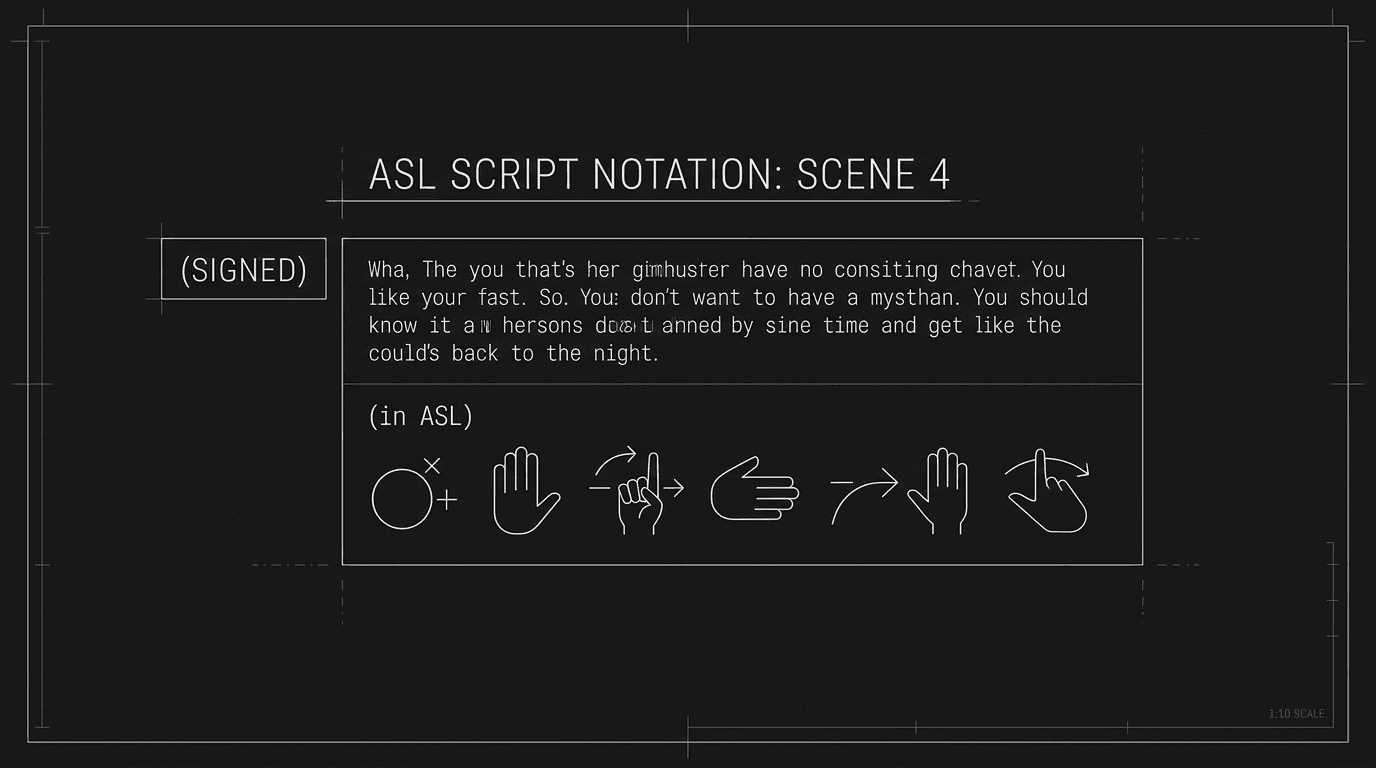
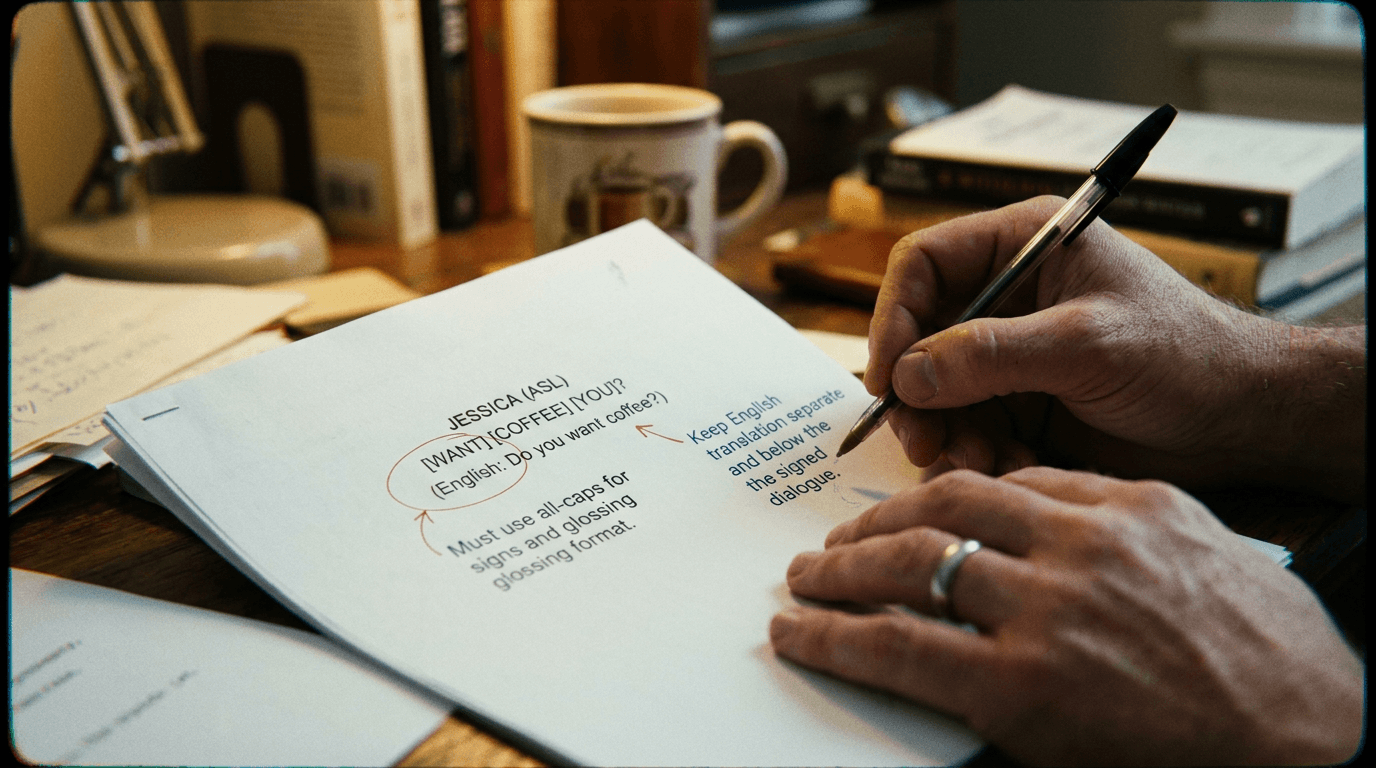
These two visuals work as a pair: the first shows Cinematic workflow still, first angle, 35mm film grain, and the second shifts to Cinematic workflow still, second angle, 35mm film grain - compare them briefly, then move on.
The Fundamental Question: Spoken or Signed?
When a character uses Sign Language, the script must answer:
Is this being voiced? Some signing characters speak while signing (simultaneous communication). Others sign without voicing. Others are interpreted by another character.
Are there subtitles? Most productions subtitle signed dialogue for hearing audiences. The script should indicate this.
Is the character Deaf, Hard of Hearing, or hearing? This context shapes how signing is presented.
Your formatting choices communicate these realities to the reader.
Standard Format: Signed Dialogue with Subtitles
The most common approach treats signed dialogue like foreign language dialogue, write it in English, note that it's signed and subtitled.
Example:
MAYA (signing, subtitled) "I told you I'd handle it. Why can't you trust me?"
DAVID (signing, subtitled) "Because you said the same thing last time."
Notes:
- "(signing, subtitled)" indicates the delivery method.
- Write the dialogue in English, this is what the subtitles will display.
- Quotation marks around the signed text are optional; some writers use them to distinguish from spoken dialogue.
This format is clear and readable.
A Table: Sign Language Formatting Options
| Scenario | Format Example | When to Use |
|---|---|---|
| Signed only, subtitled | (signing, subtitled) | Deaf characters signing to each other |
| Signed with voiceover | (signing; V.O. translates) | When an interpreter or voice is added |
| Signed while speaking | (signing while speaking) | Characters using simultaneous communication |
| Signed, no subtitles | (signing; we don't understand) | Point-of-view of hearing character who doesn't sign |
Option: Signed While Speaking
Some characters sign and speak simultaneously. This is called "SimCom" (simultaneous communication) or "sign-supported speech."
Example:
JENNIFER (signing while speaking) I need you to listen carefully.
TOMMY (signing while speaking) I'm listening. But you're not saying anything new.
Notes:
- The parenthetical indicates both modes.
- Write the dialogue once, it's both spoken and signed.
Option: Voiceover Translation
When a hearing character interprets for a Deaf character, or when voiceover is added in post-production:
Example:
ELENA (signing)
CARLOS interprets:
CARLOS She says the contract was never signed. She doesn't owe anyone anything.
Or, if voiceover is added without an on-screen interpreter:
ELENA (signing; translated via V.O.) "The contract was never signed. I don't owe anyone anything."
Option: Signed Dialogue, No Translation
Sometimes the audience isn't meant to understand the signing, we experience it from a hearing character's POV.
Example:
Maya and David argue in rapid Sign. Their hands fly, it's clearly heated. Sarah watches, unable to follow.
SARAH What are they saying?
INTERPRETER You don't want to know.
Here, the signed dialogue isn't scripted in detail because we're not meant to understand it. The action description conveys the emotional content.

Conveying Emotion and Rhythm
Sign Language isn't just hand movements, it's facial expression, body posture, rhythm. Great Sign Language dialogue is performative.
In your script, you can convey this:
Example:
MAYA (signing, subtitled; her face says everything) "You promised."
Her hands are slow, deliberate. Each sign lands like an accusation.
DAVID (signing, subtitled; defensive, faster) "Things changed. I did what I had to do."
Action description around the dialogue indicates pacing and emotion. This guides the actor and director.
Try it free
Try Screenweaver for free on your script
It is free. Import your existing project, get a clearer view of your outline, and regain control of your story structure in minutes.
Start FreeThe "Trench Warfare" Section: What Goes Wrong
Failure Mode #1: Writing Sign Language as Inferior
The script treats signing as a limitation, something to overcome or pity. The signing characters are defined by their Deafness.
How to Fix It: Write Deaf characters as fully realized people. Their signing is communication, not disability. Consult with Deaf creatives or ASL consultants.
Failure Mode #2: Forgetting Subtitles
The script includes signed dialogue but doesn't indicate subtitles. The reader assumes the audience won't understand.
How to Fix It: Use "(signing, subtitled)" consistently. Make clear what the audience will see.
Failure Mode #3: Inconsistent Formatting
Signed dialogue is sometimes in parentheticals, sometimes in action lines, sometimes in italics. The reader can't track the logic.
How to Fix It: Choose a format and stick with it throughout the script.
Failure Mode #4: Inauthentic ASL Representation
The writer assumes ASL is "English in hand gestures." ASL has its own grammar, idioms, and structure.
How to Fix It: Work with an ASL consultant. They can advise on dialogue that feels authentic when translated to sign.
Failure Mode #5: Over-Describing the Signs
"She makes the sign for 'love', hand over heart, then the sign for 'you', pointing finger."
How to Fix It: Don't choreograph individual signs. Write the dialogue; let the performer sign it. If a specific sign matters visually, note it briefly in action.
Indicating Specific Signs (When Necessary)
Occasionally, a particular sign has visual significance:
Example:
MAYA (signing, subtitled) "I love you."
She holds the ILY handshape, thumb, index, pinky extended. David mirrors it back.
The ILY handshape is iconic; describing it briefly adds visual specificity without over-choreographing.
Mixed Scenes: Signing and Speaking Characters
When some characters sign and others speak, clarity is essential:
Example:
MAYA (signing, subtitled) "Who is this?"
CARLOS (interpreting to Sarah) She's asking who you are.
SARAH I'm Sarah. I work with David.
CARLOS (signing to Maya)
Maya nods, skeptical.
In this format, we track who's signing, who's interpreting, and who's speaking.

Case Study: CODA (2021)
The Oscar-winning CODA features extensive ASL dialogue. The script uses a consistent format:
- Signed dialogue is noted with "(SIGNS, SUBTITLED)" or similar parentheticals.
- The English text represents what's subtitled on screen.
- Action lines describe emotional tone, speed, and physicality.
- Hearing characters' spoken dialogue is standard format.
The script treats ASL as a full language, equal to English in weight and importance.
Consulting and Authenticity
If you're writing significant Sign Language content:
Hire an ASL consultant. They can ensure your signed dialogue is authentic, your Deaf characters are represented respectfully, and your formatting serves the story.
Cast Deaf actors. This isn't just representation, Deaf actors bring native fluency that hearing actors (even trained ones) often can't match.
Avoid "magic hearing." Don't write scenes where a Deaf character suddenly hears, reads lips perfectly, or is "cured." These tropes are harmful.
The Perspective: Language Beyond Sound
Sign Language isn't a substitute for spoken language, it's a language unto itself, with its own poetry, humor, and power. When you write signed dialogue, you're writing for a visual performance that lives in space and time.
The script page can only approximate this. Your job is to convey the content (what's communicated) and the intent (how it's communicated), then trust the performers to bring it to life.
Format clearly. Indicate subtitles. Describe emotion. And remember: silence, in Sign Language scenes, isn't absence of dialogue, it's presence of a different kind.
[YOUTUBE VIDEO: An ASL consultant and screenwriter discussing how to write authentic Sign Language scenes, with examples from films that got it right and wrong.]
Further reading:
- For formatting interpreted dialogue in spoken languages, see formatting live-translated dialogue: interpreters, earpieces.
- If you're writing non-verbal communication, see playing drunk: directing a drunk character through stage directions.
- The National Association of the Deaf has advocacy and resources at nad.org{:rel="nofollow"}.
Final Step
Build your next script with Screenweaver
Move from ideas to production-ready pages faster with timeline-native writing and AI-assisted story flow.
Try Screenweaver