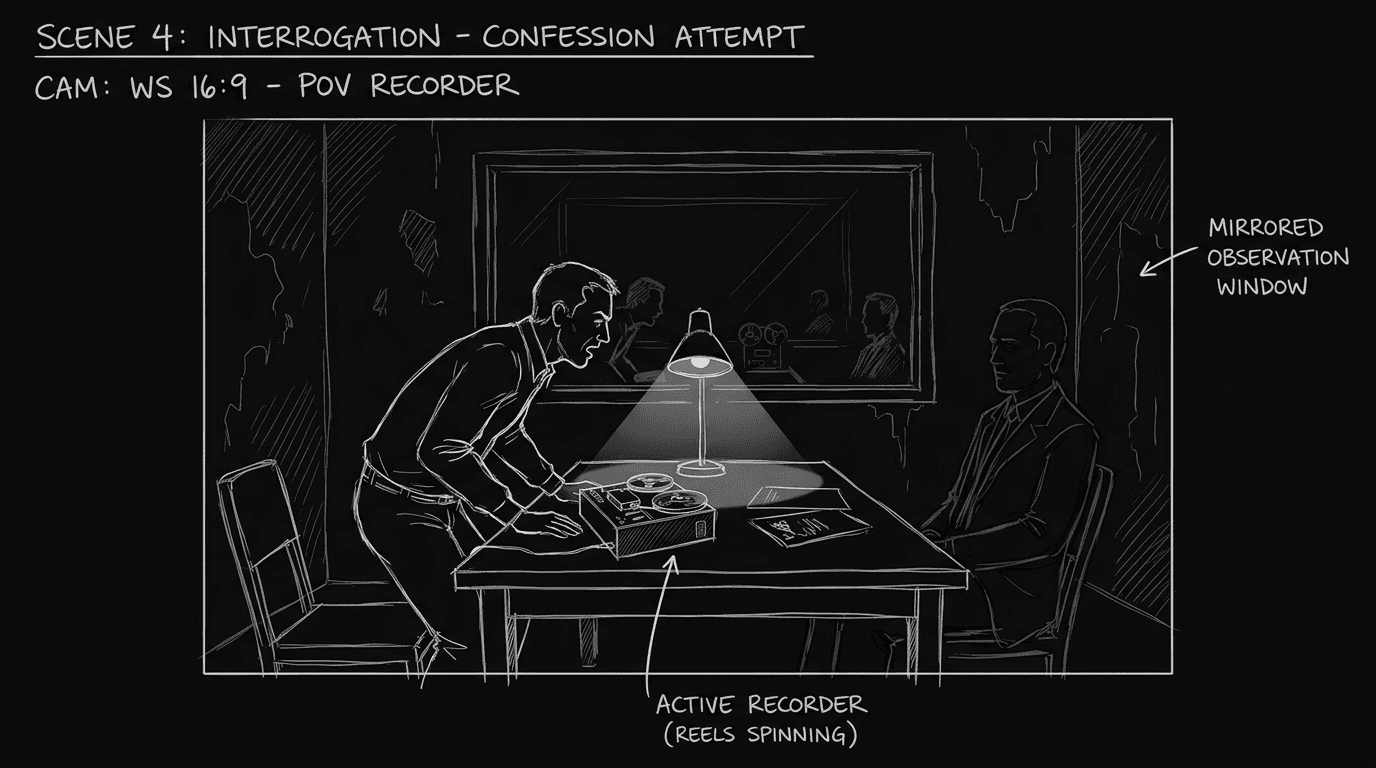

The confession scene is where many thrillers either become unforgettable or instantly predictable.
You can feel the danger. Pages and pages of investigation, suspicion, misdirection, and pressure are about to cash out in one room, one conversation, one voice finally saying what has been hidden.
And then the scene arrives.
The suspect talks too much. The detective asks obvious questions. The truth drops in neat chronological order. Everybody gets exactly what they need. The audience gets exactly what they expected.
Dead on impact.
A great confession scene in a thriller is not a data dump. It is a power event. Someone is not just revealing facts. Someone is choosing timing, framing, and consequence under pressure. Even truthful confession can be manipulative. Even partial confession can be more dangerous than silence.
Here is why that matters: in thrillers, information is leverage. A confession is the moment leverage changes hands, or appears to.
If you write it as clean exposition, you lose the thriller engine.
If you write it as contested truth with tactical intent, the scene detonates.
Why Confession Scenes Fall Into Cliche
Most weak confession scenes fail because writers treat confession as endpoint instead of battlefield.
They assume once someone starts confessing, conflict is over. It is not.
Confessions can be false, incomplete, strategically timed, legally shaped, emotionally weaponized, coerced, performative, or sacrificial. The most gripping scenes exploit this ambiguity. The audience should keep asking: what is true, what is omitted, and who benefits from this version of truth right now?
Another common failure is pacing collapse. The investigation sections are dynamic, but confession becomes static monologue. This often happens when writers save too much plot explanation for one scene.
Think about it this way: if your confession scene could be replaced by a case summary memo and nothing dramatic is lost, the scene is not doing cinematic work.
In thrillers, confession is rarely closure. It is usually transition into a more dangerous phase.
The Core Model: Pressure, Offer, Disclosure, Verification, Reversal
A high-functioning confession scene runs through five live mechanisms.
Pressure is the immediate risk environment: legal, physical, moral, relational, temporal.
Offer is what the confessor wants in exchange for speaking: protection, reduced sentence, absolution, revenge, narrative control, immunity for someone else.
Disclosure is the information released, in sequence and with intent.
Verification is the scene's credibility test: evidence match, timeline consistency, detail specificity, contradiction handling.
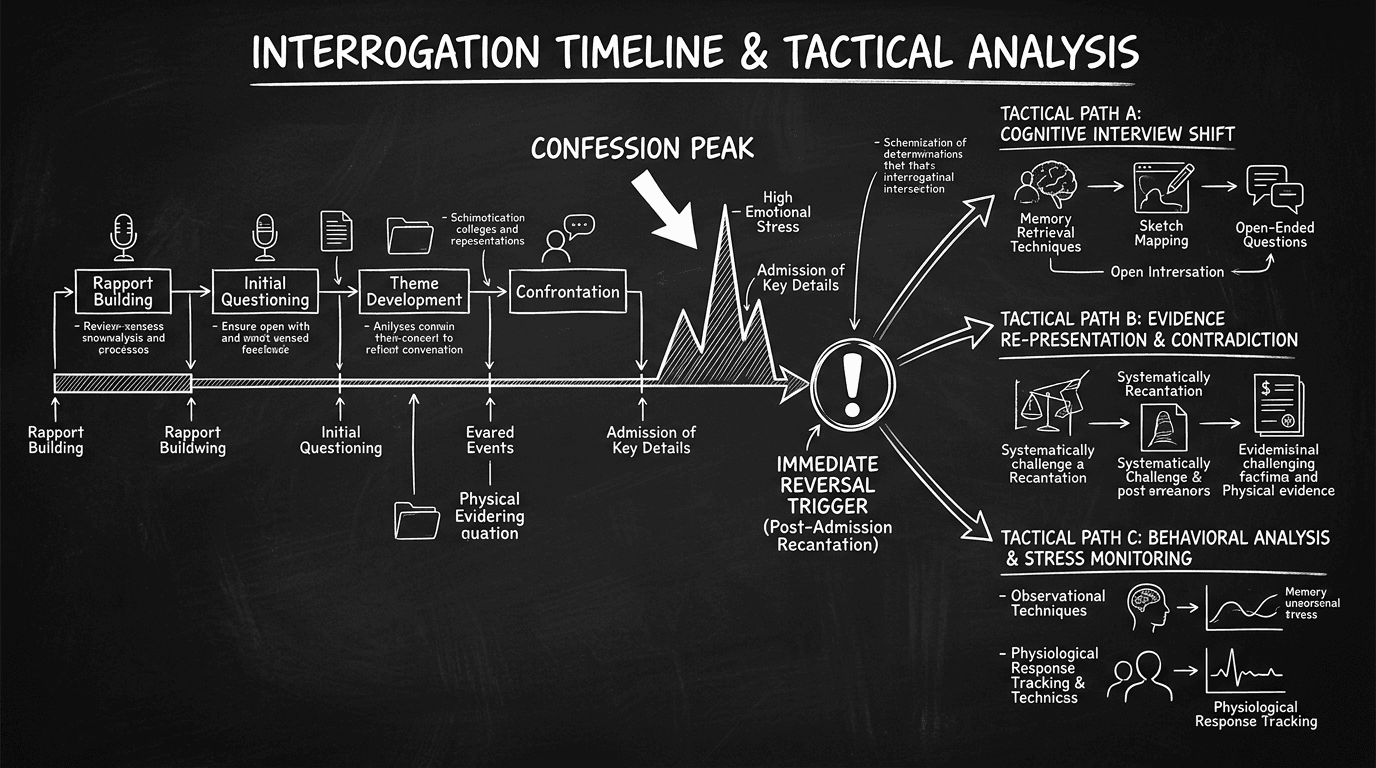
Reversal is the post-confession shift where stakes or power reconfigure rather than simply resolve.
If you skip verification, confession feels convenient.
If you skip reversal, confession feels flat.
If you skip offer, confession feels unmotivated.
Scenario One: The "Full Monologue Admission" Problem
Beginner version: suspect suddenly confesses everything in one uninterrupted speech, including motive, method, timeline, and emotional rationale.
It may feel efficient. It is usually dramatically weak.
Why? Real high-stakes confession is negotiated. Details emerge in controlled increments. Confessor tests listener reactions. Investigators test truth boundaries. Tactical pauses matter.
A stronger version breaks disclosure into phases. First confession gives one verifiable fact to establish credibility. Second wave introduces motive framing. Third wave drops a destabilizing detail that reframes earlier evidence. Fourth wave withholds key name or location to bargain.
Now scene breathes like conflict, not summary.
Scenario Two: The "Moral Catharsis Confession" in a Dark Thriller
Another common trap is writing confession as emotional healing moment in stories where institutional and legal pressures should dominate.
Character says, "I just needed to tell someone." That can work in specific character dramas, but in a thriller it often feels tonally soft unless grounded in tactical context.
To strengthen this version, attach confession to immediate consequence pressure. Maybe the confessor fears being killed before trial. Maybe evidence is about to point at the wrong person. Maybe confession is weaponized to trigger a political scandal at a precise time.
When confession has operational stakes, emotion becomes sharper, not softer.
Scenario Three: The "False Confession Twist" Without Fair Play
False confessions are powerful thriller tools and easy ways to break reader trust if mishandled.
Writers sometimes reveal late that confession was false with no prior signals. Audience feels cheated.
Better approach: plant fair-play inconsistencies during confession itself. Tiny forensic mismatch. Wrong sequence on known fact. Motivational overperformance. Excessive certainty where uncertainty is expected.
Let careful viewers suspect instability while still allowing scene-level plausibility.
Then reversal lands as earned.
Step-by-Step Workflow for Writing a Confession Scene That Carries Thriller Weight
Step 1: Define the Confessor's Strategic Objective
Before dialogue, write one line: "This character confesses now to achieve ____."
If your answer is only "to tell the truth," you likely need deeper design.
Possible objectives:
redirect investigation,
protect accomplice,
trigger plea leverage,
control media narrative,
force confrontation,
secure moral legacy.
Objective defines tone and sequencing.
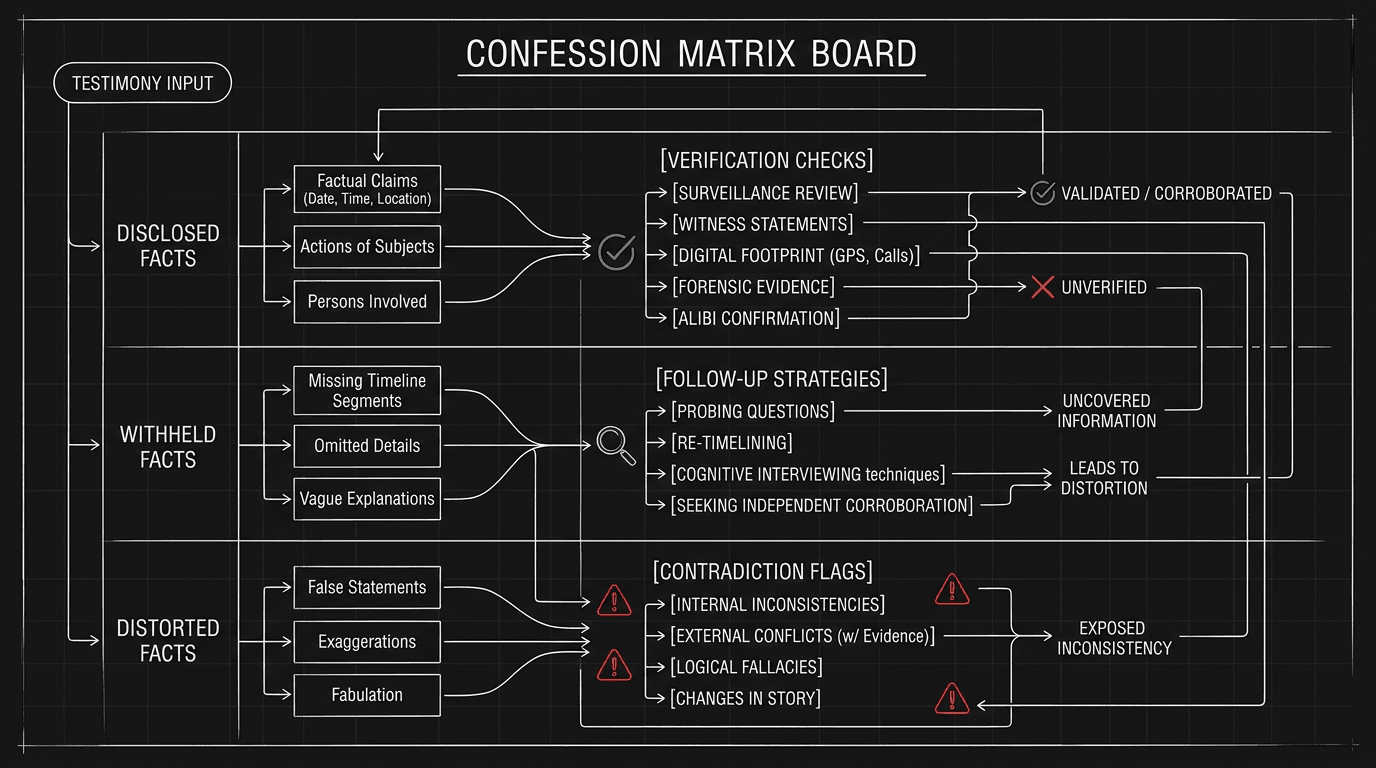
Step 2: Map What Is Said, What Is Withheld, What Is Distorted
Use a three-column note before drafting:
disclosed facts,
withheld facts,
distorted facts.
This single step prevents accidental over-disclosure and keeps tension alive.
Step 3: Build a Verification Ladder
In strong thrillers, confession is tested inside the scene.
Add verification beats:
timeline cross-check,
evidence prompt,
location specificity test,
motive inconsistency probe.
Each test should either strengthen or weaken confession credibility in real time.
Step 4: Design Interrogator/Listener Tactic Rotation
Avoid repetitive questioning.
Rotate tactics:
silence pressure,
precision question,
false certainty bluff,
empathy mirror,
contradiction trap,
consequence framing.
When one tactic stalls, pivot.
Step 5: Control Rhythm and Sentence Length
Confession scenes live on cadence.
Long uninterrupted blocks can work briefly, then suffocate pace. Break with procedural interruptions, evidence insertions, body-language shifts, recorder checks, legal counsel notes, outside pressure updates.
Use short lines during pressure spikes and selective longer lines when confessor seizes narrative control.
Step 6: Force a Reversal Beat Before Scene End
Do not end with "I did it."
End with destabilization:
new victim implied,
wrong suspect still free,
jurisdiction conflict,
confessor dead before signing statement,
accomplice already moving,
evidence corrupted.
Confession should open a trapdoor, not close a file.
Step 7: Write the Immediate Aftershock
Draft at least one follow-up beat where confession changes behavior.
Investigators split on credibility.
Prosecutor strategy changes.
Family member reacts.
Media leak starts.
Without aftershock, confession feels isolated.
Try it free
Try Screenweaver for free on your script
It is free. Import your existing project, get a clearer view of your outline, and regain control of your story structure in minutes.
Start FreeTable: Flat Confession Scene vs High-Voltage Thriller Confession
| Dimension | Flat Scene | High-Voltage Scene |
|---|---|---|
| Confession motive | Generic guilt release | Strategic objective with stakes |
| Information flow | Full dump in one pass | Controlled phased disclosure |
| Truth status | Assumed true immediately | Actively tested and contested |
| Listener behavior | Repetitive direct questioning | Tactical rotation and pressure design |
| Scene ending | Emotional closure line | Reversal with new danger |
| Structural effect | Explains past only | Rewrites future strategy |
The Trench Warfare Section: What Beginners Get Wrong (and How to Fix It)
This is where the quality gap becomes obvious.
Mistake one: treating confession as explanation patch.
Writers use confession to solve plot holes quickly. Fix by repairing setup earlier and using confession for leverage shifts, not retroactive patching.
Mistake two: no legal awareness.
Characters confess in ways that ignore rights, procedure, and admissibility concerns relevant to your setting. Fix by grounding scene in believable legal pressure context.
Mistake three: identical voices.
Confessor and interrogator sound alike under stress. Fix by preserving voice signatures: syntax, metaphors, control style, emotional leakage.
Mistake four: no partial truth strategy.
Everything is either full truth or full lie. Fix by designing mixed confession layers where truth and distortion coexist.
Mistake five: confessor has no fear profile.
Why now? Why this room? Why this listener? Fix by defining immediate fear vector that makes confession rational.
Mistake six: listener accepts too fast.
Investigators often believe confession immediately for convenience. Fix by staging skepticism and proof pressure.
Mistake seven: overlong motive speeches.
Monologues explain psychology instead of dramatizing it. Fix with short admissions under challenge and contradiction.
Mistake eight: no external pressure updates.
Scene exists in a vacuum. Fix by adding timed external vectors: warrant clock, media escalation, medical status, operational movements.
Mistake nine: no physical behavior writing.
Only dialogue carries tension. Fix by adding selective high-signal action: recorder pause, pen break, hand tremor, eye-line shifts, chair repositioning, legal pad notes.
Mistake ten: reversal missing.
Scene ends where audience expects. Fix by inserting one credible destabilizer with immediate stakes.
Mistake eleven: confession timing too late for consequence.
Reveal arrives so near ending it cannot alter strategy. Fix by moving confession earlier or increasing immediate fallout.
Mistake twelve: fake complexity via ambiguity fog.
Scene becomes intentionally unclear. Fix by being precise about what is known, unknown, and disputed.
Mistake thirteen: no emotional cost to truth.
Confession feels procedural only. Fix by tying truth release to relational fracture, self-image collapse, or moral tradeoff.
Mistake fourteen: coercion ignored.
Scene implies coercive dynamics without acknowledging ethical stakes. Fix by clearly framing power, pressure, and reliability implications.
Mistake fifteen: no secondary witness impact.
Confession lands only between two characters. Fix by letting statement alter team trust, prosecution strategy, victim family response, or public narrative.
Mistake sixteen: pacing monotony.
One tonal note throughout. Fix with waveform pacing: controlled calm, contradiction spike, silence trough, tactical pivot, reversal hit.
Mistake seventeen: overuse of rhetorical questions.
Interrogator asks endless "why?" lines. Fix by using precision prompts anchored in evidence and sequence.
Mistake eighteen: confession disconnected from theme.
Truth reveal does not engage story's moral question. Fix by aligning confession content with core thematic conflict: justice vs revenge, loyalty vs integrity, truth vs survival.
Mistake nineteen: all blame externalized.
Confessor blames system, partner, fate, everyone. Fix by including at least one unavoidable self-implicating beat, even in defensive confession.
Mistake twenty: post-confession world unchanged.
Characters continue as before. Fix by rewriting downstream scenes to reflect trust collapse, legal shifts, and strategic recalibration.
A confession scene should feel like oxygen entering a fire: clarity arrives, and danger increases.
Body Image: Confession Disclosure and Verification Matrix
Practical 60-Minute Rewrite Drill
Take your existing confession scene and run this disciplined pass.
First ten minutes: identify all exposition-only lines and cut or relocate them.
Next ten minutes: annotate each remaining line with purpose: disclose, test, distort, leverage, or stall.
Next ten minutes: insert two verification beats with evidence pressure.
Next ten minutes: add one tactical objective statement for confessor and one for listener, then adjust dialogue to serve those objectives.
Next ten minutes: engineer a reversal beat that changes immediate stakes.
Final ten minutes: write a six-line aftershock bridge into the next scene.
This process usually tightens scene velocity while deepening ambiguity and consequence.
Advanced Calibration: Confession Reliability and Audience Trust
Thrillers depend on a contract with the audience. You can deceive them, but you cannot abuse them.
That means confession scenes should use controlled uncertainty, not arbitrary rug-pulls. If you plan later reversal, seed fair indicators now. If confession is mostly true, let verification reward attentive viewers. If confession is strategic, reveal the strategy through behavior and sequence, not post hoc explanation.
Audience trust is built when surprises feel retrospectively inevitable.
For external script study, the Writers Guild Foundation Library is a useful reference and should be treated as a nofollow source in publication workflows.
As discussed in our guide on [how to write a betrayal reveal scene], trust collapse is most powerful when it rewrites both present strategy and past interpretation.
If your confession happens during containment pressure, the approach in [how to write a hostage negotiation scene] helps maintain dynamic risk and tactical movement through dialogue-heavy scenes.
And when confession is the gateway to endgame conflict, our article on [how to write a final confrontation scene that feels earned] can help structure the escalation that follows.
Body Image: Reversal Trigger in Interrogation Timeline
YouTube Placeholder
[YOUTUBE VIDEO: A thriller scene workshop demonstrating how to transform a flat confession monologue into a phased disclosure-and-verification sequence with an effective reversal ending.]
Extra Deep Dive: Writing the Listener as a Strategist, Not a Question Machine
A confession scene rises or falls on the listener.
Many drafts reduce the investigator, journalist, lawyer, or counterpart to a list of prompts. "What happened next?" "Why did you do it?" "Who else knows?" This keeps information moving, but it does not create scene intelligence.
A strong listener has a tactical agenda that evolves live.
At first, they may prioritize getting the confessor to keep talking.
Then they may shift to lock one verifiable detail before the confessor reconsiders.
Then they may test contradictions to determine whether this is full truth, partial truth, or strategic misdirection.
Finally, they decide whether to challenge aggressively, protect the channel, or escalate to external action.
This tactical arc makes the listener a co-author of tension.
Another overlooked craft point is emotional calibration. Listeners in thrillers often pretend neutrality while making high-stakes judgments in real time. You can write this through micro-behavior: delayed note-taking, deliberate stillness, controlled eye contact breaks, voice flattening at the exact moment a key contradiction appears.
These choices communicate cognition without exposition.
One practical drill: after drafting the scene, remove all listener dialogue and read only listener action lines. If you cannot track evolving strategy from those actions, the listener is underwritten. Add targeted behavioral beats until strategic progression is visible even in silence.
When listener strategy is clear, confession scenes stop feeling like information extraction and start feeling like contested authorship of reality.
Ending Perspective: Confession Is a Weapon, Not a Wrap-Up
If your confession scene feels cliche, the fix is not prettier dialogue.
It is structural intent.
Who confesses to gain what.
What truth is released and at what price.
What lies survive the room.
What verification changes credibility.
What reversal forces the story into a new threat state.
When you write confession like that, it stops being a ceremonial reveal.
It becomes active combat over narrative control.
And in a thriller, that is exactly where confession belongs: not at the finish line, but at the edge of a deeper drop where truth clarifies the map and makes the route more dangerous.
Final Step
Build your next script with Screenweaver
Move from ideas to production-ready pages faster with timeline-native writing and AI-assisted story flow.
Try Screenweaver