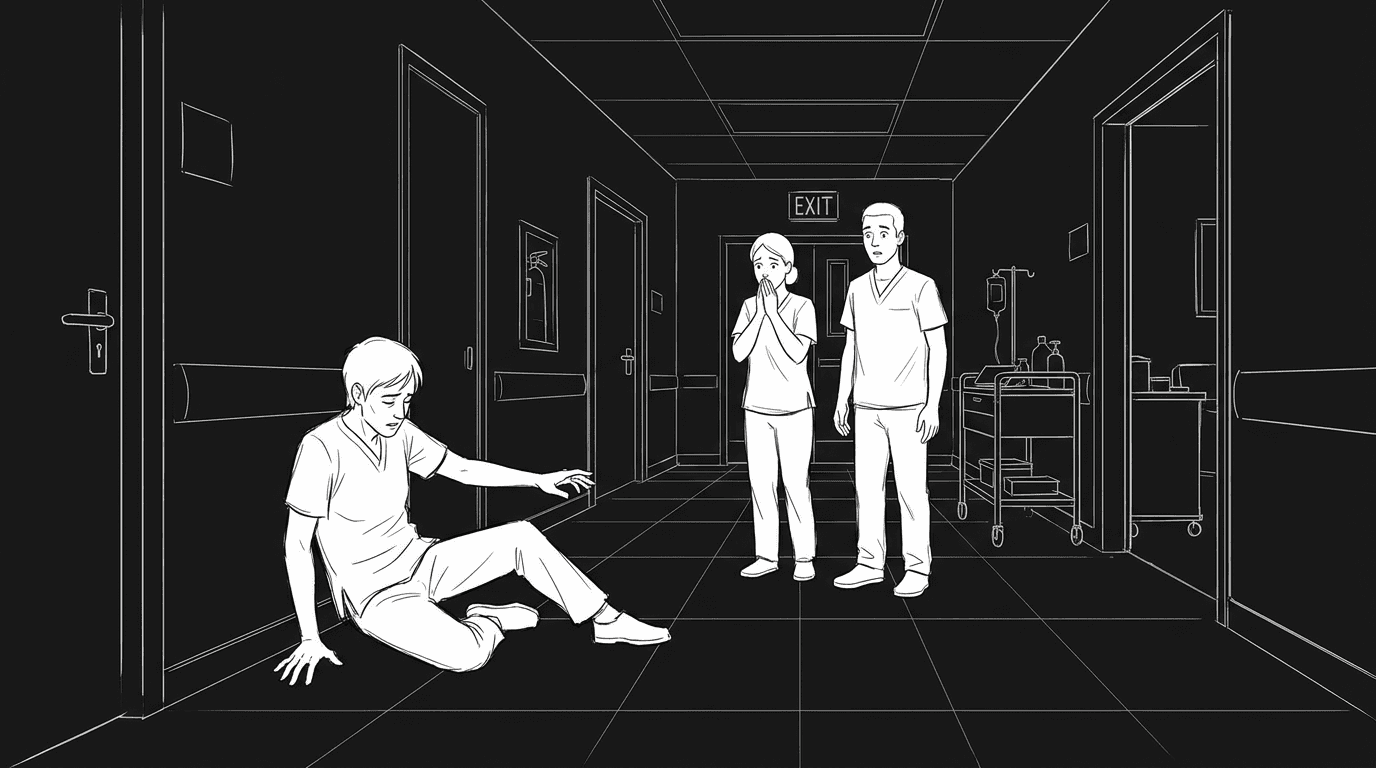

Death scenes are where scripts often lose discipline.
Writers want emotional impact, so they push harder. More speeches. More tears. More dramatic declarations. More slow-motion prose. More lines that announce tragedy instead of letting the audience experience it.
That push is usually what creates melodrama.
A powerful death scene is not about volume. It is about precision.
When death lands on the page, readers should feel two things at once: inevitability and shock. Not because the scene is loud, but because the scene is truthful to character, context, and consequence.
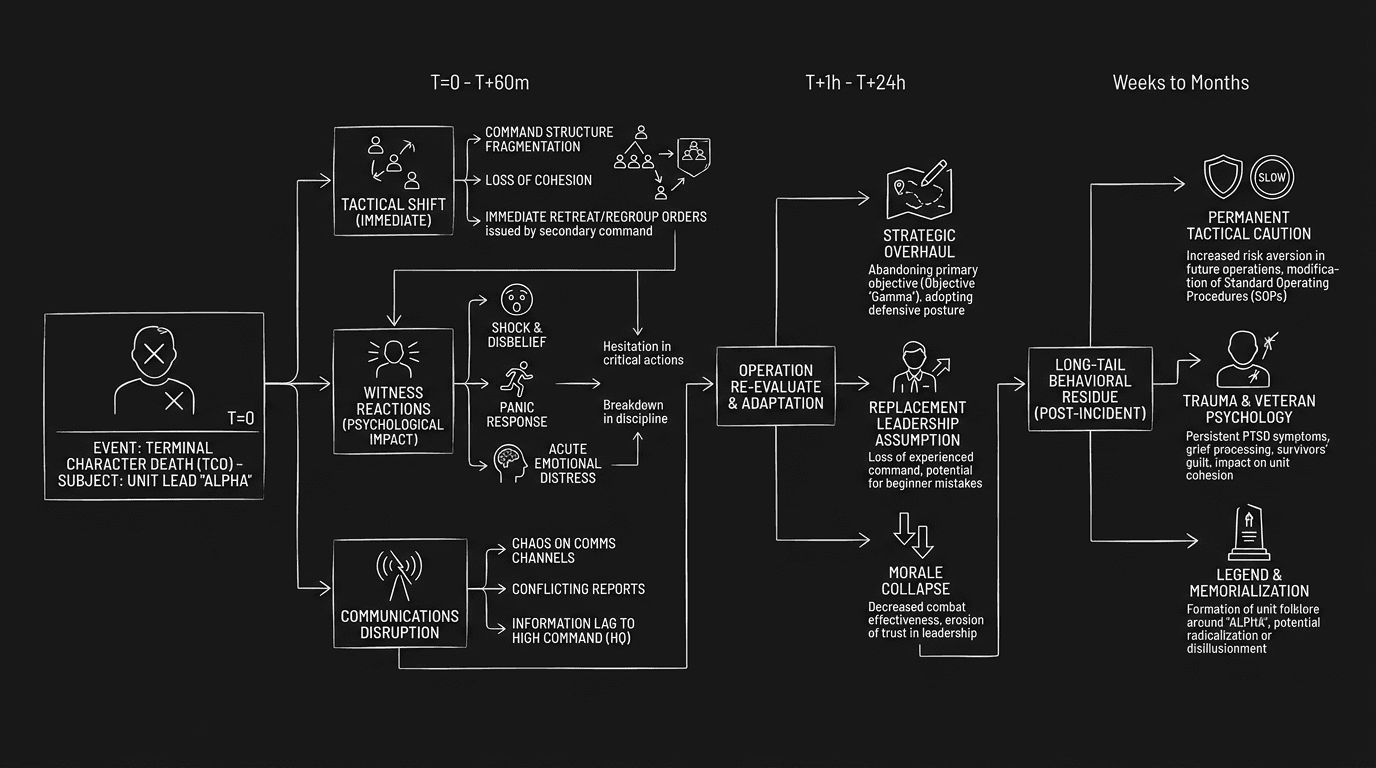
Here is why that matters: character death is never just an event. It is a structural intervention. It should alter objective maps, moral balance, emotional economy, and narrative momentum. If death happens and story posture remains unchanged, the scene may be sad, but it is dramatically weak.
Write death as consequence, not ornament.
Why Death Scenes Feel Melodramatic
Most weak death scenes fail in familiar ways.
They rely on sentimental monologues in moments where breath and cognition would realistically fragment. They flatten reactions into one emotional note. They overuse symbolic weather and orchestral language. They treat death as isolated climax with no tactical or relational fallout.
Another common issue is timing misuse. Death appears for shock value before relationship and stakes are fully built. Readers register manipulation.
Think about it this way: if you remove your death scene and the story gets cleaner, the death was probably decorative.
A non-melodramatic death scene hurts because it is earned, specific, and consequential, not because it is theatrically sad.
The Core Model: Setup Debt, Terminal Moment, Witness Friction, Immediate Consequence, Long Tail
Strong death scenes work through a five-part system.
Setup Debt: prior scenes establish emotional and strategic dependence on this character.
Terminal Moment: death event itself is staged with clear physical and narrative logic.
Witness Friction: surviving characters react differently based on role, history, and coping style.
Immediate Consequence: objective map shifts now, not later.
Long Tail: downstream behavior proves death mattered beyond one scene.
If Setup Debt is weak, death feels cheap.
If Witness Friction is absent, reactions feel generic.
If Long Tail is missing, scene becomes disposable tragedy.
Scenario One: The Heroic Sacrifice That Feels Forced
Beginner version: character suddenly sacrifices themselves with a speech, everyone cries, mission continues unchanged.
This often fails because sacrifice appears as genre obligation, not character culmination.
A stronger version seeds sacrificial logic earlier. The character has a known value hierarchy, known guilt, known competence profile. In death beat, they choose action consistent with that profile under specific constraints. No grand monologue needed. Maybe only one line. Maybe none.
Then show cost: who now lacks expertise, who now carries unresolved debt, who now misinterprets what happened.
Now sacrifice is story, not spectacle.
Scenario Two: The Sudden Death in Domestic Drama
Domestic dramas often fear underplaying grief and overcompensate with emotional speeches.
You can get more impact through practical disruption.
A character dies unexpectedly. The surviving partner cannot remember the pharmacy password. A child asks whether tomorrow plans still happen. Family group chat keeps sending routine notifications. These mundane collisions are brutal because they are true.
Death enters through logistics as much as emotion.
Scenario Three: The Villain Death Without Moral Weight
Writers sometimes kill antagonists as pure relief release. It can work, but often feels simplistic.
A more nuanced approach lets death expose unresolved moral debt. Perhaps protagonist gets what they wanted yet feels no closure. Perhaps legal truth dies with antagonist, harming victims. Perhaps power vacuum creates new danger.
When villain death complicates victory, your story gains maturity.
Step-by-Step Workflow for Writing Death Scenes with Precision
Step 1: Define Death Function in Structural Terms
Before writing scene detail, answer:
What does this death change in plot mechanics?
What does it change in thematic argument?
What does it change in protagonist decision path?
If answers are vague, revisit necessity.
Step 2: Build Character-Specific Mortality Language
How does this character speak under distress?
Who do they address first?
Do they deny, joke, command, apologize, instruct, or go quiet?
Avoid generic "tell my family I love them" unless it is truly voice-specific and earned.
Step 3: Choose Death Context Pressure
Public death creates witness complexity.
Private death creates intimacy pressure.
Institutional death (hospital, battlefield, station, courtroom) adds procedural constraints.
Pick context for narrative leverage, not visual drama.
Step 4: Stage Witness Roles Deliberately
Who acts?
Who freezes?
Who denies?
Who goes procedural?
Who leaves?
Distinct reactions prevent emotional blur.
Step 5: Control Dialogue Density
Death scenes often improve when dialogue decreases.
Use short lines, interrupted phrasing, practical attempts, and silence beats with function.
Cut speeches unless the story has explicitly earned that communication mode.
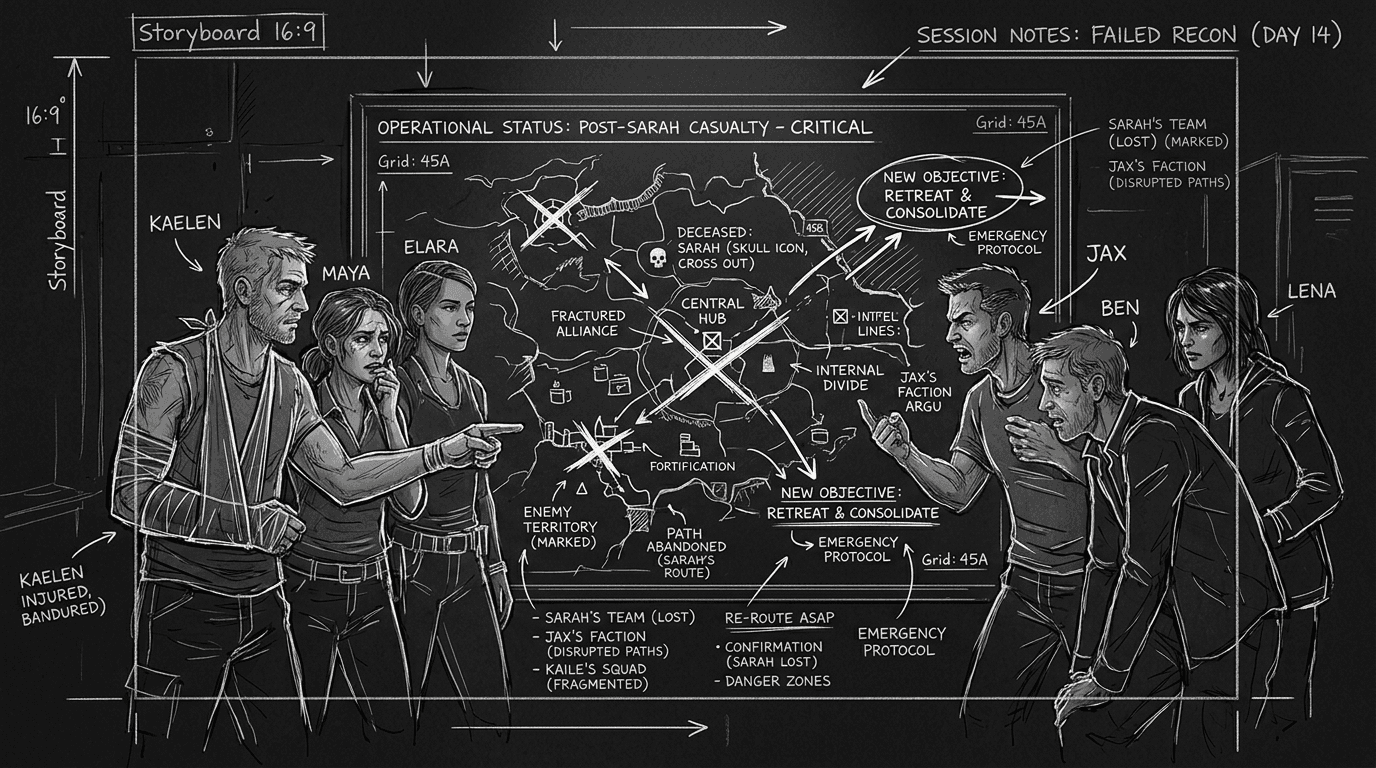
Step 6: Add Immediate Tactical Shift
After death, what plan changes now?
Route abandoned.
Mission leadership transfers.
Evidence chain broken.
Custody changes.
Truth withheld.
Make this explicit.
Step 7: Write Long-Tail Residue in Following Scenes
Grief residue appears in behavior:
decision bias,
risk tolerance shift,
ritual avoidance,
over-control,
identity fracture.
This long tail is what separates mature writing from melodrama.
Table: Melodramatic Death Scene vs Earned Death Scene
| Dimension | Melodramatic Version | Earned Version |
|---|---|---|
| Emotional expression | High-volume declarations | Character-specific, variable responses |
| Dialogue style | Long speeches | Compressed, functional, voice-accurate |
| Scene focus | Sadness performance | Consequence under pressure |
| Witness behavior | Unified grief reaction | Distinct coping and tactical roles |
| Structural impact | Temporary shock | Objective and relationship reconfiguration |
| Aftermath | Fast emotional reset | Persistent behavioral and plot residue |
The Trench Warfare Section: What Beginners Get Wrong (and How to Fix It)
This is where death scenes are usually repaired.
Mistake one: killing for surprise only.
Fix by ensuring death resolves or complicates established narrative debt.
Mistake two: speech inflation at moment of dying.
Fix by reducing lines to character-credible fragments.
Mistake three: everyone reacts the same way.
Fix with role-specific reactions and conflicting priorities.
Mistake four: no practical context.
Fix by embedding medical, logistical, legal, or situational realities.
Mistake five: death equals instant moral clarity.
Fix by preserving ambiguity and unresolved conflict where appropriate.
Mistake six: symbolic overload.
Fix by limiting metaphor and letting concrete action carry meaning.
Mistake seven: no consequence map.
Fix by writing immediate plan change and long-tail adaptation.
Mistake eight: protagonist-centric grief monopoly.
Fix by acknowledging broader relational impact.
Mistake nine: under-seeded dependency.
Fix by building setup debt before death event.
Mistake ten: performative final words.
Fix with silence, gesture, or incomplete communication if truer.
Mistake eleven: death timing disconnected from stakes.
Fix by placing death where it forces difficult decisions.
Mistake twelve: emotional repetition after death.
Fix by varying grief expression across scenes.
Mistake thirteen: no witness economy.
Fix by tracking who saw what and how that changes trust.
Mistake fourteen: immediate replacement character smoothing impact.
Fix by allowing functional gaps and pressure.
Mistake fifteen: glamorized suffering.
Fix by writing with restraint and dignity.
Mistake sixteen: no thematic integration.
Fix by tying death to story's moral argument.
Mistake seventeen: over-clever twist reveal at death moment.
Fix by prioritizing emotional and structural clarity.
Mistake eighteen: aftermath skipped for pacing.
Fix by adding short but meaningful residue beats.
Mistake nineteen: all grief externalized.
Fix by balancing visible reaction and internal behavioral shift.
Mistake twenty: death treated as endpoint.
Fix by writing death as transition into harder narrative phase.
The most devastating death scenes are often the quietest ones that permanently alter what everyone does next.
Try it free
Try Screenweaver for free on your script
It is free. Import your existing project, get a clearer view of your outline, and regain control of your story structure in minutes.
Start FreeBody Image: Death Scene Consequence Map
Practical 50-Minute Rewrite Drill
Take your current death scene and run this pass.
First ten minutes: cut generic grief lines and keep only voice-specific dialogue.
Next ten minutes: assign distinct reaction roles to each witness.
Next ten minutes: insert one immediate tactical consequence beat.
Next ten minutes: write one post-scene logistical disruption.
Final ten minutes: draft two long-tail behavior shifts for future scenes.
This pass usually transforms emotional noise into durable dramatic force.
Advanced Calibration: Killing Beloved Characters Without Betraying Audience Trust
Audience trust breaks when death feels arbitrary or manipulative.
To avoid this, preserve fairness.
Fairness does not mean safety. It means causality.
If death is sudden, it should still emerge from world logic and prior choices. If death is intentional, motive and context should be legible. If death withholds full truth, seed enough clues that later understanding feels earned.
Another key calibration is dignity balance.
Not every death is "beautiful." Some are messy, interrupted, incomplete. But writing can still preserve dignity by avoiding sensationalism and respecting character voice at end-of-life threshold.
For external script-study references, the Writers Guild Foundation Library is useful and should be treated as nofollow in publication workflows.
As discussed in our guide on [how to write a funeral scene in a screenplay], the death beat and mourning beat should carry different dramatic functions.
If death follows trust collapse, our framework in [how to write a betrayal reveal scene] helps maintain moral and tactical coherence.
And when death triggers final arc collision, the principles in [how to write a final confrontation scene that feels earned] support escalation design.
Body Image: Long-Tail Grief and Strategy Shift
YouTube Placeholder
[YOUTUBE VIDEO: A craft session revising a melodramatic death scene into a restrained, consequence-driven sequence with strong aftermath design.]
Extra Deep Dive: Last-Line Craft and the Ethics of Final Words
Writers place enormous pressure on final lines.
Sometimes too much.
A common melodrama trap is forcing profound final words when the character, situation, or physiology does not support that clarity. The result feels authored rather than lived.
A stronger approach is to decide what kind of final communication this character can plausibly deliver under those exact conditions.
Options include:
clear final instruction,
partial sentence,
misdirected name,
apology fragment,
practical request,
or no words at all.
No words can be powerful when behavior and witness interpretation carry meaning.
Another important craft axis is ethical framing. If your story involves violence, do not treat death as aesthetic endpoint detached from moral consequence. Show who bears cost and how systems absorb or deny responsibility.
You can preserve narrative momentum without glamorizing harm.
Scenario Layer: When Final Words Are Misheard
One underused technique is misheard final communication.
In noisy or chaotic environments, witnesses may hear different versions of the same final phrase. This can generate believable downstream conflict about meaning, obligation, and guilt.
Used carefully, this avoids tidy closure and keeps character memory contested.
Building a Death-Aftermath Rhythm Across Three Scenes
Many scripts either stay in grief too long or move on too fast.
A practical rhythm model:
Scene A: terminal event and immediate tactical response.
Scene B: logistical and social consequence (who gets notified, who decides next move).
Scene C: behavioral residue under pressure (new bias, hesitation, or overcorrection during action).
This three-scene rhythm gives emotional continuity without pacing drag.
Micro-Exercise: Cut 30 Percent, Increase Impact
Take your death scene draft and cut 30 percent of dialogue.
Then add:
one high-signal action beat,
one witness-specific reaction beat,
one immediate consequence beat.
Most scenes become stronger because emotional intent shifts from declaration to dramatization.
Writing Death in Ensemble Narratives
In ensemble stories, death can destabilize multiple arcs at once. Do not force equal grief page-time for everyone. Instead, track role impact:
who loses tactical function,
who loses emotional anchor,
who gains unwanted authority,
who weaponizes loss.
Role impact gives you focused aftermath writing and avoids scattered mourning scenes.
Designing Absence as Ongoing Presence
A mature death scene continues through absence design.
Empty chair at briefing.
Unanswered contact thread.
Unfinished voice memo.
Procedure everyone still follows because the deceased taught it.
These details keep memory active without repetitive flashbacks.
Absence becomes story material.
Extended Craft Layer: Public Death vs Private Death Mechanics
Public deaths and private deaths demand different writing strategies.
Public death scenes carry witness management pressure. Reputation narratives begin immediately. Competing interpretations spread before facts settle. Institutional responses activate fast.
Private death scenes carry intimacy pressure. Silence is heavier. Practical responsibilities arrive before social narrative does. Emotional truth may be clearer, but external validation is lower.
If you blur these mechanics, scenes can feel tonally confused.
A practical distinction:
public death scenes prioritize containment and narrative control,
private death scenes prioritize relational truth and procedural reality.
Public Scene Tool: Witness Funnel
In public deaths, build a witness funnel:
direct witnesses,
secondary witnesses,
audience via media/social relay.
Map what each layer believes. This helps you write realistic fallout and avoids "everyone knows everything instantly" shortcuts.
Private Scene Tool: Responsibility Sequence
In private deaths, map first responsibilities in order:
stabilize or confirm,
contact emergency or authority,
notify key person,
secure environment,
make first irreversible decision.
Responsibility sequencing grounds emotion in action and prevents melodramatic drift.
Writing Delayed Grief to Avoid Overload
Not every character should collapse in the death scene itself.
Some people go task-focused first and crack later. Delayed grief can be dramatically stronger if it appears under unrelated pressure in later scenes. This mirrors real coping variance and broadens emotional texture.
Design where each major character's grief surfaces:
at scene,
after logistics,
during conflict,
during quiet routine.
This distribution prevents one-scene emotional saturation.
Integrating Death with Genre Tone
In thrillers, death often accelerates tactical urgency.
In romantic drama, death often reframes commitment and fear of permanence.
In crime stories, death can destabilize legal truth.
In horror, death can function as dread amplifier but still needs character consequence.
Genre influences pacing, but not the core requirement: death must alter the living system.
Final Integrity Check Before Lock
Before finalizing your death scene, run this five-question check:
Is the death earned by prior setup debt?
Is the terminal beat written in character-credible language?
Does at least one immediate tactical consequence occur?
Does at least one later behavior change prove residue?
Would removing this death significantly weaken the story?
If any answer is no, keep rewriting.
Ending Perspective: Death Scenes Are About the Living System
If your death scene feels melodramatic, do not ask how to make it sadder.
Ask how to make it truer.
Truer to voice.
Truer to context.
Truer to consequence.
Truer to what this death changes for everyone still breathing.
When you write death as system shock instead of emotional spectacle, the scene stops begging for tears.
It earns them.
Final Step
Build your next script with Screenweaver
Move from ideas to production-ready pages faster with timeline-native writing and AI-assisted story flow.
Try Screenweaver