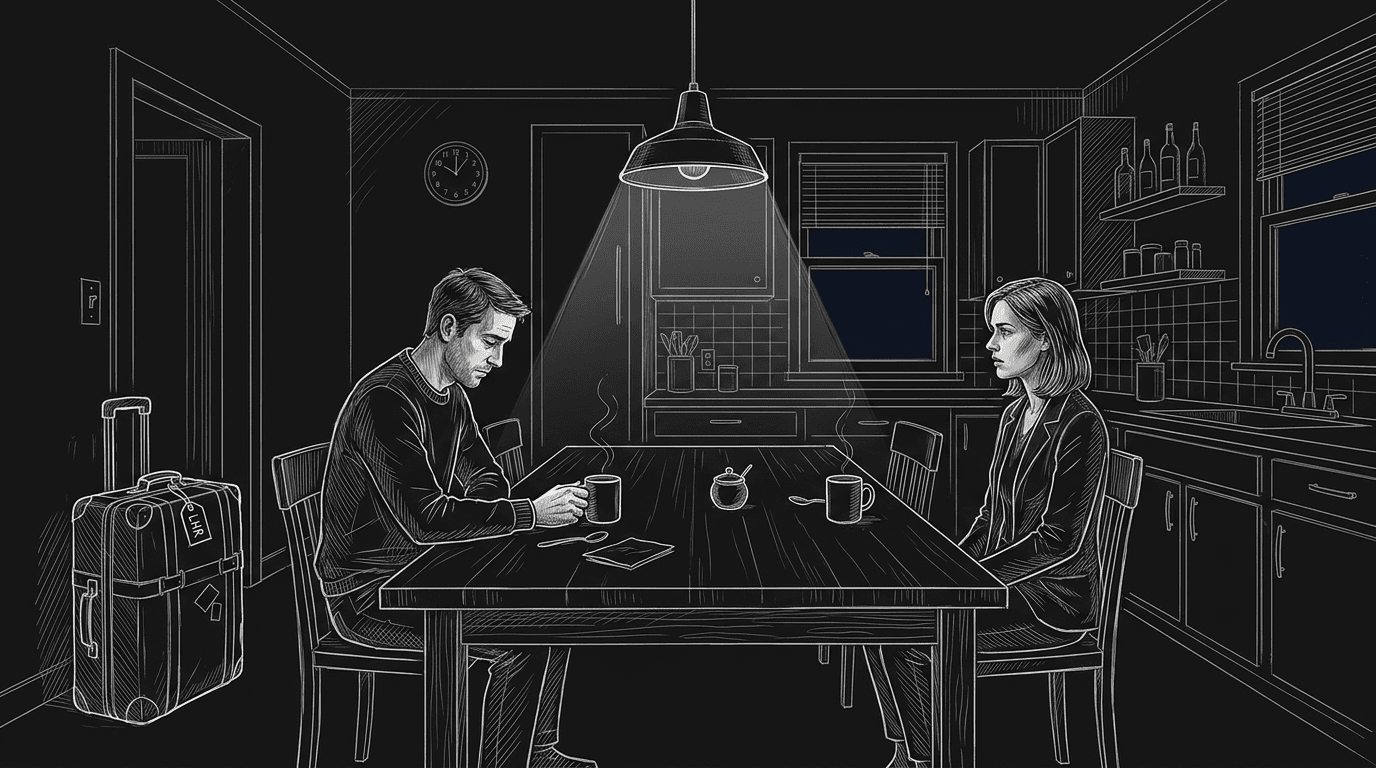

Most breakup scenes fail for one simple reason: they are written as speeches, not collisions.
Two people sit down, one person explains feelings, the other person cries, and the page tells us this is devastating. But devastation is not declared. It is demonstrated through pressure, timing, and irreversible choice.
You can feel the difference when reading scripts that land. In weak breakup scenes, both characters sound strangely calm and eloquent, as if they had rehearsed this moment in a mirror for two weeks. In strong breakup scenes, language fractures. One person reaches for logic while the other reaches for memory. A sentence starts as an accusation and ends as a plea. Silence suddenly does more work than dialogue.
Here is why that matters: a breakup scene is not about announcing the end of a relationship. It is about exposing the terms under which that relationship actually existed. Every hidden contract comes to the surface at once. Who sacrificed more. Who lied first. Who stayed out of guilt. Who kept pretending things were fine because the rent was split and the family liked them together.
That is where the scene gets alive.
If you are a beginner, the temptation is to chase lines that sound quotable. Sharp one-liners. Brutal insults. Tearful declarations. But there is a catch. Quotable lines without structural progression read as melodrama. They may sound intense in isolation, yet they collapse across a full page because nothing truly changes from beat to beat.
A breakup scene that avoids cliche behaves like a controlled demolition. The building does not vanish in one explosion. Support beams fail in sequence.
The Real Problem With Cliche Breakup Scenes
Most cliche breakup scenes are built on generic emotional labels instead of specific relational mechanics.
The dialogue says things like "we are different people now" or "I need to find myself." Those lines can be true in life, but on the page they are placeholders unless grounded in concrete behavior and consequence. The reader is not moved by abstract truth. The reader is moved by precise contradiction.
Think about it this way: if you replace your characters' names with random names and the scene still works exactly the same, your breakup is generic.
In professional scripts, breakups feel inevitable in hindsight and surprising in the moment. That paradox comes from setup-payoff design. Earlier scenes quietly plant the pressure points that finally rupture in the breakup. The audience feels the thread snap because they felt the tension pulling for thirty pages.
When beginners skip this architecture, they overcompensate with volume. More crying. More shouting. More profanity. More "I cannot do this anymore."
Volume is not drama.
Friction is drama.
How a Non-Cliche Breakup Scene Actually Works
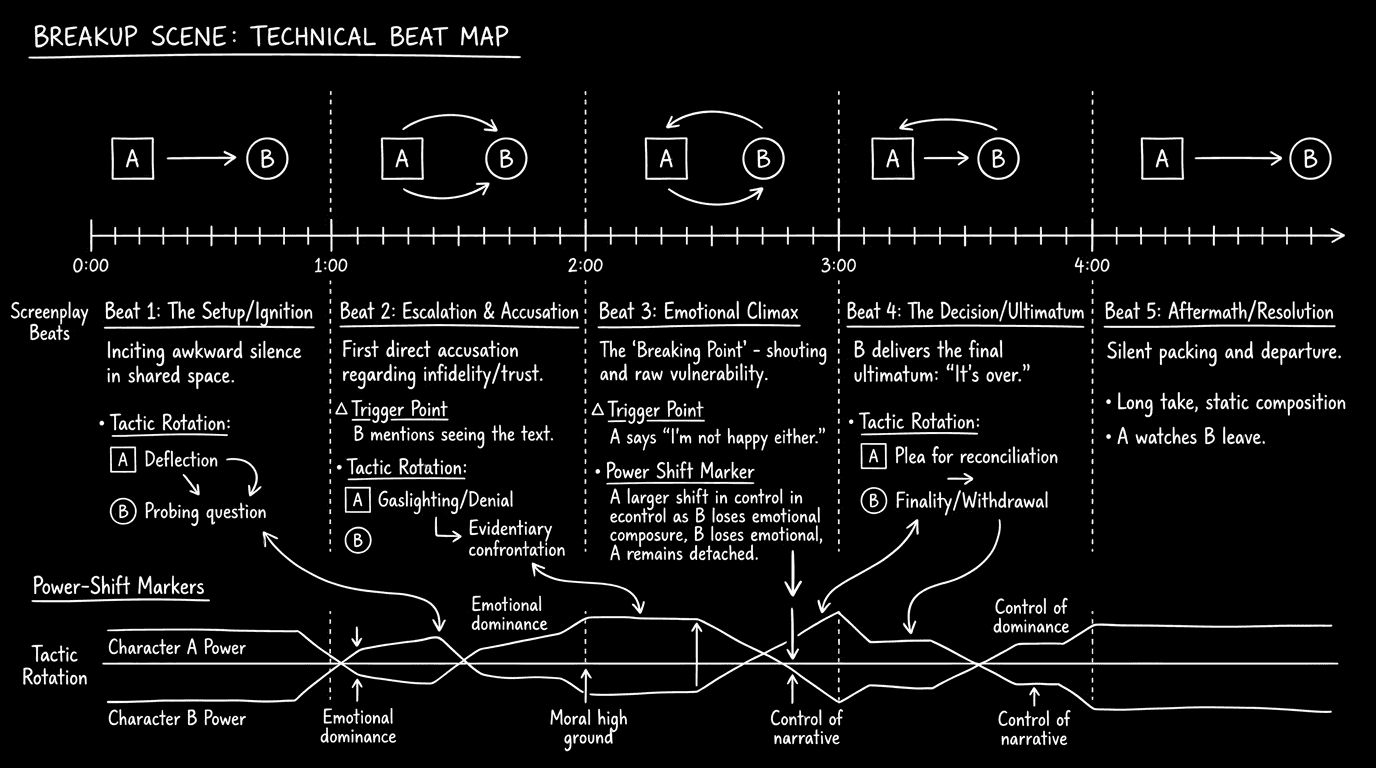
A strong breakup scene runs on four engines simultaneously: objective conflict, tactical variation, power transfer, and irreversible consequence. If any engine stalls, the scene drifts toward cliche.
Objective conflict means each person wants a different outcome in the immediate scene, not just in the relationship. One wants closure tonight. The other wants postponement. One wants clarity. The other wants ambiguity because ambiguity preserves optionality.
Tactical variation means emotional strategy changes under pressure. A character may start with reason, switch to nostalgia, then use shame, then retreat into composure. That movement prevents repetitive dialogue loops.
Power transfer means relational control moves back and forth. Who frames the meaning of events? Who asks the questions? Who decides whether they sit or stand, stay or leave, keep talking or cut the conversation?
Irreversible consequence means the scene does not merely release emotion. It changes the narrative state. Someone moves out. A wedding is canceled. A shared project collapses. A co-parenting arrangement begins under duress. A secret finally becomes common knowledge.
A breakup scene is not the end of love. It is the end of one story both people agreed to tell about love.
Scenario One: The "Polite Apartment Breakup" That Feels Dead
You have probably written this version at least once. Two characters sit in a tidy apartment. One says, "I think we both know this is not working." The other nods and tears up. They exchange a few poetic lines about growing apart. Then one leaves.
Nothing is technically wrong.
Everything is dramatically flat.
Why? Because no one is fighting for a specific immediate objective. Both characters are already emotionally at the same destination by page one of the scene. There is no tactical conflict and no uncertainty about outcome.
To fix this, you need asymmetry.
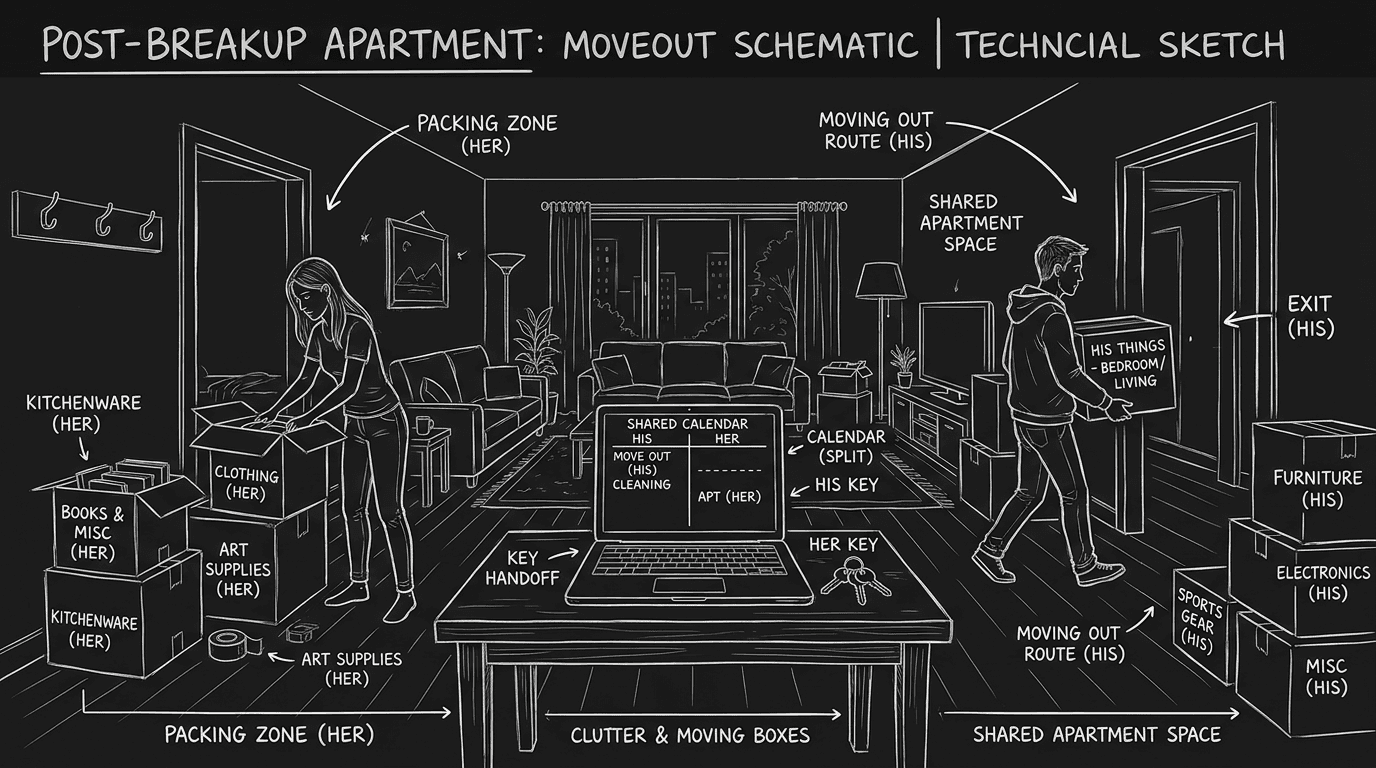
In a living version of this scene, one character arrives expecting reconciliation and discovers the breakup is already administratively underway. Their books are in labeled boxes. The streaming passwords are changed. The lease email is drafted but unsent. Suddenly the scene is not "we should break up." The scene is "you already left while pretending you were still here."
That is playable for actors. That is readable for executives. That is memorable for the audience.
Scenario Two: The "Public Restaurant Breakup" That Turns Theatrical
Another classic beginner setup: a crowded restaurant, wine glasses, emotional confrontation. It sounds cinematic, but it often becomes stagey because writers treat the extras as wallpaper and forget the social mechanics of public shame.
A breakup in public is not just two people speaking loudly. It is two people managing self-image under surveillance.
One character keeps their voice low because they do not want to be "the dramatic one." The other weaponizes composure: smiling while saying something devastating. A waiter arrives at the worst possible beat and asks if they are ready to order dessert. The scene's pressure comes from interrupted performance, not just emotional content.
If you want this setup to avoid cliche, write the social choreography in detail. Track eyeline breaks, pauses caused by service interruptions, and the way each character edits language when strangers are close enough to hear.
The breakup becomes a duel between private truth and public behavior.
Scenario Three: The "Mutual Breakup" That Pretends To Be Mature
Beginners often try to avoid melodrama by writing "mature mutual breakups" where both people agree calmly that separation is best. This can work, but only if "mutual" does not mean "conflict-free."
Conflict still exists in mature scenes. It just shifts register.
A high-functioning breakup may revolve around logistics that carry emotional landmines. Who keeps the dog. Who tells the child first. Whether they attend the same family wedding next month. Whether one person can still use the other's health insurance through the end of the quarter.
These details sound mundane. They are not. They are where grief becomes concrete.
When you write this level of specificity, the scene gains authority. It stops sounding like generic relationship dialogue and starts sounding like two humans trying to dismantle a shared life without pretending the process is clean.
Workflow: Building the Scene Beat by Beat
Step 1: Define the Immediate Objective for Each Character
Before writing dialogue, write one sentence per character answering: what do they want by the end of this conversation, right now, tonight?
Not in life. In this scene.
Examples include securing permission to leave without guilt, forcing a confession, preserving dignity in front of others, delaying the breakup until after a critical event, or extracting one final act of care.
If both characters want the same thing, introduce asymmetry. Otherwise the scene will flatten.
Step 2: Choose the Rupture Trigger and Place It Late
A breakup scene needs a trigger beat that shifts the conversation from unstable to irreversible. Many beginners put it in the first ten lines. That drains momentum.
Place the trigger after at least one false stabilization beat.
In practical writing software terms, create a scene card titled "false normal" followed by a card titled "rupture evidence." In your draft, keep the rupture evidence out of the first 25 percent of the scene. This pacing rule forces build and prevents immediate emotional dumping.
Step 3: Map Tactic Rotation in a Two-Column Grid
Open your note pane and create two columns: Character A tactics, Character B tactics. Fill each with at least four modes, ordered from socially acceptable to emotionally desperate.
For example, Character A may move from reason to humor to accusation to withdrawal. Character B may move from apology to minimization to blame-shift to ultimatum.
During drafting, do not let either character repeat the same tactic more than twice in a row. This simple constraint eliminates repetitive dialogue faster than line-level polishing.
Step 4: Design Power Transfers Every 8-12 Lines
Mark your draft in chunks of roughly eight to twelve lines of dialogue and action. At the end of each chunk, ask: who currently controls the frame of reality in this scene?
If the same person controls every chunk, you do not have a dramatic breakup. You have a monologue with interruptions.
Power can transfer through information reveal, physical movement, refusal to answer, or unexpected calm. Write these as concrete action beats, not abstract stage directions.
Step 5: Engineer the Physical Environment as a Pressure System
Beginners treat location as decoration. Professionals treat location as leverage.
If the breakup happens in an apartment, decide where the exit points are and who blocks which path. If it happens in a parked car, track who holds the keys. If it happens over video call, track lag, camera angle, and the emotional violence of muting someone at the exact wrong moment.
In your scene settings panel, document three environmental constraints before writing the first line. Then force at least one of those constraints to matter by mid-scene.
Step 6: Write the Aftermath Beat in the Same Draft Session
Do not stop at the line "we are done."
Immediately draft the next short beat, even if it is only half a page. Someone walks back into a room and realizes the toothbrush is gone. Someone cannot unlock a shared note app because permissions changed. Someone rehearses what they will tell a parent and deletes every version.
This aftermath beat is where cliche dies. It proves the breakup altered narrative reality.
Comparison Table: Cliche vs Earned Breakup Construction
| Craft Dimension | Cliche Breakup Scene | Earned Breakup Scene |
|---|---|---|
| Trigger | Vague emotional declaration | Specific event or evidence with timing |
| Dialogue Rhythm | Repeated accusations and restatements | Tactic shifts, interruptions, silence with function |
| Power Dynamics | One long emotional speech | Ongoing frame control and reversal |
| Location Use | Generic backdrop | Environment actively affects choices |
| Stakes | "Relationship ends" in abstract | Concrete losses decided in-scene |
| Aftermath | Cut away immediately | Immediate behavioral residue on next beat |
Try it free
Try Screenweaver for free on your script
It is free. Import your existing project, get a clearer view of your outline, and regain control of your story structure in minutes.
Start FreeA Contrarian Truth About Tears on the Page
Writers often ask whether they should include crying in breakup scenes. The honest answer is yes, sometimes. But tears are not your dramatic engine. Tears are a byproduct.
Here is why that matters: if your scene only works when performed with maximal emotional display, the writing is weak. The scene should still read as devastating when played with restraint.
One of the strongest breakup reads you can stage as a writing exercise is this: remove every exclamation mark, remove every all-caps outburst, and cut explicit feeling labels like "heartbroken," "destroyed," or "shattered." If the scene still hurts, you built real dramatic structure. If it collapses, you were leaning on textual volume.
A breakup that reads quietly but lands hard is almost always better than a breakup that screams on the page and evaporates in memory.
The Trench Warfare Section: What Beginners Get Wrong, and How to Fix It Precisely
This is where the real progress happens.
Failure Mode 1: Generic Reasons
The dialogue uses floating reasons such as "we changed" or "I need space" without concrete referents. The fix is to anchor every major claim to at least one verifiable incident. If a character says trust is broken, attach it to a specific lie with date, context, and consequence.
Failure Mode 2: Simultaneous Emotional Clarity
Both characters articulate their feelings with perfect coherence. Real breakup scenes are cognitively uneven. One person may be emotionally prepared and rhetorically controlled while the other is still processing in real time. Write that asymmetry into sentence structure, interruptions, and delayed comprehension beats.
Failure Mode 3: Monotone Tactical Behavior
Characters keep attacking in the same way, usually accusation-response loops. Fix this by pre-assigning tactic ladders and forcing pivots after failed attempts. If accusation fails, move to evidence. If evidence fails, move to leverage. If leverage fails, move to withdrawal or self-exposure.
Failure Mode 4: No Material Stakes
The relationship ends, but no immediate practical cost appears. Add concrete decisions inside the scene: housing, finances, co-created work, caregiving obligations, social network fracture. Emotional stakes intensify when logistics become unavoidable.
Failure Mode 5: Over-Explained Backstory
Beginners dump relational history in long speeches to "justify" the breakup. But breakup scenes are payoff scenes, not exposition scenes. Move the exposition burden earlier in the script through planted behavior. In the breakup, reference history through short, loaded details that imply shared memory without narrating it.
Failure Mode 6: Decorative Action Lines
Writers add actions that do not alter power or stakes, such as random pacing and generic sighing. Keep only action that changes leverage: picking up keys, opening a door, deleting a photo album, sending a message, removing a ring, unlocking a drawer.
Failure Mode 7: Equal Verbal Competence
Every character speaks with the same polish. Break this pattern. One character may weaponize precise language while the other fragments under emotional load. One may avoid nouns entirely. One may ask questions instead of making claims. Voice contrast reduces cliche instantly.
Failure Mode 8: Ending on the Speech Instead of the Choice
The scene climaxes on a poetic line rather than an irreversible action. Make the final beat a decision executed in real time. A suitcase crosses the threshold. A call is made. A shared calendar is split. The key is not what they say. The key is what they do.
Failure Mode 9: No Residual Contamination in Next Scene
The script moves on as if the breakup was a contained emotional event. That feels false. In the next scene, show residue in behavior: missed cues, altered routines, overcompensation, reckless choices, numb efficiency. Residue is narrative credibility.
Failure Mode 10: Trying Too Hard to Sound "Cinematic"
Writers overstyle dialogue to imitate famous breakup moments from films. This creates borrowed tone and thin character specificity. Replace borrowed lines with language only your characters would say given their class background, education, humor style, and relationship history.
Failure Mode 11: Confusing Cruelty With Honesty
Some beginner drafts equate emotional brutality with truth. But unfiltered cruelty often reads one-note. Strong scenes layer contradiction: a painful statement followed by an instinctive act of care, or a kind sentence delivered for self-protection. Contradiction creates human texture.
Failure Mode 12: Ignoring Temporal Pressure
Breakups floating in timeless space feel theatrical. Add a clock. A train in twenty minutes. A child arriving from school. A deadline call from work. A landlord inspection. Time pressure forces decisions and prevents endless circular dialogue.
Failure Mode 13: Forcing Symmetry for Fairness
Writers fear that readers will "side too much" with one person, so they over-balance blame. Real breakups are rarely symmetrical in moment-to-moment behavior. Let empathy drift across the scene. The complexity is more compelling than artificial fairness.
Failure Mode 14: Writing a Breakup Detached From Genre
A breakup in a thriller should not feel like a breakup in a romantic comedy. Genre alters pacing, risk, and surrounding pressure. In thrillers, information security and danger proximity may dominate. In comedy, social embarrassment and timing mishaps carry weight. In drama, identity rupture often sits center frame.
Failure Mode 15: Using Silence as Empty Pause
Silence can be devastating, but only when motivated. Labeling "a long silence" repeatedly is dead air. Instead, tie silence to specific cognition or action: someone reads a text on the other's phone and says nothing, someone begins packing mid-conversation, someone cannot answer a direct question and stares at the floor vent as if it might open.
Body Image: Breakup Power-Shift Diagram
Operational Revision Pass: A Practical 45-Minute Drill
If you already drafted a breakup scene and it feels flat, run this exact pass.
Open your script editor and duplicate the scene into a scratch document. Set a 45-minute timer. For the first 10 minutes, strip all dialogue and keep only action lines plus one-line intent notes per beat. If the emotional arc still makes sense, good. If not, your scene depended on dialogue cosmetics instead of dramatic structure.
For the next 15 minutes, rebuild dialogue with a hard constraint: every new line must either introduce new information, change tactic, or alter leverage. If a line does none of those, cut it immediately.
For the next 10 minutes, audit environment leverage. Add at least two concrete objects or spatial constraints that affect choices. A staircase that amplifies distance. A locked drawer. A rideshare notification arriving mid-argument. Make the space participate.
For the final 10 minutes, write a six-line aftermath beat and place it directly after the breakup scene in your timeline. This protects you from the beginner habit of ending on emotional rhetoric instead of consequence.
When this drill works, your pages feel less "written" and more observed.
Industry Calibration: What Readers and Development Execs Notice Fast
People reading scripts at volume have seen hundreds of breakup scenes. They can smell formula in one page.
What impresses them is not originality for its own sake. It is precision under emotional pressure. They notice when your characters fight about something concrete. They notice when every beat changes the scene state. They notice when the breakup has structural ripples beyond itself.
If you want an external craft benchmark for scene pressure and subtext, the WGA Library resources are useful for studying produced scripts across genres, and this link should be treated as nofollow in publication markup.
As discussed in our guide on [how to write a confession scene in a thriller], the exact timing of truth release can transform a conversation from flat to electric. The same principle applies here.
If your breakup happens under social observation, our companion piece on [how to write a public humiliation scene in a screenplay] can help you stage reputation pressure without reducing characters to caricature.
And when breakup logistics collide with family systems, the framework in [how to write a dinner party scene with hidden conflict] is useful for carrying unresolved rupture into ensemble scenes.
Body Image: Aftermath Logistics Scene
YouTube Placeholder
[YOUTUBE VIDEO: A side-by-side rewrite session showing a cliche breakup draft transformed into an earned breakup scene through tactic rotation, trigger timing, and consequence-focused aftermath writing.]
Ending Perspective: Write the Cost, Not the Slogan
You do not need louder dialogue to write a memorable breakup.
You need sharper consequence.
When beginners ask how to avoid cliche, they usually ask about lines. Which words to choose. Which phrases to avoid. Whether a speech sounds poetic enough.
That is the wrong layer.
The right layer is design.
Design the trigger. Design the leverage shifts. Design the irreversible action. Design the residue in the next scene. Once that architecture is solid, the dialogue does not need to perform miracles. It only needs to be true to character under stress.
A breakup scene that lands is not a quote machine. It is a structural turning point that changes who these people are allowed to be in the story from this moment forward.
Write that turning point with specificity and nerve, and your scene will stop feeling borrowed.
It will feel lived.
Final Step
Build your next script with Screenweaver
Move from ideas to production-ready pages faster with timeline-native writing and AI-assisted story flow.
Try Screenweaver