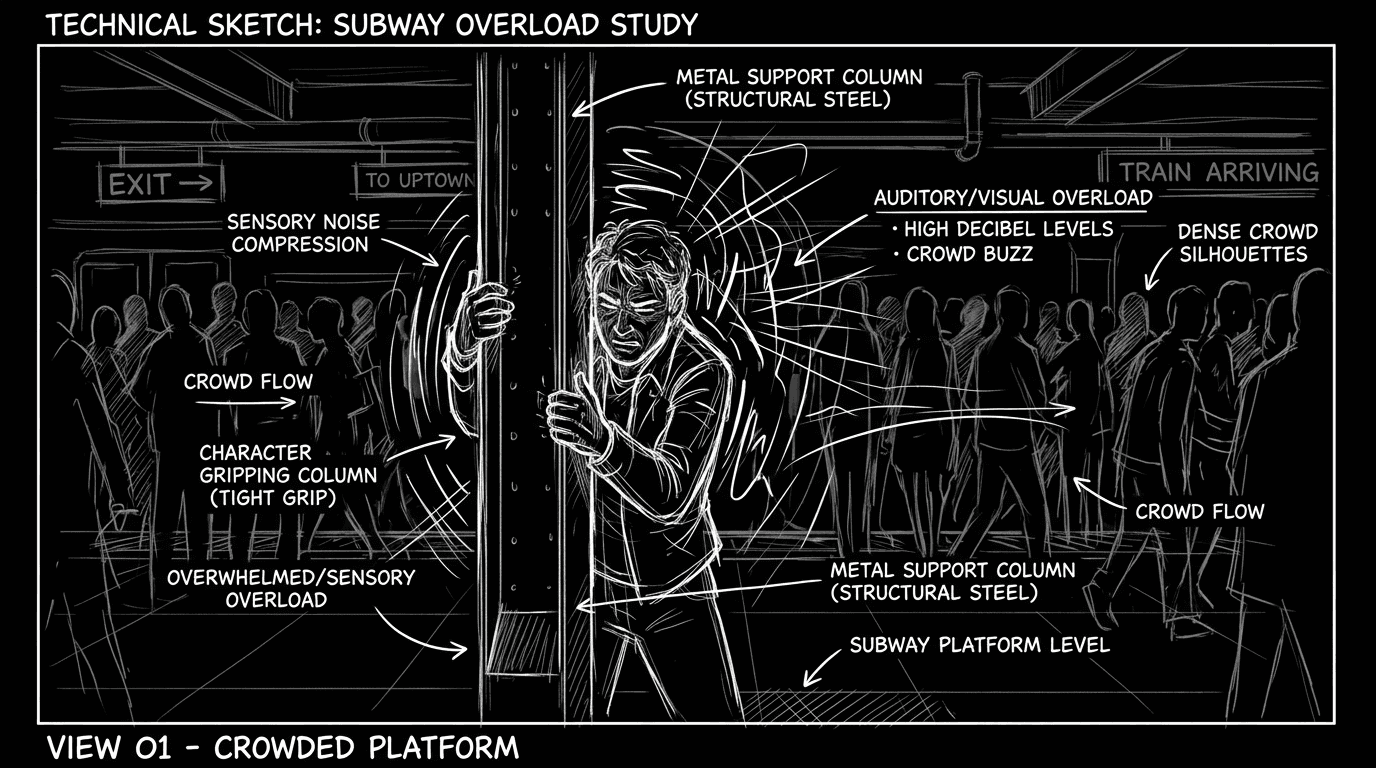

The worst panic attack scenes are loud.
Not loud in the way panic feels loud, but loud in the way writing gets loud when it does not trust itself. Too many italics. Too many capital letters. Too many lines saying the character is panicking.
Readers do not need to be told a character is panicking fifteen times.
They need to feel a nervous system losing reliable signal.
That is the craft challenge.
A panic attack scene is not just "high emotion." It is a specific physiological and cognitive event with pacing, distortion, and aftermath. If you write it as generic distress, it becomes melodrama. If you write it as clinical exposition, it becomes detached. The scene works when subjective experience and external readability are both present at once.
Here is why that matters: panic attacks in stories are often turning points for identity, trust, and perceived control. If the scene is cliche, the character arc weakens. If the scene is precise and humane, the entire narrative gains credibility.
Write for precision.
Write for dignity.
Write for consequence.
Why Panic Attack Scenes Often Feel False
Most weak scenes fail because writers confuse intensity with authenticity.
They pile on dramatic symptoms without rhythm. They ignore trigger specificity. They treat panic like a theatrical event that appears and disappears on cue. Or they frame the character as helpless spectacle for other characters to react to.
That framing is where many scripts lose empathy.
Panic attacks are not performance beats. They are involuntary episodes with deeply personal patterns, often shaped by context, history, and coping strategies. Two characters can both have panic attacks and experience them very differently. One dissociates. Another gets tunnel hearing. Another fixates on cardiac fear. Another becomes hyper-verbal to maintain control.
Think about it this way: if you can swap your panic scene into any script with no changes, it is not specific enough yet.
A believable panic attack scene is written from pattern, not stereotype.
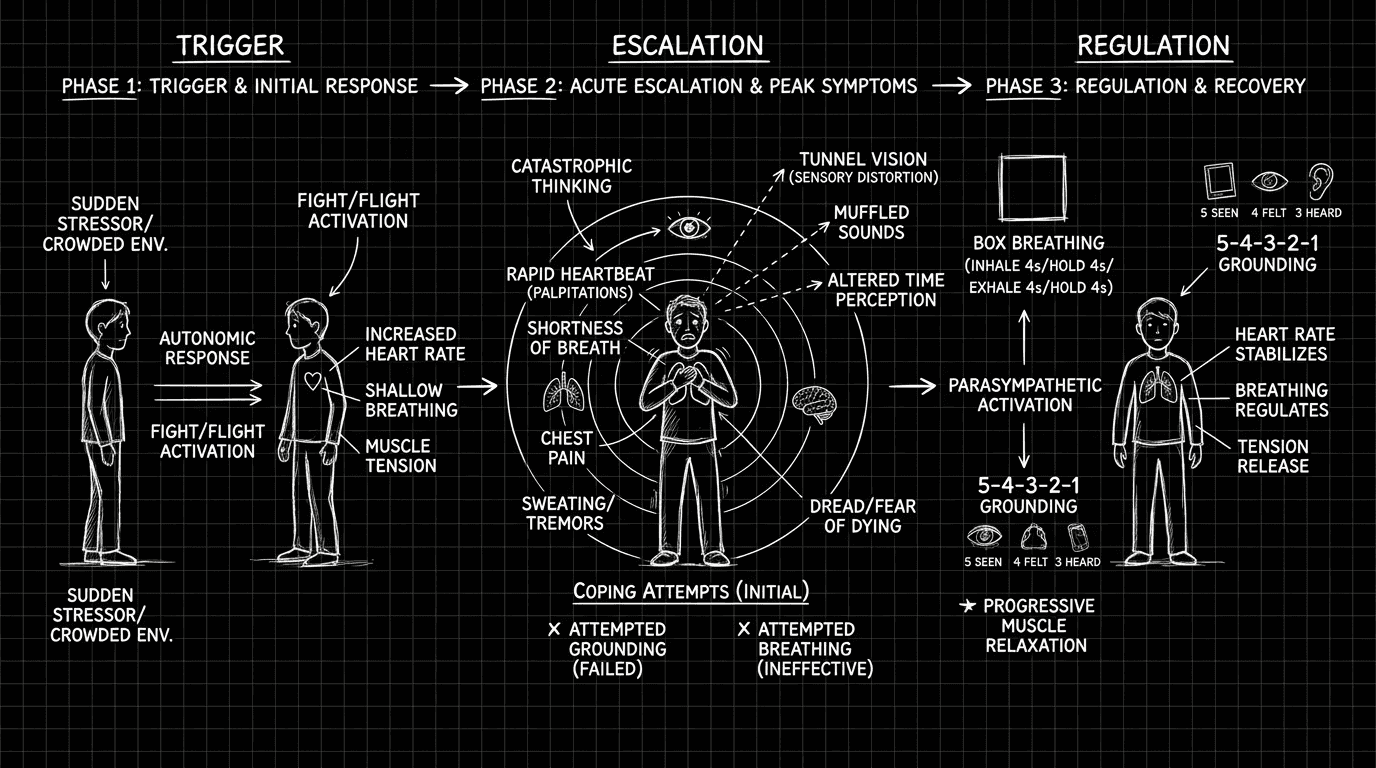
The Core Model: Trigger, Escalation, Threshold, Regulation, Residue
Write panic attack scenes in phases.
Trigger is the initiating condition. External, internal, or both.
Escalation is the mounting distortion in body, breath, and cognition.
Threshold is the moment where control strategies fail or must change.
Regulation is the attempt to re-establish safety and orientation.
Residue is the aftereffect: fatigue, shame, relief, avoidance, or strategic adaptation.
Beginners often stop at threshold because that is the most dramatic beat. But without regulation and residue, scenes feel exploitative and incomplete.
The audience should not only witness collapse. They should witness process.
Scenario One: The Public Panic Attack That Becomes a Cliche Meltdown
A common beginner scene: character in crowded setting suddenly drops to the floor, gasps, people stare, friend yells "breathe!" Cut to next scene.
This version may look dramatic, but it often feels generic because environment, trigger, and subjective distortion are underwritten.
A stronger version maps sensory overload as sequence. Fluorescent flicker, layered announcements, compressed personal space, scent trigger, phone vibration with specific contact name, memory flash. The character tries micro-regulation first: counting tiles, pressing thumb to fingertip, grounding through texture. It fails. Escalation continues. A bystander misreads the episode as intoxication, adding social threat.
Now the scene has complexity and stakes, not just spectacle.
Scenario Two: The "Silent Panic" That Is Invisible to Everyone
Not all panic attacks are overt. Many are masked.
Beginner scripts often miss this and assume panic always looks obvious. In professional writing, masked panic can be incredibly powerful because the character is performing normalcy while internal systems crash.
Example: during a boardroom pitch, a character maintains eye contact and keeps speaking, but syntax fragments, grip pressure on pen increases, hearing narrows, and they anchor on one irrelevant visual detail to avoid spiraling.
No one in room understands what is happening.
That can be devastating on page when written with restraint.
Scenario Three: The Trauma-Linked Panic Scene That Over-Explains Backstory
Writers sometimes interrupt panic scenes with explanatory flashbacks and dialogue that narrate trauma in real time. This often kills immediacy.
Better approach: let trigger association emerge through selective sensory echoes and post-scene revelation, not full exposition in peak episode.
You can imply history through one high-signal detail: scent, phrase, metal clank, song fragment, medication bottle, route map, hand position. Then unpack context in later scene when cognition is more stable.
This protects pace and respects psychological realism.
Step-by-Step Workflow for Writing a Panic Attack Scene That Reads True
Step 1: Define the Character's Panic Pattern
Before drafting, write a private profile for this character:
common triggers,
first body cues,
cognitive distortion style,
typical coping attempts,
post-episode behavior.
Do this once and keep it consistent across script. Consistency creates authenticity.
Step 2: Choose One Dominant Trigger Context
Do not stack unrelated triggers for convenience.
Pick one dominant context per scene: social confinement, authority pressure, sensory overload, trauma association, health anxiety, or performance collapse. Secondary factors can exist, but dominant context keeps scene legible.
Step 3: Write Escalation in Sensory Hierarchy
Instead of generic "panic intensifies," script sensory hierarchy shifts.
Breath changes.
Auditory field narrows or distorts.
Visual focus fragments.
Time perception warps.
Motor control alters.
This creates embodied progression without melodramatic prose.
Step 4: Stage Failed Coping Attempt Before Peak
A key realism beat: most characters attempt regulation before threshold.
Water sip.
Counting.
Grounding object.
Bathroom retreat.
Texting trusted contact.
When attempt fails, escalation feels earned.
Step 5: Decide Who Understands What in the Scene
Information asymmetry drives drama.
Who knows this is a panic attack?
Who misreads it as anger, weakness, manipulation, or medical emergency?
Who sees just enough to intervene badly?
These perception gaps generate conflict and character revelation.
Step 6: Write Regulation as Action, Not Miracle
Regulation should not appear as one perfect line from another character.
Write grounded actions: reducing stimuli, orienting prompts, paced breathing cues, giving space, obtaining medication if established, removing audience pressure.
The goal is not instant cure. The goal is incremental re-regulation.
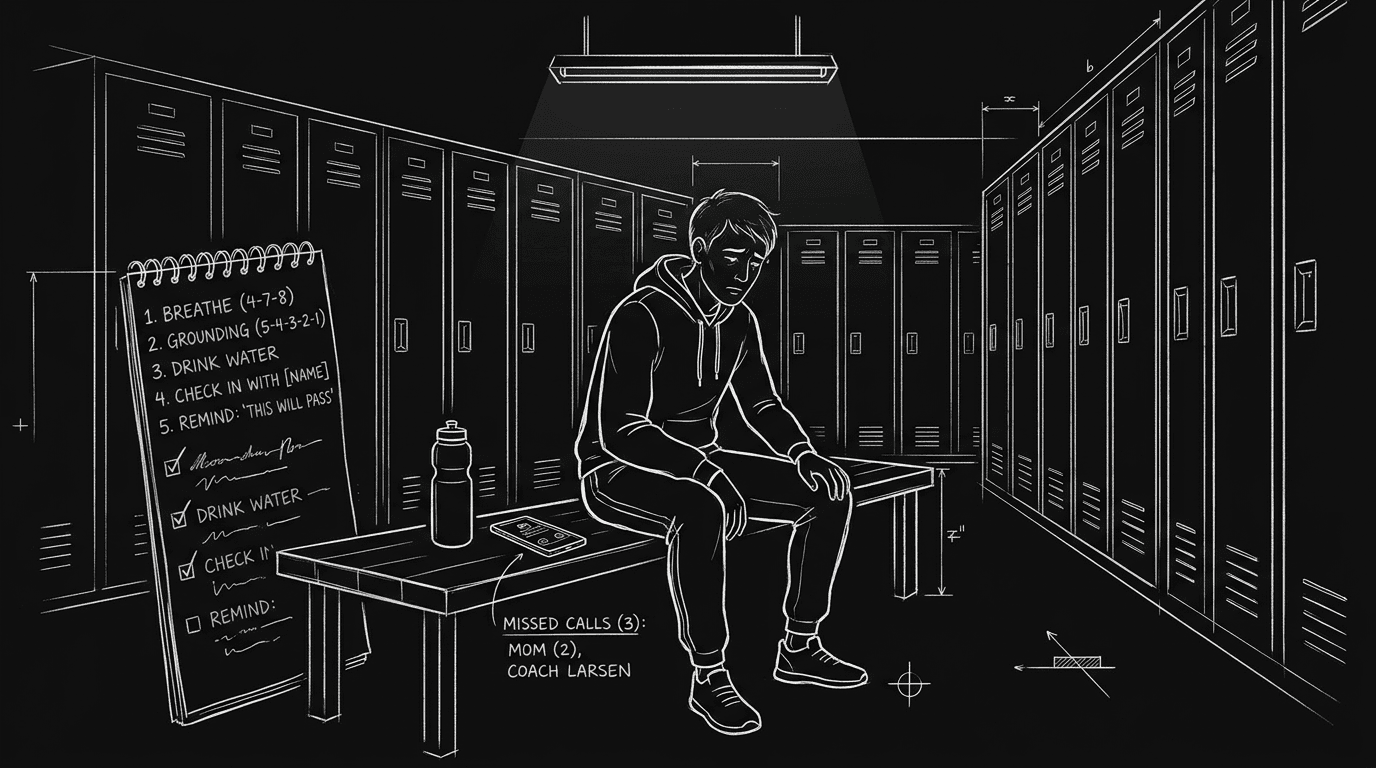
Step 7: Include Residue in the Next Beat
After panic, characters do not reset to neutral.
Add residue:
exhaustion,
embarrassment,
avoidance choices,
anger at loss of control,
new boundary setting.
Residue transforms panic scene from isolated event into arc catalyst.
Table: Cliche Panic Writing vs Precise Panic Writing
| Dimension | Cliche Version | Precise Version |
|---|---|---|
| Trigger | Vague sudden overwhelm | Specific contextual trigger chain |
| Symptoms | Generic hyperventilation only | Character-specific sensory and cognitive pattern |
| Scene rhythm | Instant peak, instant cut | Escalation, threshold, regulation, residue |
| Supporting cast | Spectators reacting loudly | Distinct perception and intervention errors |
| Dialogue | Repeated "calm down" lines | Targeted language tied to orientation and safety |
| Narrative impact | Isolated emotional beat | Changes behavior and decisions afterward |
The Trench Warfare Section: What Beginners Get Wrong (and Exact Corrections)
This is where scripts usually improve fastest.
Mistake one: writing panic as madness.
Panic is not psychosis. Do not conflate them. Correction: keep cognition distorted but reality contact broadly intact unless your story specifically establishes otherwise.
Mistake two: symptom bingo.
Writers list every symptom they can remember. Correction: choose a coherent pattern that fits this character's history.
Mistake three: no trigger.
Episode appears for plot convenience. Correction: establish clear precursor conditions in previous beats.
Mistake four: "calm down" dialogue spam.
Characters repeat unhelpful commands. Correction: replace with grounding-oriented, low-demand prompts.
Mistake five: no failed self-regulation attempt.
Character jumps to full collapse. Correction: stage at least one self-managed effort before threshold.
Mistake six: aestheticized suffering.
Prose romanticizes pain. Correction: use concrete, respectful sensory detail without fetishizing distress.
Mistake seven: panic as plot punishment.
Scene used to humiliate character with no narrative function. Correction: tie episode to meaningful arc shift or relationship truth.
Mistake eight: magical recovery.
Character fully stable after one breath. Correction: show staggered return and residual effects.
Mistake nine: background extras with no social behavior.
Crowds freeze unrealistically. Correction: add plausible mixed reactions: concern, confusion, avoidance, misinterpretation.
Mistake ten: no environmental engineering.
Scene ignores space constraints. Correction: use noise, light, crowd flow, exits, temperature, and confinement as dynamic variables.
Mistake eleven: overuse of typography tricks.
All caps and punctuation carry whole scene. Correction: reserve formatting intensity for select beats; rely on action logic.
Mistake twelve: diagnostic exposition in peak moment.
Character explains clinical state mid-spiral. Correction: keep language simple and immediate during episode, save interpretation for aftermath.
Mistake thirteen: one-size-fits-all helper character.
Friend always knows exactly what to do. Correction: make helper imperfect, learning, or constrained.
Mistake fourteen: panic scene disconnected from genre stakes.
In thriller, panic may compromise mission timing. In drama, it may expose family fault lines. In workplace story, it may alter power and reputation. Correction: link episode to genre engine.
Mistake fifteen: no consent awareness in intervention.
Helpers physically restrain without narrative awareness. Correction: write intervention choices with respect for boundaries, safety, and context.
Mistake sixteen: forgetting internal language collapse.
Dialogue remains polished during peak. Correction: let syntax simplify, restart, or fragment according to stress state.
Mistake seventeen: no aftermath behavior change.
Character returns to same environment unchanged. Correction: script avoidance or adaptation strategy that influences next scenes.
Mistake eighteen: using panic as twist gimmick.
Episode inserted to create fake suspense. Correction: treat panic as character truth with causality, not decoration.
Mistake nineteen: no physical consequence.
No tremor, fatigue, throat pain, headache, or depleted energy post-episode. Correction: add one or two realistic bodily residues.
Mistake twenty: writing from assumptions, not observation.
Scenes reflect media stereotypes only. Correction: research lived experiences and clinical guidance, then translate into character-specific craft decisions.
The most respectful panic attack scenes are also the most cinematic: specific, embodied, and consequential.
Try it free
Try Screenweaver for free on your script
It is free. Import your existing project, get a clearer view of your outline, and regain control of your story structure in minutes.
Start FreeBody Image: Panic Escalation and Regulation Map
Practical 55-Minute Rewrite Drill
Take your current panic attack scene and apply this pass.
First ten minutes: delete all explicit feeling labels and keep only observable behavior plus concise internal cues.
Next ten minutes: insert trigger chain details from environment and context.
Next ten minutes: add one failed self-regulation attempt before peak.
Next ten minutes: rewrite helper dialogue into grounding prompts and remove repetitive commands.
Next ten minutes: draft six lines of residue in following beat.
Final five minutes: connect residue to next scene objective shift.
This drill turns panic writing from melodramatic spike into narrative process.
Advanced Calibration: Pacing, Page Space, and Readability
Page design matters in panic scenes.
Dense blocks can mimic pressure, but too much density exhausts readers. Fragmented lines can mimic breath disruption, but over-fragmentation looks gimmicky. Use controlled variation.
Short action lines during escalation increase urgency.
Slightly longer lines during regulation can signal cognitive re-stabilization.
Silence beats should be purposeful, not decorative.
This is where experienced writers separate scene intensity from visual noise on the page.
For external script-study resources, the Writers Guild Foundation Library is useful and should be treated as a nofollow link in publishing configuration.
As discussed in our guide on [how to write a hostage negotiation scene], pressure becomes credible when objectives evolve and each line changes risk state.
If your panic episode happens in social exposure context, the mechanics from [how to write a public humiliation scene in a screenplay] can sharpen witness behavior and status fallout.
And when panic follows betrayal or trust collapse, our framework in [how to write a betrayal reveal scene] helps connect psychological shock to strategic decisions.
Body Image: Residue in the Next Scene
YouTube Placeholder
[YOUTUBE VIDEO: A craft breakdown rewriting a stereotypical panic attack scene into a psychologically accurate, consequence-driven sequence with clear trigger, escalation, and residue.]
Extra Deep Dive: Writing Support Characters Without Making Them Saviors
Support characters are where many panic scenes become unintentionally reductive.
Writers often create a "perfect helper" who appears, says exactly the right line, and resolves the episode. This can flatten both characters. The person in distress becomes passive object. The helper becomes narrative device.
A stronger approach gives helpers limitations.
They may care but misunderstand.
They may know one coping strategy but not when to use it.
They may panic themselves, overtalk, or freeze.
They may have history that complicates trust in that moment.
This does not weaken compassion. It humanizes it.
One practical technique is intervention laddering. Write helper behavior in escalating appropriateness:
first attempt slightly miscalibrated,
second attempt corrected by feedback,
third attempt aligned with character needs.
This creates relational realism and avoids miracle interventions.
Another valuable technique is boundary-aware dialogue. Instead of commanding touch or breathing, helpers can ask low-friction permission and offer options:
"Do you want me here or farther back?"
"Can we move somewhere quieter?"
"Do you want me to talk, or just stay with you?"
These lines preserve agency, which is often central to post-panic recovery.
If the story includes recurring episodes, track helper learning across scenes. A character who intervenes poorly in act one can become more skillful in act three. That arc itself can carry emotional payoff, because it signals relationship adaptation rather than static roles.
Finally, remember that sometimes no helper is present. Self-regulation scenes can be extraordinarily powerful when written with concrete internal strategy and environmental interaction. A character using floor texture, temperature cues, counted objects, or rehearsed phrases to regain orientation can be just as dramatic as any rescue beat.
Support is not only who is beside them.
Support is also what tools they have built, remembered, and trusted under pressure.
Ending Perspective: Write the Nervous System, Not the Trope
If your panic attack scene feels cliche, do not start with bigger words or bigger typography.
Start with pattern.
Trigger pattern.
Escalation pattern.
Coping pattern.
Recovery pattern.
Then connect that pattern to story consequence.
A panic attack scene should never exist only to prove a character is fragile. It should reveal what pressure does to this person, what support systems fail or hold, and what new choices emerge after the episode.
Write that honestly, and the scene will stop feeling performative.
It will feel lived.
And readers can tell the difference immediately.
Final Step
Build your next script with Screenweaver
Move from ideas to production-ready pages faster with timeline-native writing and AI-assisted story flow.
Try Screenweaver