

The film is ending. The protagonist stares into the sunset. Their voice rises:
"I learned that the real treasure was the friends we made along the way. In the end, family is what matters. And maybe, just maybe, if we all work together, we can change the world."
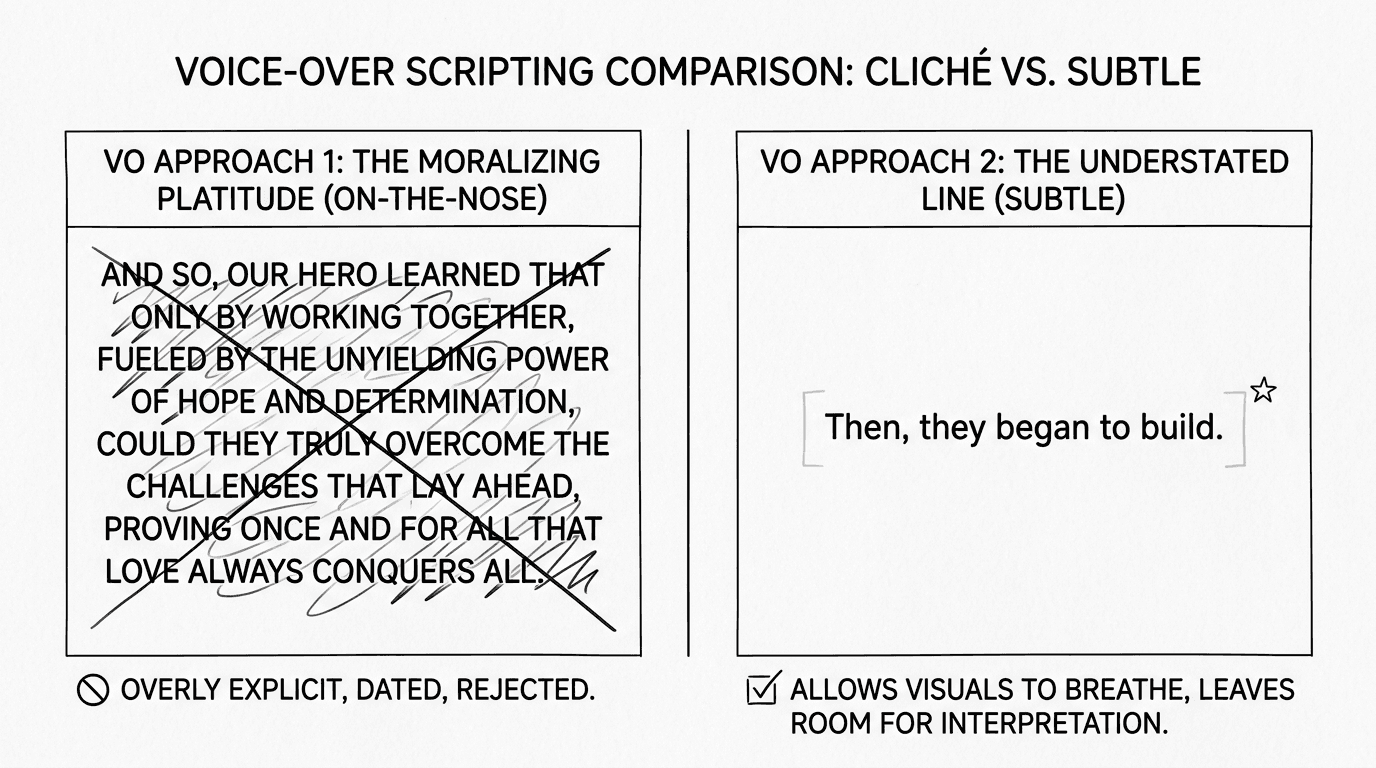
The audience groans. What was a resonant film has become an after-school special. The ending voice-over has committed the cardinal sin: explaining the moral.
Ending voice-overs are powerful tools. They can land emotional punches, provide reflection, and send audiences home with a feeling. But they're also dangerous, they invite overexplanation, simplification, and the dreaded "moral of the story" effect.
This guide covers how to write ending voice-overs that resonate without reducing your story to a greeting card.
Cinematic workflow frames

These two visuals work as a pair: the first shows Cinematic workflow still, first angle, 35mm film grain, and the second shifts to Cinematic workflow still, second angle, 35mm film grain - compare them briefly, then move on.

Why Ending Voice-Overs Go Wrong
The ending voice-over is positioned at the moment of maximum vulnerability. The story is over. The audience is processing. Whatever you say here has amplified weight.
This amplification is double-edged:
A good ending voice-over deepens what the audience already feels, adding resonance without dictation.
A bad ending voice-over tells the audience what to feel, reducing complex experience to simple message.
The problem is usually:
- Over-explanation. Saying what the story already showed.
- Simplification. Reducing nuance to a lesson.
- Closure addiction. Trying to tie up every emotional thread.
The fix is restraint, ambiguity, and trust in your audience.
What Makes an Ending Voice-Over Work
It reflects rather than explains. The character thinks aloud about what happened, without naming the theme.
It raises questions rather than answers them. The audience leaves with something to consider, not a resolved equation.
It echoes earlier dialogue or imagery. Connection to prior moments creates resonance without exposition.
It's tonally consistent. The voice-over sounds like the character, not the writer delivering a message.
It lets visuals do work. The voice-over and images are in conversation, not redundancy.
A Table: On-the-Nose vs. Resonant Ending Voice-Overs
| On-the-Nose | Resonant |
|---|---|
| "I finally understood that love means sacrifice." | "I never saw her again. But I think about what she said, every day." |
| "Home wasn't a place. It was the people around me." | "The house is empty now. But sometimes I still hear them." |
| "We all have to face our fears if we want to grow." | "I'm still afraid. I'm just not running anymore." |
| "In the end, the truth set us free." | "I don't know if I did the right thing. I just know it's done." |
The right column doesn't explain. It evokes. The audience does the interpretive work.
Technique #1: Reflection Without Conclusion
The character reflects on what happened without naming the lesson:
Example:
MARCUS (V.O.) I used to think I knew what I wanted. A bigger house. A better job. Something to prove I wasn't like my father.
We see Marcus sitting on a porch, watching his kids play.
MARCUS (V.O.) (CONT'D) I don't know when it changed. I just know it did.
No "I learned that family matters." Just reflection. The audience infers the lesson from the gap between past want and present reality.
Technique #2: The Unanswered Question
End with uncertainty rather than certainty:
Example:
ELENA (V.O.) People ask if I regret it. I tell them I don't know. How do you regret something that made you who you are?
We see Elena alone on a train platform, watching a train depart.
ELENA (V.O.) (CONT'D) I still wonder what she's doing now. If she's happy. If she ever thinks about that summer.
The voice-over doesn't resolve. It lingers. The audience carries the uncertainty.
Technique #3: The Echo
Call back to earlier dialogue or imagery:
Example:
Early in the film, a character says: "You can't run forever."
Ending voice-over:
JAMES (V.O.) She was right. I couldn't run forever. But I could run far enough.
We see James on a beach, somewhere distant, somewhere new.
The echo creates structural resonance without explanation. The audience remembers the earlier moment; the callback lands.
Try it free
Try Screenweaver for free on your script
It is free. Import your existing project, get a clearer view of your outline, and regain control of your story structure in minutes.
Start FreeThe "Trench Warfare" Section: What Goes Wrong
Failure Mode #1: Stating the Theme
"This story was about redemption." "I finally learned that hope is always possible."
How to Fix It: Never name the theme. The theme is what the story means; the voice-over should evoke, not label.
Failure Mode #2: Universal Platitudes
"We're all just trying to find our way." "Life is short, live it fully."
How to Fix It: Be specific. Specific to this character, this story. Universal resonance comes from specificity, not abstraction.
Failure Mode #3: Resolving What Should Stay Ambiguous
The film's power came from ambiguity, but the voice-over closes it: "In the end, she really was innocent."
How to Fix It: Let ambiguity stand. The voice-over can acknowledge complexity without resolving it. "I still don't know the truth. Maybe that's the point."
Failure Mode #4: Voice-Over Contradicts Visuals
The character says they're at peace; the visuals show them crying.
How to Fix It: This can be intentional irony, but if unintentional, it confuses. Align voice-over and image, or use the contrast deliberately.
Failure Mode #5: Too Long
The voice-over runs for three minutes. The film ended two minutes ago.
How to Fix It: Short and precise. Ending voice-overs should be a final breath, not a second wind.
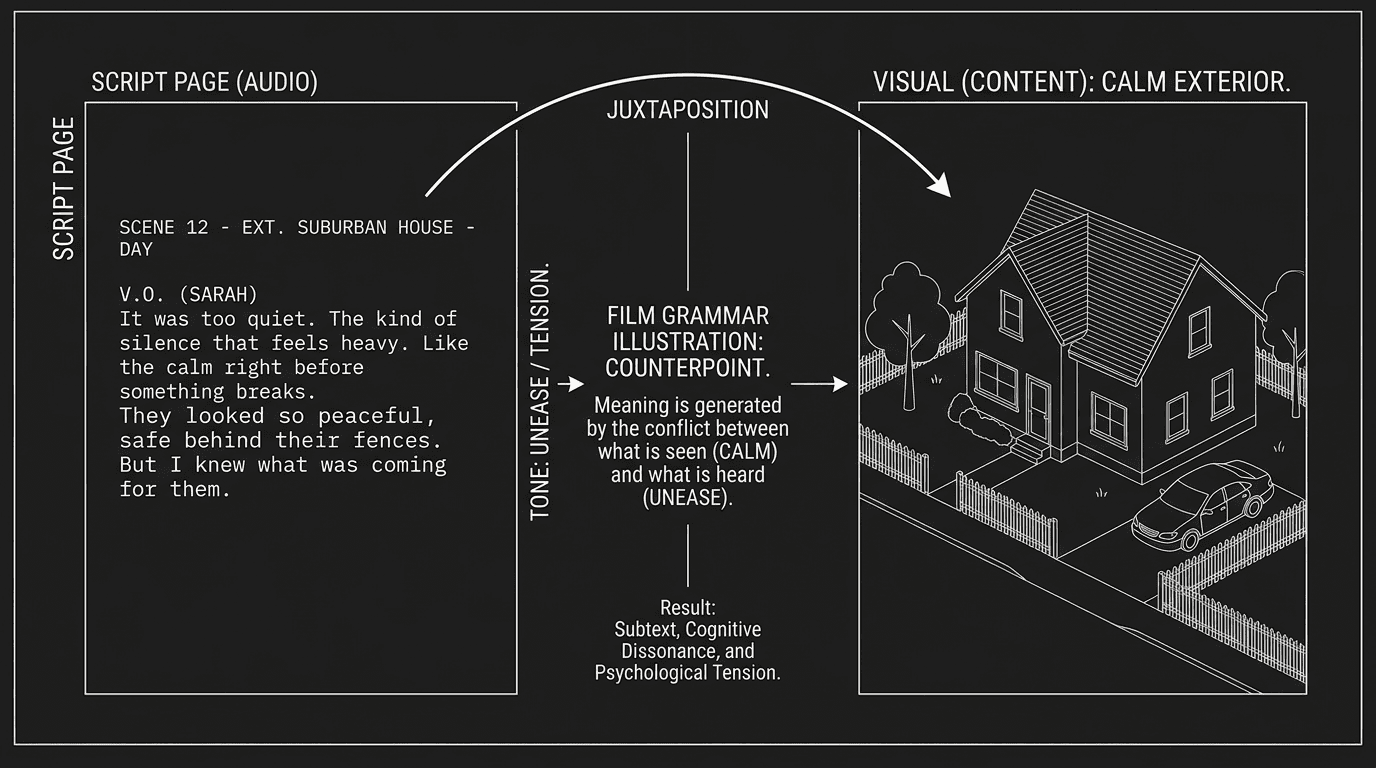
Visual Counterpoint: Voice-Over and Image
The best ending voice-overs use visuals to add layers:
Agreement: The voice-over reflects peace; the image shows the character at peace.
Counterpoint: The voice-over reflects hope; the image shows the character alone, uncertain. The tension creates depth.
Irony: The voice-over says one thing; the image suggests another. The audience reads between.
Example of counterpoint:
ANNA (V.O.) I told myself it was over. That I could move on.
We see Anna standing at a window, looking out at nothing.
ANNA (V.O.) (CONT'D) Maybe one day I'll believe it.
The image undercuts the words. She's not moving on, not yet. The gap is where the emotion lives.
When NOT to Use Ending Voice-Over
Not every film needs one. Consider alternatives:
Silence. Sometimes the best ending is no words at all. The final image speaks.
Dialogue. A final exchange between characters can land harder than internal monologue.
Action. The character does something, a gesture, a departure, a decision, that conveys everything.
Use voice-over when reflection serves the story. Don't use it because you feel obligated to sum up.
Case Study: American Beauty
The ending voice-over of American Beauty works because it doesn't explain the film's meaning, it evokes the character's perspective:
"I guess I could be pretty pissed off about what happened to me... but it's hard to stay mad when there's so much beauty in the world."
Notice: No "the moral is..." No "I learned that..." Just a character reflecting on his experience, with specific imagery (plastic bags, his daughter, his wife). The voice-over is emotional, not didactic. The audience extracts meaning; the film doesn't deliver it pre-packaged.
Case Study: The Shawshank Redemption
Red's ending voice-over is about hope:
"I hope to see my friend and shake his hand. I hope the Pacific is as blue as it has been in my dreams. I hope."
Why does it work? The word "hope" carries the whole film, but it's earned. The story built toward this moment. Red's voice-over doesn't explain what hope means; it expresses hope itself.
The Perspective: Trust Your Audience
The ending voice-over is a moment of trust. You're handing the audience your final words and trusting them to feel without being told.
The "moral of the story" effect happens when writers don't trust. They worry the audience won't get it, so they explain. They worry the emotion won't land, so they underline it. The result is a film that talks down to its viewers.
The best endings trust. They offer reflection, not resolution. They raise questions, not answers. They evoke, they suggest, they imply, and they leave the rest to the audience.
Your job isn't to teach a lesson. It's to create an experience that stays with them after the credits roll.
Trust that you did.
[YOUTUBE VIDEO: A video essay analyzing iconic ending voice-overs, comparing those that work to those that over-explain, and what writers can learn from both.]
Further reading:
- For writing internal states in action lines, see the unfilmable action line: writing what can't be seen.
- If you're working on visual storytelling, see the before/after scene: showing status change without dialogue.
- Lessons from the Screenplay has analyses of ending techniques at youtube.com/@LessonsFromTheScreenplay{:rel="nofollow"}.
Final Step
Build your next script with Screenweaver
Move from ideas to production-ready pages faster with timeline-native writing and AI-assisted story flow.
Try Screenweaver