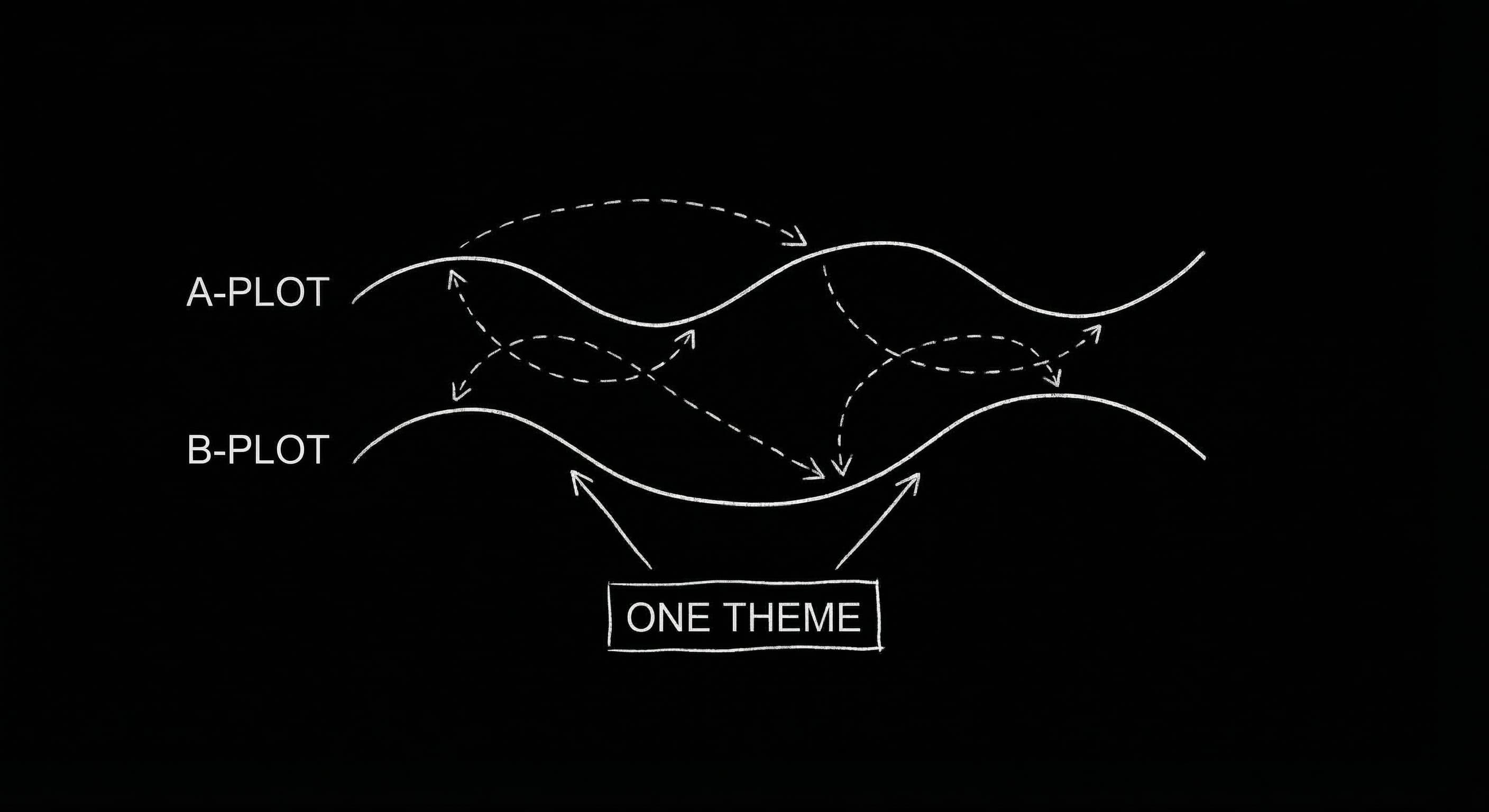

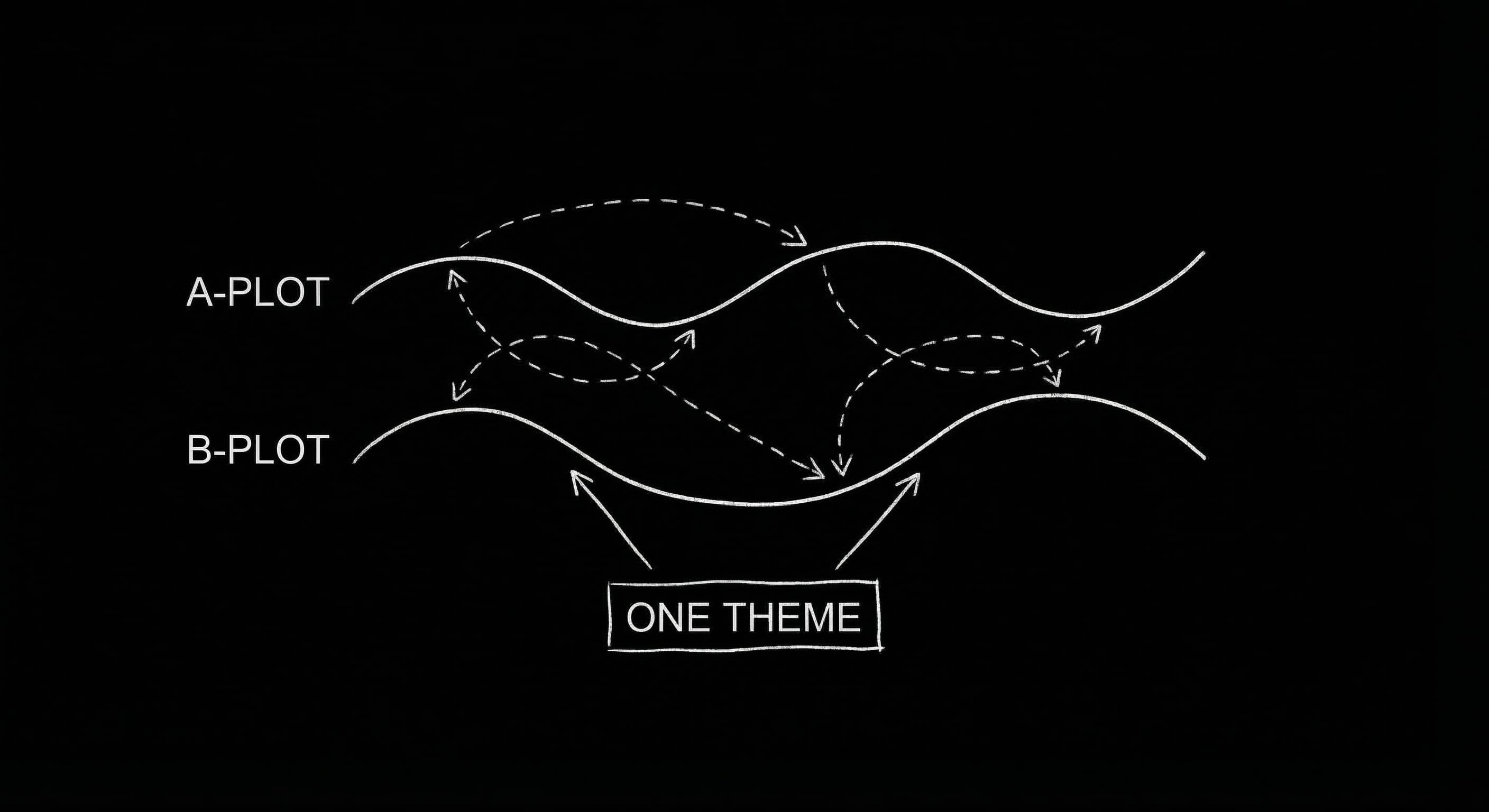
The A-plot is the heist. The B-plot is the detective’s failing marriage. They’re not separate. They’re the same story at different scales. Thematic resonance is when the B-plot doesn’t just run beside the A-plot,it echoes it. Same question. Same flaw. Same cost. When you get it right, the audience feels the whole show tighten. When you get it wrong, the B-plot feels like filler. So the choice isn’t “do I have a B-plot?” It’s “what is my B-plot saying about the same thing the A-plot is saying?”
The B-plot isn’t a subplot. It’s the theme in a different key.
Think about it. In The Godfather, Michael’s story is power and family. The B-plots,Sonny’s temper, Connie’s marriage, the Don’s refusal to get into drugs,all orbit the same question: what does family cost, and what will you do to protect it? In a procedural, the case of the week might mirror the lead’s personal struggle. They’re not two stories. They’re one argument, twice. So when you structure the B-plot, you’re not just filling time. You’re asking: what theme does my A-plot carry? And what version of that theme can the B-plot play in a smaller, more intimate register?
What Thematic Resonance Actually Is
Thematic resonance means the B-plot explores the same idea or question as the A-plot, but in a different context. The A-plot might be external (the mission, the case, the goal). The B-plot might be internal (the relationship, the secret, the flaw). Same theme. Different arena. So when the A-plot asks “can you win without losing yourself?” the B-plot might ask “can you love without losing yourself?” We’re not repeating the plot. We’re deepening the theme. The audience gets it even if they can’t name it. They feel the echo.
That doesn’t mean the B-plot has to resolve the same way. It can contrast. The A-plot ends in victory; the B-plot ends in loss. Or the other way around. The point is that the two strands are in conversation. They comment on each other. So when you outline, you don’t just slot “B-plot: relationship stuff.” You ask: what is the relationship about? And how does that connect to what the main story is about?
How to Find the Link
Start with the A-plot. What is it really about? Not the plot,the theme. Trust? Sacrifice? Identity? Power? Then ask: where does that same theme show up in the character’s personal life? If the A-plot is about the cost of loyalty, the B-plot might be about a friendship or a family bond that’s being tested. If the A-plot is about the danger of secrets, the B-plot might be about a lie the character is telling at home. The link doesn’t have to be obvious. It has to be felt. The audience should be able to say, after the episode, “the case and the relationship were both about the same thing.” That’s resonance.
| A-plot theme | B-plot echo (example) |
|---|---|
| Can you do the job and stay human? | Relationship where they’re losing the person they love |
| What do you sacrifice for the mission? | Family or friend who needs them and isn’t getting them |
| Who do you become when you have power? | Smaller power struggle at home or at work |
| Truth vs. protection | Lie they’re telling to someone they care about |
Once you have the link, you structure the B-plot so it has its own arc,setup, complication, climax,but the beats rhyme with the A-plot. When the A-plot hits a crisis, the B-plot might hit a crisis too. When the A-plot resolves (or doesn’t), the B-plot’s resolution should feel like part of the same argument. As discussed in our guide on the midpoint, the middle of the script is where the theme often deepens. The B-plot is one of the places that deepening happens.
Relatable Scenario: The Cop Drama
A-plot: The detective is chasing a killer who targets people who “don’t matter”,the homeless, the addicts. B-plot: Her brother is an addict. She’s been avoiding him. The case forces her to see the victims as people; the B-plot forces her to see her brother as a person. Same theme: who counts? The B-plot isn’t “she has a brother.” It’s “she has to face the same blindness in herself that the killer has.” When the A-plot climaxes,she saves someone she would have once written off,the B-plot can pay off: she picks up the phone and calls her brother. The two strands close the same loop. The audience feels the episode as one story.
Relatable Scenario: The Workplace Show
A-plot: The team has to land a client or the company folds. B-plot: The lead is lying to their partner about how bad things are. The A-plot is about survival and risk. The B-plot is about the cost of hiding,the same risk, at home. When the A-plot resolves (they get the client, or they don’t), the B-plot should move: the lie either deepens (and we feel the cost) or the character comes clean. The theme is “what do you hide to protect people, and what does it cost?” Both plots ask it. That’s resonance.
Try it free
Try Screenweaver for free on your script
It is free. Import your existing project, get a clearer view of your outline, and regain control of your story structure in minutes.
Start FreeThe Trench Warfare Section: What Beginners Get Wrong
B-plot as filler. The B-plot is “character has a date” or “character has a hobby” with no connection to the main story. It feels like padding. Fix: Ask what the B-plot is about. If it’s not about the same thing as the A-plot (theme, question, flaw), either cut it or rewrite it so it echoes. Every B-plot should earn its place by deepening the theme or the character in a way that pays off the A-plot.
Making the link too literal. The A-plot is about a stolen necklace; the B-plot is about a missing necklace at home. That’s parallel plot, not thematic resonance. The audience feels the gimmick. Fix: Link by theme, not by plot. The B-plot doesn’t have to mirror the events. It has to mirror the question or the stake. What is the character learning or failing to learn in both strands?
B-plot that never intersects the A-plot. The two stories run in parallel and never touch. The character’s personal life doesn’t affect their choices in the main story, and the main story doesn’t affect their personal life. Fix: Let the A-plot and B-plot influence each other. A choice in one strand should cost something in the other. A realization in one strand should pay off in the other. The best episodes feel like one engine, not two separate ones.
Resolving the B-plot in a way that contradicts the theme. The A-plot says “you can’t save everyone.” The B-plot ends with the character saving everyone at home. The audience feels the disconnect. Fix: The B-plot resolution should support or complicate the theme, not undercut it. It can offer hope or contrast,but it has to be in conversation with what the A-plot said.
No B-plot arc. The B-plot is a static situation,relationship is fine, then fine, then fine. Nothing changes. Fix: Give the B-plot its own arc. Setup, complication, climax (or at least movement). It doesn’t have to be as big as the A-plot. It has to move. When it moves in sync with the theme, the episode lands.
Step-by-Step: Building a Resonant B-Plot
Name the theme of your A-plot (one sentence: “This episode is about…”). Ask: where could that same theme show up in the character’s personal life? That’s your B-plot premise. Give the B-plot a clear arc: what’s the situation at the start? What complicates it in the middle? What’s the movement or resolution at the end? Check: does the B-plot’s resolution (or non-resolution) support or complicate the A-plot’s theme? If you cut the B-plot, would the episode feel like it’s missing something? If yes, you’ve got resonance. If no, strengthen the link. Our guide on ensemble storylines applies when you have multiple threads; the same principle holds,each thread should be in conversation with the whole.
[YOUTUBE VIDEO: Breakdown of one episode’s A-plot and B-plot, showing how the theme echoes and where the strands intersect.]
When the B-Plot Contrasts Instead of Echoes
Sometimes the B-plot doesn’t echo the theme,it contrasts. The A-plot is dark; the B-plot is light. The A-plot is about failure; the B-plot is about a small win. That can work. The contrast can make both strands stronger. But the contrast still has to be intentional. The audience should feel that the two strands are in conversation,even if the conversation is “here’s the opposite.” Random contrast (one plot is sad, one is funny, no reason) feels like two shows. Thematic contrast (the case is hopeless, the relationship gives one moment of hope) feels like one show with two movements.
The Perspective
The B-plot isn’t the thing you do so the A-plot can breathe. It’s the thing you do so the theme can deepen. Find the link. Structure the B-plot so it has its own arc but rhymes with the main story. When the audience feels the echo,when they sense that the relationship and the case are both about the same thing,you’ve done the job. That’s when the episode feels whole.
Final Step
Build your next script with Screenweaver
Move from ideas to production-ready pages faster with timeline-native writing and AI-assisted story flow.
Try Screenweaver