
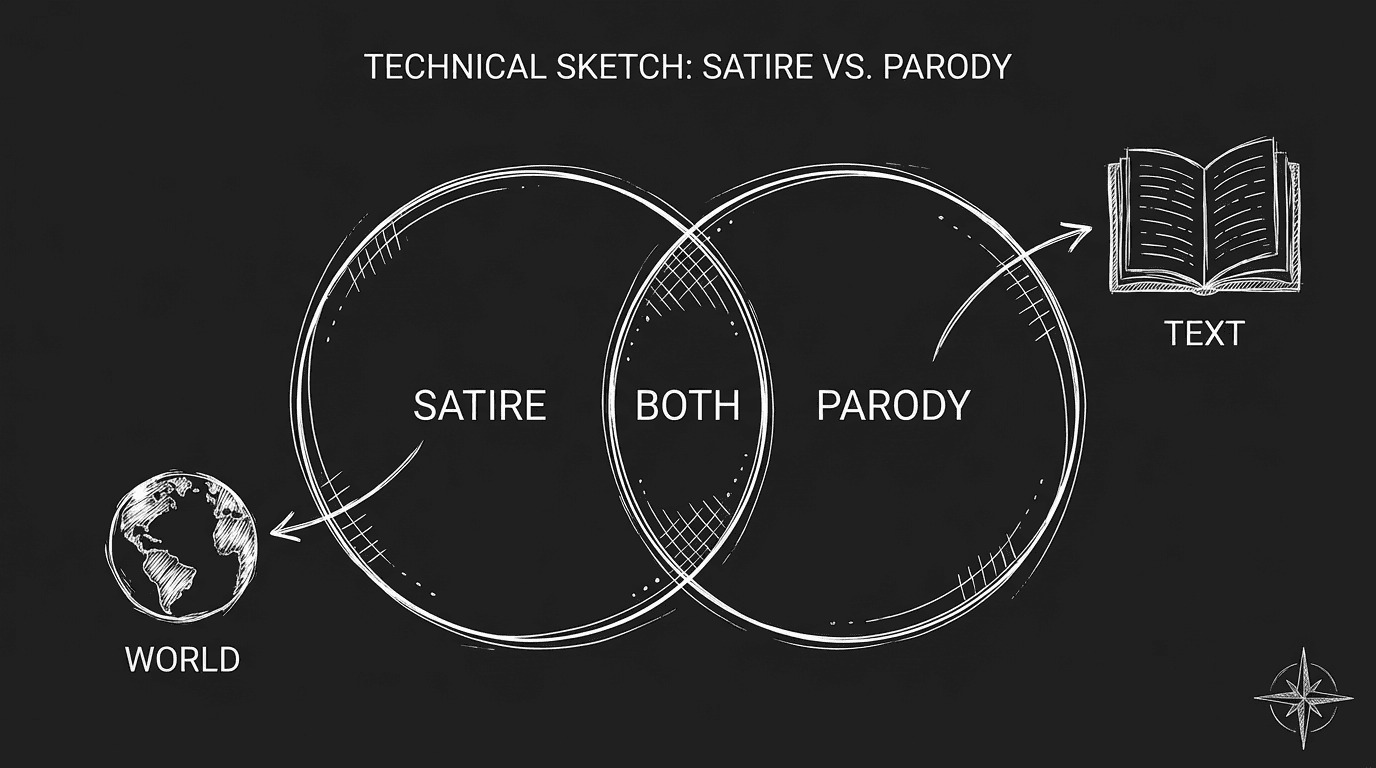
Hero image prompt: Dark mode technical sketch. Solid black background, thin white hand-drawn lines. Two overlapping circles, one labeled “satire” (pointing at the world), one labeled “parody” (pointing at a text). Where they overlap: “both.” Minimalist, high-contrast. No neon.
Don’t Look Up is not a parody of disaster movies. It’s a satire of how we respond to disaster, the media, the politics, the self-interest. The film uses the form of a disaster movie to say something about the real world. A parody of disaster movies would be making fun of Armageddon or Deep Impact, the tropes, the dialogue, the genre itself. Same toolbox. Different target. If you don’t know which you’re writing, the script will wobble. The audience will feel the confusion. Here’s how to tell them apart and how to write each one clearly.
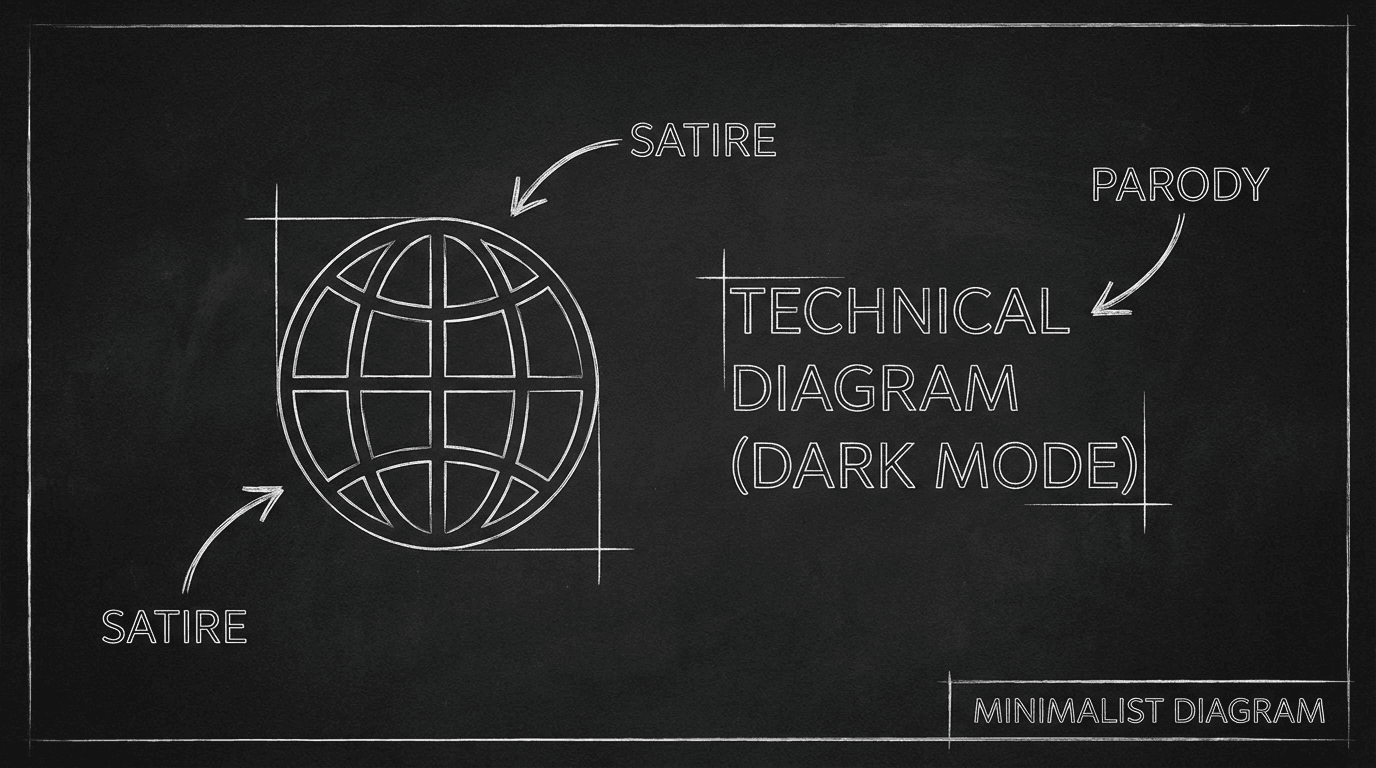
Satire aims at the world. Parody aims at a text or a genre. Satire uses humor to criticize. Parody uses imitation to exaggerate. You can do both in the same script, but you have to know which engine is driving the scene.
Think about Dr. Strangelove. It’s satire. The target is nuclear policy, Cold War logic, the people in the room. It’s not making fun of other war films; it’s using the form of a war room to show how absurd the real thing is. Now think about Spaceballs. It’s parody. The target is Star Wars and sci-fi tropes. The jokes are “remember that thing from the movie? Here it is, bigger and sillier.” Both are funny. Both use genre. But the aim is different. When you write satire, you’re asking the audience to see the real world differently. When you write parody, you’re asking them to recognize and laugh at the reference. Mixing them is fine, Don’t Look Up has moments that parody celebrity and media, but the dominant mode should be clear. Our guide on theme vs plot applies to satire: the “point” of the story is the comment on the world, and the plot is the vehicle.
Satire: Aiming at the World
Satire uses humor, exaggeration, and irony to criticize something real, institutions, behavior, politics, culture. The story might be set in a heightened world, but the target is ours. The audience is supposed to leave thinking about the real thing, not just about the movie. So when you write satire, you need a clear target. What are you criticizing? Greed? Incompetence? The way we consume news? The way we avoid hard truths? The sharper the target, the sharper the satire. If the target is vague (“society”), the satire will feel vague too.
The tone can be angry, sad, or cold. It doesn’t have to be gentle. But the humor has to be in service of the critique. The joke isn’t “ha, that’s silly.” The joke is “ha, and that’s exactly how it works.” The audience might laugh and then feel uncomfortable. That’s the point. So when you’re writing a satirical scene, ask: what real thing is this moment pointing at? If you can’t answer, the scene might be parody or just comedy. If you can, you’re in satire territory. For more on writing comedy that carries weight, see dark comedy and humor in trauma, satire and dark comedy often share the same willingness to make the audience uncomfortable.
Parody: Aiming at the Text or Genre
Parody imitates a specific work or genre to exaggerate its traits. The audience is supposed to recognize the source and enjoy the twist. “That’s from Star Wars, and now it’s ridiculous.” The pleasure is in the recognition. So parody depends on the audience knowing the reference. If they don’t, the joke falls flat. That’s why parody can date: the thing you’re parodying might not be in the culture anymore. Satire can age too, but if your target is human nature or institutions, it often holds up. Parody is more fragile. It’s tied to the specific text or moment.
When you write parody, you’re playing with expectations. The audience knows the trope. You give them the trope, and then you push it further, or you undercut it, or you put it in a wrong context. The humor is “we both know this form, and look what I’m doing with it.” So the script has to be clear about what it’s referencing. If the reference is obscure, only a few will get it. If the reference is obvious, you have to find a fresh angle. The best parody doesn’t just repeat. It twists. For more on playing with genre expectations, see subverting three acts and A24-style structure, parody is a form of subversion.
The Overlap: When a Script Does Both
Many scripts mix satire and parody. Don’t Look Up satirizes media and politics but also parodies the celebrity interview, the press conference, the tech billionaire. The satire is the main engine: we’re supposed to think about climate and denial and complicity. The parody is the texture: we recognize the forms and laugh at how they’re used. When you mix them, keep the hierarchy clear. What’s the script mainly doing? If it’s satire, the parody moments should support the critique. If it’s parody, the satire might be a side effect, we’re mainly here to laugh at the genre, but we might also notice something about the world. The confusion comes when the writer doesn’t know. So before you write, name it. “This is a satire of X, with parody of Y and Z.” Then every scene can serve the main aim.
| Mode | Target | Audience Takeaway | Example |
|---|---|---|---|
| Satire | The real world (institutions, behavior, culture) | “That’s how it really works” | Dr. Strangelove, Don’t Look Up |
| Parody | A text or genre | “I see what you did there” | Spaceballs, Scary Movie |
| Both | World + genre/form | Laugh at the reference, think about the world | Don’t Look Up (satire first, parody in the margins) |
Relatable Scenario: The Script That Can’t Decide
You’re writing a comedy about a political campaign. Sometimes you’re making fun of real politics, the spin, the donors, the emptiness. Sometimes you’re making fun of The West Wing or Veep. The reader doesn’t know which movie they’re in. Fix: choose the primary mode. Is this a satire of how campaigns work? Then the Veep-style jokes should support that. Is this a parody of political dramas? Then the real-world critique might be lighter. Once you know, you can make every scene serve the main aim. Our piece on theme vs plot helps: the theme of a satire is the critique; the theme of a parody might be “genre is fun to play with.”
Try it free
Try Screenweaver for free on your script
It is free. Import your existing project, get a clearer view of your outline, and regain control of your story structure in minutes.
Start FreeRelatable Scenario: The Satire That Feels Preachy
You’re writing satire. You have a point. So you have a character deliver the point in a speech. The audience feels lectured. Fix: let the story make the point. The satire is in the situation, the way the characters behave, the way the world responds. When the behavior is exaggerated but recognizable, the audience gets it. They don’t need a character to spell it out. Show the absurdity. Let the audience name it. For more on dialogue that carries meaning without being on-the-nose, see subtext and the art of dialogue.
The Trench Warfare Section: What Beginners Get Wrong
Calling it satire when it’s just parody. You’re making fun of superhero movies. That’s parody. If you want it to be satire, you need a target in the real world, fame, violence, power, whatever the genre is pointing at. Fix: name the target. If the target is “superhero movies,” it’s parody. If the target is “how we worship power,” it’s satire that uses superhero form.
Making the satire too broad. “Society is bad.” “People are selfish.” The audience nods and moves on. Fix: get specific. What institution? What behavior? What moment in the culture? The sharper the target, the more the satire cuts.
Parody that only references. You’re doing “remember this?” over and over. There’s no twist. The audience gets it once, then gets tired. Fix: push the reference. Exaggerate it. Put it in a wrong context. Make it pay off in the story. Parody is imitation with a point, the point can be “this is ridiculous” or “this is what it would look like if we took it seriously.”
Forgetting that both need to be funny. Satire that’s only angry can feel like a lecture. Parody that’s only accurate can feel like a recap. Both need to land as comedy. The audience should laugh. Then they can think (satire) or recognize (parody). If they’re not laughing, the mode isn’t working.
[YOUTUBE VIDEO: Side-by-side comparison of a satirical scene and a parody scene, e.g. a moment from Don’t Look Up vs a moment from Spaceballs, with commentary on what each is aiming at and how the writing serves the aim.]
Step-by-Step: Choosing and Holding the Mode
Before you write, answer: what is the primary target? The real world (satire) or a genre/text (parody)? Write it in one sentence. “This script is a satire of X.” Or “This script is a parody of Y.” Then, as you write each scene, ask: does this scene serve that target? If you’re in satire, does the scene point at the real thing? If you’re in parody, does the scene rely on recognition and twist? If a scene doesn’t serve the main mode, cut it or reshape it. The audience can handle both in one script, but they need to know which movie they’re in. For structure that supports a clear throughline, see theme vs plot, your theme in satire is your critique; in parody it might be the love of the form you’re playing with.
One External Resource
For a concise overview of satire and parody as literary and film concepts, see Satire on Wikipedia and Parody on Wikipedia. Reference only; not affiliated.
The Perspective
Satire and parody are not the same. One aims at the world; one aims at the text. When you know which you’re writing, every scene can do its job. When you don’t, the script sends mixed signals. Name the target. Serve it. Then the audience will know whether to laugh and think, or laugh and recognize, or both, if you’ve built the mix with intention.
Final Step
Build your next script with Screenweaver
Move from ideas to production-ready pages faster with timeline-native writing and AI-assisted story flow.
Try Screenweaver