

The script is locked. Ninety-two pages. A woman trapped in a remote cabin, her captor dead downstairs, her memory fractured from trauma. The story builds to a single question: did she kill him, or did someone else? The producer reads the ending, nods slowly, and says: "What if we shot two versions?"
This happens more than you'd think. Not because the ending is bad, because there are two endings that work, and nobody wants to lose either one. In psychological thrillers especially, where ambiguity is the currency and audience interpretation is the reward, multiple endings aren't a failure of decision-making. They're a creative opportunity. Sometimes both endings become part of the release strategy. Sometimes one gets cut. Sometimes you shoot three and test all of them.
But here's the thing: writing alternate endings isn't the same as writing one ending twice. Branching narrative changes the architecture of the entire third act. What's set up early, what questions get answered, what information the audience holds, all of it shifts depending on which ending you're serving. If you try to write branches without understanding how they affect the trunk, you'll end up with an incoherent middle and two endings that don't feel earned.
This guide is about how to branch deliberately. How to structure a psychological thriller with alternate endings in mind. How to track what each version requires, what each version pays off, and how to keep your screenplay from collapsing under the weight of possibilities.
Cinematic workflow frames
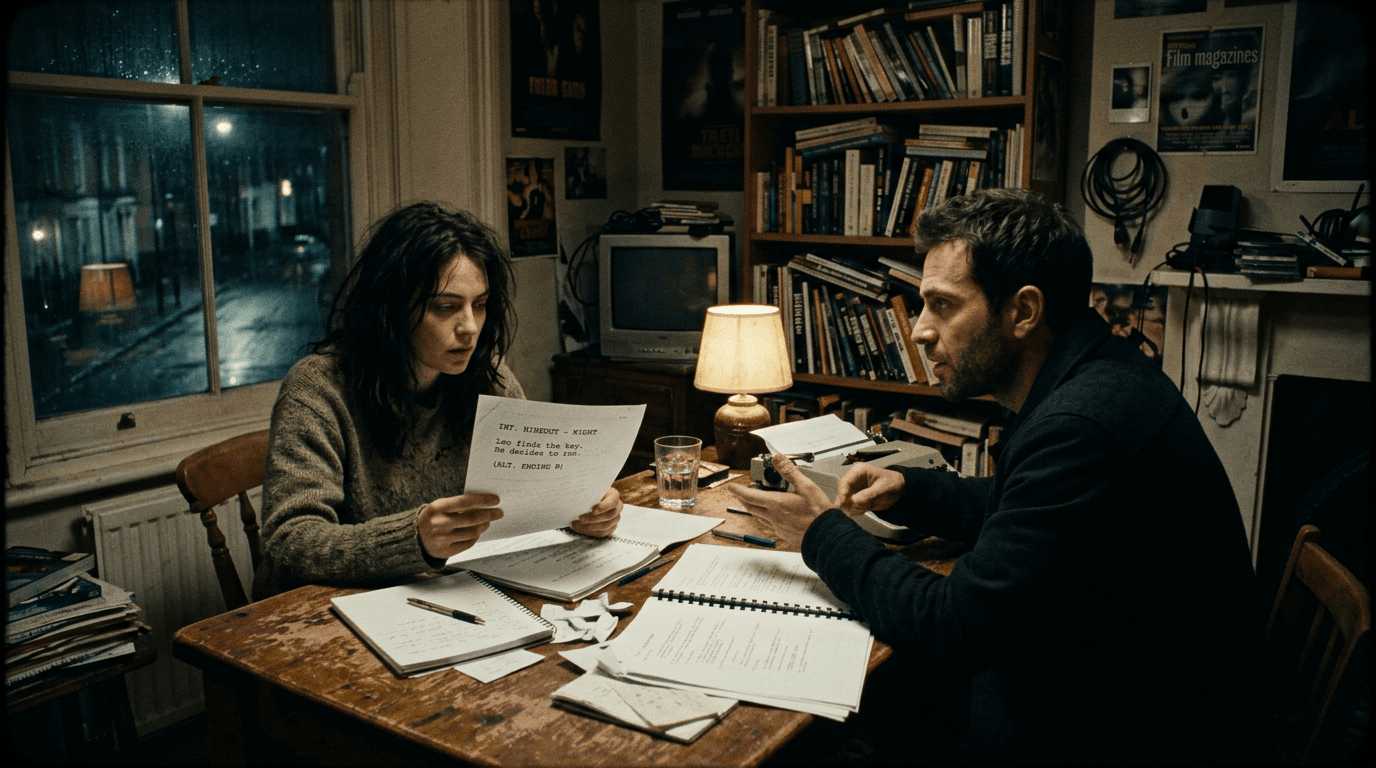
These two visuals work as a pair: the first shows Cinematic workflow still, first angle, 35mm film grain, and the second shifts to Cinematic workflow still, second angle, 35mm film grain—compare them briefly, then move on.

Why Psychological Thrillers Are Ideal for Branching
Not every genre benefits from multiple endings. Romantic comedies need closure; the couple gets together or they don't, and the emotional satisfaction depends on clarity. Action films usually build to a single climactic confrontation, splitting the climax dilutes the catharsis.
But psychological thrillers live in ambiguity. The best ones leave you questioning what you saw. Black Swan ends with an image that can be read multiple ways. Shutter Island hinges on whether the protagonist's delusion is real. Gone Girl ends on a note of dread precisely because you can imagine several directions from the final frame.
Audiences who come to psychological thrillers don't want neat resolution. They want to think. They want to argue about what happened. An alternate ending isn't a cheat in this genre, it's an extension of the experience. "Which ending is the 'real' one?" becomes part of the film's mythology.
The alternate ending works when both versions are legitimate interpretations of the same evidence. If one ending requires rewriting the rules of the story, it's not an alternate, it's a contradiction.
This is the key principle. Branching only works if both paths are supported by what came before. The audience shouldn't feel tricked; they should feel that they might have seen the other truth all along.
The Architecture Problem: How Branches Affect the Middle
Here's where most writers go wrong. They write the whole script, arrive at the ending, and then try to add a second version. It doesn't work. The second ending feels grafted on, because it is.
Effective branching has to be designed from the beginning. Both endings must be supported by setups in Acts One and Two. This means planting dual-purpose clues: moments that can point in either direction depending on how they're interpreted later.
Take our cabin thriller. The woman has flashbacks of her captor. In one ending, we learn she killed him in self-defense, and the flashbacks are traumatic memories of the attack. In another ending, we learn she hallucinated the entire captivity, and the "captor" was actually a helper she mistook for a threat. Both endings need the flashbacks to be legible. So the flashbacks must be written to support both readings.
This is the architectural challenge: every major clue, every emotional beat, every piece of dialogue that addresses the central mystery must be doubly articulated. It must work for Ending A. It must work for Ending B. If a clue only works for one ending, the other ending will feel like a twist the movie didn't earn.
A Structural Workflow: Planning Branches Before You Draft
Let me walk you through a process that keeps branches manageable.
Step One: Identify the Branch Point
The branch point is the moment where the story diverges. In most thrillers, this is somewhere in the final fifteen to twenty pages, the climax or the revelation. Earlier branches are possible but exponentially harder to execute, because they affect more of the story.
Ask yourself: At what moment must the audience commit to one reading of events? That's your branch point. Everything before that moment must serve both interpretations.
Step Two: Define Both Endings Fully
Write out each ending in prose, not screenplay format, just prose. What happens? What does the protagonist learn? What's the final image? How does the audience feel walking out?
Be specific. "She realizes the truth" is not enough. "She finds the photograph that proves her captor was her brother, and the film ends on her face as she understands that she chose to forget" is specific. Do this for both endings.
Step Three: List the Requirements of Each Ending
For each ending to land, certain things must have been set up earlier. Make a list.
Ending A (self-defense): Requires that the captor's violence be established early. Requires that the protagonist's fear be justified. Requires that we see or imply a weapon she could have used.
Ending B (hallucination): Requires early hints that the protagonist's perception is unreliable. Requires that the "captor" could plausibly be a helper (or imagined). Requires that the setting could be a treatment facility, not an isolated cabin.
Compare the lists. Where do they overlap, they're natural dual-purpose setups. Where they conflict, you have a problem to solve.
Step Four: Build the Dual-Purpose Scenes
Write Act One and Act Two with both requirement lists in hand. Every scene that introduces evidence should be checked against both lists. Can this scene support both endings?
For example: An early scene shows the protagonist tied to a chair. This supports the captivity reading (Ending A). But you can add a detail, hospital bracelets cut into her wrists, or the "rope" is fabric restraint, that also supports the treatment facility reading (Ending B). Same scene, dual-purpose.
Step Five: Write Both Branches
When you reach the branch point, write both versions of the remaining pages. These are separate documents, but they share the same prior ninety percent.
Make sure each branch explicitly pays off its setups. If Ending B requires unreliable perception, the final scenes must contain a moment where the protagonist (and audience) recognizes the unreliability. Don't leave payoff to implication; this is the moment for clarity.
A Table: Dual-Purpose Scene Checklist
Here's how to track whether a scene supports both endings:
| Scene | Surface Purpose | Supports Ending A (Self-Defense)? | Supports Ending B (Hallucination)? | Notes |
|---|---|---|---|---|
| Opening: protagonist wakes, bound | Establish captivity | Yes – she's a prisoner | Yes – she's a patient in restraints | Add hospital-grade restraints visual |
| Flashback: captor strikes her | Establish violence | Yes – justifies fear | Yes – could be misremembered | Keep his face obscured |
| Phone call: she reaches someone | Show her trying to escape | Yes – someone on the outside | Yes – could be a therapy line | Make dialogue ambiguous |
| Discovery: she finds a weapon | Set up self-defense | Yes – this is what she uses | Weaker – why would a patient find a weapon? | Problem: may need to adjust or cut |
| Final confrontation: she acts | Climax | Branch point | Branch point | Write both versions |
The "Notes" column is where you identify problems and solutions. If a scene only works for one ending, you either rewrite it or accept that one branch will be weaker.

Three Realistic Scenarios: Different Branching Strategies
Scenario A: The "Director's Choice" Branch
You're writing for a director who wants to film both endings and choose in post. The endings are genuinely different, but only one will be in the theatrical release. The other becomes a bonus feature.
What this requires: Both endings must be film-worthy, not just functional. You're writing two climaxes, each emotionally complete. The director will show both to test audiences and see which scores better.
What to watch for: You can't hedge. Each ending must commit fully to its interpretation. If Ending B is the hallucination ending, don't soften it by leaving the door open for reality, commit to the delusion. Otherwise, the test audience won't know what they're evaluating.
Scenario B: The "Ambiguous Cut" Branch
You're writing for a release that keeps ambiguity intact. Both endings are implied by the text, but neither is explicitly shown. The film ends just before the branch, letting the audience interpret.
What this requires: An ending that is formally complete without resolving the central question. The audience gets a final image, maybe her face, maybe an object, maybe a tableau, that can be read either way.
What to watch for: This is risky. Some audiences will love the ambiguity; others will feel cheated. You must earn it by making both interpretations genuinely available throughout. If the film obviously leans one way, the "ambiguity" will feel like cowardice.
Scenario C: The "Interactive Release" Branch
You're writing for a platform that allows viewer choice, a streaming feature where the audience picks the ending they want to see. Think Black Mirror: Bandersnatch, but simpler: a single fork at the end rather than a tree.
What this requires: Both endings must be dramatically satisfying when experienced in isolation. A viewer who picks Ending A shouldn't feel they need to go back and watch Ending B to "really" understand the story.
What to watch for: The branch must feel like a genuine choice, not a trick. The setup scenes must be even more carefully dual-purpose, because the audience will analyze them on rewatch. If they spot a scene that only works for one ending, they'll call it a plot hole.
Try it free
Try Screenweaver for free on your script
It is free. Import your existing project, get a clearer view of your outline, and regain control of your story structure in minutes.
Start FreeThe "Trench Warfare" Section: Common Failures in Branching
Failure Mode #1: The Grafted Ending
The script is written linearly, with one ending in mind. Late in development, someone asks for an alternate. The writer bolts on a second ending without revising the middle. Result: the new ending feels unearned because the setups aren't there.
How to Fix It: Go back to Step Three. List what the new ending requires. Then revise Act One and Two to install those requirements. This may mean adding scenes, altering dialogue, or restructuring evidence. It's not a quick fix.
Failure Mode #2: The Obvious Lean
Both endings exist on paper, but the movie clearly prefers one. Every clue points to Ending A; Ending B requires ignoring half the evidence. When the audience sees Ending B (either in a test screening or as a bonus feature), it feels like a curiosity, not a genuine alternative.
How to Fix It: Track your evidence. If you have ten clues pointing to Ending A and two pointing to Ending B, rebalance. Cut some A-clues or add B-clues. The audience should feel, going into the branch, that either outcome is possible.
Failure Mode #3: The Contradiction
The endings are mutually exclusive in a way that violates the story's internal logic. In Ending A, the captor is real and dies. In Ending B, the captor never existed. But there's a scene in Act Two where a third character interacts with the captor. If the captor doesn't exist, how did that interaction happen?
How to Fix It: Map every scene involving the disputed element (the captor, in this case). Check each scene against both endings. If a scene creates a logical impossibility for one ending, rewrite it. Sometimes this means making the third character's interaction ambiguous, maybe they're on a phone call with someone whose identity isn't confirmed.
Failure Mode #4: Emotional Incoherence
Both endings are logically possible, but they demand different emotional journeys. Ending A is tragic; Ending B is triumphant. The Act Two emotional arc supports the tragedy; when you watch Ending B, it feels tonally off, like a forced happy ending on a dark story.
How to Fix It: Emotional arcs must also be dual-purpose. If Ending A is tragedy and Ending B is triumph, the Act Two arc must be genuinely ambivalent, dark enough to earn tragedy, hopeful enough to earn triumph. This is hard. Some scripts genuinely only support one emotional trajectory; forcing a second ending will always feel wrong.
Failure Mode #5: Branching Too Early
The story forks at the midpoint. Now you're not writing two endings; you're writing two entire second halves. The word count doubles. The setups quadruple. Production needs to shoot essentially two films.
How to Fix It: Move the branch later. The later you branch, the less you have to duplicate. Most thriller branches work best in the final fifteen pages. You can still set up the possibilities earlier, but the actual divergence should be late.

What Test Audiences Tell You (And What They Don't)
If you're lucky enough to run test screenings with both endings, you'll learn a lot. But you have to ask the right questions.
"Which ending did you prefer?" gives you a vote. But it doesn't tell you why. Sometimes audiences prefer the ending that's less challenging, they want closure, even if ambiguity would be more interesting. Sometimes they prefer the ending that flatters their theory, they guessed correctly, so they vote for that.
Better questions: "Did the ending feel earned?" and "Were you surprised, or did you see it coming?" and "After the ending, what did you want to know more about?"
These questions probe whether the ending worked dramatically, not just whether it was popular. A controversial ending that provokes discussion may be better for the film's longevity than a crowd-pleaser that's forgotten by the time people reach their cars.
The Producer's Perspective: Why They Want Options
From a writer's perspective, branching can feel like lack of commitment, like the creative team doesn't know what they want. But there are legitimate reasons producers request alternate endings.
Marketing flexibility. Different cuts can target different audiences or territories. An ambiguous arthouse ending for festivals; a resolved ending for theatrical release.
Hedge against test results. If one ending bombs, the other might save the project. You've already shot the material.
Awards versus commercial. An intense, darker ending might play well for critics and awards; a more accessible ending might widen box office appeal.
IP extension. If the film succeeds and spawns a sequel, one ending might leave more room for continuation.
None of these are creatively cynical. They're recognition that films serve multiple audiences and contexts. The writer's job is to make both endings good, genuinely satisfying within their own logic, so that whichever gets chosen represents the project well.
The Perspective: Branching Is Not Indecision
Here's a reframe. The instinct is to think that branching means you couldn't commit. But in a psychological thriller, branching is a kind of commitment, to the genre's central value, which is ambiguity itself.
The best psychological thrillers don't resolve neatly. They leave interpretive space. When you write two endings that are both valid, you're embedding that interpretive space into the structure. You're telling the audience: Both of these are possible. You decide.
That's not indecision. That's design.
And when you've done the work, planted dual-purpose clues, tracked the logic of both endings, balanced the emotional arcs, the branching doesn't feel like a split. It feels like the story unfolding into its full possibility.
Which ending is real? Maybe both. Maybe neither. Maybe the question is the point.
[YOUTUBE VIDEO: A filmmaker and writer discussing how they approached alternate endings on a psychological thriller, with clips from both endings and commentary on audience reception.]
Further reading:
- For guidance on interactive fiction formatting (Bandersnatch-style branching scripts), see our interactive fiction formatting guide.
- If your thriller involves memory or perception problems, our guide on handling multiple timelines may help.
- The Final Draft blog has resources on managing multiple script versions during production at finaldraft.com{:rel="nofollow"}.
Final Step
Build your next script with Screenweaver
Move from ideas to production-ready pages faster with timeline-native writing and AI-assisted story flow.
Try Screenweaver