
Aaron Sorkin writes at 10 p.m. Quentin Tarantino writes longhand in a spiral notebook. Greta Gerwig structures her day around when the light is good. None of them are right. All of them are right. The point isn't to copy their habits. It's to see that the writers whose work you admire didn't wait for inspiration. They built systems. They showed up at a time, in a place, with a rule. Then they repeated it until the script was done. Here's what we can learn from how three very different minds get the work on the page, and how to steal the principle without aping the ritual.
Why Routines Matter More Than Inspiration
Inspiration is real. It's also unreliable. If you only write when you feel like it, you'll have long dry spells and bursts of guilt. The writers who ship scripts treat writing like a job. They don't ask whether they're in the mood. They ask whether it's writing time. That shift, from "Do I feel like it?" to "Is it time?", is what separates hobbyists from professionals. Not talent. Not connections. Routine. As we've covered in the vomit draft, speed and consistency beat waiting for the perfect moment. The routine is what makes the vomit draft possible. You can't write badly on purpose if you never show up.
The writers who ship scripts treat writing like a job. They don't ask whether they're in the mood. They ask whether it's time.
Aaron Sorkin: Late Nights and No Internet
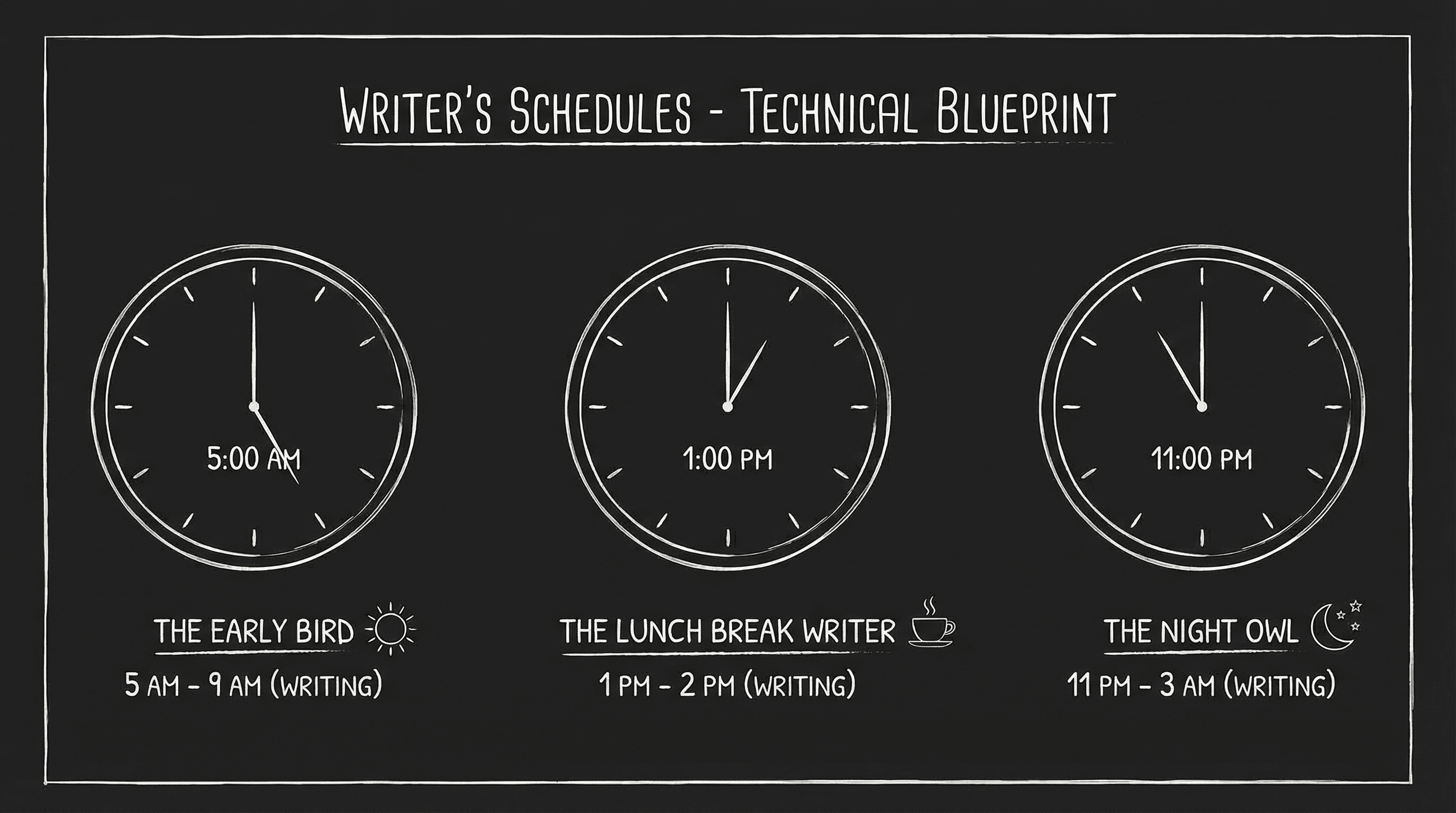
Sorkin is famous for writing at night. Ten p.m. to dawn, or something close. He's also famous for avoiding the internet during sessions. The pattern isn't random. Late night is when the world stops asking for things. No meetings, no calls, no drip of email. For him, that's when the dialogue can run without interruption. He's said he writes in long bursts, doesn't leave the desk until he's done a chunk, and that the worst thing is breaking flow to "quickly check" something online. One click becomes an hour. So the rule is simple: when it's writing time, the browser is closed.
What to steal: Protected time and no optional inputs. You don't have to write at 10 p.m. You do have to decide when your writing block is and treat it as non-negotiable. No "I'll just answer this one thing." No social scroll. If you can't trust yourself, use a blocker or a separate device with no apps. Sorkin's routine works because it removes choice. You're not fighting temptation every five minutes. The environment does the fighting for you.
Quentin Tarantino: Longhand and the Physical Page
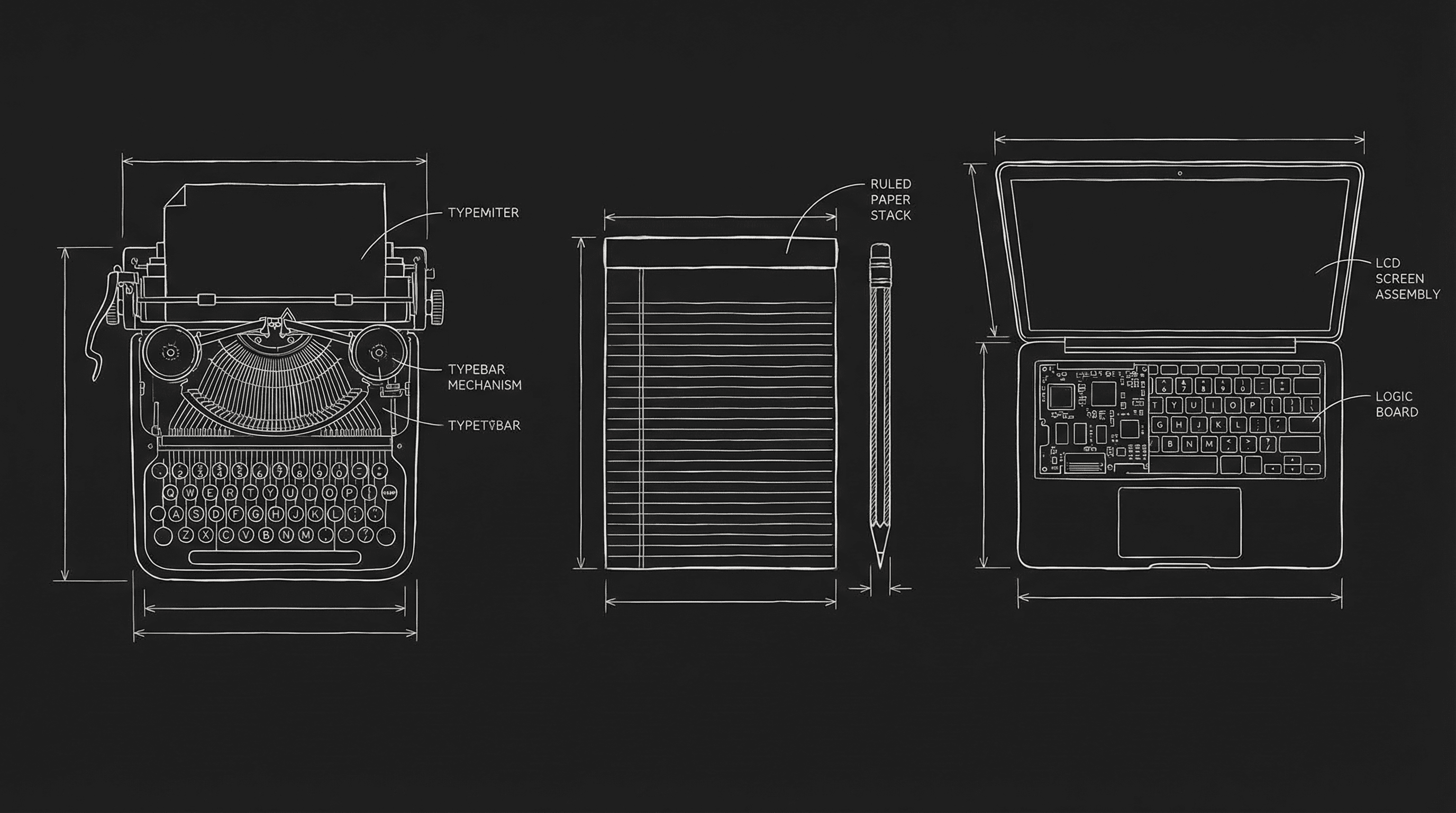
Tarantino writes his first drafts by hand. Pen, paper, spiral-bound notebooks. He's described typing as something that comes later, when he's transferring and revising. The first pass is tactile. He likes the pace of hand-writing. It slows him down enough to hear the rhythm of the dialogue. It also means his drafts exist in a form that can't be deleted with a keystroke. There's a psychological difference. When you write on a screen, the backspace is right there. When you write on paper, you cross out or move on. The page fills up. You see progress in a stack of filled notebooks instead of a scroll bar.
What to steal: A first-draft medium that resists editing. You don't have to go full longhand. But you can separate "getting it down" from "cleaning it up." Some writers use a separate app for drafting, no formatting, no outline panel, then paste into their main screenwriting software for the next pass. The idea is the same: create a phase where the goal is volume and flow, not polish. Tarantino's notebooks are that phase. Yours might be a plain text file or a dedicated drafting template. The principle is to make the first pass feel different from the rewrite.
Greta Gerwig: Light, Space, and When the Brain Works
Gerwig has talked about structuring her day around when she's sharpest and when the light in the room is good. She's not mystical about it. She's observational. She noticed she writes better at certain times and in certain conditions. So she arranged her life to protect those conditions. That might mean writing in the morning before the world wakes up, or in a room with a window, or after a walk. The point is she didn't assume all hours were equal. She found what worked and then built the routine around it.
What to steal: Audit yourself. For a week, note when you actually got good pages down. Not when you sat down, when the work happened. Note the time of day, whether you'd slept, whether you'd been outside, whether the room was quiet or noisy. Most people never do this. They keep trying to write at the "right" time according to someone else's advice. Gerwig's approach is to use your own data. Once you see a pattern, protect that window. Time management for part-time writers often comes down to this: finding the one or two hours that actually work and defending them.
Relatable Scenarios
Scenario one. You've read about Sorkin's late nights. You're a morning person. You try writing at 10 p.m. anyway. You're exhausted, the prose is flat, and you decide you're "not a real writer." The fix isn't to push through. It's to ignore Sorkin's clock and keep his principle. His principle is: block time, remove distractions, don't break flow. Do that at 6 a.m. if that's when you're awake. The routine has to fit your life and your body. The famous examples are prompts. Not prescriptions.
Scenario two. You love the idea of writing longhand like Tarantino. You try it. Your hand cramps, your handwriting is illegible, and you spend twice as long to get half the pages. You're not Tarantino. So what? The takeaway isn't "write by hand." It's "separate the messy first pass from the polished pass." If that means drafting in a minimal app or in a different font so it "feels" like a draft, do that. The goal is to create a phase where you're not tempted to edit. The tool is secondary.
Scenario three. You have a day job. You can't "structure your day around when the light is good." You have an hour before work or after the kids sleep. Gerwig's lesson isn't that you need a perfect room. It's that you should notice when you're actually productive and protect that. Maybe your hour is 6 a.m. Maybe it's 10 p.m. Maybe it's lunch in the car. Find it. Then treat it as sacred. One protected hour with no internet and a clear goal (e.g. 2 pages) will beat three scattered hours of half-attention.
| Writer | Habit | Principle to steal |
|---|---|---|
| Sorkin | Late night, no internet | Protected block + remove optional inputs |
| Tarantino | Longhand first draft | Separate "get it down" from "clean it up" |
| Gerwig | Match writing time to when she's sharp + good light | Audit when you actually produce; protect that window |
Try it free
Try Screenweaver for free on your script
It is free. Import your existing project, get a clearer view of your outline, and regain control of your story structure in minutes.
Start FreeWhat Beginners Get Wrong: The Trench Warfare Section
Mistake 1: Adopting the ritual, not the function. You buy a fancy notebook because Tarantino uses one. You write at 10 p.m. because Sorkin does. But you haven't asked what function the habit serves. Sorkin's function is uninterrupted focus. Tarantino's is a first pass that doesn't invite editing. If your version of the habit doesn't serve that function, e.g. you write at 10 p.m. but you're exhausted and distracted, you're performing someone else's routine. Extract the function. Then design a habit that achieves it in your life.
Mistake 2: Waiting for the perfect setup. "I'll have a routine when I have a proper office / when the kids are older / when I quit my job." Routines don't require perfect conditions. They require a decision. Even 30 minutes at the same time every day, in the same place (or the same chair), with the same rule (e.g. no phone), is a routine. The writers you admire started somewhere. They refined as they went. Start with what you have.
Mistake 3: Breaking the routine the first time it's hard. Some days you won't want to write. If you only show up when you're motivated, the routine is just a suggestion. The routine is what you do when you don't want to. That doesn't mean you have to write well. It means you have to show up and put in the block. Even a bad session counts. You sat down. You didn't let the skip become a habit. Sorkin doesn't only write when he's "on." He writes when it's time.
Mistake 4: No measurable target. "I'll write for an hour" is vague. "I'll write 3 pages" or "I'll write until the end of this scene" is a finish line. Routines work better when the session has a goal. You can stop when you hit it. You know when you're done. That reduces the "how long should I sit here?" anxiety and makes the routine repeatable.
Routines don't require perfect conditions. They require a decision.
How to Build Your Own Routine
Don't copy Sorkin's schedule. Copy his clarity. Pick a time. Pick a place or a trigger (e.g. "after coffee"). Pick a rule (no internet, no phone, no leaving until X pages). Write it down. Then do it the same way for two weeks. If something consistently doesn't work, you're always too tired at that hour, or the place is too noisy, adjust one variable. But don't scrap the whole thing. The routine is the thing that runs when motivation doesn't. For more on protecting your energy over the long run, see signs you need a break from your script, routines include rest, not only output.
One External Anchor
The Writers Guild Foundation and similar organizations often host panels where showrunners and feature writers discuss how they work. Hearing multiple voices normalizes that there's no single "right" way, only what works for you. (<a href="https://www.wgfoundation.org/" rel="nofollow">Writers Guild Foundation</a>.)
[YOUTUBE VIDEO: Short documentary or interview montage of working screenwriters describing their daily routine, wake time, where they write, one non-negotiable rule, with no glamour, just concrete details.]
The Perspective
Sorkin, Tarantino, and Gerwig don't agree on when or how to write. They agree that writing gets done when it's built into the day like a fact, not a mood. Your job isn't to imitate their rituals. It's to notice what they're really doing: choosing a time, protecting it, and showing up. The rest is decoration. Find your time. Find your rule. Then repeat.
Final Step
Build your next script with Screenweaver
Move from ideas to production-ready pages faster with timeline-native writing and AI-assisted story flow.
Try Screenweaver