

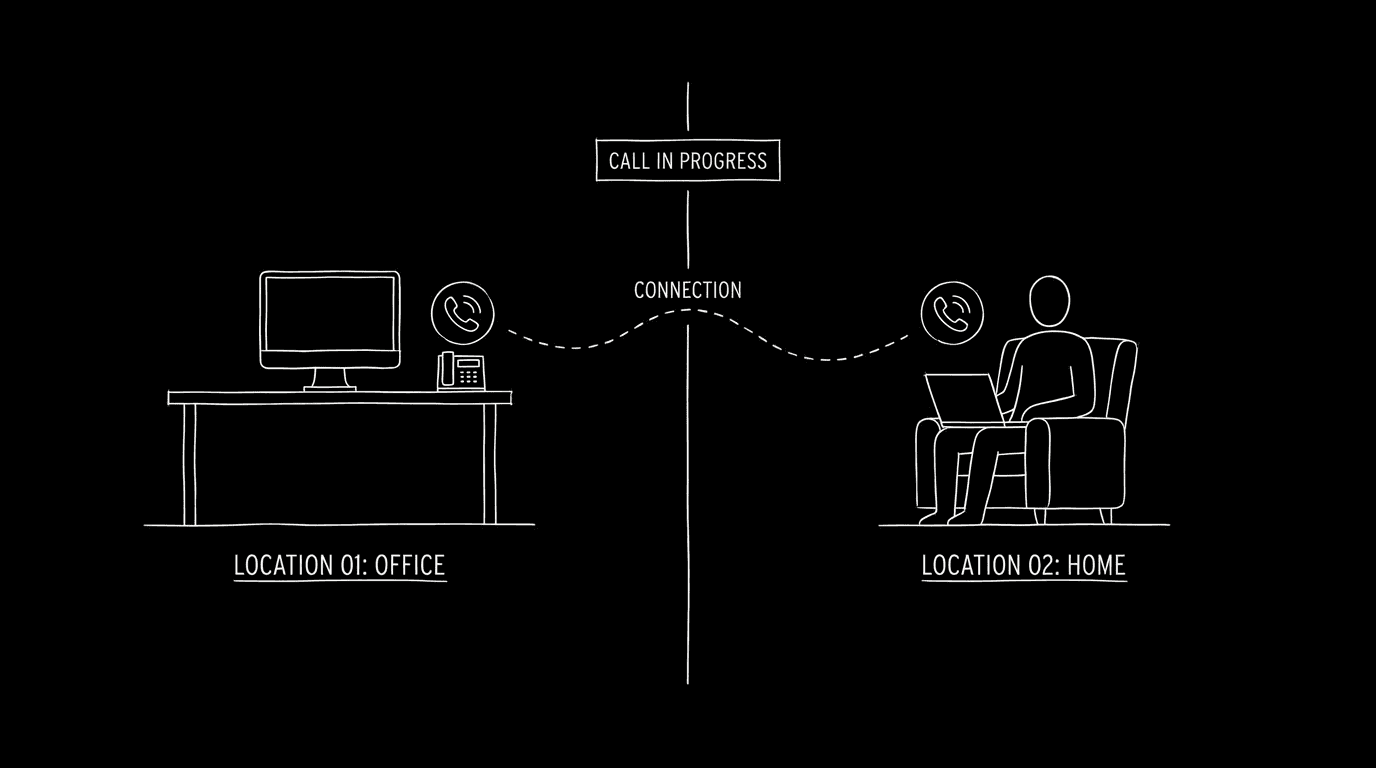
She's in her apartment. He's in his car. They're on the phone. On the page you have two main ways to show it: intercut (we cut between the two locations, each with their own scene/block) or one-side (we stay with one character and hear the other as V.O. or O.S.). Dual dialogue is for when two people are in the same space talking at once, not for two locations. Here's when to use intercut vs. one-side for phone calls, and why dual dialogue doesn't apply.
Intercut = two places. Dual dialogue = same place, same time. For a phone call, you're in two places, so intercut or one-side, not dual.
Think about it this way. Intercut means we go back and forth between Location A and Location B. Each has a scene heading or a clear slug; each has dialogue. The reader and the editor see the cut. One-side means we stay with one character; the other is (V.O.) or (O.S.), we hear them, we don't cut to them. Dual dialogue is two columns for two people in the same room talking at once. So for a phone call, the choice is intercut or one-side. Our full guide on formatting a phone call covers both in detail; this piece focuses on when to choose which and on not misusing dual dialogue. For dual dialogue in the same room, see dual dialogue.
When to Use Intercut
Use intercut when: We need to see both people. Their reactions, their environment, their face. The cut is part of the rhythm, we're in a scene that's built from two spaces. Format: Establish both locations (e.g. INT. SARAH'S APARTMENT - NIGHT and INT. MIKE'S CAR - NIGHT). Then INTERCUT or CUT BETWEEN as needed. Each character's dialogue appears under their location when we're there. Pros: Full visual on both sides. Good for tension, comedy, or when both reactions matter. Cons: More space on the page. For intercutting technique, see intercutting masterclass.
When to Use One-Side
Use one-side when: We're with one character. The other is a voice. We might never see their location. Format: One scene heading. One character's dialogue is normal; the other is (V.O.) or (O.S.) or (PHONE). "MIKE (V.O.): I'm on my way." Pros: Fast. Focused. Good for mystery, POV, or when we're not supposed to see the other person yet. Cons: We don't see the other side's reaction. For when to stay on one side, see formatting phone call.
Why Not Dual Dialogue for Phone Calls
Dual dialogue is for two people in the same room speaking at the same time, two columns, same moment. A phone call is two locations. So dual dialogue would mislead: it would suggest they're in the same space. Use intercut (two places, we cut) or one-side (one place, we hear the other). For dual dialogue, see dual dialogue.
Relatable Scenario: The Argument on the Phone
They're fighting. We need both faces. Use: Intercut. We cut between them. Each reaction lands. For tension, see intercutting masterclass.
Relatable Scenario: The Call We're Not Supposed to See
We're with the protagonist. The voice on the phone is a threat or a mystery. Use: One-side. We stay with the protagonist. The other is (V.O.) or (PHONE). For subtext and tension, see subtext.
Relatable Scenario: The Quick Check-In
"Where are you?" "Five minutes away." We don't need to see both. Use: One-side is usually enough. Short. Clear. For economy, see micro-pacing.
Try it free
Try Screenweaver for free on your script
It is free. Import your existing project, get a clearer view of your outline, and regain control of your story structure in minutes.
Start FreeThe Trench Warfare Section: What Beginners Get Wrong
Using dual dialogue for a phone call. They're in two places. Fix: Use intercut or one-side. Reserve dual dialogue for same-room overlap. For dual dialogue, see dual dialogue.
Intercut when one-side would do. We don't need to see the other person. Fix: Stay on one side. Use (V.O.) or (PHONE). Save intercut for when both faces matter. For phone format, see formatting phone call.
Unclear who's where. The reader loses track of which location we're in. Fix: Slug or label each side in the intercut. "SARAH'S APARTMENT" and "MIKE'S CAR" or character names. For clarity, see screenplay format.
Mixing intercut and one-side in the same call without reason. We start one-side, then suddenly cut. Fix: Choose one for the call unless the story demands a switch (e.g. we reveal the other location mid-call). For structure, see scene entry and exit.
Intercut vs. One-Side at a Glance
| Intercut | One-side | |
|---|---|---|
| We see | Both people | One person |
| Other voice | In their own block when we cut there | (V.O.) / (PHONE) |
| Best for | Reactions, tension, comedy | POV, mystery, economy |
| Dual dialogue? | No (two places) | No (two places) |
Step-by-Step: Choosing and Formatting
First: Do we need to see both people? If yes, intercut. If no, one-side. Second: For intercut, establish both locations and use INTERCUT or clear slugs so we know where we are. Third: For one-side, one scene heading; the other character is (V.O.) or (PHONE). Fourth: Never use dual dialogue for a phone call, that's for same room. For full phone-call format, see formatting phone call. For intercutting, see intercutting masterclass.
[YOUTUBE VIDEO: Same phone conversation as intercut vs. one-side, read and impact.]
The Perspective
For phone calls: intercut when we need both faces; one-side when we stay with one and hear the other. Dual dialogue is for same-room overlap, not for calls. When you choose the right format, the reader and the editor follow. So pick intercut or one-side. Format it clearly. And keep dual dialogue for the same space.
Final Step
Build your next script with Screenweaver
Move from ideas to production-ready pages faster with timeline-native writing and AI-assisted story flow.
Try Screenweaver