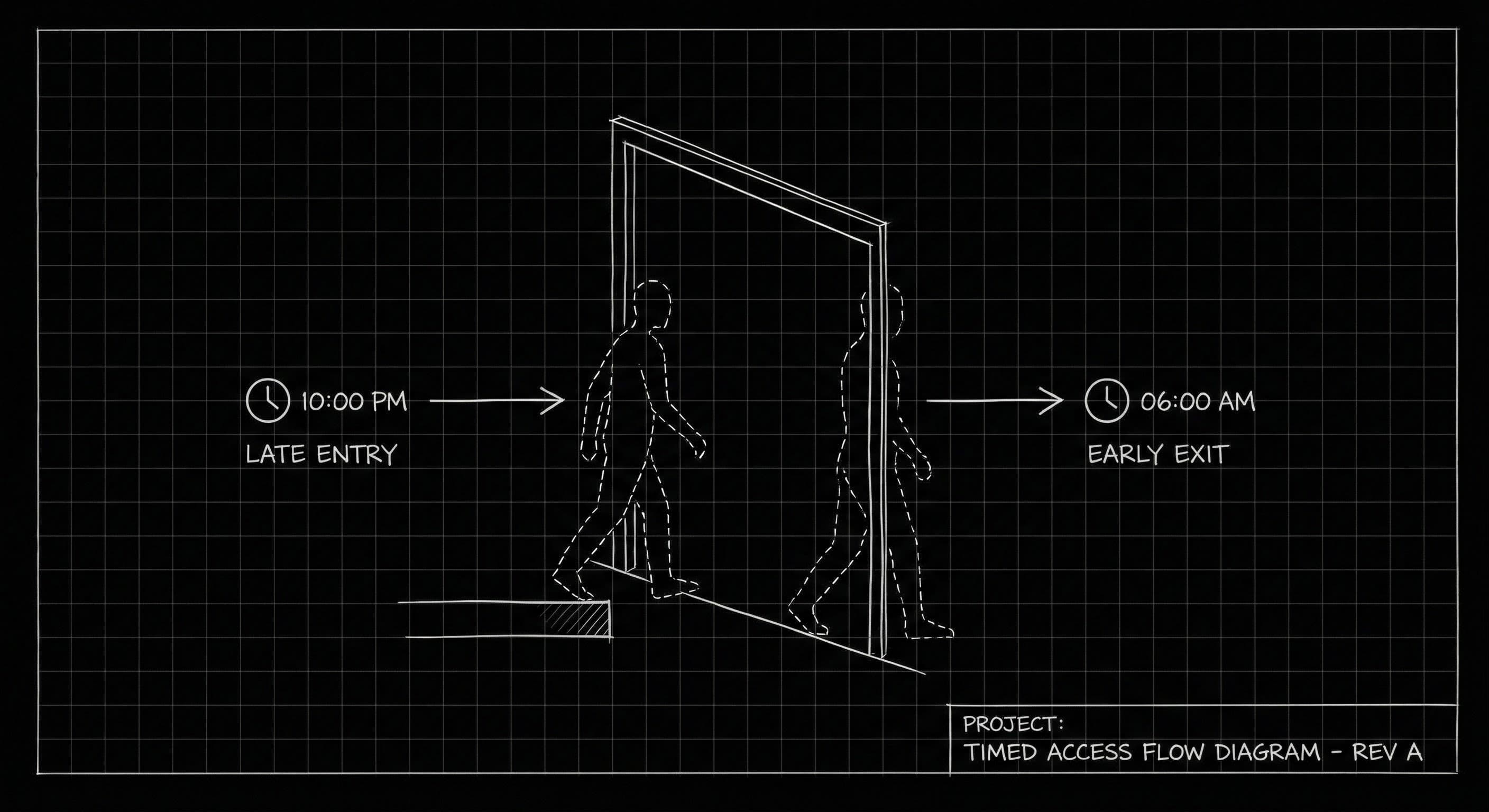

The door opens. Your character walks in. They say hello. They sit down. They have a conversation. They stand up. They say goodbye. They leave. You just wrote two pages that could have been half a page,and the reader felt every second. Arriving late and leaving early isn’t a gimmick. It’s the discipline of cutting the fat so that every scene earns its place. The best scenes don’t show the handshake. They show the moment the deal breaks.
The audience doesn’t need to see your character park the car, walk to the building, and open the door. They need to see the moment something changes.
Think about it this way: in life we endure small talk and transitions. In story we skip them. We enter when something is already in motion or about to tip. We leave when the consequence is clear,or when the next beat would be anticlimax. The writer who masters this doesn’t just save pages. They tighten pace and keep the reader leaning forward.
What “Late” and “Early” Actually Mean
Arriving late means you drop the reader into the scene after the boring part has already happened. We don’t see the detective drive across town. We see her step into the interrogation room, case file in hand, the suspect already waiting. We don’t see the couple sit down at the restaurant. We see her push the wine away and say “We need to talk.” The scene starts at the point of no return,or one beat before it. Everything that came before (the drive, the seating, the ordering) is implied or skipped.
Leaving early means you cut away before the scene runs out of steam. The argument doesn’t end with a tidy resolution. It ends with one of them walking out,and we go with them, or we cut to the next scene. We don’t linger for the awkward silence, the cleanup, the “I’m sorry” that might come later. We leave when the emotional or narrative point has landed. What happens after is for another scene,or for the audience to imagine.
Here’s why that matters. When you stay for the full “in and out” of a scene, you’re often writing buffer. Buffer feels safe. It gives the reader time to “arrive.” But buffer is also where attention drifts. The reader’s eye starts skimming. They’re waiting for the next thing that matters. So give them the thing that matters. Enter when the tension is present. Exit when the beat is complete.
A Practical Comparison
| Approach | What we see | Page count | Effect on reader |
|---|---|---|---|
| Full in/out | Character arrives, full exchange, character leaves | Higher | Safe but slack; risk of skim |
| Late in / early out | We join as stakes appear; we leave as consequence lands | Lower | Tighter; reader stays engaged |
| Late in / full out | Strong start, then trailing resolution | Mixed | Strong open, weak tail |
| Full in / early out | Setup, then cut before payoff | Rare | Can work for mystery or dread |
The sweet spot for most scenes is late in, early out. You trim the arrival and the goodbye. You keep the middle,the conflict, the revelation, the shift,and you make sure that middle doesn’t sprawl. As discussed in our guide on the 3-act structure, economy in scene work keeps your act breaks sharp and your second act from sagging.
Relatable Scenario: The Job Interview Scene
You’re writing a drama. Your protagonist has a make-or-break job interview. The lazy version: we see her wake up, get dressed, drive to the building, sit in the waiting room, get called in, shake hands, sit down, answer questions one by one, stand up, shake hands again, leave. Six pages. Half of it is logistics.
The disciplined version: we cut to the moment the interviewer leans back and says, “Your résumé says you left your last job after six months. Why?” We’re already in the room. We don’t know how she got there; we don’t need to. The scene is about the question that threatens to sink her,and her answer. When she’s given a final “We’ll be in touch,” we don’t follow her to the elevator. We cut to her in the parking lot, sitting in her car, hands on the wheel. Or we cut to the next day, when the letter arrives. We left early. The audience felt the weight of the moment; they don’t need to watch her walk to the car.
Relatable Scenario: The Confrontation at the Family Dinner
Family dinner. Old wounds. You could start with everyone arriving, coats off, drinks poured, food served. Ten lines of small talk. Then the fight. Or you could start with the first line that isn’t small talk,the question that makes the table go quiet. “So, Dad, when were you going to tell us?” We’re in. Late. The scene is already charged. When the fight peaks,someone throws a napkin, someone stands up,you don’t have to write the full aftermath: the apologies, the clearing of plates. You can cut to the next morning, or to a different character’s POV. You left early. The echo of the fight does more work than the cleanup.
Try it free
Try Screenweaver for free on your script
It is free. Import your existing project, get a clearer view of your outline, and regain control of your story structure in minutes.
Start FreeThe Trench Warfare Section: What Beginners Get Wrong
Starting every scene with a full scene heading and a character entering. The reader sees INT. OFFICE , DAY. Then “John enters.” Then John walks to the desk. Then John sits. By the time the scene actually starts, we’re three paragraphs in. Fix: Start in the middle of the room. John is already at the desk. Or start with dialogue,someone is already speaking,and let the reader orient from the content. Use “late” entry as the default; only show the door opening when the act of entering is the point (e.g., an intruder, a surprise visit).
Writing the polite goodbye. Characters say “I should go.” “Okay.” “Talk soon.” Then they leave. Unless the goodbye is a beat (e.g., one character refusing to say goodbye), cut before the exit. End on the last line that lands. The reader will assume they left. Fix: Identify the last line that carries meaning. Everything after that is candidate for the cut.
Staying for the reaction shot after every beat. Character A drops the bombshell. Character B reacts. Then Character B speaks. Then Character A reacts. Then they both sit in silence. Sometimes the scene should end on the bombshell. We don’t need to see the full reaction in that moment; we can pick it up in the next scene. Fix: Ask “What is the single beat this scene exists to deliver?” When that beat is on the page, consider cutting. The next scene can carry the aftermath.
Using “arriving late” as an excuse to confuse. We don’t see the character enter, so the reader doesn’t know where we are or who’s in the room. That’s not late entry,that’s bad orientation. Fix: Within the first two or three lines, the reader should know location and who’s present. You can do that with a single action line or a line of dialogue. Late entry means skipping the walk to the door, not skipping the information the audience needs.
Leaving so early that the scene has no payoff. You cut away before the character (or the audience) has registered what happened. The scene feels truncated, not tight. Fix: “Early out” means leave after the beat lands, not before. If the beat is “she says no,” we need to see or hear the no,and maybe one reaction. Then we can go. If we leave on the question, we’d better have a reason (e.g., we’re in a mystery and the answer is deferred).
Step-by-Step: How to Trim a Scene You’ve Already Written
Open the scene. Find the first line that introduces conflict, new information, or a clear emotional shift. That’s your candidate for the new first line. Everything above it,the entrance, the greeting, the setup,read it and ask: does the reader need it? If not, cut it or compress it to one line. Now find the last line that delivers the scene’s point. Everything after it,the reaction, the goodbye, the exit,is candidate for the cut. Remove it or move the aftermath to the next scene. Read the scene again. If you’ve cut too much, the reader will feel disoriented or cheated. If you’ve cut just enough, the scene will feel lean and purposeful.
[YOUTUBE VIDEO: A side-by-side comparison of a scene written “full in/out” vs “late in/early out,” with the same story beat,e.g., a breakup or a job rejection,showing how much can be cut without losing meaning.]
When to Break the Rule
Sometimes you need the full arrival. The character is entering a space we’ve never seen,a prison, a mansion, a spaceship,and the journey in is part of the world-building. Sometimes you need the full exit,the character walking out the door is the climax of the scene (e.g., “I’m leaving you”). And sometimes a scene is deliberately slow: a breather after a set piece, or a moment of intimacy that earns its length. The rule is a default, not a straitjacket. Use it to trim the scenes that don’t need the buffer. Keep the buffer where it serves mood or story.
How This Connects to Structure
Scenes that arrive late and leave early give you more room for the scenes that need to breathe. When every scene is tight, you can afford a longer sequence,a negotiation, a chase, a party,without the script bloating. Your midpoint and your act breaks land harder because the reader hasn’t been worn down by filler. They’re used to something happening. So when the big beat hits, it stands out.
The Perspective
Arriving late and leaving early is the writer’s version of “kill your darlings.” You’re not killing the scene. You’re killing the parts of the scene that don’t earn their keep. The reader came for the moment something changes. Give them that moment. Then get out.
Final Step
Build your next script with Screenweaver
Move from ideas to production-ready pages faster with timeline-native writing and AI-assisted story flow.
Try Screenweaver