
Prompt: Dark Mode Technical Sketch, A contract or sale document with a "Final Draft" or industry stamp; a question mark; clean thin white lines on solid black; no 3D renders --ar 16:9
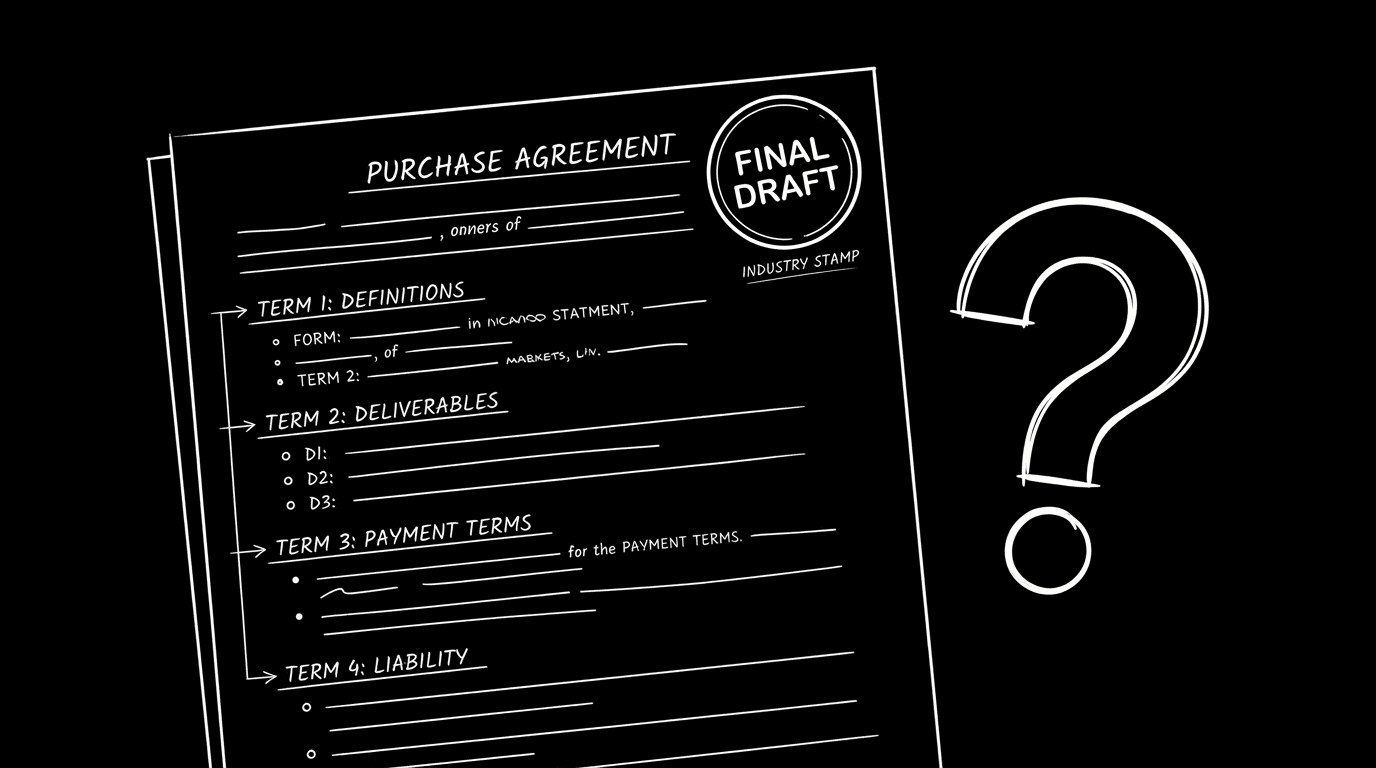
A producer asks for your script. You send a PDF. They write back: "Do you have the FDX?" You don't. You wrote in something else. You're not sure if that just cost you the meeting. The fear is real. Final Draft has been the default in Hollywood for so long that "send me the FDX" often means "send me the Final Draft file." But does that mean you have to own Final Draft to sell your screenplay? The short answer is no. The long answer is about what buyers actually need, what they assume, and how to stay in the game without paying the tax if you don't want to.
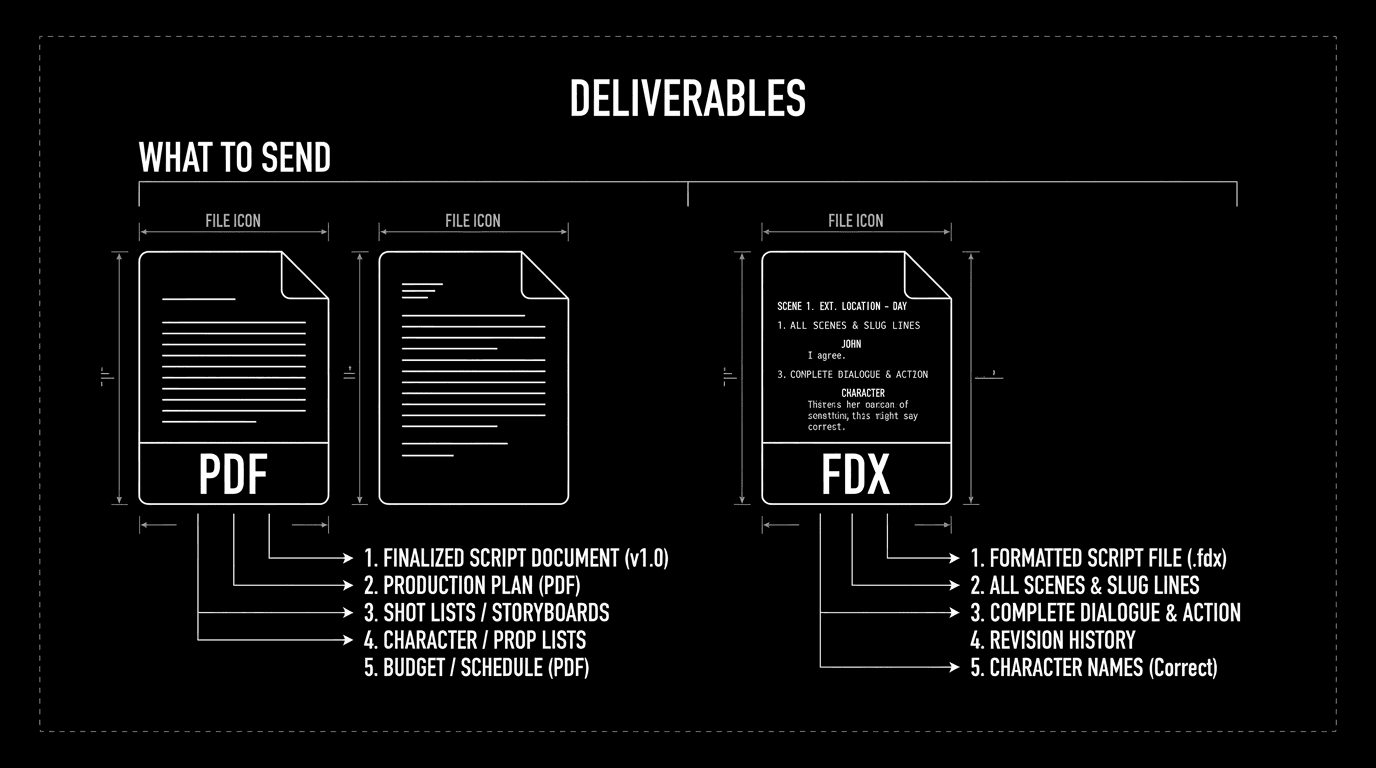
Selling a screenplay is about the script, the story, the pages, the format. Buyers need to read it, share it with partners, and often hand it to production for breakdown and scheduling. For that they need a file they can open. PDF works for reading. FDX (Final Draft's format) works for reading and for dropping into production pipelines. So the question isn't "Do I need Final Draft to write?" It's "Do I need to deliver FDX, and can I do that without owning Final Draft?" You can. Many tools export FDX. You can write in Fade In, WriterDuet, Celtx, or another app and export to FDX when someone asks. The "industry tax" is the belief that you must buy Final Draft to be taken seriously. That belief is partly true (some people do assume it) and partly false (you don't have to pay it to deliver what they need). For what production expects, see exporting for production. For alternatives that export FDX, the list is long.
Why does the myth stick? Because Final Draft was there first in a lot of offices. Because assistants and coordinators say "send the Final Draft" when they mean "send the FDX." Because nobody at the agency is going to open your email and think "I wonder what app they used." They just want a file that opens. So the language of the industry reinforces the idea that Final Draft is the only option. It isn't. It's the most named option. Once you know that "FDX" is the deliverable and that multiple apps can produce it, the tax becomes a choice.
You need to deliver a script they can read and use. You don't need to have written it in Final Draft. The tax is optional, as long as you can export FDX when it's asked for.
What Buyers Actually Need (And What They Ask For)
Most of the time, a PDF is enough. Readers, managers, and many producers will read a PDF. They don't need to edit your file. They need to read it. So for the first round of submissions, queries, contests, general meetings, PDF is the standard. When things get serious, someone may ask for FDX. That usually means they want to pass the script to a line producer, a breakdown artist, or scheduling software. FDX carries structure (scene headings, character names, etc.) in a way that PDF doesn't. So "we need the FDX" means "we need to put this into our pipeline." You don't have to have created the file in Final Draft. You have to deliver a valid FDX. If your tool exports FDX, you're good. Think about it this way: the buyer doesn't open your file and run a check for which app created it. They open it. If it looks right and imports into their tools, you're done. For format rules so your export looks correct, see screenplay format. For recovering if your FDX ever corrupts, that's a separate worry.
Relatable Scenario: The Writer Who Said "I Only Have PDF"
Alex got a request for a meeting. The producer's assistant asked for the FDX. Alex had written in a different app and had only ever exported PDF. They didn't know their app could export FDX. They said "I only have PDF." The meeting still happened, but they felt like they'd slipped. Afterward they checked: their app did export FDX. They exported it, sent it, and from then on kept an FDX ready. The lesson: you don't need to own Final Draft to have an FDX. You need an app that exports it. Check yours. For a round-up of tools that export FDX, see screenwriting software alternatives.
Relatable Scenario: The Writer Who Was Told "We Only Accept Final Draft"
Jordan submitted to a contest. The rules said "Final Draft format only." Jordan assumed that meant they had to buy Final Draft. They didn't. They skipped the contest. Later they learned that "Final Draft format" usually means FDX, and that many apps export FDX. So they could have submitted without owning Final Draft. The industry tax had cost them an opportunity they didn't need to miss. Fix: When someone says "Final Draft," clarify: do they mean the software or the file format? If it's the format, export FDX from whatever you use. If it's the software (rare), then you're in a different conversation. For protecting your script in standard formats, always keep an FDX and a PDF.
Relatable Scenario: The Writer in a Room Where Everyone Uses Final Draft
Sam staffed on a show. The room uses Final Draft. The showrunner asked for scripts in FDX. Sam had been writing in another app at home. They had two choices: buy Final Draft for the job, or keep writing in their app and export FDX when handing in. They chose to use Final Draft on the show (the room's standard) and keep their other app for specs. So they "paid" the tax for the job, but not because they needed it to sell. They needed it to work in that room. The distinction matters. Selling your spec: PDF and FDX from any capable app can be enough. Working in a room that mandates Final Draft: that's a job requirement, not a universal industry tax. For when subscriptions make sense, we break down cost vs. value.
Relatable Scenario: The Writer Who Bought Final Draft for One Contest
Riley had been writing in Fade In for years. A major contest required "Final Draft (.fdx) file." Riley didn't read that as "we need an FDX." They read it as "we need Final Draft." So they bought a license. They exported from Fade In to FDX, submitted the FDX, and never opened Final Draft again. The contest didn't care how the FDX was created. Riley had paid the tax for a misunderstanding. Takeaway: When a contest or program says "Final Draft," look for ".fdx" or "FDX" in the same sentence. If they want the file, export it. If they explicitly require the software (e.g., "must be submitted from Final Draft"), that's the rare case. For keeping your script safe in standard formats, always keep an FDX next to your PDF.
Granular Workflow: Exporting FDX When You Don't Own Final Draft
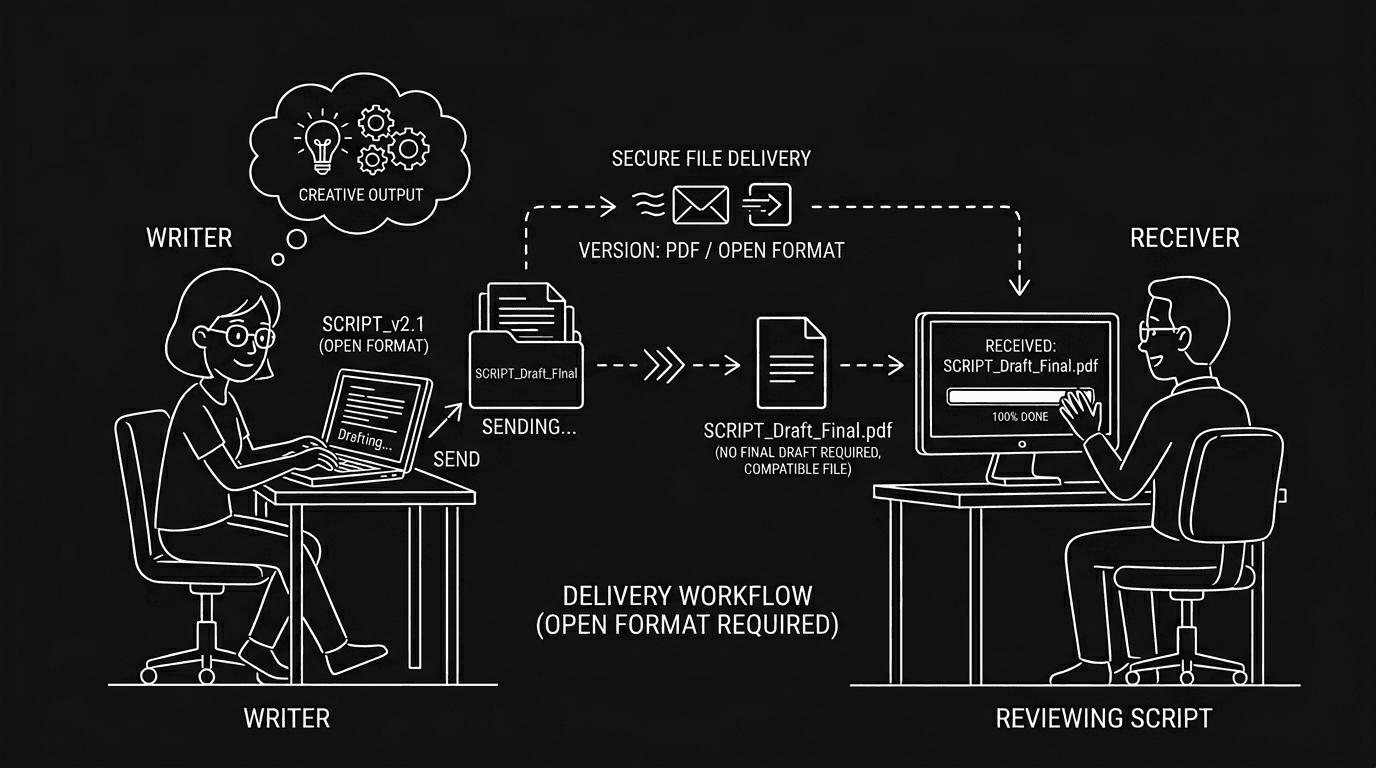
Here's the actual workflow so you're never caught off guard. Step one: Finish your draft in whatever app you use. Lock the draft (no more edits you care about for this version). Step two: Export to PDF. That's your reading copy. Name it clearly, e.g. Title_DraftDate.pdf. Step three: Export to FDX. In Fade In: File → Export → Final Draft (.fdx). In WriterDuet: Export → Final Draft. In Celtx: Export → Script → Final Draft. In Highland: Export → FDX. Your app may use different menu names; look for "Export" or "Save As" and "Final Draft" or "FDX." Step four: Open the FDX in a free reader if you have one (e.g. Final Draft Reader, or another app that can open FDX) and spot-check. Make sure scene headings, character names, and dialogue didn't get mangled. Step five: Store both PDF and FDX in the same folder, and back them up. When someone says "send the FDX," you send the FDX. You never have to say "I don't have Final Draft." You have the file. For a full rundown of what production needs and when, see exporting for production.
Do You Need Final Draft to Sell? A Reality Check
| Situation | Need Final Draft? | What you need instead |
|---|---|---|
| Querying, contests, first reads | No | PDF (and often FDX for contests that ask) |
| Producer asks for "the file" | No | FDX from any app that exports it |
| Room or show mandates Final Draft | Yes, for that job | Use FD for the show; use anything for your specs |
| You want to look "professional" | No | Correct format (PDF/FDX) matters; which app created it doesn't |
So: you do not need to own Final Draft to sell your screenplay. You need to deliver a script in the format the buyer wants, usually PDF, sometimes FDX. If your app exports both, you're not paying the tax. For a full list of tools that export FDX, see best screenwriting software alternatives.
Try it free
Try Screenweaver for free on your script
It is free. Import your existing project, get a clearer view of your outline, and regain control of your story structure in minutes.
Start FreeThe Trench Warfare: What Writers Get Wrong
Assuming "professional" means "Final Draft." Professional means correct format, clean pages, and a story that works. The app is a detail. Fix: Use any app that outputs industry-standard PDF and FDX. No one can tell which app you used from the file. For format rules, see screenplay format.
Not exporting FDX until someone asks. Then you're scrambling. Fix: Export both PDF and FDX when you lock a draft. Keep them in a backup folder. When someone asks for FDX, you send it. For backup discipline, see .fdx and cloud.
Paying for Final Draft "just in case." You're not in a room. No one has asked for FDX yet. You buy Final Draft to feel legitimate. Fix: Only buy Final Draft if you have a concrete reason, a job that requires it, or a workflow you prefer. Otherwise, use an app that exports FDX and keep the cash. For when subscriptions and cost make sense, we go deeper.
Saying "I don't have Final Draft" when they ask for FDX. That sounds like "I can't give you what you need." Fix: Say "I'll send the FDX" and export it from your app. You're not lying. FDX is the format; Final Draft is one way to create it. For exporting for production, we cover what to send and when.
Thinking the tax is unavoidable. It's not. The tax is buying Final Draft when you don't need it. Fix: Confirm what buyers need (PDF vs. FDX). Deliver it from the tool you have. Only pay for Final Draft when the job or the room requires it. For tools that export FDX without a subscription, see screenwriting software alternatives.
Exporting FDX once and never checking it. Some exports introduce small errors, wrong font, a character name split across lines, or a scene heading that lost its formatting. Fix: Open the FDX in a reader or in another machine after export. Scroll through. If something looks off, fix it in your main app and re-export. For avoiding format surprises, we cover how formatting can bite you.
Believing that "industry standard" means "only Final Draft." Industry standard means format, page layout, element types, pagination. Many apps produce that. Fix: Use an app that outputs correct screenplay format and exports FDX. You're meeting the standard. For format rules, we go through what readers and production expect.
Refusing to send FDX because you're attached to your app. You love your workflow. You don't want to "give in" to Final Draft. So you push back when they ask for FDX. Fix: Sending FDX isn't giving in. It's delivering what they need. Your creative process stays in your app; the deliverable is just a file. For how to export without losing your work, we cover backup and versioning.
When You Do Need Final Draft (Or Something That Plays Nice)
You need Final Draft (or an FDX-capable workflow) when: a room or show requires it, you're on staff and the production standard is Final Draft; a contest or program explicitly requires the software, rare but possible; you prefer it, you like the workflow and the cost is worth it. You do not need it to sell a spec. You need to deliver a script. PDF and FDX are the deliverables. The industry tax is the idea that you must pay for Final Draft to be taken seriously. You must deliver a professional script. You don't have to create it in one specific app. For Final Draft vs. alternatives and exporting for production, we cover the full picture.
The Perspective
Do you really need to own Final Draft to sell your screenplay? No. You need to write a great script and deliver it in the format the buyer wants, almost always PDF, and when they ask for it, FDX. You can do that from Fade In, WriterDuet, Celtx, Highland, or any number of tools. The industry tax is the belief that you must pay for Final Draft to be legitimate. That belief is useful to the company that sells Final Draft. It's not a requirement for selling your work. Own Final Draft if you want it or if the job requires it. Don't own it because you think the gatekeepers will reject you without it. The gatekeepers care about the script. Give them the file they need. For more on format and delivery, see screenplay format and exporting for production. For the official Final Draft product, <a href="https://www.finaldraft.com" rel="nofollow">Final Draft</a> is the source of record, but buying it is a choice, not a tax you're obliged to pay.
[YOUTUBE VIDEO: Writer exports script to FDX from a non–Final Draft app, opens it in a reader to verify, and explains when to send PDF vs FDX.]
Prompt: Dark Mode Technical Sketch, PDF and FDX file icons with "what to send" or "deliverables"; thin white lines on solid black; no 3D renders --ar 16:9
Takeaway
The industry tax is optional. You need a script that reads well and a file (or two) that meets the ask. PDF for reading. FDX when they need to put it in the pipeline. Export both from whatever you use. Only pay for Final Draft when the job or your preference demands it. For tools that export FDX and protecting your script, you're covered.
Prompt: Dark Mode Technical Sketch, A writer sending or handing off a script file; "no Final Draft required" implied; thin white lines on solid black; no 3D renders --ar 16:9
Final Step
Build your next script with Screenweaver
Move from ideas to production-ready pages faster with timeline-native writing and AI-assisted story flow.
Try Screenweaver