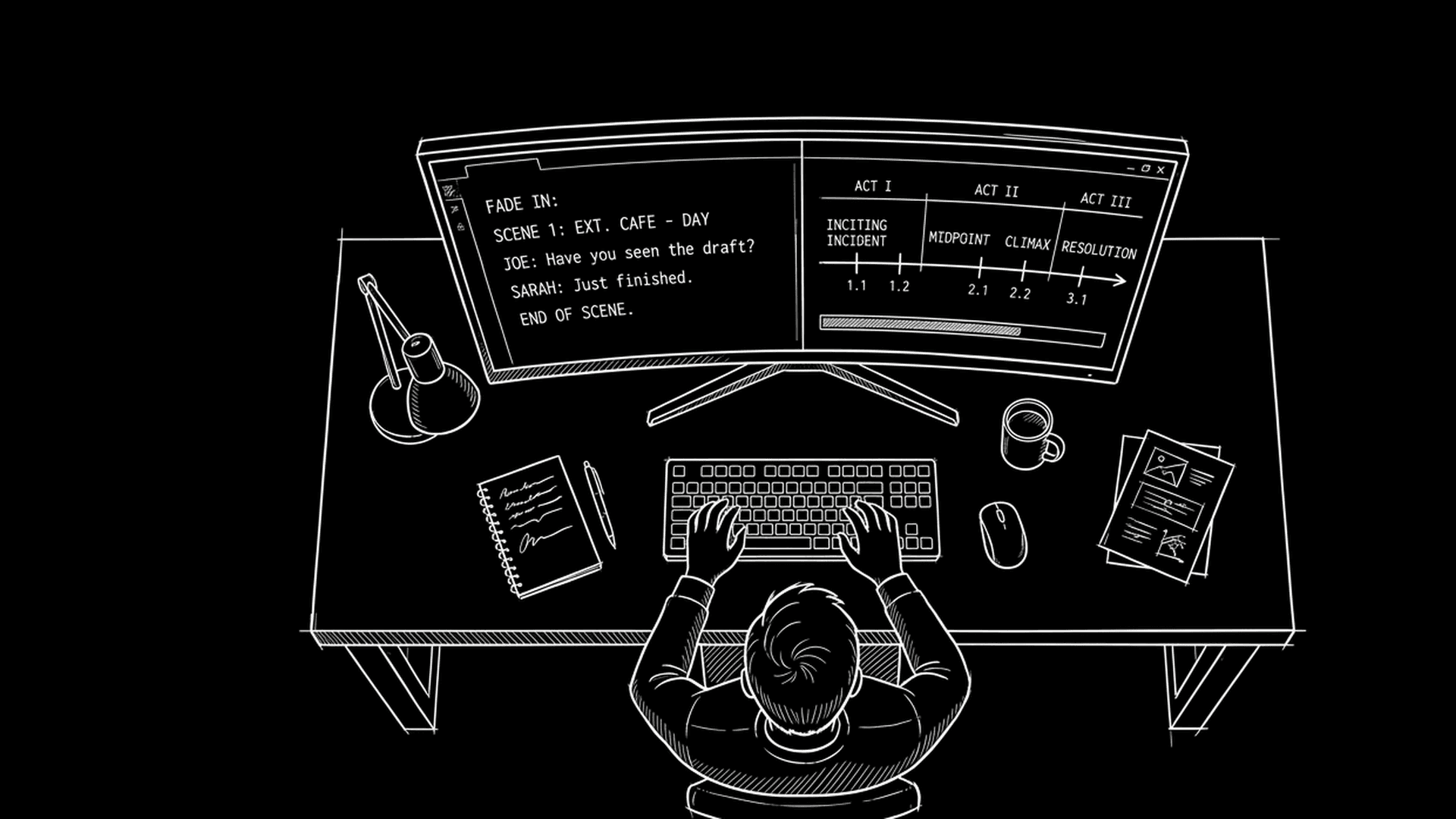

A limited series is not a short movie cut into episodes. It is a long argument with checkpoints. Each episode must deliver a satisfying pay-off while withholding enough to pull viewers forward, and the finale must feel both inevitable and surprising - not because of twists alone, but because the thematic engine finally reveals why every episode existed.
Software that treats your project like one ninety-page feature will quietly sabotage you. You need episode consciousness: pacing rhythms per hour, engine design for ongoing escalation, and bibles that stay honest while scripts change.
Here is why that matters: development in 2026 often asks for materials earlier - bibles, synopses, polished pilots, sometimes multiple episode outlines - before writers have the emotional space to do their best work. Your toolchain should reduce duplication labor so creative energy goes into decisions, not file administration.
Limited series writing is carpentry and music theory at the same time. Your software should help you hear the chord changes across hours.
Cinematic workflow frames

These two visuals work as a pair: the first shows Cinematic workflow still, first angle, 35mm film grain, and the second shifts to Cinematic workflow still, second angle, 35mm film grain - compare them briefly, then move on.

What Limited Series Development Requires From Tools
You need multi-document architecture without chaos: pilot script, episode capsules, series overview, character arcs, research vault, and revision history that does not punish exploration.
| Artifact | Function | Failure Mode |
|---|---|---|
| Series spine | Thematic and plot engine | Vague “it’s about family” babble |
| Episode promises | Hook and progress per hour | Episodes become featurettes |
| Character trajectories | Growth tracked across hours | Reset-button characterization |
| Canon tracker | World rules and twists | Accidental contradictions |
| Writer room notes | Decisions made visible | Chat amnesia |
Scenario One: Six-Episode Mystery With Dual Timeline
Episode intercutting risks audience confusion and writer confusion. Writers maintain two timelines with clear anchors and labeling inside their development environment. When a timeline beat shifts in Episode 3, writers trace dependent scenes backward and forward before committing.
Scenario Two: Mini-Room Pilot Plus Room Bible
Financiers want pilot polish plus proof the season is not a one-trick pony. Writers link beat decisions from bible pages to pilot scenes so rewrites do not orphan the pitch narrative.
Scenario Three: Showrunner Revisions While Casting Moves
Casting reality reshapes voice. Writers track character dialect notes per episode as actors attach. Without tagging discipline, Episode 5 dialogue reads like a different show.
As discussed in our guide on five-act structure instincts in limited series, engine shape matters more than episode count fashion.
Step-by-Step: Stand Up a Limited Series Workspace
Step 1 - Write a one-page engine statement: what changes from Ep1 to finale, and why viewers keep watching.
Step 2 - Create episode question cards: what is answered this hour, what is deepened, what is withheld.
Step 3 - Build character delta charts: start state, mid reversal, end cost.
Step 4 - Maintain a canon sheet for twist logistics and clue distribution if applicable.
Step 5 - Pilot drafting happens with episode promises visible, not buried.
Step 6 - After each pilot rewrite, audit outlines for drift.
Step 7 - Export packages for partners: pilot PDF plus concise overview docs with matching naming dates.
As discussed in our breakdown of TV series bible components in 2026, bibles are coordination contracts.
Trench Warfare: Limited Series Failure Modes
Pilot perfectionism kills momentum.
Bible cosplay replaces real scene craft.
Mystery logistics rot when writers track clues casually.
Thematic statements multiply until none mean anything.
Room notes live in chat, die in execution.
A limited series bible is not fan fiction about your own idea. It is operational memory.
For external craft grounding, see <a href="https://www.oscars.org/nicholl/about/screenwriting-resources" rel="nofollow">Nicholl Fellowship screenwriting resources</a>.
[YOUTUBE VIDEO: Limited series beat audit - trace Episode 3 obligations against pilot promises using multi-doc organization]
Tool Categories: Integrated vs Multi-App
Integrated tools reduce context switching; multi-app systems reduce vendor lock. Choose based on team literacy and export needs.
The Real Workflow: From Greenlight Deck to Locked Finale
Think about the first week after someone says "we should develop this as a limited series." You are not writing Episode 6 yet. You are naming promises. That distinction is where software starts helping or hurting. In a healthy stack, every promise has an address: one line in your series statement, one row in your episode map, one or more scenes in script pages, and one revision note when reality changes. In an unhealthy stack, the same promise appears in six docs with six phrasings and no owner. That is where contradictions are born.
Now imagine a producer call. They ask a simple question: "What does the midpoint shift in Episode 4 force the lead to sacrifice in Episode 5?" If your tooling is clean, you answer in twenty seconds because your notes are linked. If your tooling is fragmented, you answer with vibe and memory. Memory fails under pressure. This is why dense projects need operational writing systems, not just elegant prose instincts.
Writers who move from features to limited series often underestimate this. In a feature, you can hold the whole thing in your head for a while. In a six or eight episode arc, you cannot. You should not try. Your software should absorb memory burden so your brain can spend cycles on tone, moral ambiguity, and scene energy.
The best limited series tool is not the one with the prettiest board. It is the one that remembers your commitments when you are tired.
Here is a practical model that works for many mini-rooms. The series statement lives at the top and never exceeds one page. Episode promises live in a separate view that can be scanned quickly. Character deltas live in their own grid so emotional movement is explicit, not implied. Canon facts live in a constrained note layer with ownership, because unowned canon becomes fan theory. Draft pages stay clean. The system is boring by design. Boring systems are reliable systems.
Scenario: The "Prestige Crime" Trap
Maya and Leo sell a six-episode crime limited series on a pitch that promises two clocks: a present-day manhunt and a historical cover-up. Their pilot reads beautifully. Episode outlines are glossy. Then Episode 3 collapses in rewrite because clues seeded in Episode 1 no longer line up with the revised historical timeline. Nobody notices for ten days because clue notes live in chat messages and private docs.
They rebuild with a stricter workflow. Every clue gets a source scene, revelation scene, and verification owner. Timeline edits require a quick dependency pass before script changes are approved. The process feels slower for one week. Then it gets faster. Suddenly they can cut a subplot with confidence because they can see exactly which reveals it touched.
The lesson is not "be rigid." The lesson is "be explicit." Limited series projects fail quietly when assumptions stay implicit.
Try it free
Try Screenweaver for free on your script
It is free. Import your existing project, get a clearer view of your outline, and regain control of your story structure in minutes.
Start FreeScenario: The "Pilot Is Amazing, Rest Is Fog" Problem
Another common pattern: a team over-invests in pilot polish because it is the asset buyers read first. Fair. But if the rest of the season exists only as mood paragraphs, the pilot can become a liar. Characters promise one trajectory in Episode 1 and drift into a different genre by Episode 4.
A better workflow treats the pilot as one node in a season contract. Each major pilot beat must point to downstream consequence. If a beat has no future cost, ask why it is in the pilot at all. Software can help by surfacing beat references across episode docs. When this is visible, pseudo-depth dies quickly. You stop writing "cool opening events" and start writing durable obligations.
For a companion deep dive, our guide on how to write a TV show bible explains how to make those obligations readable to partners who were not in the room.
Granular System Setup: Parameters You Actually Configure
Most advice says "organize your project." That is vague. Better to define concrete parameters. Set one naming convention for episode files and never improvise it mid-season. Set one date stamp pattern for exports so everyone knows what is current. Set one rule for who can edit canon notes. Set one threshold for when a pilot rewrite triggers an outline re-audit. These are simple decisions, but they prevent expensive confusion.
Use this reference matrix as a baseline:
| System Parameter | Recommended Baseline | Why It Matters |
|---|---|---|
| Episode file naming | S01E0X_title_vYYMMDD | Prevents duplicate-current drafts |
| Canon ownership | 1 person signs off each lore change | Stops accidental contradictions |
| Rewrite trigger | Any pilot beat change forces episode audit | Keeps promises synchronized |
| Export cadence | Shared package after each major pass | Avoids stale attachments in emails |
| Character delta review | Weekly, same day each week | Emotional continuity stays visible |
This is not bureaucracy for its own sake. It is protection against entropy.
The Trench Warfare, Expanded: What Beginners Get Wrong and How to Fix It
Beginners often confuse "more documentation" with "better process." They write extensive bible prose that feels sophisticated but does not answer operational questions. Can we trace this clue from setup to payoff? Can we prove this character shift is earned? Can we show where the finale cost was seeded? If the answer is no, the document is decorative.
Another failure mode is timeline optimism. A team believes they can rewrite quickly later, so they postpone structure alignment. Then casting, financing, and schedule constraints arrive together. Rewrites become triage. The fix is ugly and unglamorous: schedule alignment passes early, before production pressure arrives. One focused pass now is cheaper than five panic passes later.
Writers also underuse search. In limited series work, search is not convenience. It is QA. If a motif term appears in Episodes 1 and 2 but vanishes until finale, maybe that is intentional. Usually it is drift. Search catches drift before readers do.
There is also the "bible cosplay" issue. Teams produce gorgeous PDFs with polished language and cinematic mood boards, then discover they cannot answer logistics questions in the room. Mood is not memory. Narrative tone is not dependency tracking. Keep the pitch doc polished, yes. But maintain an internal operations layer that is brutally specific.
The hardest beginner mistake is emotional attachment to early architecture. Limited series evolve. New actor chemistry changes scene priorities. Budget changes collapse set-piece plans. A healthy workflow expects architecture changes and makes them survivable. If your software setup assumes the outline is sacred, you will fight reality instead of adapting to it.
Limited series discipline is not rigidity. It is controlled adaptation.
Reader Experience: Why This Impacts the People Who Matter
Development readers are fast. They are not cruel by default. They are overloaded. If your materials reveal coherent episode intent, clear character progression, and stable canon handling, they trust you earlier. That trust buys attention. Attention buys pages. Pages buy decisions.
Conversely, when materials contradict themselves, readers stop believing payoffs before they arrive. They might not articulate "canon drift" in notes. They will call it "messy middle," "unclear motivation," or "soft ending." The underlying problem is often systems failure upstream from prose quality.
As discussed in screenplay revision passes, great rewrites are structured passes, not one giant intuition storm.
Unique Visual Prompt Blocks
The "Room Intelligence" Layer: Why Your Bible Is a Database
Think about the traditional series bible. It is a PDF. It is static. The moment you rewrite Episode 2, the bible starts lying. In a modern development environment, your bible is not a document; it is the "room intelligence" layer that lives alongside your script. If a character’s motivation shifts in the pilot, that shift should propagate through your episode summaries automatically.
This is not just about avoiding typos. It is about maintaining the "thematic engine" of the show. If the show is about the cost of secrets, and you remove a secret in Episode 3, you need to see the impact on the Episode 6 payoff immediately. Software that treats these as separate files is forcing you to do the integration work manually. Manual integration is where prestige series lose their edge.
A series bible should be the source of truth, not a collection of outdated guesses.
Scenario: The "Binge-Watch" Rhythm Audit
In 2026, audience behavior is the ultimate constraint. If Episode 4 feels like a "filler" hour, you lose half your viewers before the finale. Writers now use structural audits to check "binge-ability." They map the emotional high and low of each episode and look for the "valley of death" where momentum stalls.
By visualizing the season as a single wave, you can see where you need to compress or expand. Maybe the subplot in Episode 2 is actually the engine for Episode 5. Moving it requires more than a copy-paste; it requires a structural re-audit. This is why limited series writers are moving toward tools that show the "whole season at once," not just one script at a time.
Outcome Benchmarks: How You Know the System Is Working
By week three, you should be able to answer structural questions without rummaging through folders. If someone asks why a reveal lands in Episode 5 instead of Episode 4, you should have a traceable rationale that connects to earlier commitments. If you cannot answer quickly, the issue is rarely talent. It is usually visibility.
Healthy limited-series workflows produce measurable signals. Draft naming is consistent. Outline updates are timestamped close to script updates. Character deltas align with scene behavior. Canon disputes decrease because ownership is explicit. These are mundane signs, but they correlate strongly with stronger reads.
There is also a morale dimension. When systems are clear, mini-rooms spend less energy negotiating process and more energy arguing story, which is where creative tension belongs. Teams burn out less when tools reduce ambiguity.
One More Scenario: Late-Stage Network Note Cascade
A network sends a heavy note packet after reading the pilot and first two episode outlines. They want stronger antagonist pressure by midpoint and cleaner thematic articulation in the finale. Without a structured workspace, this kind of note cascade can derail the room for weeks. With a structured workspace, writers map each note to affected beats, then to scenes, then to canon entries. Work is still hard, but it is directed.
The hidden advantage is confidence. Writers can reject bad notes with evidence, not ego. "If we move this beat to Episode 2, we break the payoff chain in Episode 5." That is a persuasive production conversation.
The point of process is not obedience. It is leverage.
Closing Perspective
Pick software that honors episodic thinking without drowning you in dashboards.
Then write episodes that feel necessary - not because you planned six, because each hour must exist.
That necessity is what limited series greatness shares with great novels and great seasons.
Build systems that protect necessity.
Final Step
Build your next script with Screenweaver
Move from ideas to production-ready pages faster with timeline-native writing and AI-assisted story flow.
Try Screenweaver