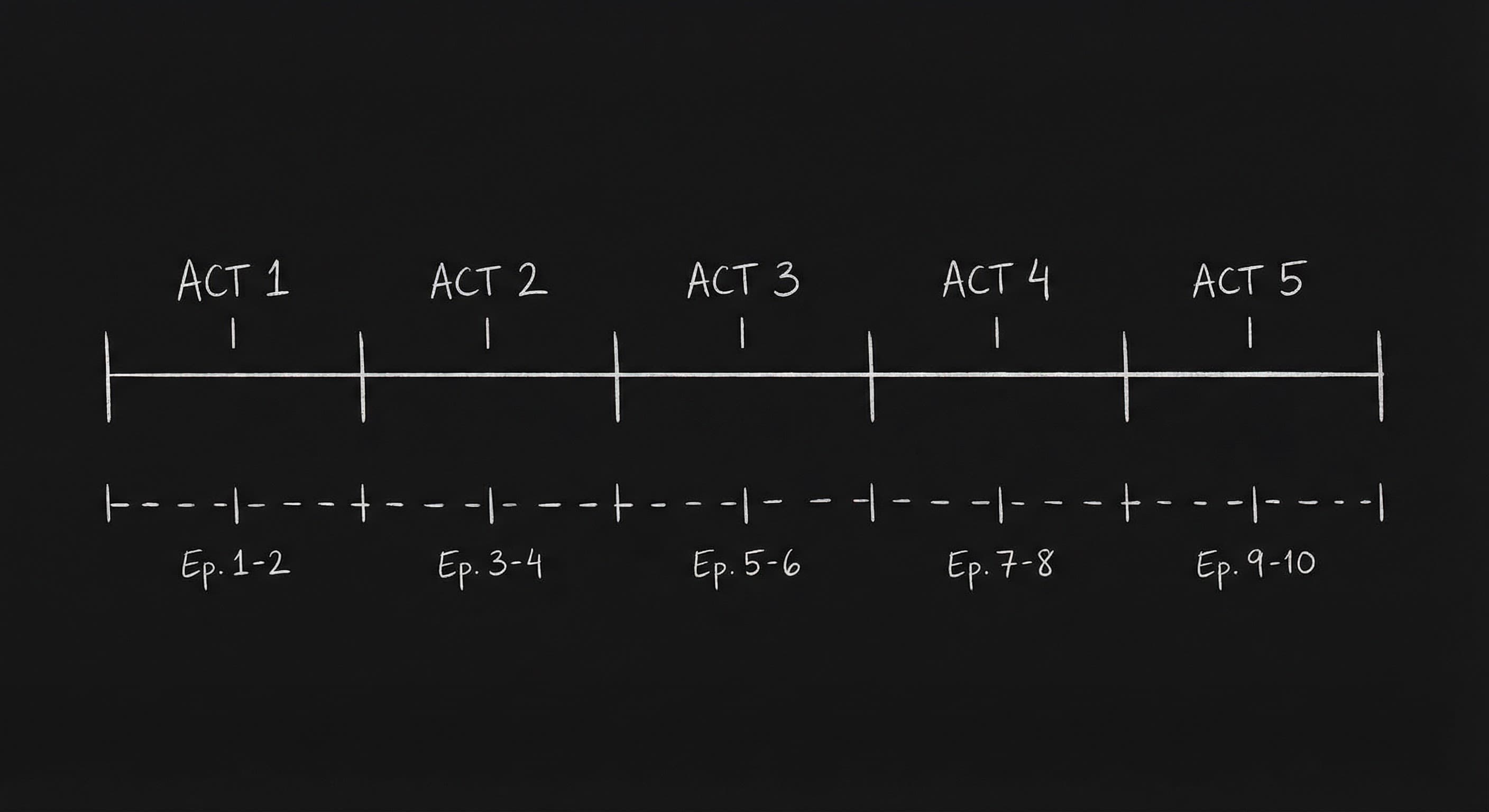

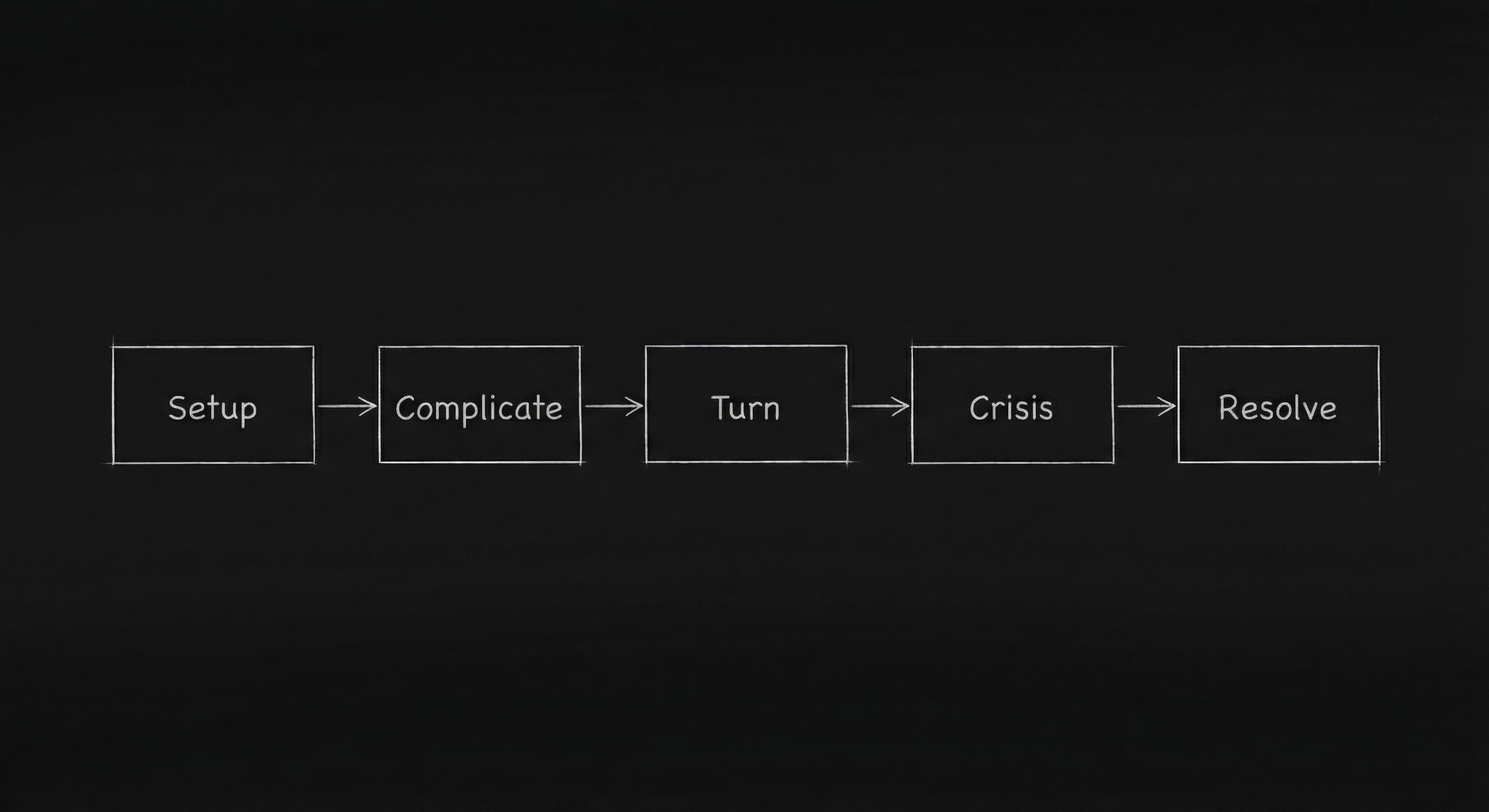
The limited series isn't a long movie. It's not a procedural with a new case every week. It's a single story,six, eight, ten episodes,that has to land as one arc while giving each episode a reason to exist. That's a different beast from the feature. The 5-act structure, borrowed from theatre and adapted for television, gives you a map. Not three acts stretched thin, but five distinct movements. Setup, complication, midpoint, crisis, resolution. When you overlay that on a season, you know where the big turns go. You know which episode carries the midpoint, which carries the lowest point, which carries the climax. The binge viewer feels it. They might not name it. But when the season is structured in five acts,and when each act gets the right amount of room,they don't click away. They click "Next Episode."
Here's the practical part. A six-episode limited series might map like this: Act 1 = episode 1 (and maybe the top of 2). Act 2 = the rest of 2 and 3. Act 3 (midpoint) = end of 3 or top of 4. Act 4 = the bulk of 4 and 5 (complications and crisis). Act 5 = episode 6 (climax and resolution). An eight-episode run spreads the same five acts across more hours. The proportions shift. The functions don't. You're still building to a midpoint shift, a crisis, and a climax. You're just doing it across episodes instead of pages.
Why Five Acts (And Not Three)?
Three acts work for a two-hour film. You have one setup, one long middle, one resolution. In a limited series, the "middle" can be four or five hours. If you leave it as one undifferentiated block, the season sags. The 5-act model splits the middle into clearer phases. Act 1: setup and inciting incident. Act 2: commitment and first major complications. Act 3: midpoint,a major shift (revelation, reversal, or point of no return). Act 4: escalation and crisis (often including the "all is lost" or equivalent). Act 5: climax and resolution. So you're not inventing a new structure. You're taking the same dramatic logic and giving it five waypoints instead of three. The midpoint becomes a dedicated act (or half-act). The crisis gets its own space. The writer,and the viewer,always know where they are.
The binge isn't random. It's designed. When each episode ends on a turn or a question, the viewer hits "Next." When the season has five clear acts, the viewer feels the shape.
Mapping Five Acts Onto Episodes
| Season length | Act 1 | Act 2 | Act 3 (Midpoint) | Act 4 | Act 5 |
|---|---|---|---|---|---|
| 6 episodes | Ep 1 | Ep 2–3 | End 3 / start 4 | Ep 4–5 | Ep 6 |
| 8 episodes | Ep 1–2 | Ep 3 | Ep 4 | Ep 5–6 | Ep 7–8 |
| 10 episodes | Ep 1–2 | Ep 3–4 | Ep 5 | Ep 6–8 | Ep 9–10 |
These are templates. Your show might put the midpoint at the end of episode 3 instead of the start of 4. The point is to assign each act to a chunk of the season. Then, within each chunk, you know the job. Act 3 isn't "more story." It's "the turn." Act 4 isn't "the middle." It's "escalation and crisis." That clarity prevents the season from feeling like one long second act.
Relatable Scenario: The True-Crime Limited Series
You're developing a six-episode series based on a real case. Episode 1: we meet the detective and the victim's family; the crime is introduced. Episode 2: the investigation deepens; a suspect emerges. Episode 3: the arrest,but by the end of the episode, new evidence suggests they have the wrong person. That's your midpoint. The season isn't "will they catch the killer?" anymore. It's "they caught the wrong person; now what?" Act 4: the real investigation; pressure from the system; the "all is lost" might be the case being closed or the detective being taken off. Act 5: the final push, the real culprit, the resolution. When you plan the season, you're not just "telling the story." You're placing the midpoint and the crisis in specific episodes. The rest of the season supports those anchors. For more on making the midpoint feel like a real turn, see our guide on the midpoint shift: in a limited series, that shift often lands at the act break between 3 and 4.
Relatable Scenario: The Family Drama Limited Run
Eight episodes. A family gathers for a wedding; secrets surface; by the end the family is fractured. Act 1 (episodes 1–2): we meet everyone; the wedding is the frame; the first cracks appear. Act 2 (episode 3): commitments deepen; one character is digging into the past; another is hiding something. Act 3 (episode 4): the midpoint,a revelation at the rehearsal dinner or the wedding itself. The audience (and some characters) learn something that changes the story. Act 4 (episodes 5–6): fallout; alliances shift; the "all is lost" might be the wedding cancelled or a relationship destroyed. Act 5 (episodes 7–8): the aftermath; who stays, who leaves; the new normal. Each act has a clear emotional job. The writer's room can assign episodes to acts and then break each episode into scenes that serve that act's function.
The Trench Warfare Section: What Beginners Get Wrong
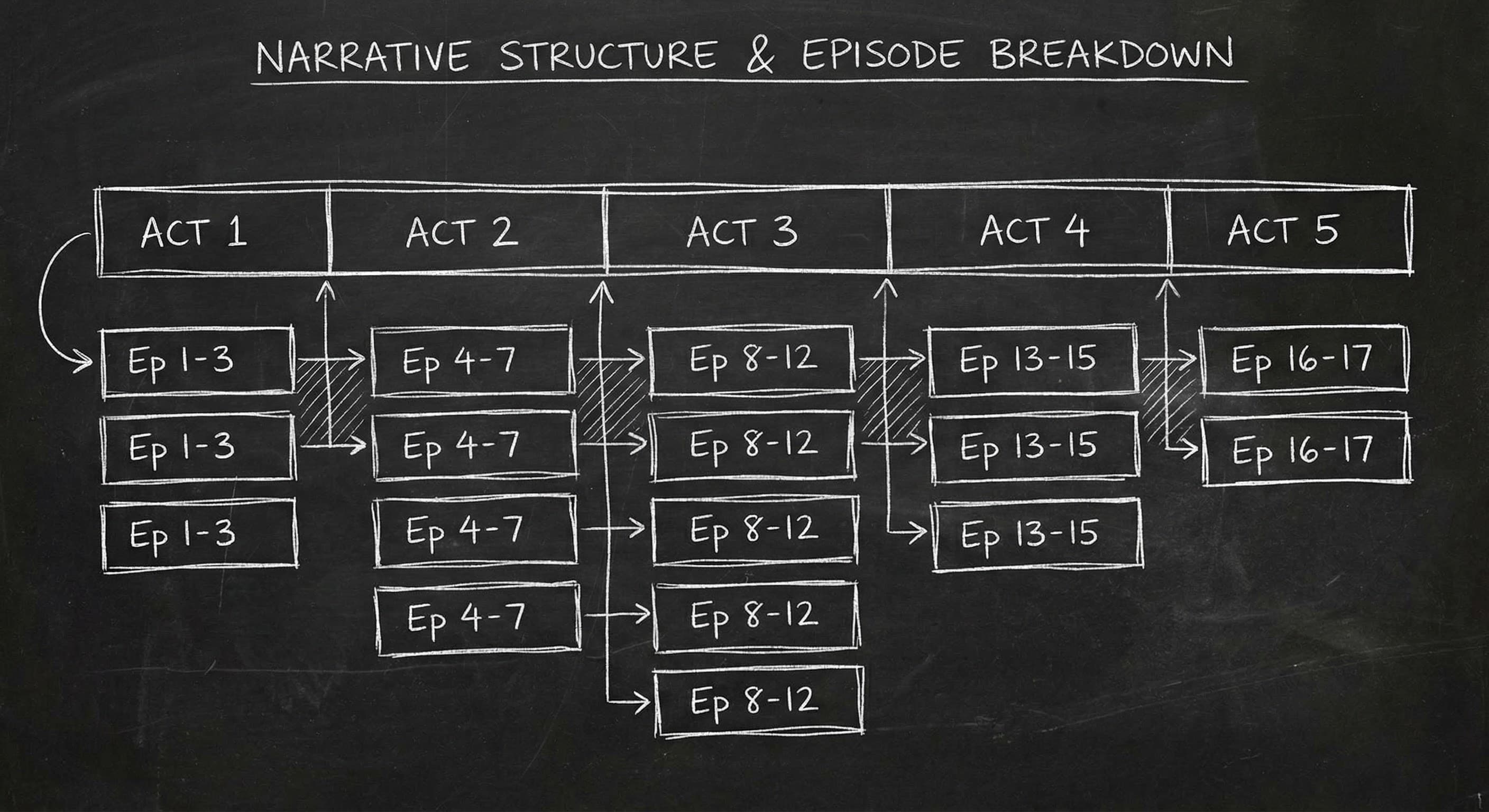
Treating the limited series as a long movie. A movie has one viewing. A series has episode breaks. Each episode needs its own mini-arc,a question, a turn, or a cliffhanger,so the viewer has a reason to continue. The 5-act structure lives at the season level. Within each act, you still need episode-level beats. Don't let an episode be "more of the same." Give it a purpose in the act.
Midpoint too late or too early. If your midpoint is at the end of episode 5 in a six-episode season, Act 4 and 5 are crushed. If it's at the end of episode 1, Acts 2 and 3 have nothing to build on. Aim for the middle of the season,end of episode 3 or start of episode 4 in a six-episode run. The midpoint should feel like the hinge. Too early and the back half feels repetitive. Too late and the back half feels rushed.
No clear "all is lost" or crisis. In a 5-act limited series, Act 4 usually contains the lowest point. Something fails. The plan collapses. The protagonist is isolated or defeated. If that beat is fuzzy,"things are hard",the climax won't land. Name the crisis. Which episode? What specifically is lost? Our piece on the All Is Lost moment applies here: the beat needs to be concrete and emotionally real, not a vague "stuff goes wrong."
Act 5 rushed. You've spent five episodes building. Episode 6 (or 7–8) has to deliver the climax and the resolution. Too many limited series cram the climax into the last 15 minutes and then tag a quick resolution. Give the climax room. Give the resolution at least one scene,or one episode,so the audience can process. The refusal of the call might have been in Act 1; the payoff of the character finally committing can land in Act 5. Don't shortchange the end.
Episode length inconsistency. If episodes vary from 35 to 65 minutes, the act boundaries get fuzzy. When possible, keep episode length consistent so that "Act 3 = episode 4" means something. If you're in a format with variable length, map acts by story beats, not by minute count,and make sure each act's beats are clear in the room.
Try it free
Try Screenweaver for free on your script
It is free. Import your existing project, get a clearer view of your outline, and regain control of your story structure in minutes.
Start FreeStep-by-Step: Outlining a Limited Series in Five Acts
Before you break story, decide: how many episodes? What's the midpoint (the turn that changes the story)? What's the crisis (the lowest point)? What's the climax? Write one sentence for each. Now assign them to episodes. "Midpoint = end of episode 3." "Crisis = middle of episode 5." "Climax = episode 6." Then fill Acts 1 and 2: what has to happen to get us to the midpoint? Then fill Act 4: what has to happen between midpoint and crisis? Then Act 5: how do we get from crisis to climax to resolution? Once the five acts are placed, break each act into episodes and each episode into scenes. You're building from the skeleton. For a parallel skill,structuring a single episode,our guide on outlining a 60-minute TV drama pilot uses similar logic at the episode level.
[YOUTUBE VIDEO: A single limited series (e.g. one season of Mare of Easttown or The Queen's Gambit) broken down by five acts, with timestamps for act boundaries and a brief note on what each act accomplishes.]
How This Fits With the 8-Sequence Approach
The 8-sequence approach is for features,roughly 15 minutes per sequence. The 5-act structure is for seasons. You can use both: within a single episode, you might think in sequences or in beats; across the season, you think in five acts. The 8-sequence model (see our 8-sequence guide) helps with pacing inside one unit. The 5-act model helps with pacing across the whole run. Different scales, same principle: name the units, give each a function, then write to that function.
The Perspective
The limited series is the dominant prestige format. One story, one season, built to be binged. The 5-act structure gives you a map for that story. Put the midpoint in the middle. Put the crisis in Act 4. Give Act 5 room to land. Then break each act into episodes and each episode into scenes. The viewer might not name the acts. They'll feel the shape. And they'll keep watching.
Final Step
Build your next script with Screenweaver
Move from ideas to production-ready pages faster with timeline-native writing and AI-assisted story flow.
Try Screenweaver