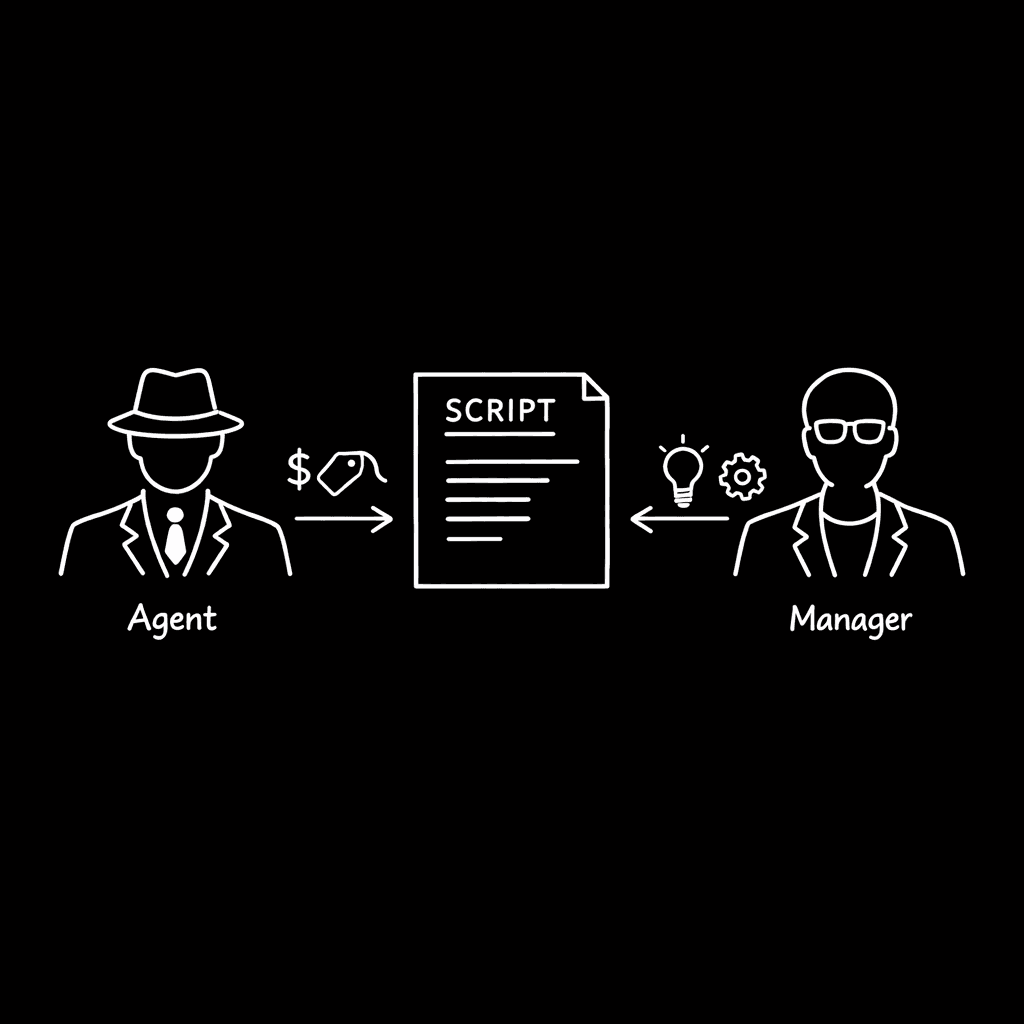

You're staring at your finished script like a fresh print in the can. It's real. It's solid. And now you're stuck on the same question every emerging writer hits: do I need an agent, a manager, or both? Who gets this thing sold? Here's the secret nobody says up front: an agent and a manager are not two flavors of the same job. One is built to sell. The other is built to develop. Most beginners blur those roles and do the wrong thing at the wrong time. You don't have to.
If you take one thing from this article: agents sell what already works; managers help you become the writer whose work can actually sell.
We're going to live in that difference. We'll walk through real scenarios, the mistakes that quietly kill momentum, and how to sequence your move: develop, then package, then sell, instead of spray, pray, and burn bridges. For the full business picture, pair this with our guide on Understanding WGA Minimums and our How to Get a Literary Manager in 2026 for a complete representation toolkit.
The Core Divide: Selling vs. Developing
Think of it like a film set. On one side you have the assistant director with a stopwatch and a shot list, pushing to make the day. On the other, the director, obsessed with performance and story even if it costs another take. Agent. Manager. Same project. Different incentives.
Agents are commission-driven. They make a percentage when money moves. So their question is: what can I sell this quarter? They work the phone, talk to buyers, leverage relationships. Managers are long-game builders. They're in the trenches with your material. Notes, strategy, which idea to write next, when to rewrite instead of sending. Their question is: what kind of writer are you becoming, and how do we make you valuable over the next five years?
So when you ask "agent or manager first?" you're really asking: is my script ready to be sold right now, or do I secretly know it's a draft away? If you're honest about that, the choice gets clear.
What Agents Actually Do
Agents don't sit in leather chairs slowly reading every page. They're on the phone. They're in email. They're tracking who's buying what, who's staffing, who needs a thriller, who just lost a writer on a rom-com. They negotiate deals, fees, steps, credit, backend. They submit market-ready material: polished specs, pilots, samples. They get you in the room. Their Rolodex is: who can buy what I'm holding right now? If your script still reads like a rough cut, they don't have time to fix it. Their inbox is full of clients who are ready to go out.
What Managers Actually Do
Managers live in the edit bay. They read early drafts. They give hard notes when the script is still messy. They talk strategy: feature or pilot, thriller or character piece, staffing sample or spec. They help you find your lane. They tell you to finish the right script, not the one you're obsessed with. They help you target the right buyers once the work is there. A manager's real value is often invisible: the bad pages they stopped you from sending, the draft that never hit a buyer's inbox.
A manager's job is to sit with you in the dark and say: we're losing the audience right here.
Three Real Scenarios
Scenario 1: Film school grad with a hot short. You have one feature on draft three and a half-written pilot. You're tempted to cold-email every agency. The problem: you don't have a package yet. An agent sees no produced long-form work and one unproven script. A hungry manager sees clay: a short that proves you can execute, a feature that can become a killer sample with another pass. Here you chase a manager first. You're not selling a movie yet. You're building the version of you an agent can later sell.
Scenario 2: Contest winner with heat. Your grounded sci-fi feature placed in real competitions. You've had requests, maybe a general or two. Now an agent can smell something. If the script is lean and readers responded, you might land a manager and an agent in short order. You're between developing and selling. Don't sit on the opportunity; a good manager will help you move fast and use that heat to approach agents strategically.
Scenario 3: Working but under-repped. You've been staffed once or done rewrites. You're not breaking in from zero, you're under-leveraged. What you need is someone who can turn credits into better work and negotiate terms. That's agent territory. Not having an agent at this stage is like leaving the lighting truck parked. You're leaving power on the table.
Agent vs. Manager at a Glance
| Aspect | Agent (Sell) | Manager (Develop) |
|---|---|---|
| Primary focus | Selling projects, closing deals | Building material, shaping career |
| When they engage | When the work is market-ready | Earlier drafts, long-term plan |
| Time on notes | Limited, high-level | Deep, iterative development |
| Relationships | Buyers, studios, networks | Writers, producers, some buyers |
| Incentive | Commission on money | Commission + building a career |
| Best for you when… | You have a strong spec or heat | You're still finding your voice |
Try it free
Try Screenweaver for free on your script
It is free. Import your existing project, get a clearer view of your outline, and regain control of your story structure in minutes.
Start FreeWhat Beginners Get Wrong
Querying agents with half-baked material. Sending a raw, flabby draft to an agent is like screening a rough cut with temp sound. They see risk, not potential. Fix the script first. Get a manager to help you get it there. Then think agent.
Treating managers like junior agents. "How many people can you send this to?" "Can you get me in at Netflix?" If your only expectation is access, you're missing the point. Managers are there to say: we're not going out yet. This second act isn't doing what we need.
Spraying the same script everywhere. Mass-emailing the same not-quite-there draft burns your first impression. A good manager slows you down: we're not sending wide yet; we're picking five targets and you're doing one more pass on the climax first.
Expecting rep to replace hustle. Getting a manager or agent doesn't turn your life into limo rides. You still write. You still network. You still learn the business, including WGA minimums so you know your leverage when a deal lands.
When Geography Matters
Outside LA, managers are often easier to reach. They're more open to Zoom, to tracking writers they've never met, to reading PDFs from someone not in the coffee-shop circuit. Agents are under pressure to close; they often prefer writers who can take meetings on short notice and be in the room. That doesn't mean you can't get an agent from afar. It means you'll likely get there through work that gets notice and a manager who turns that into something saleable. We go deeper in Networking in LA vs. Remote.
If you're outside LA, the manager is often your lifeline in; the agent is the amplifier you add once that line is live.
When to Involve a Lawyer
When you don't have rep but a producer is offering money or a contract, your first call might not be manager or agent, it might be an entertainment attorney. They review the agreement, explain option terms and reversion, and protect you from signing away rights you didn't know you were giving. We cover Entertainment Lawyers: When Do You Need One? in detail. For now: don't sign anything important without someone who reads contracts for a living. The WGA Schedule of Minimums{rel="nofollow"} is a useful external reference for rates.
The Sequence That Works
Solo grind and peer notes. Then targeted outreach to managers. Development cycle: rewrites, more samples, a slate instead of one script. Heat and validation, contests, coverage, generals. Then agent conversations, because now there's something to sell. Lawyer in the mix when real deals appear. New writers often skip the manager step and go straight to agents. That's like hand-delivering a rough assembly to a distributor. Bet on the sequence instead.
The Perspective
If your work were a film print, where is it? Still in the Steenbeck with tape marks? You're in manager territory. Locked, mixed, ready to project with buzz? You're stepping into agent territory. Most writers want to jump to the sales call. The ones who build careers respect the sequence. So ask yourself: do I need someone to sell me, or someone to help me become the writer who's actually sellable? Your answer tells you who to call first.
[YOUTUBE VIDEO: Side-by-side of an "agent-ready" script vs a "manager-stage" script, first act from an early draft vs the tightened version, with on-screen notes on what a manager would flag and what an agent needs before they can sell.]
These two visuals work as a pair: the first shows Writer's desk with script pages and manager's card; dark mode technical sketch, and the second shifts to Phone and contract on table; dark mode technical sketch—compare them briefly, then move on.

Final Step
Build your next script with Screenweaver
Move from ideas to production-ready pages faster with timeline-native writing and AI-assisted story flow.
Try Screenweaver