
A producer offers you money to write a feature. Or to do a rewrite. Or to staff on a show. The number they throw out might sound big until you realize it's below what the Writers Guild says you should get, or it might be exactly at guild minimum, and you didn't know. WGA minimums are the floor. They're what signatory companies (studios, networks, many streamers) have agreed to pay for guild-covered work. Even if you're not in the WGA yet, those numbers are your reference. They tell you what "professional" looks like. This guide walks you through why minimums matter, how they're structured, and how to use them as leverage when you're negotiating, with or without an agent or lawyer.
WGA minimums are not a ceiling. They're a floor. Knowing them lets you recognize a lowball offer and push for at least guild scale, or better, when you have leverage. Ignore them and you might leave thousands on the table.
For the full deal context, see Option Agreement and Entertainment Lawyers. For protecting your work before any deal, Copyright and Registration is your baseline.
What the WGA Is and Who It Covers
The Writers Guild of America (WGA) is the union for film, television, and streaming writers in the US. It negotiates minimum compensation and working conditions with producers and studios. When a company is a signatory to the WGA agreement, it has agreed to pay at least the minimums for covered work and to follow guild rules (credits, residuals, etc.). Not every project is guild. Micro-budget indies, some non-union productions, and certain international co-productions may operate outside the guild. But most studio features, network TV, and major streamer series are guild. So when you're in the room for those jobs, the minimums are the starting point.
If you're not yet a WGA member, you can still work on guild projects. The company will typically "Taft-Hartley" you, bring you in under the guild agreement, and you'll be paid at least minimum. Once you've done enough guild work, you can join. So minimums matter for you even before you're in the union.
How Minimums Are Structured
Minimums are set by contract (the MBA, Minimum Basic Agreement) and are updated when the guild renegotiates. They're usually expressed as dollar amounts per type of work and sometimes as percentages of budget for features. Key categories:
Features. Minimums depend on budget tier (low, mid, high) and step (treatment, first draft, rewrite, polish). So there's a minimum for a "story and screenplay" on a low-budget feature, a different one for a high-budget feature, and so on. The WGA publishes a Schedule of Minimums that breaks this down. Numbers change each contract cycle, so you need the current schedule.
Television. Minimums per episode, per format (e.g. half-hour, one-hour). There are minimums for staff writers, story editors, executive story editors, co-producers, etc. There are also script fees, additional payment when you write an episode. Again, the Schedule of Minimums has the exact figures.
New media / streaming. The guild has carved out minimums for high-budget streaming (e.g. Netflix, Amazon, Apple). They're in the same Schedule. So when someone says "it's a streamer show," the minimums still apply if the project is guild-covered.
You don't have to memorize every number. You need to know they exist, where to find them, and that your offer should be at least at minimum for the type of work you're doing, unless you're consciously doing a non-union or ultra-low-budget project.
Where to Find the Numbers
The WGA publishes its Schedule of Minimums on its website. Search "WGA Schedule of Minimums" or go to the contracts section. The document is long and detailed. For a quick sanity check, you can look up your scenario: feature screenplay, low-budget; half-hour episode, staff writer; etc. The WGA official site{rel="nofollow"} is the authoritative source. Use it. When a producer or your rep says "this is guild minimum," you can verify.
Using Minimums When You're Not Repped
You don't have an agent. A producer offers you $X for a rewrite. You look up the minimum for that type of work and see it's higher. Now you have leverage. You can say: "My understanding is that guild minimum for this is $Y. I'd like to be at least at that." You're not being difficult. You're being professional. They may come up. They may say the project is non-union (in which case you decide whether to take it). They may meet you at minimum. Either way, you've used the numbers instead of guessing.
If the project is guild and they're a signatory, they're required to pay at least minimum. So if they're offering below that, something's wrong, either the project isn't guild, or they're trying to get you cheap. Ask. Get it in writing. And if the deal is big enough, loop in an entertainment lawyer to review the deal memo or long-form contract.
Try it free
Try Screenweaver for free on your script
It is free. Import your existing project, get a clearer view of your outline, and regain control of your story structure in minutes.
Start FreeUsing Minimums When You're Repped
Your agent or manager negotiates. They should know minimums cold. But you should too. When they come back and say "we got you $Z," you can check: is that at or above minimum for this job? If you're staffed on a guild show, is your script fee at minimum? Knowing the floor keeps you in the conversation and ensures you're not accidentally undercut.
Relatable Scenario: The "We'll Pay You When We Get Funding" Offer
A producer says: "We can't pay guild minimum now, but when we get the greenlight we'll make it right." That's a risk. Until the project is funded and you have a signed deal, you have no guarantee. Some writers take that bet for the relationship or the material. Others push for at least a small upfront payment (option fee or development fee) and a written commitment that the purchase price or rewrite fee will be at WGA minimum (or a stated number) when the project goes. Get it in writing. Otherwise "we'll make it right" can vanish. And see Shopping vs. Option: free holds are dangerous.
Relatable Scenario: Non-Union Feature
A low-budget indie is non-union. They offer you $5K for the script. Guild minimum for that budget tier might be $30K. You have a choice: say no, or take the job knowing you're below scale. Some writers take non-union work to get a credit or to work with a director they believe in. That's a personal call. The point is: know that you're below scale. Don't assume $5K is "normal." Use minimums as your reference so you're making an informed choice.
What Beginners Get Wrong
Not checking minimums before saying yes. You get an offer. It sounds good. You sign. Later you look up the minimum and realize you're 20% below. Check first. Every time.
Thinking minimums are only for members. Non-members working on guild projects get minimums too. The company pays at least scale; you get Taft-Hartley'd in. So the numbers apply to you even before you join.
Confusing minimum with "what I should ask for." Minimum is the floor. With heat, credits, or competition, you can negotiate above minimum. But if you don't know the floor, you can't tell if you're being lowballed.
Ignoring the Schedule when the deal is verbal. Verbal deals are not deals. Get the number in a deal memo or contract. And make sure it matches the type of work (e.g. "first draft screenplay" vs "rewrite") so you're comparing apples to apples with the Schedule.
The Perspective
WGA minimums are your rate card. They tell you what professional work is worth in the guild world. Use them to evaluate offers, to push back when you're below scale, and to know when you're consciously taking less (e.g. non-union indie). Check the WGA Schedule of Minimums{rel="nofollow"} when a real offer lands. Then negotiate from there, with your rep or lawyer if you have one, or on your own with the numbers in hand.
[YOUTUBE VIDEO: Walk through the WGA Schedule of Minimums, where to find it, how to look up feature vs TV minimums, and how to use the numbers in a negotiation.]
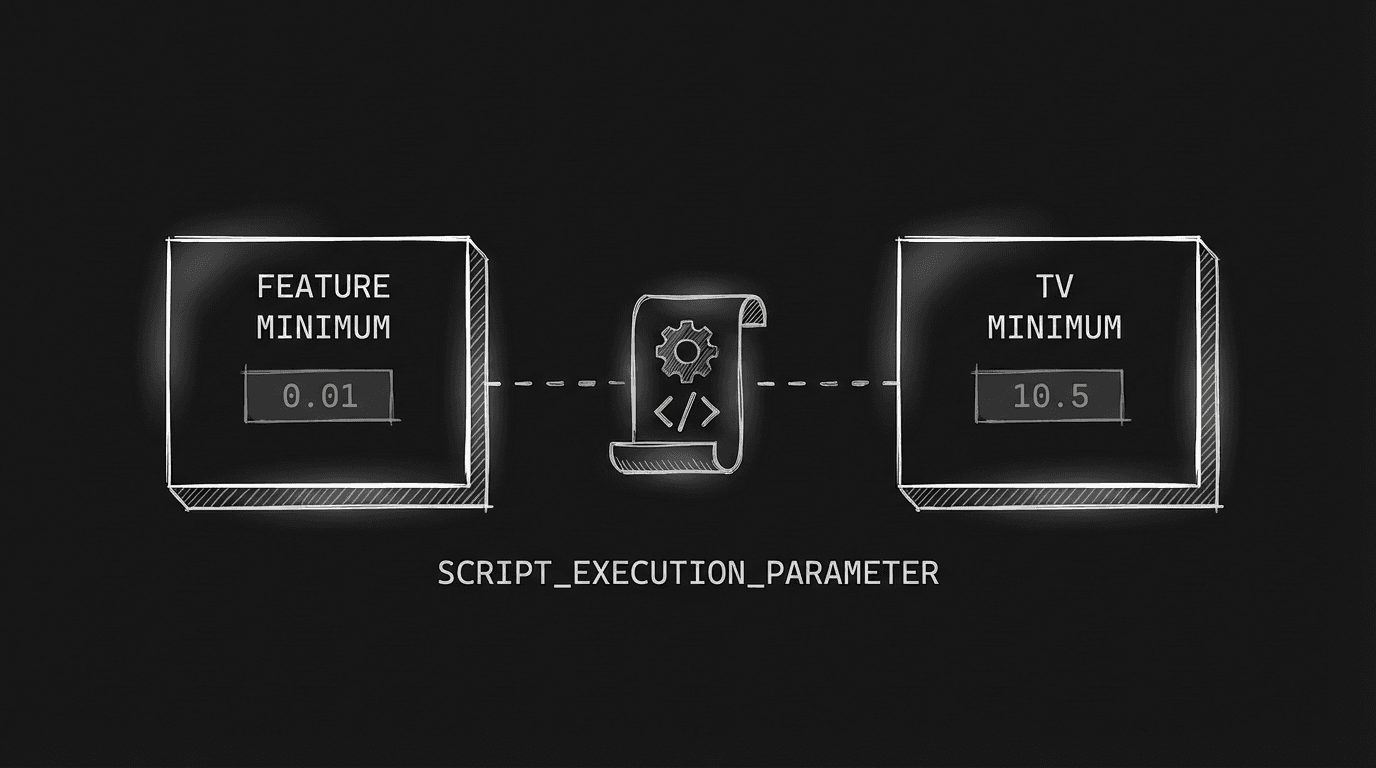
These two visuals work as a pair: the first shows Rate card: feature vs TV minimums; dark mode technical sketch, and the second shifts to Deal memo with "at least WGA minimum" clause; dark mode technical sketch—compare them briefly, then move on.
Final Step
Build your next script with Screenweaver
Move from ideas to production-ready pages faster with timeline-native writing and AI-assisted story flow.
Try Screenweaver