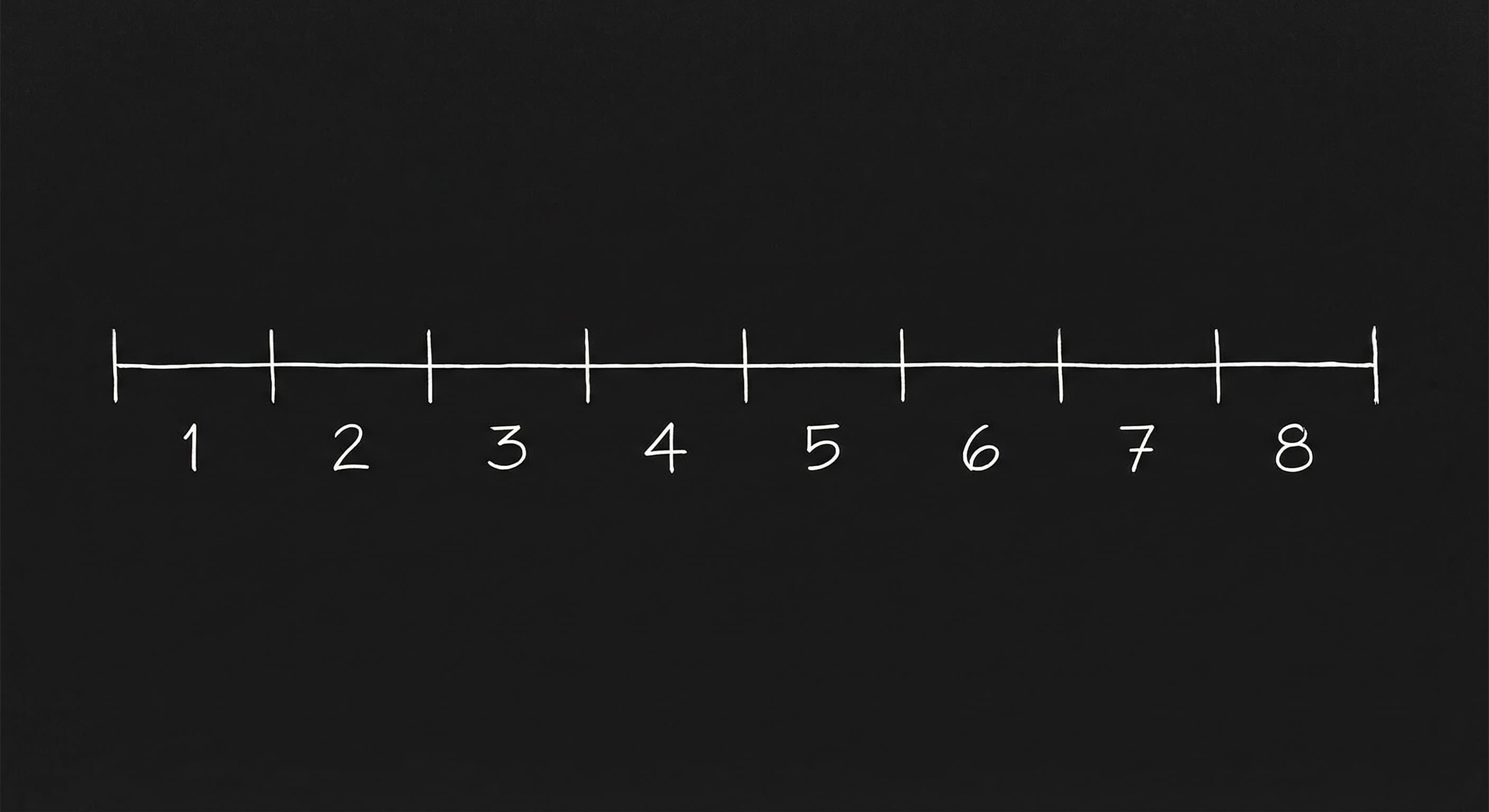

You have 120 pages. Maybe 110. The middle sags. You know it does,readers say "the second act drags" and you don't know where to cut or what to move. The problem isn't inspiration. It's architecture. A feature film is not one long story. It's a series of mini-movies, each about 12–15 minutes, each with its own setup, complication, and payoff. That's the 8-sequence approach. It comes from the way studios used to think about reels: one reel, one chunk of story. Today we don't ship reels. We still feel story in chunks. When you plan your feature as eight sequences instead of one blur, you give yourself a rhythm the audience can follow and a checklist that keeps the middle from collapsing.
Here's why that matters. In a traditional three-act model, Act Two is "the long stretch." It's where scripts die. Writers run out of gas. Stakes flatten. The 8-sequence model doesn't shorten Act Two,it subdivides it. You're not writing "the middle." You're writing Sequence 3, then 4, then 5. Each has a job. Each has a mini-arc. Tension stays high because you're always building toward the next sequence break, not some distant climax.
What the Eight Sequences Actually Are
The model maps cleanly onto a 120-page script if you treat one page as roughly one minute. Not every film runs exactly two hours; comedies often land at 90–100 pages, thrillers at 110. Adjust the page counts proportionally. The point is proportion, not magic numbers.
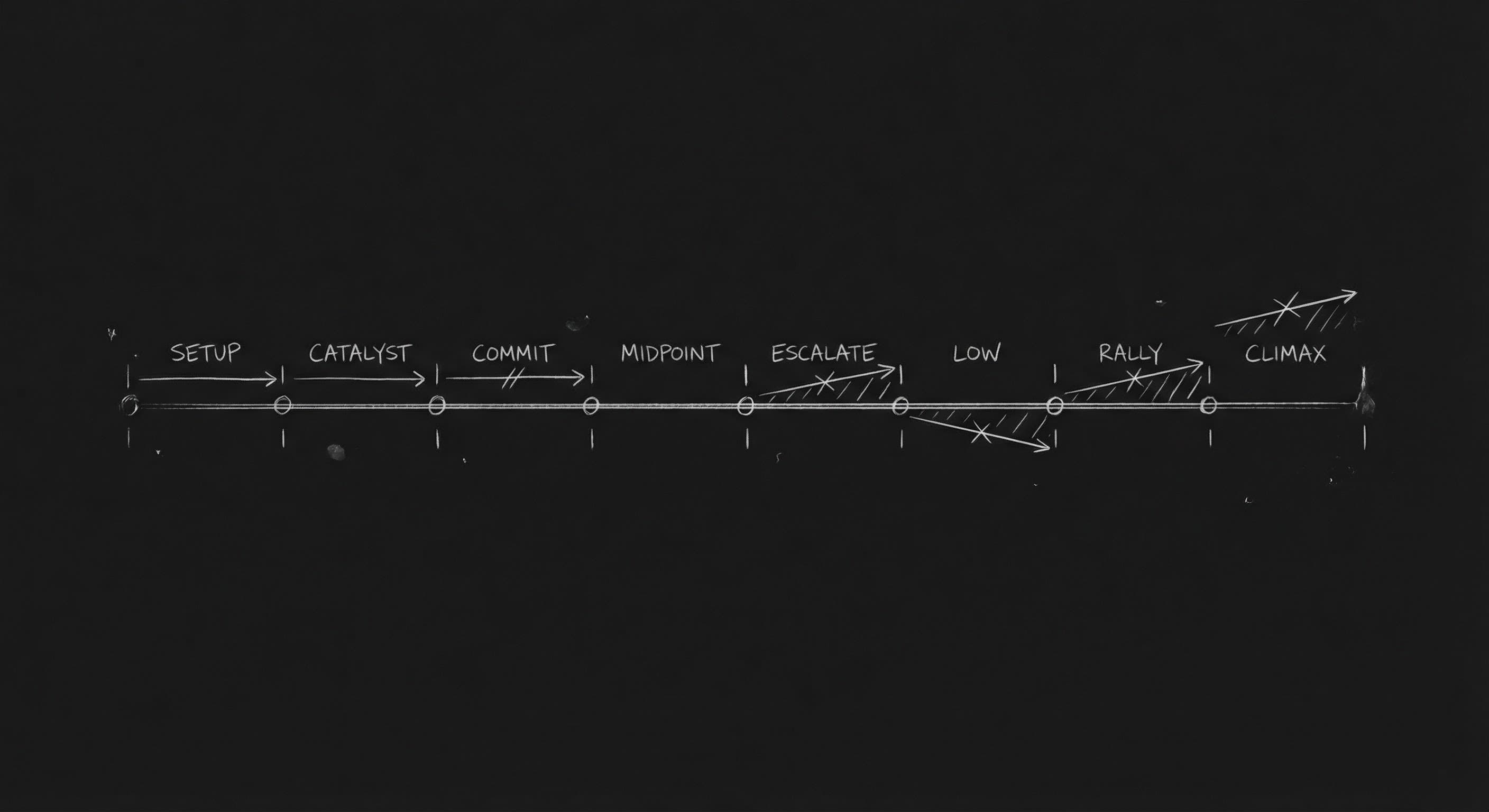
| Sequence | Approx. Pages | Function |
|---|---|---|
| 1 | 1–15 | Setup: world, protagonist, status quo |
| 2 | 15–30 | Inciting incident; protagonist enters the main conflict |
| 3 | 30–45 | First major obstacle; commitment to the goal |
| 4 | 45–60 | Midpoint: major shift (false victory or false defeat) |
| 5 | 60–75 | Complications escalate; antagonist or obstacles tighten |
| 6 | 75–90 | Lowest point; "all is lost" or equivalent |
| 7 | 90–105 | Rally; protagonist chooses to fight with new clarity |
| 8 | 105–120 | Climax and resolution |
Sequence 1 is your first 15 minutes. We meet the world and the character in their ordinary life. By the end of Sequence 2 we're in the main story,the catalyst has hit, the protagonist has reacted (or refused, then been pushed). Sequence 3 deepens the commitment. Sequence 4 is the midpoint: something big changes. New information, a reversal, a false win or false loss. Sequences 5 and 6 are the squeeze. Things get worse. The protagonist hits bottom. Sequence 7 is the turn: they get up, often with a new plan or a new understanding. Sequence 8 is the climax and the new normal.
The audience doesn't count sequences. They feel them. When the rhythm is right, they're never bored because something is always building toward the next beat.
Relatable Scenario: The Indie Drama That Sags at Page 60
You're writing a character piece. Two siblings have to drive across the country to scatter their father's ashes. Act 1 works: we meet them, we see the funeral, we see the inciting incident (the road trip begins). Around page 55 you introduce a detour,they visit an old family friend. Good idea. But then you have 40 more pages before the climax. The detour runs long. The next two stops feel like filler. You're not sure what should happen in the "middle."
With the 8-sequence lens, the middle isn't vague. Sequence 4 (45–60) needs a midpoint shift. So the visit to the family friend isn't just a stop,it's the moment they learn something that reframes the trip (e.g. the father had another child, or the ashes aren't what they thought). That's your midpoint. Sequence 5 (60–75) is "complications escalate": maybe they fight, or one wants to quit. Sequence 6 (75–90) is the low: the worst fight, or they lose the ashes, or one of them walks away. Now you have three distinct movements instead of "stuff that happens on the road." Each 15-minute block has a job. You write to that job.
Relatable Scenario: The Genre Thriller That Feels Stretched
You have a solid premise: a hacker has to break into a server before midnight or a bomb goes off. Act 1 and the climax are clear. The problem is the 50 pages in between. One chase? Two? How many "almost caught" beats before it feels repetitive?
Sequence 4 (midpoint) might be: they get in,then realize the real server is somewhere else, or the countdown was wrong. The goal shifts. Sequence 5: the antagonist closes in; a ally betrays them or a tool fails. Sequence 6: they're captured, or the bomb is moved, or they think they've lost. Each sequence is a mini-movie. "Hacker almost gets caught" isn't one blur,it's Sequence 3 (first real attempt, partial success), Sequence 5 (second attempt, things go wrong), Sequence 6 (captured or defeated). You're varying the kind of obstacle, not just repeating the same beat. Our guide on mastering the midpoint goes deeper on how that pivot at the middle changes everything that follows.
Why 15 Minutes (Roughly 15 Pages)?
Reel length is the historical answer. The psychological answer is attention. Audiences settle into a rhythm. A 15-minute chunk is long enough to develop a mini-arc (setup, complication, turn) and short enough that they don't drift. When you hit the sequence break, you've paid off one unit of tension and you're setting up the next. It's like chapters in a novel,except the chapter length is consistent and tied to time.
Not every sequence will be exactly 15 pages. Some run 12, some 18. The table above is a template. Use it to ask: "What is the function of this chunk? What must be true by the end of it?" If you can answer that for each block, you have a skeleton that won't collapse.
Try it free
Try Screenweaver for free on your script
It is free. Import your existing project, get a clearer view of your outline, and regain control of your story structure in minutes.
Start FreeThe Trench Warfare Section: What Beginners Get Wrong
Treating sequences as filler. Each sequence must do narrative work. If you can remove a 15-minute block and the story still works, that block shouldn't exist. Sequence 5 isn't "more of the same." It's "things get worse in a new way." New obstacle, new revelation, or new cost. If your middle sequences feel interchangeable, you haven't differentiated them.
No clear midpoint in Sequence 4. The midpoint isn't a random twist. It's the moment the protagonist (or the audience) learns something that changes the nature of the quest, or the protagonist shifts from reactive to active. A lot of scripts have a "thing that happens" at page 55 but it doesn't shift anything. The second half feels like the first half, just longer. Fix: make Sequence 4's end a genuine pivot. New goal, new stakes, or new understanding.
Sequence 6 not low enough. The "all is lost" or equivalent low has to hurt. If the protagonist is only mildly set back, the rally in Sequence 7 feels unearned. The audience needs to feel that they've lost,the plan, the ally, the hope. Then the choice to continue (Sequence 7) means something. For more on landing that low without melodrama, see our piece on writing the "All Is Lost" moment.
Sequence 1 too long. Writers love setup. They want to "establish" the world. By page 20 we're still in the ordinary world and the reader is bored. Sequence 1 should be about 15 pages. By page 15 we need to be at the doorstep of the inciting incident. Trim the setup. Get to the catalyst.
Sequence 8 rushed. After all that building, the climax and resolution get five pages. The villain is dispatched in a paragraph. The emotional aftermath is a single scene. Give the climax room. Resolution doesn't need to be long, but it needs to exist. The audience has earned a breath and a clear new normal.
Step-by-Step: Applying the 8-Sequence Model to Your Outline
Before you write a single scene, break your story into eight blocks. For each block, write one or two sentences: what happens, and what is achieved by the end (e.g. "By end of Sequence 4: they learn the father had a second family; the trip is no longer about scattering ashes but about facing the truth."). Then check: does Sequence 4 actually change the story? Does Sequence 6 feel like the bottom? Does Sequence 7 show a clear choice to continue? If any block is vague ("they keep going"), give it a specific event and a specific outcome. Once the eight blocks are clear, write the script sequence by sequence. You can still draft in order, but when you're lost in the middle, look at your Sequence 5 and 6 cards. What had to happen there? Write to that.
[YOUTUBE VIDEO: A walkthrough of a well-known film (e.g. The Matrix or Jaws) broken into eight 15-minute segments, with on-screen labels for each sequence and a brief note on the function of each.]
How This Fits With Three-Act and Other Models
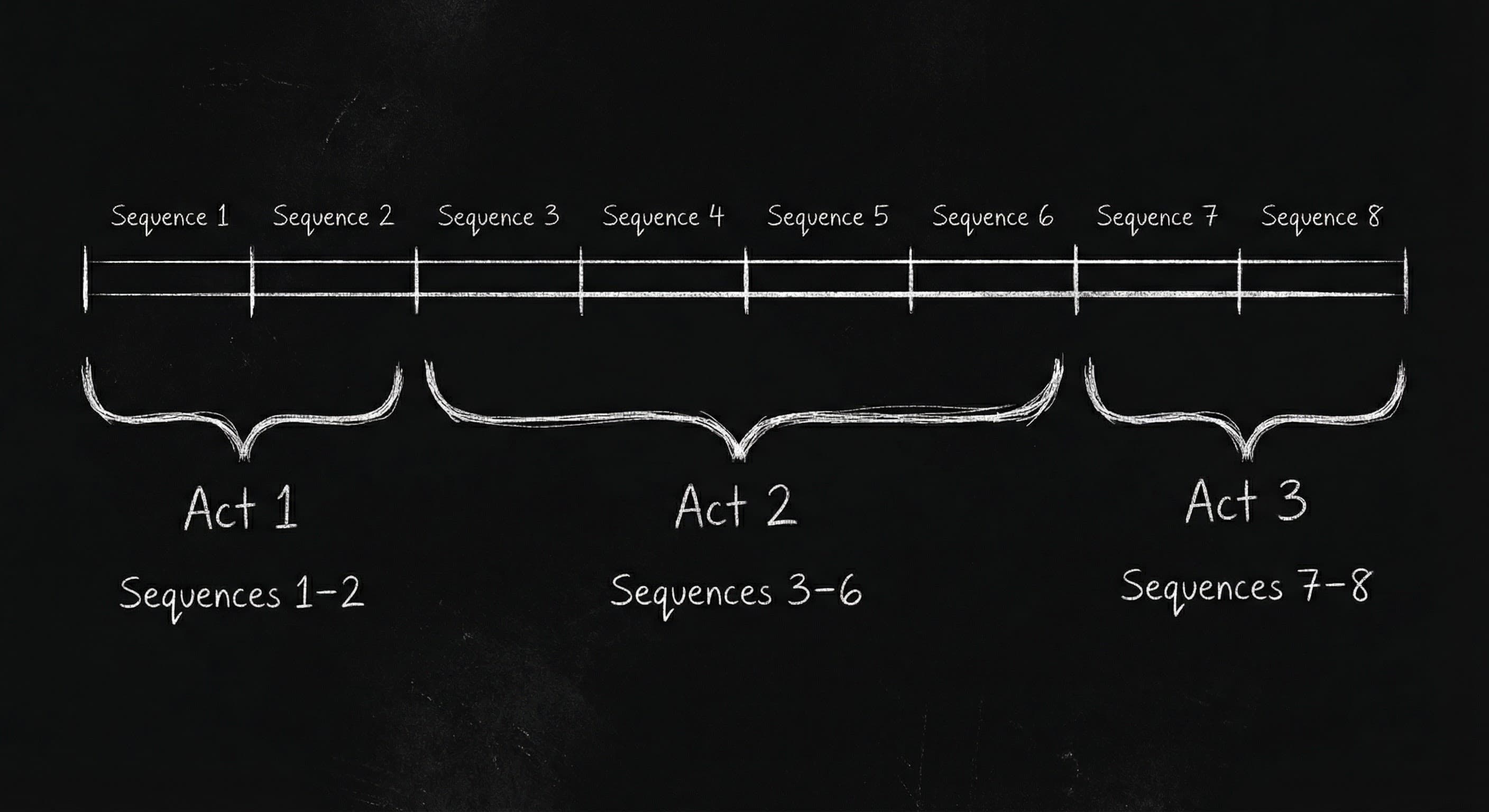
The 8-sequence approach doesn't replace three-act structure. It nests inside it. Act 1 is roughly Sequences 1–2. Act 2 is Sequences 3–6 (with the midpoint at the end of 4). Act 3 is Sequences 7–8. So you keep the big three-act shape and add a finer rhythm. Same with Save the Cat or other beat sheets: the beats (inciting incident, midpoint, all is lost, etc.) still land; the 8-sequence model tells you where they land and what to put in between. If you're used to the 3-act structure, think of the eight sequences as the way you fill Act Two so it doesn't sag,and so you know exactly what each 15 minutes is for.
The Perspective
The 8-sequence approach is a pacing tool. It doesn't tell you what to write. It tells you how to distribute tension and payoff across 120 pages so the audience is never adrift. Use it when the middle feels long and vague. Use it when you need to explain to a collaborator where the script is going. And use it when you're outlining: eight blocks, eight functions. Hit those, and the feature will feel like a series of 15-minute movies that add up to one.
Final Step
Build your next script with Screenweaver
Move from ideas to production-ready pages faster with timeline-native writing and AI-assisted story flow.
Try Screenweaver