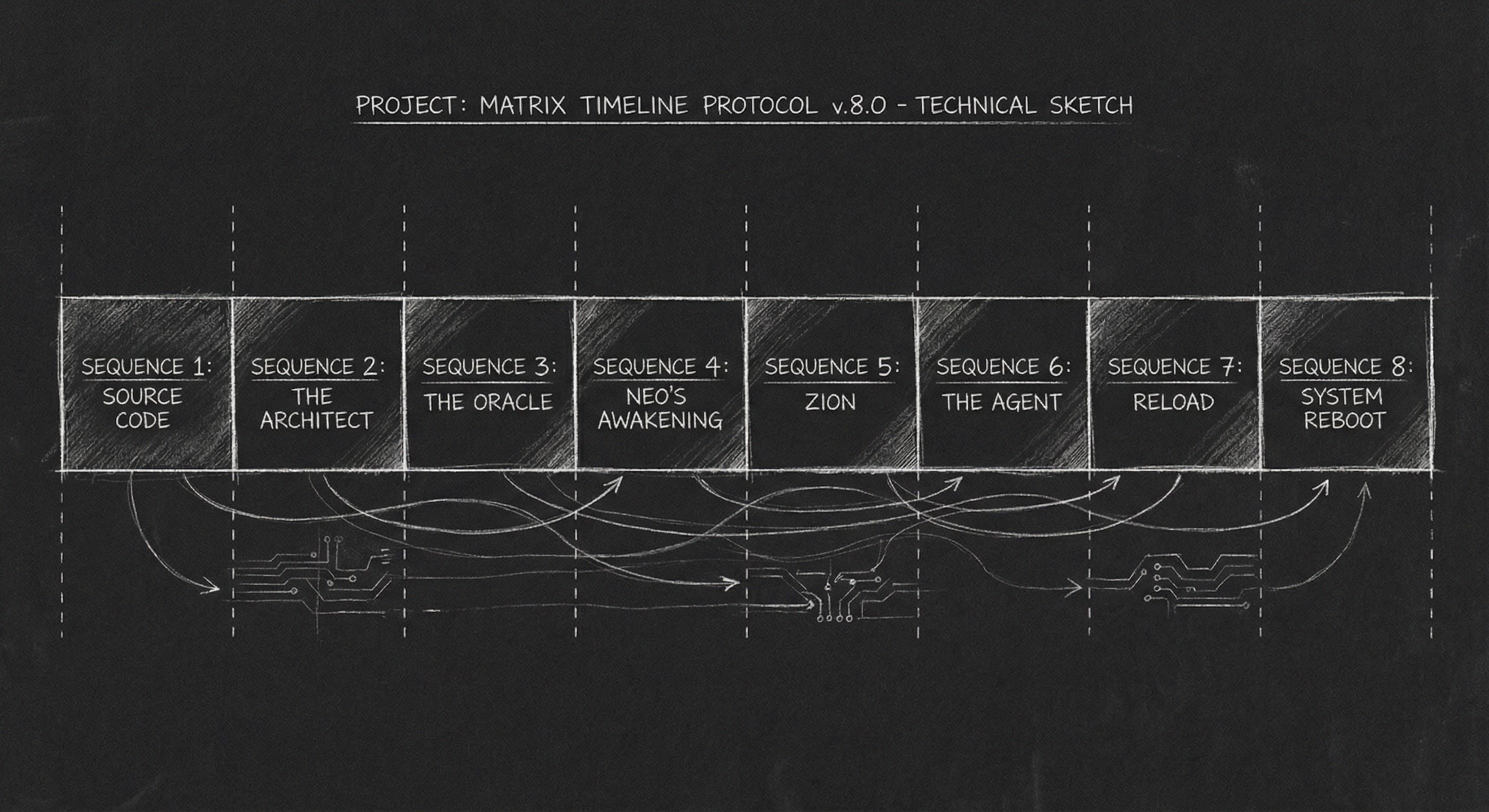

The Matrix isn’t one long movie. It’s a series of sequences,roughly eight of them, each about 12–15 minutes, each with a clear job. When you break the film down that way, you see how the middle holds. You see where the twists land. You see why the audience never checks out. The sequence method is a way to analyze (and to build) a feature: treat it as a string of mini-movies. Each sequence has a setup, a turn, and a payoff. Each one pushes the story forward. This isn’t the only way to read The Matrix. But it’s a useful one. And it’s a template you can use for your own script.
A feature is eight 15-minute movies. Get each one right, and the whole thing works.
Think about it. When you watch The Matrix, you don’t feel the 2-hour run. You feel a series of movements: Neo’s ordinary world, the call to adventure, the jump into the real, the training, the betrayal, the crisis, the climax, the new world. Each movement has its own tension and release. That’s the sequence method. You don’t write “Act 2” as a blob. You write Sequence 3, Sequence 4, Sequence 5,each with a clear purpose. The method was popularized by screenwriting teachers like Paul Joseph Gulino; it’s closely related to the 8-sequence approach we’ve written about before. Here we apply it to one film. You can apply it to any film,or to your own outline.
How the Sequence Method Works
A sequence is a block of the film,usually 10–15 minutes,that functions as a unit. It has a beginning, a middle, and an end. It advances the plot and often ends on a turn: new information, a reversal, a cliffhanger. So the audience is never lost in a 50-minute “Act 2.” They’re in Sequence 4, then Sequence 5, then Sequence 6. Each sequence has a job. One might be “introduce the world.” Another might be “train the hero.” Another might be “the betrayal.” When you analyze a film in sequences, you list them. You note the job of each. You see where the film breathes and where it pushes. When you write, you do the same: you outline in sequences. You make sure each 15-minute block has a clear purpose and a clear turn. The whole feature becomes manageable. The middle doesn’t sag because you’ve given it structure.
The Matrix in Eight Sequences (One Reading)
What follows is one way to divide The Matrix into sequences. Other readings are possible. The point is the pattern.
Sequence 1 (approx. 1–15 min): Ordinary world and the call. We meet Neo. He’s stuck. He gets the message: follow the white rabbit. He’s pulled toward something. The sequence ends when he chooses to go with Trinity,or when he’s taken. The job: establish the protagonist and the hook. We’re in the real world, but we sense there’s something else.
Sequence 2 (15–30 min): Into the unknown. Neo is taken to Morpheus. He’s offered the choice: the red pill or the blue pill. He takes the red pill. He wakes up in the real world. The job: cross the threshold. The world changes. The rules change. The sequence ends when he’s “born” into the real,or when he meets the crew. We’re in a new world.
Sequence 3 (30–45 min): The new world and the rules. Neo learns what the Matrix is. He’s trained. He fights Morpheus. He begins to believe. The job: establish the rules and the stakes. The sequence ends when he’s “ready” or when the next mission is set. We understand the world. We understand the enemy.
Sequence 4 (45–60 min): The mission and the midpoint. The team goes into the Matrix. They’re on a mission. Something goes wrong,or something is revealed. The midpoint might be Neo meeting the Oracle, or the revelation about his nature, or the first major confrontation. The job: raise the stakes and turn the story. The sequence ends on a shift. We’re not in setup anymore. We’re in confrontation.
Sequence 5 (60–75 min): Complication and betrayal. Things get worse. Cypher’s betrayal. Or the agents close in. Neo is in danger. So are the others. The job: complicate. The sequence ends on a crisis,maybe the death of a ally, or Neo’s capture, or the team’s defeat. We’re at the low point.
Sequence 6 (75–90 min): All is lost and the choice. The crisis deepens. Neo might be dead. Morpheus might be captured. The job: the dark moment. Then the turn,Neo chooses to go back. To save Morpheus. To fight. The sequence ends when he commits. We’re moving toward the climax.
Sequence 7 (90–105 min): The climax. Neo returns to the Matrix. The final confrontation. He faces Smith. He dies,and comes back. He sees the code. He wins. The job: the main battle. The sequence ends when the immediate threat is over. We’ve had the payoff.
Sequence 8 (105–end): The new world. Neo is the One. He speaks to the machines. He flies. The job: resolution and the new normal. The film ends with the promise of what comes next. We’ve closed the loop.
| Sequence | Approx. time | Job |
|---|---|---|
| 1 | 1–15 min | Ordinary world, call |
| 2 | 15–30 min | Threshold, new world |
| 3 | 30–45 min | Rules, training |
| 4 | 45–60 min | Mission, midpoint turn |
| 5 | 60–75 min | Complication, betrayal/crisis |
| 6 | 75–90 min | All is lost, choice to fight |
| 7 | 90–105 min | Climax |
| 8 | 105–end | Resolution, new world |
This is a template. Your film might have different jobs. But the principle holds: break the feature into blocks. Give each block a job. Make sure each block ends on a turn or a clear beat. Then the middle doesn’t sag. You’re not writing “Act 2.” You’re writing Sequence 4, 5, and 6. As with the inciting incident, the sequence method helps you place key beats; here we’re placing them in 15-minute chunks so the whole film has rhythm.
Try it free
Try Screenweaver for free on your script
It is free. Import your existing project, get a clearer view of your outline, and regain control of your story structure in minutes.
Start FreeWhat This Teaches About Structure
When you look at The Matrix this way, you see that the midpoint (Neo and the Oracle, or the revelation about his role) sits in Sequence 4. The crisis (betrayal, capture, death) sits in Sequences 5 and 6. The climax is Sequence 7. So the sequence method doesn’t replace the three acts or the beat sheet. It divides them. Act 2 is long. So you don’t think “Act 2.” You think “Sequence 4, 5, 6.” Each has a job. Each has an end. When you write your own script, you can do the same. Outline in sequences. Give each 12–15 minutes a purpose. You’ll know what goes in the middle. You’ll know where the turns are. The midpoint shift from reactive to active fits into this: it often lands in the middle sequences, turning the story so the second half has a new engine. In The Matrix, Neo’s choice to go back and save Morpheus is that shift. It lands in Sequence 6. The structure holds.
Relatable Scenario: Your Own Script
You have a feature outline. Act 2 feels long and vague. Try this: divide Act 2 into three sequences. Sequence 4: what’s the job? (Maybe: first major attempt, midpoint turn.) Sequence 5: what’s the job? (Maybe: things get worse, complication.) Sequence 6: what’s the job? (Maybe: crisis, all is lost, the choice.) Give each sequence a clear end. A turn. A cliffhanger. Now you’re not writing “the middle.” You’re writing three 15-minute movies. The structure will hold. The audience will feel the rhythm. That’s what the sequence method gives you: a way to build the middle so it doesn’t sag.
The Trench Warfare Section: What Beginners Get Wrong
Treating sequences as arbitrary. You divide the script into 15-minute chunks but each chunk has no clear job. So you’ve just renamed “Act 2” into “Sequence 4, 5, 6” without fixing the structure. Fix: Each sequence needs a purpose. What does this block do? Introduce? Complicate? Turn? Resolve? Name the job. Then the sequence has shape.
Making every sequence the same length. Real films don’t have exactly 15 minutes per sequence. Some are shorter. Some are longer. Fix: Use 12–15 minutes as a guide, not a rule. The point is that the feature is made of blocks. The blocks don’t have to be identical. They have to have clear jobs and clear ends.
No turn at the end of a sequence. The sequence just stops. The audience doesn’t feel a beat. Fix: Each sequence should end on something: a turn, a revelation, a cliffhanger, a decision. The end of the sequence is a mini-climax. It keeps the audience in the flow. When you outline, ask: what’s the last beat of this sequence? Make it land.
Using the sequence method only for analysis. You break down The Matrix and then you go back to writing without sequences. Fix: Use the method when you outline your own script. Plan in sequences. Write toward the end of each block. The method is for building, not just for studying.
The Perspective
The Matrix works because it’s built in clear movements. Each movement has a job. Each movement ends on a turn. When you analyze it in sequences, you see the craft. When you build your own script the same way, you give yourself a map. The middle isn’t a void. It’s Sequence 4, 5, and 6,each with a purpose. That’s the sequence method. Use it to break down the films you love. Then use it to build the script you’re writing.
Final Step
Build your next script with Screenweaver
Move from ideas to production-ready pages faster with timeline-native writing and AI-assisted story flow.
Try Screenweaver