

The reader is three-quarters of the way down the page. Quiet scene. A character alone in a room. Then the next line hits,and even on the page, before a single frame is shot, they flinch. That's not luck. That's craft. The jump scare is one of the few moments in screenwriting where the writer can make the reader's body respond. But only if the page is built for it.
Horror and thriller scripts live or die on tension. The jump scare is the sharpest tool in that box: a sudden, visceral strike that bypasses the brain and goes straight to the nervous system. On screen, directors have sound design, editing, and the literal jump of the frame. On the page, you have words, white space, and rhythm. If you don't use them deliberately, the scare doesn't land. The reader turns the page unmoved. The producer imagines the moment flat. And the moment you wrote to make them jump becomes just another beat in a long scene. This piece is about how to format and structure the jump scare so that the reader,and everyone downstream,feels it.
Why the Jump Scare Is a Page Problem First
It's tempting to think of the jump scare as a director's or an editor's problem. The director will add the sting. The sound designer will drop in the cue. True,but if the script doesn't set it up, the team has nothing to work with. The script is the first draft of the experience. When a reader hits your scare and doesn't react, they don't think "this will be great once we add sound." They think "this moment didn't work." Your job is to make the scare work on the page so that everyone who reads it,development, director, actor, editor,already feels the hit. That starts with understanding what a jump scare actually is: not just something sudden, but something that breaks a silence you've carefully built.
The jump scare is the punctuation of dread. The dread is the sentence. If you haven't written the sentence, the punctuation is just a typo.
So the first rule is counterintuitive: the jump scare is not the hard part. The hard part is everything that comes before it. The stillness. The expectation. The moment when the reader's guard is just low enough,or high enough with anticipation,that the strike lands. As discussed in our guide on screenplay formatting, the way you use action lines, line length, and white space directly affects pacing. For scares, that pacing is everything. Short, sparse lines before the hit make the reader's eye move quickly and then stop. Dense blocks of text absorb the impact. You're not just describing a moment; you're designing the rhythm of the read.
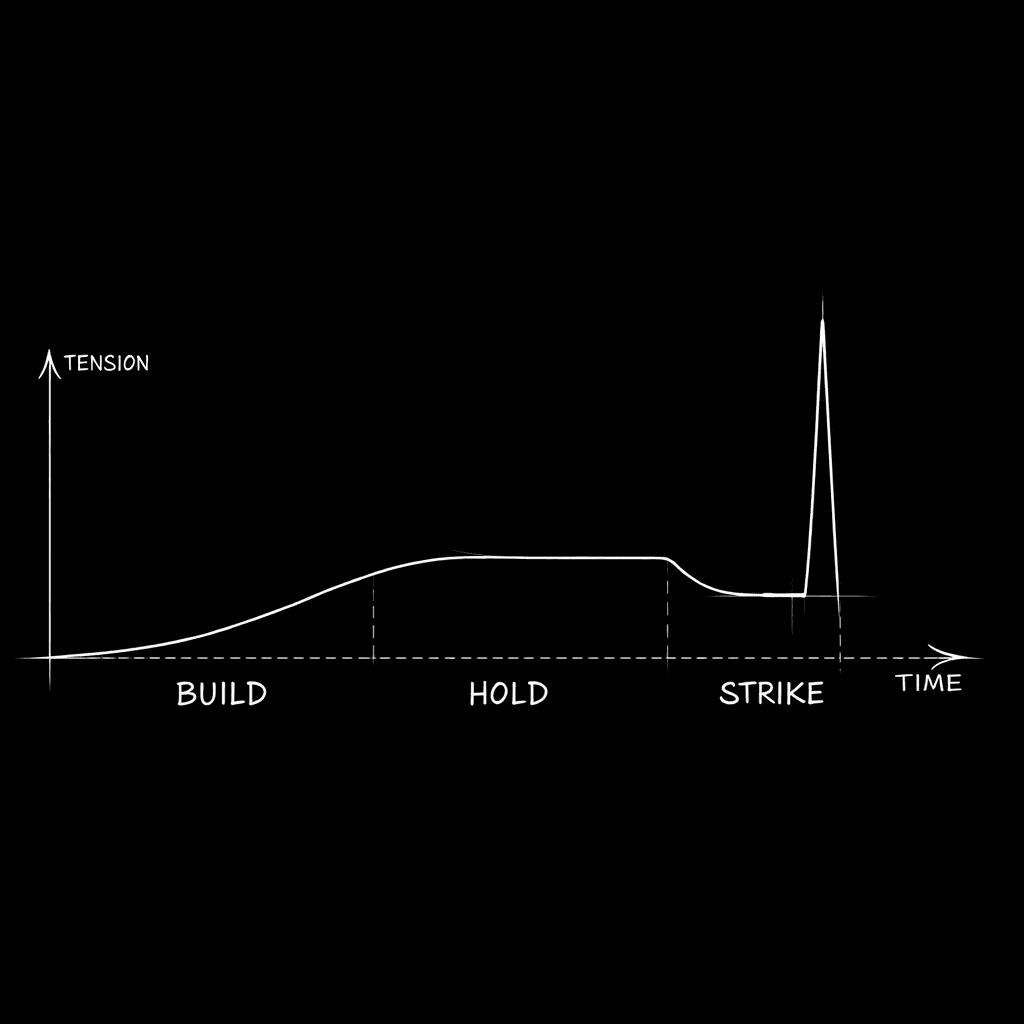
The three phases of a jump scare on the page: build, hold, strike.
The Silence Before the Strike
In film, the jump scare often follows a stretch of quiet. No music. Minimal dialogue. Maybe the hum of a fridge, or nothing. On the page, the equivalent is white space and short, deliberate action lines. You're not writing "nothing happens." You're writing the minimum that keeps the reader in the scene while slowing their eye. A character crosses the room. A door is closed. A light flickers. Each beat gets its own line or two. No long paragraphs. No dense blocks. The reader's pace drops. They're waiting. They might not know for what. That's when you hit.
Formatting the Build
Use action lines in short bursts. Two to three lines per paragraph max in the build. Single-sentence paragraphs are allowed,even preferred,as you approach the scare. The eye moves down the page in small steps. Each step is a beat. When the strike line comes, it should either stand alone as its own short paragraph or be the first line of a new paragraph after a brief pause (a line break). The goal is that the strike is the only thing on that part of the page. No competition from surrounding text. No burying the moment in the middle of a block. In horror and thriller scripts that work, the scares are almost always visually isolated on the page. That's not an accident. It's design.
Consider the difference. Version A: a long paragraph that ends with "and then the figure stepped out from behind the door." The reader absorbs it as the last clause of a sentence. Version B: a short paragraph. White space. Then a single line: "The figure steps out from behind the door." Same content. Different rhythm. Version B makes the reader stop. The eye lands on that line. The body follows. That's the jump. You can sharpen it further with a single sound or action in caps,BANG, or the character's reaction in a terse beat,but the foundation is the isolation of the moment on the page.
Formatting the Strike Itself
The strike is the instant of the scare. Something appears. Something moves. Something makes a sound. On the page, this moment should be clear, immediate, and short. One action. One line, or two at most. Avoid stacking multiple beats in the same paragraph. "The figure steps out. She screams. He runs." That's three beats. The first one is the scare; the others are aftermath. If you pack them together, the scare gets diluted. Let the strike land. Then, if you need reaction, give it a separate paragraph or a new beat. The reader needs to feel the hit before they feel the response.
Capitalization in action lines is a tool. Use it sparingly. A key sound (FOOTSTEP. CREAK. SCREAM.) or a key visual (THE FIGURE. THE FACE.) in caps can mark the strike. Don't cap everything,then nothing stands out. One or two caps in the strike line is enough. The rest of the sentence stays in sentence case. You're not shouting the whole moment. You're underlining the one thing that should punch.
Sentence length matters. Short sentences read faster and land harder. "The door opens. She turns. It's right behind her." Three short sentences. Each one is a micro-beat. The last one is the strike. If you write "She turns and sees that it is standing right behind her," the moment stretches. The tension softens. Keep the strike sentence tight. Subject, verb, impact. No extra clauses. No cushioning. The reader should get the information in a single gulp. That's when the body responds.
The False Scare and the Real One
Many effective sequences use a false scare before the real one. The cat jumps out. The friend grabs the shoulder. The reader's guard goes up,and then you hit them when they're either relieved (guard down) or hyper-alert (expecting something, but not that). On the page, the false scare gets the same treatment as the real one in terms of rhythm: build, strike, release. But it should be clearly smaller. Shorter build. Quicker release. Maybe one short paragraph for the fake-out, then a beat of "nothing," then the real build begins. If the false scare is as big as the real one, the real one loses power. If the false scare is too small, the reader doesn't drop their guard. You're tuning the reader's nervous system. The false scare is the tuning fork.
Misdirection only works if the reader trusts the silence. If every quiet moment has a payoff, they stop trusting. Let some silences stay silent. Save the strike for when it counts.
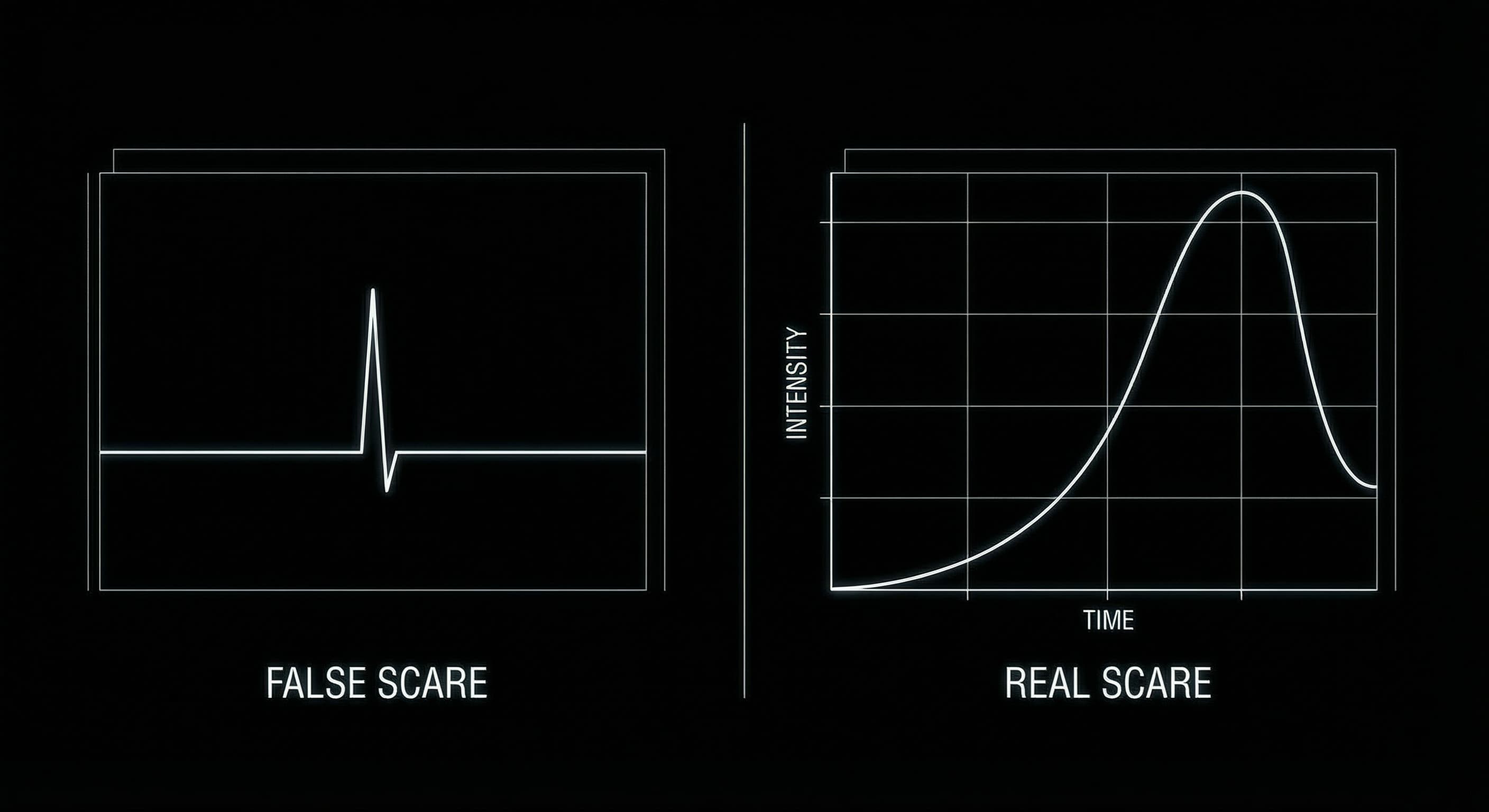
False scare vs. real scare: relative size and build length on the page.
Tension and Release: Why Buildup Can't Be Rushed
A jump scare without buildup is just a loud noise. It might make someone startle once, but it won't sit in their chest. The buildup is where the dread lives. The character is alone. The power is out. They heard something. They're walking toward the door. Each of those beats needs room on the page. If you race to the scare, the reader races with you,and when the strike comes, they're already moving too fast to stop. The scare works when the reader is moving slowly, carefully, and then something breaks the rhythm. So give the buildup real estate. Two pages of quiet tension before a single strike will land harder than five scares in two pages. Horror scripts that feel "cheap" often have too many strikes and not enough silence. The reader becomes numb. The opposite,long stretches of unease with one or two well-placed strikes,makes each one count.
Sound and Silence on the Page
You don't have a soundtrack. You have action lines. So you write sound into the description. The BUZZ of a flickering light. The CREAK of a floorboard. The absence of sound can be written too: "Nothing. No wind. No traffic. Just the thump of her own heart." When you want silence before the strike, name it. "The house is dead quiet." Then the strike,a sound or a visual,breaks that silence. The contrast is what the reader feels. If the page has been busy with description and dialogue, the strike has nothing to break. If the page has been still, the strike is a rupture. That's the jump.
What Works on the Page vs. What Falls Flat
Not every scare is built the same. The table below summarizes how formatting and structure choices affect whether a jump scare lands for the reader,and thus for the rest of the production chain. Use it as a diagnostic. If your scares aren't landing, check which column you're in.
| Scares That Fall Flat on the Page | Scares That Land |
|---|---|
| Strike buried in the middle of a long action paragraph | Strike on its own line or short paragraph; white space above and below |
| No real buildup; scare happens within a line or two of the scene start | Clear buildup: short action beats, quiet, then strike |
| Long, complex sentence for the strike ("She turned around and then she saw that the figure was standing right there behind her") | Short, simple sentence: subject, verb, impact. One idea per line. |
| Multiple strikes in quick succession with no recovery; reader goes numb | One or two strikes per sequence; room for recovery and renewed dread |
| False scare same size as real scare; no differentiation in rhythm or length | False scare shorter and quicker; real scare gets more build and more space |
| Sound and silence not specified; page reads busy or neutral before strike | Silence named in buildup; strike breaks it. Key sounds in caps where they punch. |
The Reader Isn't the Only One Who Jumps
When a development executive or a director reads your script, they're not just reading for story. They're imagining the film. When they hit a jump scare that's built correctly on the page, they feel it. That feeling gets passed to the pitch, to the budget conversation, to the edit. A scare that works in the script is a scare that everyone agrees "we have to get this right." A scare that doesn't work on the page is a note: "This moment needs work." You want the former. So treat the page as the first performance. If the reader doesn't flinch, you haven't done your job. The same discipline that keeps scripts from getting tossed,clean format, clear pacing, professional presentation,applies here. As we've written in our piece on mistakes that get scripts tossed, readers are looking for control. Control of tone, of pace, of craft. A jump scare that's formatted and built with intention signals that you have that control. A jump scare that's buried or rushed signals the opposite.
The Scare You Don't See Coming
The best jump scares feel inevitable in retrospect. The setup was there. The silence was there. The reader just didn't know where the strike would come from. That's the balance: predictable enough that the rhythm works, surprising enough that the body still jumps. You can't do that by formula. You can do it by caring about the reader's experience line by line. Short sentences when the tension rises. White space when the silence needs to breathe. One clear strike when it's time to hit. No clutter. No mercy.
Write the silence. Then break it. The rest is just formatting.
Structure Your Scares,And Your Whole Script
ScreenWeaver gives you a Living Story Map so you can see where tension builds and where it pays off. Format is automatic; you focus on rhythm, beats, and the moment the reader jumps.
Start Writing for FreeFinal Step
Build your next script with Screenweaver
Move from ideas to production-ready pages faster with timeline-native writing and AI-assisted story flow.
Try Screenweaver