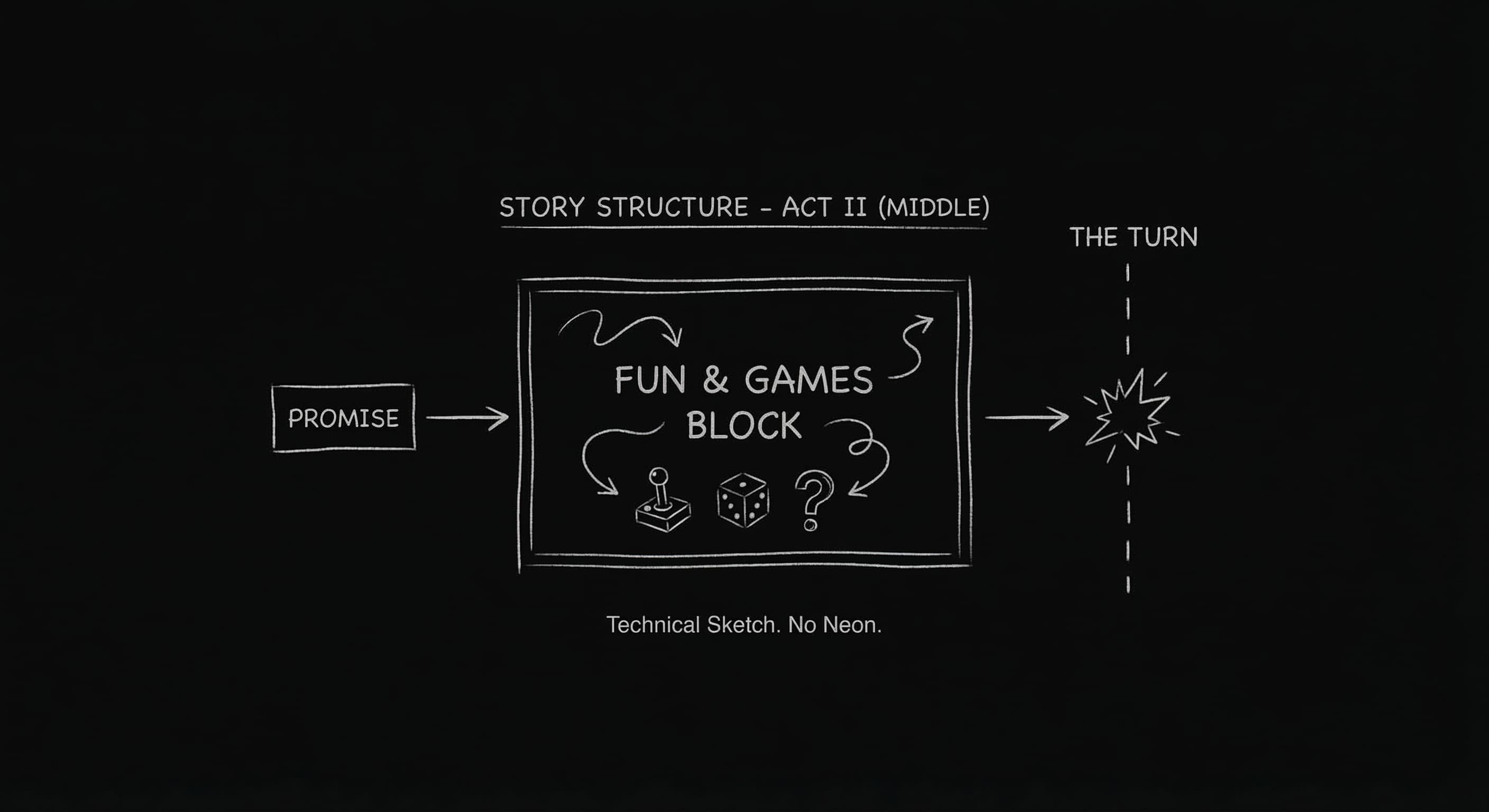

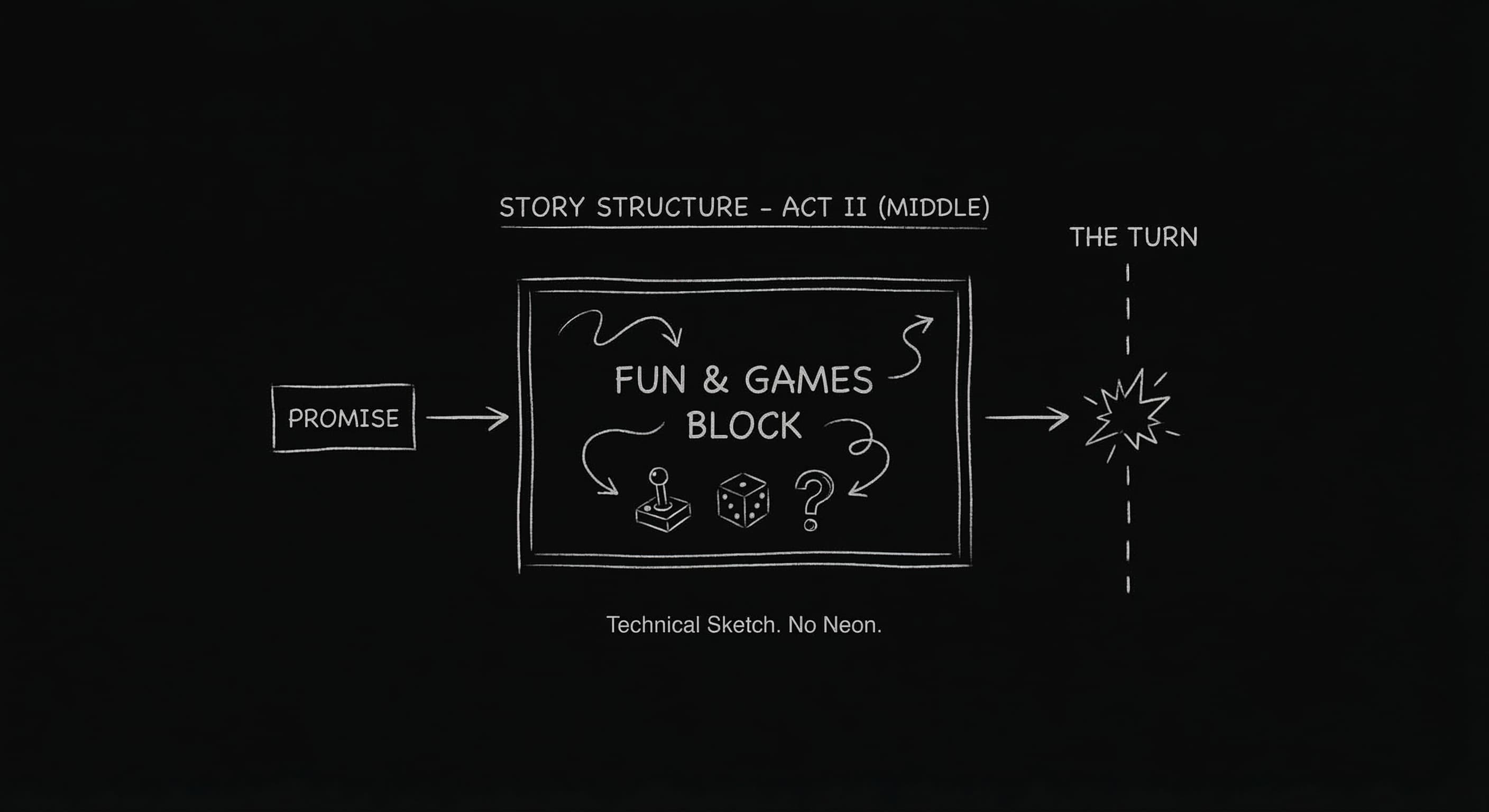
The setup is done. The character has crossed into the new world. Then comes the long middle. If the middle is just “stuff happens,” the script sags. The audience checks out. The fun and games is Blake Snyder’s name for the stretch where the premise pays off,where we get what we came for. The detective does detective work. The superhero uses their powers. The romantic comedy gives us the montage of dates. It’s the “trailer” section: the part that would go in the preview. When you give the audience that stretch,when you deliver on the promise of the premise,the middle holds. When you skip it or rush it, the middle feels like a waiting room. So the craft is: know what your premise promises. Then give the audience a stretch of that. In the middle. Before things get dark. That’s the fun and games.
The middle sags when the audience is waiting for something. The fun and games is when you give them what they came for.
Think about it. In a heist film, the fun and games might be the planning and the training,or the first half of the heist itself. In a romance, it’s the falling in love,the dates, the banter, the “this could work.” In a superhero film, it’s the hero using their powers, learning the suit, saving people. The audience came for that. So you give it to them. Not forever. Long enough that they’re satisfied. Then you turn. The fun and games ends when something goes wrong,the midpoint, the betrayal, the complication. But before that turn, you’ve earned the audience’s investment. They’ve had the good stuff. Now they’re ready for the hard stuff. Our guide on the midpoint covers the turn that often follows; the fun and games is what comes before it. It’s the stretch that keeps the middle from sagging because it’s the stretch that delivers the premise. If you don’t have it, the middle feels like filler. If you do, the middle feels like payoff.
What “Fun and Games” Actually Means
In Save the Cat, the fun and games is the section after the protagonist enters the new world and before the midpoint. It’s where the “promise of the premise” is fulfilled. The logline says “A detective must solve a case in 24 hours.” The fun and games is the detective doing the solving,the interviews, the clues, the close calls. The logline says “A woman falls in love with her enemy.” The fun and games is the falling,the scenes where they’re forced together and the chemistry builds. So the fun and games isn’t random middle material. It’s the material that the premise implies. It’s what the audience signed up for. When you deliver it, you’re not filling time. You’re paying off the setup. The section has its own rhythm. It can have wins and small setbacks. It can have a montage. It can have set pieces. But the throughline is: we’re in the world we were promised, and we’re getting the experience we came for. That’s what holds the middle. Without it, the middle is “and then more stuff until the climax.” With it, the middle is “this is why we’re here.”
How Long and Where It Goes
The fun and games usually sits in the first half of Act 2,after the protagonist has committed to the journey and before the midpoint turn. So roughly pages 30–55 in a 110-page feature. It can be one long sequence or several shorter ones. It can include a “false victory”,the character thinks they’re winning, and then the midpoint undercuts it. The key is that the audience gets a stretch of the premise. They’re not just waiting for the climax. They’re in the middle, and the middle is giving them something. When the midpoint hits (the twist, the betrayal, the revelation), the fun and games is over. The tone can shift. The stakes go up. But you’ve already given the audience the good stuff. So they’re with you. They’re invested. As with narrative drive vs. deepening, the fun and games is often high on drive,things are happening,but it can include deepening too (we learn who the character is when they’re in their element). The balance is: enough happening to hold the middle, enough meaning to make the turn matter when it comes.
A Practical Comparison
| Without fun and games | With fun and games |
|---|---|
| Middle = “stuff happens” | Middle = premise pays off |
| Audience waits for climax | Audience gets what they came for |
| Second act sags | Second act holds |
| Turn feels arbitrary | Turn feels earned (we had the good stuff; now it gets hard) |
The fun and games is the section that makes the audience say “this is the movie I wanted to see.” When you have it, the midpoint and the climax land harder. When you don’t, the script feels like it’s treading water. Our guide on the 8-sequence approach fits here: one of those 15-minute blocks in the middle is often the fun and games. Sequence 3 or 4. Give it a clear job: deliver the premise. Then the next sequence can turn.
Relatable Scenario: The Heist Script
The premise: they’re going to rob the vault. The fun and games is the planning, the team assembly, the training, maybe the first phase of the heist. We see them in their element. We see the vault. We see the close calls. We get the “this is a heist movie” experience. Then the midpoint: something goes wrong. The plan is compromised. The fun and games is over. Now we’re in the second half,the scramble, the betrayal, the climax. Without the fun and games, we’d go from “they decide to do the heist” to “things go wrong” too fast. The audience wouldn’t have had the pleasure of the premise. With it, we’ve had the pleasure. So when it goes wrong, we feel the loss. The middle held. The turn lands.
Try it free
Try Screenweaver for free on your script
It is free. Import your existing project, get a clearer view of your outline, and regain control of your story structure in minutes.
Start FreeRelatable Scenario: The Rom-Com
The premise: they’re going to fall in love (or fall back in love). The fun and games is the falling. The meet-cute. The forced proximity. The dates. The montage. The “we’re so different but we get each other” scenes. We get the chemistry. We get the hope. Then the midpoint or the mid-act turn: the misunderstanding, the ex, the lie. The fun and games is over. Now we’re in the break-up or the crisis. Without the fun and games, we wouldn’t care when they break up. With it, we’ve seen what we’re losing. The middle held. The turn hurts. That’s the craft. Give the audience the good stuff. Then take it away (or threaten to). The second act doesn’t sag because the second act was doing its job: delivering the premise.
The Trench Warfare Section: What Beginners Get Wrong
Skipping the fun and games. You go from setup to complication too fast. The audience never gets to enjoy the premise. Fix: Identify what your premise promises. Give the audience a stretch of that. Even 10–15 pages. Let them have the detective work, the romance, the heist planning. Then turn. The turn will land harder.
Making the fun and games too long. The middle is 40 pages of “fun” and the script feels repetitive. Fix: The fun and games has a limit. It’s not the whole second act. It’s the first half (or so). Then something has to go wrong. If the fun and games runs too long, cut it or add variation,small setbacks, new information,so the section has shape. It should build toward the midpoint, not meander.
Fun and games with no stakes. It’s all win, no tension. The audience gets bored. Fix: The fun and games can have small obstacles. Close calls. Near-misses. The character is in their element but not invincible. So when the midpoint hits, we’ve already felt that things can go wrong. The fun and games isn’t “everything is great.” It’s “we’re getting what we came for,and it’s good, but it’s not safe.”
Not knowing what your premise promises. You’re not sure what the “fun and games” would be for your script. So the middle is vague. Fix: Look at your logline. What would the audience expect to see? That’s the promise. The fun and games is the section where you deliver it. Name it. Then write it. The middle will have a job. It won’t sag.
Turning too early. The midpoint hits on page 40. We’ve barely had the fun and games. The audience feels cheated. Fix: Let the fun and games breathe. Give the audience time in the premise before you take it away. The midpoint usually lands around the middle of the script (page 55 or so). So the fun and games is roughly pages 30–55. Don’t rush the turn. Let the audience enjoy the premise first.
Step-by-Step: Adding or Strengthening the Fun and Games
Look at your outline or draft. Find the section after the protagonist commits to the journey and before the midpoint. Ask: is this section delivering the promise of the premise? If not, what would “delivering” look like? List 3–5 beats that would give the audience the experience they came for. Add them or expand them. Then check: does the midpoint (or the turn) come after we’ve had enough of the good stuff? If the turn comes too early, add fun and games. If the fun and games runs too long, trim or add a small complication so the section has shape. Read the middle. Does it hold? If the audience would be bored, you need more premise payoff. If the audience would be satisfied when the turn comes, you’ve got it. Our guide on beat boards can help: put the fun and games on the board as its own block. Give it a job. Make sure it’s there before the midpoint. Then the structure holds.
[YOUTUBE VIDEO: One film broken down,where the fun and games section is, what “promise of the premise” means for that film, and how the midpoint ends it.]
The Perspective
The second act sags when the audience is waiting. The fun and games is the section where you stop making them wait. You give them what they came for. The detective work. The romance. The heist. The premise pays off. Then you turn. The midpoint complicates. The second half of Act 2 is different. But you’ve already held the middle. You’ve already earned the investment. That’s the fun and games. Find it. Write it. The script will thank you.
Final Step
Build your next script with Screenweaver
Move from ideas to production-ready pages faster with timeline-native writing and AI-assisted story flow.
Try Screenweaver