

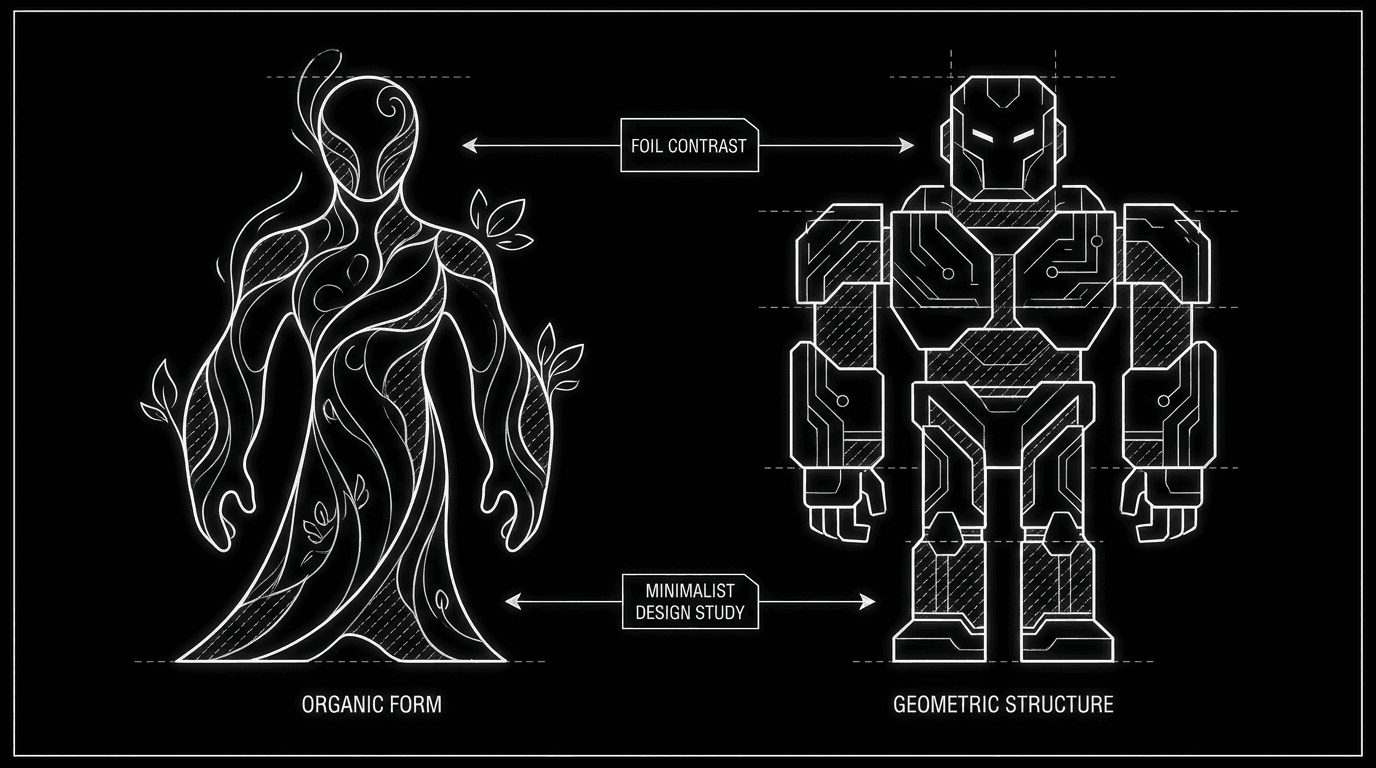
Your protagonist is cautious. So you add a character who's reckless. Your protagonist is a liar. So you add one who can't help telling the truth. The foil exists to make the hero's traits visible by contrast. Not by description, by putting two people in the same room and letting the difference do the work. Done badly, the foil is a cartoon: the "funny friend," the "voice of reason," the one-note opposite. Done well, the foil is a full character who happens to reflect and sharpen the protagonist. Here's how to design foils that serve the story without becoming props.
A foil isn't "the opposite." It's the character who makes the hero's choice, or flaw, impossible to miss.
Think about it this way. In life we see ourselves in relation to others. The friend who takes risks makes our own caution visible. The colleague who says no makes our yes feel like a choice. On the page, the foil does that job deliberately. They don't have to be the antagonist. They can be the best friend, the partner, the mentor. What matters is that when they're in the scene, the protagonist's trait is highlighted. The audience doesn't need to be told the hero is guarded. They see the foil reach out and the hero step back. Our guide on character arcs explains how change works over the story; a foil can be the one who embodies the path not taken or the trait the hero is moving toward. This piece is about building the contrast so it reads on the page.
Why Foils Work (And When They Don't)
A foil works because comparison is faster than explanation. "She's impulsive" is a note. She says yes to the road trip while her friend lists every reason to stay, that's a scene. The audience gets "impulsive" and "cautious" in one beat. No voice-over. No dialogue that says "you're so impulsive." Just two people making different choices. The risk is that the foil becomes a function. They exist only to contrast. They have no want of their own, no flaw, no moment where they're right and the hero is wrong. When that happens, the foil feels like a device. The fix is to give the foil a story. They're not just "the reckless one." They're reckless for a reason. They want something. They have a flaw that isn't the inverse of the hero's. They're a character who happens to foil the hero, not a mirror with legs.
Another trap: foiling the wrong thing. You want to highlight the hero's courage, so you add a coward. But the story is really about the hero's inability to ask for help. So the foil should highlight that, someone who asks for help easily, or who offers it in a way the hero can't accept. Match the foil to the trait that matters for the arc. If the hero needs to learn to trust, the foil might be the one who trusts too easily, or the one who trusted and was burned and now the hero sees two paths. Foil the thematic trait, not just any trait.
Relatable Scenario: The Heist Leader and the Loose Cannon
Your protagonist is the planner. Careful. Every angle covered. You add a crew member who improvises, breaks the plan, takes risks. Classic foil. The danger is making the loose cannon a joke, the "wacky" one who exists to cause problems. Stronger approach: give the loose cannon a point of view. Maybe the plan is too rigid. Maybe the planner's need for control is the real flaw. In one scene the loose cannon's improvisation saves the day; in another it blows the job. Now the foil isn't just "opposite." They're an argument. The audience sees two philosophies. The protagonist's arc might be learning when to let go of the plan, so the foil embodies the trait the hero is moving toward. For more on protagonists who drive the story, see passive protagonist: sometimes the foil is the one who acts while the hero hesitates.
Relatable Scenario: The Rom-Com Lead and the "Best Friend"
The lead is hesitant in love. They've been hurt. They're slow to commit. The best friend is the foil: they're all in, they give advice, they push the lead to take the leap. If the best friend is only that, a pusher, they're a function. Give them a want. Maybe they're in a bad relationship and they're pushing the lead to do what they can't do themselves. Maybe they're lonely and they need the lead to be happy so they don't feel left behind. Now the foil has a cost. And when the foil's own love life crosses the story, we see the same theme (risk, commitment) in two different bodies. The foil isn't a sidekick. They're a variation on the theme. For dynamics that sustain tension over a season, our guide on will they/won't they touches on how a foil can keep the central relationship from resolving too soon.
Relatable Scenario: The Detective and the Partner
The detective is a lone wolf. Doesn't trust the system. The partner is by-the-book, believes in the process. Standard setup. The foil makes the detective's isolation visible: every time they refuse to share, the partner is right there, willing to share. The trap is making the partner a nag or a punching bag. Stronger: the partner has their own flaw. Maybe they trust the system too much, and in Act 2 they're wrong, and the detective's instinct was right. Now we're not just "lone wolf vs. team player." We're "when do you trust?" The foil and the hero are both partially right. The story tests which instinct fits which moment. That's a foil with teeth.
The Trench Warfare Section: What Beginners Get Wrong
Making the foil only opposite. They're the opposite of the hero in every way. Funny when the hero is serious. Brave when the hero is scared. The foil becomes a checklist of inversions. Fix: Foil one or two traits that matter for the arc. Let the foil share other traits with the hero (same goal, same world). They're not a negative image. They're a character who differs on the thing that counts.
Giving the foil no want. The foil exists to support, advise, or contrast. They have no goal of their own. Fix: Give the foil a want. Something they're after in the story. It can align with the hero's or clash. When the foil has stakes, they feel real. When they're only "there for the hero," they feel like a tool.
Letting the foil always be right (or always wrong). Some scripts use the foil as the "voice of reason", they're always correct, and the hero is wrong until they see the light. Others use the foil as the "bad example", they're always wrong. Both get old. Fix: Let the foil be right sometimes and wrong sometimes. Let the hero learn from the foil in one scene and reject the foil's advice in another. The foil is a perspective, not a verdict.
Using the foil to explain the hero. Dialogue like "You never let anyone in" or "You're so stubborn" from the foil to the hero is exposition. The foil should show the contrast through behavior. Fix: Cut the line that names the trait. Add a scene where the foil does something the hero wouldn't do, or where the foil's choice makes the hero's choice visible by comparison.
Forgetting to foil the antagonist. The antagonist can be a foil too. They often want the same thing as the hero (power, the girl, the prize) but pursue it in a different way. The antagonist's method highlights the hero's method. When the villain is a dark mirror, same wound, different choice, the foil structure goes deep. See our guide on complex villains for building antagonists who reflect the hero.
Try it free
Try Screenweaver for free on your script
It is free. Import your existing project, get a clearer view of your outline, and regain control of your story structure in minutes.
Start FreeFoil Design: A Quick Reference
| Goal | Foil strategy |
|---|---|
| Highlight hero's flaw | Foil has the "healthy" version of the trait, or the same flaw with different consequences |
| Highlight hero's want | Foil wants something else, or wants the same thing differently |
| Show the path not taken | Foil is where the hero could end up (better or worse) if they don't change |
| Thematic argument | Foil embodies one side of the theme; hero embodies the other; story tests both |
Pick one primary job for the foil. Don't ask them to do everything.
Step-by-Step: Building a Foil That Feels Real
First: Name the trait you want to highlight in the hero. One trait. (If you've mapped want vs need, the foil might highlight the need the hero resists.) Second: Decide how the foil will contrast. Do they have the "positive" version (e.g. they trust easily) or the "negative" version (e.g. they're reckless in a different way)? Third: Give the foil a want. What do they need in this story? Fourth: Give the foil one flaw that isn't just "opposite of hero." Something that's theirs. Fifth: Write one scene where the foil and hero make different choices in the same situation. No dialogue that explains the difference. Just the choices. Sixth: Check that the foil could exist without the hero. If you removed the protagonist, would the foil still have a life? If not, add one. They're a character who foils, not a foil who's forced to be a character.
[YOUTUBE VIDEO: Two versions of the same scene: one with a foil who only contrasts, one with a foil who has a want and a flaw; discussion of which reads as "real."]
Foils in Ensemble Casts
When you have many characters, each can foil someone. A doesn't just foil the hero, B might foil A, and C might foil the hero in a different way. The result is a web of contrasts. No one is "the foil." Everyone is a foil to someone. For balancing many threads, see our guide on ensemble casts: foils help differentiate characters so the audience never confuses who's who. The risk in ensemble is that everyone becomes a type. Giving each foil a want and a flaw keeps them from flattening into functions.
The Perspective
A foil makes the hero's trait visible by contrast. Design the foil around one trait that matters for the arc. Give them a want and a flaw so they're a character, not a mirror. Let the contrast show in behavior, not in dialogue that explains the hero. And remember: the antagonist can be the sharpest foil of all, same want, different path. When the foil is full and the contrast is specific, the support cast does more than fill the frame. It sharpens the lead.
Final Step
Build your next script with Screenweaver
Move from ideas to production-ready pages faster with timeline-native writing and AI-assisted story flow.
Try Screenweaver