

Writing Intimacy: Working with Intimacy Coordinators in Mind
You’ve written the scene. Two characters. A bedroom, or a kitchen at 2 a.m., or the back seat of a car. The script says they kiss. It says more. You’ve tried to keep it specific enough for the story and vague enough not to dictate an actor’s body in a way that feels invasive or unplayable.
Then the script goes to production. An intimacy coordinator joins the team. They have questions. About consent, about boundaries, about what’s actually in the script and what’s been left to “we’ll figure it out on the day.”
That moment is where a lot of writers feel lost. They didn’t train for this. They’ve never had to think about their love scene as a document that will be used to plan choreography, discuss limits, and protect people, while still serving the story.
Here’s what you need to know.
Why Intimacy Coordination Exists (And Why It Affects the Page)
Intimacy coordinators aren’t censors. They’re specialists who bridge the gap between the script, the director’s vision, and the safety and agency of the performers. They help design intimate scenes so that everyone knows what’s being asked, what’s negotiable, and what’s off the table. They’re on set to run closed sets, communicate with costume and camera, and de-escalate when something crosses a line.
That work starts with the script.
If the script says “they make love” and nothing else, the production has to invent the scene from zero. That can mean last-minute improvisation, unclear expectations, and pressure on actors to “just try it.” If the script is overly explicit, every touch, every position, every beat described in anatomical detail, it can lock in choices before anyone has had a chance to discuss boundaries or alternatives.
The writer’s job is to give the production enough to understand story and tone without scripting the choreography in a way that’s unusable or unsafe. When you write with intimacy coordination in mind, you’re not watering down the scene. You’re writing a document that can actually be used to plan, rehearse, and shoot it with care.
The best intimate scenes on the page are clear about intention and outcome, and flexible about the path. They give the coordinator and the actors something to work from, not a straitjacket.
What the Script Needs to Communicate (Without Over-Specifying)
Think in layers.
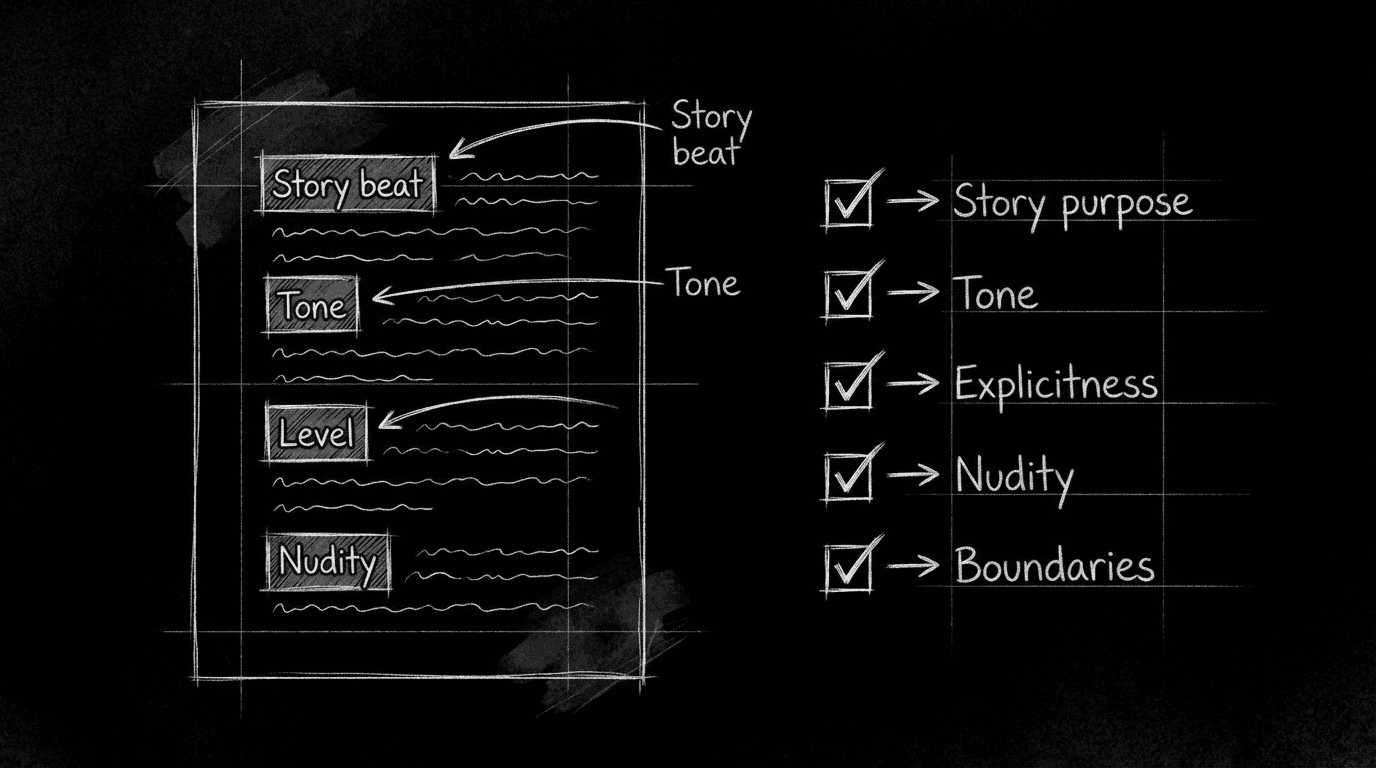
Story layer. What does this scene do? Does it consummate a relationship? Reveal power? Show tenderness, violence, regret, joy? Does it change the characters’ dynamic? The script must make that clear. A coordinator and a director need to know why the scene exists so they can protect that while adjusting the how.
Emotional layer. What do we want the audience to feel? Connected? Uncomfortable? Turned on? Heartbroken? The tone drives choices. A scene that’s meant to feel dangerous is blocked differently from one that’s meant to feel tender. Name the tone in action lines or in a brief note if it’s not obvious.
Physical layer (broad strokes only). We need to know kind of contact, not a shot list. Kissing. Undressing. Who initiates. A shift in power (e.g., one character takes control). Whether the scene is implied (fade, cut away) or shown. Whether there’s nudity and whose. You don’t need to write “left hand on right shoulder, then…” You do need to write enough so that someone can build a choreography that serves the story without guessing your intent.
Boundary-sensitive language. Avoid writing that prescribes specific body parts, positions, or acts in clinical or pornographic detail unless the project explicitly requires it and the production is set up for it. You can suggest intensity, rhythm, and emotional beats without scripting the mechanics. “They fall into each other” and “the scene builds to a peak of intensity before they collapse, breathless” give direction. “He puts his hand on her [specific body part]” often doesn’t add story, and it’s the kind of detail that can make an actor or a coordinator push back because it’s too specific before anyone has consented to it.
| Script element | Useful to include | Better to avoid (or keep minimal) |
|---|---|---|
| Story purpose | Why the scene exists; what changes after | Vague “they get closer” with no consequence |
| Emotional tone | Desire, fear, power, tenderness, etc. | No tone; pure physical description |
| Level of explicitness | Implied / suggested / shown / explicit | Anatomical or pornographic detail on the page |
| Who initiates what | Broad beats (who moves first, who stops) | Step-by-step choreography |
| Nudity | Whether it’s required, whose, and context | Gratuitous nudity that doesn’t serve story |
Scenario 1: The Writer Who Leaves It All to “We’ll Block It”
Sam has written a pivotal love scene. Two characters who’ve been circling each other for two acts finally give in. On the page it says: “They kiss. One thing leads to another. They make love. Fade out.”
Sam thinks they’re being tasteful. They’re also being vague.
In prep, the director and the intimacy coordinator have nothing to work with. “One thing leads to another” doesn’t tell them: Is this tender or hungry? Is there undressing? Nudity? Who’s in control? Is there a moment of hesitation or consent that we need to see? The actors are left to invent the scene in rehearsal or on the day, which can mean stress, mismatched expectations, or a scene that doesn’t match the tone of the rest of the film.
The fix isn’t to write pornography. It’s to write enough. Add two or three story beats: what we need to see or feel for the scene to do its job. Add a tone line. Add whether you see nudity and whose, and whether the scene fades or we stay with them. That gives the team a brief they can use to build choreography and discuss boundaries without you dictating every touch.
Scenario 2: The Writer Who Over-Specifies Every Touch
Jesse has written the same scene with the opposite instinct. They’ve blocked every kiss, every hand placement, every beat. The script reads like a manual. They’re proud of how “clear” it is.
In the room, the intimacy coordinator and the actors push back. One performer isn’t comfortable with a specific beat. Another wants to adjust the power dynamic. The director wants a different rhythm. But the script has locked so much in that every change feels like a fight with the writer.
The script has become a choke point. It wasn’t meant to be a shot list or a consent form. It was meant to communicate story and tone so that the experts, director, coordinator, actors, could make it safe and playable.
The fix is to distinguish between story and choreography. Story is your job: what happens, why it matters, how it feels. Choreography is a collaboration. Write the former clearly. Leave room for the latter. If a specific touch or moment is non-negotiable for the story (e.g., “she takes his hand and puts it on her chest, this is the moment she chooses to be vulnerable”), say so and say why. Everything else can be “they move together,” “the intensity builds,” “we hold on their faces,” and so on.
Scenario 3: The Showrunner Who Has Never Heard of an Intimacy Coordinator
Alex is running a streaming drama. They’ve been in the business for years. They’ve shot love scenes before. Nobody ever had a “coordinator.” They’re not sure what the role is or why the studio is insisting on it now.
So they ignore it. They write the scenes the way they always have. They don’t loop in the coordinator in prep. On the day, the coordinator is there but the script doesn’t give them much to work with, and the director is used to “just talking to the actors.” The coordinator ends up reactive, putting out fires when someone is uncomfortable, instead of proactive, because they were never given the script as a tool.
The fix is to treat the coordinator as part of the creative team from the start. That doesn’t mean the writer has to become an expert. It means: the script should be readable by someone whose job is to plan intimate content. Clear story, clear tone, clear level of explicitness, no over-choreography. When the coordinator is in the loop early, they can flag potential issues, suggest language that works better for boundaries, and help the director and actors build a scene that’s safe and still serves the story.
Try it free
Try Screenweaver for free on your script
It is free. Import your existing project, get a clearer view of your outline, and regain control of your story structure in minutes.
Start FreeGranular Workflow: Writing Intimate Scenes for a Coordinated Production
Step 1: Define the scene’s story function.
In one sentence: “This scene exists because ________.” If you can’t fill that in, the scene may be redundant or underthought. Once you know the function, you know what must be visible or felt (e.g., consent, surrender, power shift, aftermath) and what can be implied.
Step 2: Choose the level of explicitness.
Decide where you sit on the spectrum: fully implied (fade to black), suggested (we see kissing and undressing, then cut), partially shown (we stay with faces and bodies in a way that suggests sex without graphic detail), or explicit (the project requires visible sexual content). That choice drives everything else. Say it in the script or in a brief note so the coordinator and director aren’t guessing.
Step 3: Write in beats, not moves.
Instead of “he unbuttons her shirt, then she pushes him onto the bed,” try “she meets his kiss with equal hunger. The dynamic shifts, she takes the lead. They move to the bed. We stay on faces and hands; the rest is suggestion. Fade before full nudity.” You’ve given story (who’s in control, tone, how far we go) without blocking an actor’s body in a way that might be revised in rehearsal.
Step 4: Note nudity and consent clearly.
If the scene requires nudity, say whose and in what context (e.g., “brief nudity, her back, as she gets into bed”). If there’s a story beat about consent or withdrawal, make it explicit so it’s not cut or improvised away. The coordinator will use this to plan modesty garments, closed sets, and actor boundaries.
Step 5: Add a short production note if needed.
For scenes that are sensitive or unusual, a one-line note can help: “This scene should be choreographed with the intimacy coordinator; tone is vulnerability, not eroticism.” You’re not directing. You’re giving the team a heads-up so they can prepare.
Step 6: Be open to revision.
If the coordinator or the actors come back with “we can’t do X” or “we’d like to do Y instead,” the writer’s job is to ask whether the story still works. Sometimes a small change (different body part, different beat, cut earlier) preserves the story and respects boundaries. You’re part of a chain. The script is the start of the conversation, not the end.
The Trench Warfare Section: What Writers Get Wrong
Mistake 1: Treating the coordinator as the enemy.
Writers sometimes feel that “safety” means “no sex, no edge, no story.” In practice, a good coordinator wants the scene to work. They’re there to make it possible to shoot without harm, not to delete it. If you’ve written something that’s hard to perform safely, they’ll often help find an alternative that keeps the story. Engage them as collaborators.
Mistake 2: No consent or refusal in the story.
If your scene involves any kind of pressure, power imbalance, or ambiguity about consent, the script has a responsibility to make the story’s stance clear. Does the character consent? Do they withdraw? Does the story treat that as serious? Leaving it vague can force actors into performing something that reads as non-consensual without the script owning it. Write the beat. Let the coordinator and director protect it in execution.
Mistake 3: Gratuitous nudity or intimacy with no story payoff.
Nudity and sex are powerful. If they’re in the script only to titillate or fill time, the coordinator (and many actors) will question them. If they’re there to reveal character, power, or consequence, say so. The script doesn’t have to justify every choice to the coordinator, but it should justify it to itself. If you can’t articulate why the scene is there, trim it or deepen it.
Mistake 4: One size fits all.
Not every project has an intimacy coordinator. Not every project needs the same level of detail. Low-budget indie, network TV, and premium streaming all have different norms. Research the context. When in doubt, write toward clarity of story and tone and leave choreography flexible. That approach travels.
Mistake 5: Forgetting the aftermath.
Intimate scenes have consequences. The next scene often carries more weight than the act itself. Who avoids whom? Who wants to talk? Who’s ashamed, who’s relieved? If you’ve written the sex but not the morning after (or the next beat), the scene can feel like a set piece. Tie it to the arc.
How This Connects to Broader Craft
Intimate scenes are still scenes. They need purpose, conflict (internal or external), and a turn. They need to fit the tone of the rest of the script. The same principles that make a dinner scene or a confrontation work, clear objectives, subtext, blocking that reveals character, apply here. For more on writing scenes where subtext and physical space do the work, see our guide on How to Write a Dinner Scene (Subtext and Seating); the discipline of “what’s the beat, what’s the turn, what do we need to see” is the same. And for making sure character arcs pay off in key moments, Character Arcs 101: Positive, Negative, and Flat Arcs can help you tie the intimate beat to the character’s growth or collapse.
One External Reference
Intimacy coordination is a fast-evolving field. Guidelines and training are still being standardized. The Intimacy Directors and Coordinators (IDC) organization{rel="nofollow"} and similar bodies publish resources on best practices, vocabulary, and how productions can integrate coordinators from development through post. Writers don’t need to be experts, but a quick read of what coordinators look for in scripts can demystify the process and improve what you put on the page.
The Takeaway: Write for the Room
Writing intimacy with intimacy coordinators in mind doesn’t mean writing less. It means writing for the room, for the director who has to block it, the actors who have to perform it, and the coordinator who has to make it safe and playable.
Give them story, tone, and level. Leave choreography to collaboration. Then be willing to adjust when the humans in the room need something different. The scene on the page is the beginning of a conversation, not the last word.
Do that, and your intimate scenes stand a better chance of making it to the screen with their power intact and everyone involved able to do their best work.
[YOUTUBE VIDEO: An intimacy coordinator and a screenwriter discuss a sample scene from a script, what’s useful, what’s over-specified, what’s missing, and how they’d prepare it for rehearsal and shoot.]
Article complete. Should I proceed to the next topic from your list?
Final Step
Build your next script with Screenweaver
Move from ideas to production-ready pages faster with timeline-native writing and AI-assisted story flow.
Try Screenweaver