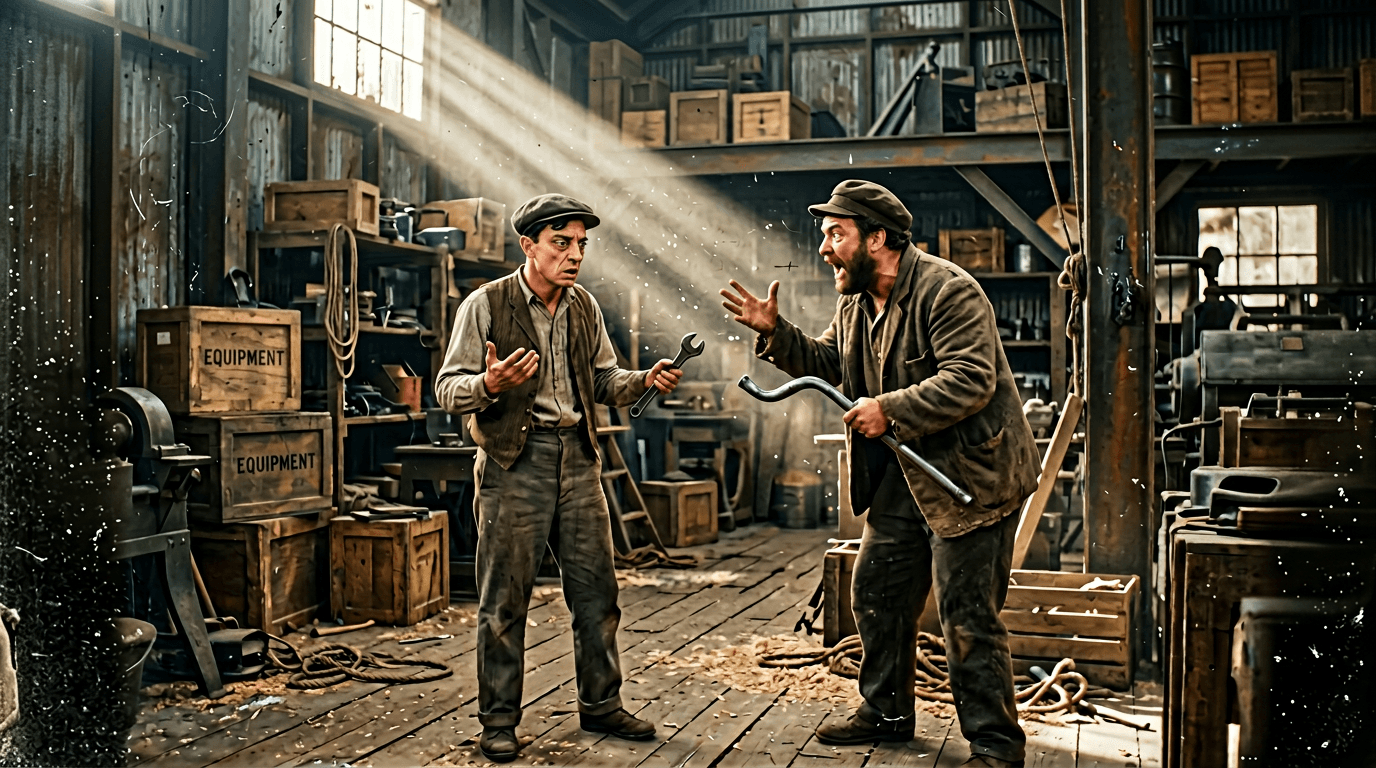

No one speaks.
Not once.
The protagonist still lies, negotiates, threatens, forgives, and changes.
That is the challenge of a no-dialogue screenplay. Also the opportunity.
Writers often think dialogue is where story intelligence lives. Remove dialogue and many scripts collapse because the underlying scene design was never strong enough to stand on behavior alone.
Here’s why that matters: writing a screenplay with no dialogue is not a gimmick format exercise. It is a craft stress test that exposes whether your storytelling is truly cinematic.
If readers can understand objective, conflict, reversal, and emotional shift without spoken lines, your scene architecture is solid.
If they cannot, dialogue was probably hiding structural weaknesses.
Think about it this way: dialogue can explain intention. Silent action must prove intention.
This guide gives you a practical method to write no-dialogue scripts that stay tense, clear, and emotionally legible page after page.
Cinematic workflow frames
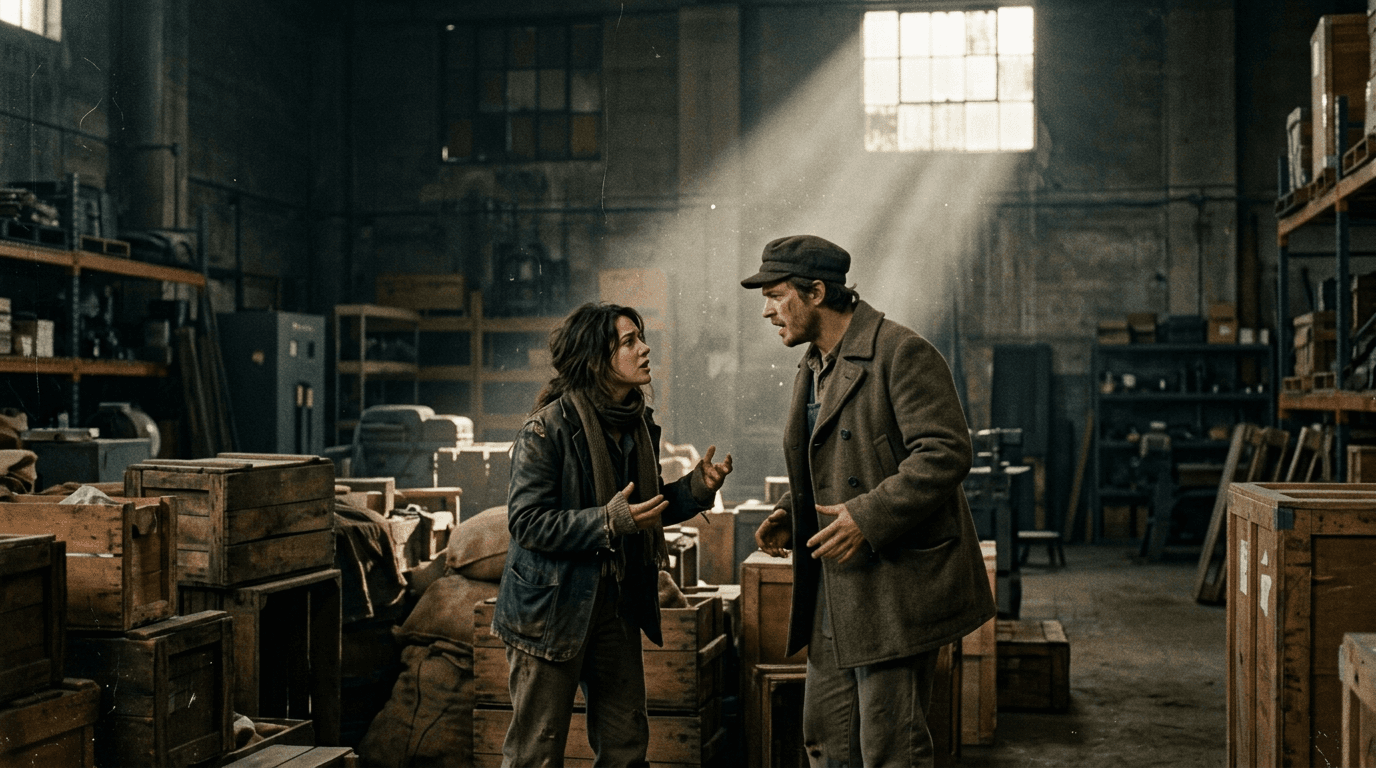
These two visuals work as a pair: the first shows Cinematic workflow still, first angle, 35mm film grain, and the second shifts to Cinematic workflow still, second angle, 35mm film grain - compare them briefly, then move on.

What “No Dialogue” Actually Means
A no-dialogue screenplay is not a no-sound screenplay.
You still have behavior, sound cues, environmental detail, rhythm, and reaction.
You may include nonverbal vocalizations, ambient media, radio chatter in world, or text cues depending on your ruleset. But your core dramatic progression cannot rely on spoken character dialogue.
That distinction matters because beginners often confuse silence with emptiness.
Silence is not absence of information.
Silence is information pressure delivered through nonverbal channels.
In no-dialogue writing, every movement becomes a sentence and every object can become a verb.
Core Structural Principles for Dialogue-Free Scenes
Principle 1: Objective Must Be Visible
If the audience cannot infer what a character wants in the scene, silence becomes fog.
In dialogue scenes, characters can state goals.
In silent scenes, goals must appear in behavior patterns: searching, hiding, repairing, blocking, following, stealing, refusing, waiting.
Principle 2: Conflict Must Alter Behavior, Not Just Mood
Without lines, emotional shifts need external expression.
A character opening a door halfway instead of fully can carry more conflict than a speech if staged correctly.
Principle 3: Reversal Needs a Physical Pivot
In dialogue-heavy scenes, reversal can arrive through new information in speech.
In no-dialogue scenes, reversal usually lands through object reveal, spatial shift, timing disruption, or unexpected reaction.
Principle 4: Scene Endings Need Action Residue
Do not end silent scenes on generic atmosphere.
End on a choice, consequence, or unresolved action vector that propels next beat.
Comparison Table: Dialogue-Driven vs Silence-Driven Writing
| Element | Dialogue-Heavy Scene | No-Dialogue Scene | Common Beginner Trap |
|---|---|---|---|
| Objective clarity | Declared verbally | Shown through repeated behavior | Objective too abstract to visualize |
| Conflict expression | Argument/explanation | Blocking, timing, space, objects | Mood without actionable friction |
| Reversal delivery | Spoken reveal | Visual/physical reveal | “Nothing happens” pacing drag |
| Subtext vehicle | Line contradiction | Behavior contradiction | Overwriting action lines to compensate |
Three Beginner Scenarios That Usually Fail
Scenario 1: The Breakup Scene With No Words but No Action
Two characters sit silently at a table for two pages, looking sad.
Atmosphere exists.
Drama does not.
Fix: convert emotional state into tactical actions: one packs bag, other hides passport, both race to control final object exchange.
Scenario 2: The Heist Sequence That Overwrites Action Prose
Writer compensates for silence by writing dense literary paragraphs explaining internal emotion.
Result: unreadable page blocks and weak cinematic specificity.
Fix: short action lines, concrete behaviors, clear cause-and-effect.
Scenario 3: The Art Film Draft With Symbol Overload
Every scene uses abstract visual metaphor without objective progression.
Result: stylish ambiguity, low narrative pull.
Fix: assign each scene a practical task and measurable failure risk.
Step-by-Step Workflow for Writing a No-Dialogue Screenplay
Step 1: Define Story Spine in Verbs
Before drafting pages, map major beats using verbs only:
pursue, hide, protect, sabotage, trade, escape, confess (nonverbally), surrender.
If your spine depends on abstract nouns alone, you will struggle in scene execution.
Step 2: Build Character Lexicons of Behavior
Each lead character needs a distinct nonverbal grammar.
One avoids eye contact and over-organizes objects.
Another invades space and breaks routines.
Another communicates through ritual repetition.
These lexicons replace dialogue voice.
Step 3: Design Scene Objectives as Observable Tasks
Rewrite scene intents into visible outcomes:
“Win forgiveness” becomes “return stolen item and stay in room long enough to be accepted.”
“Hide guilt” becomes “remove evidence before partner enters.”
Step 4: Engineer Reversals Through Physical Information
Every 1-2 pages, introduce physical pivot: misplaced key, empty drawer, broken lock, late bus, missing ring, changed calendar mark.
No pivots, no momentum.
Step 5: Control Action-Line Density
Silence scripts can become prose-heavy quickly.
Keep lines short.
One action per line in high tension beats.
Whitespace is pacing control.
Step 6: Use Sound as Structural Counterpoint
No dialogue does not mean no sonic rhythm.
Use alarms, trains, footsteps, buzzing lights, construction noise, TV murmur, breathing patterns as beat markers.
Sound can turn, accelerate, or puncture scenes.
Step 7: Run a Blind Readability Pass
Give pages to a reader and ask:
What does each character want in this scene?
What changed by end of scene?
If answers are vague, clarify objective behavior before polishing style.
Body Image: Silent Scene Beat Map

The Trench Warfare Section: What Beginners Get Wrong and Exact Fixes
This is where no-dialogue drafts usually break.
Failure 1: Confusing Silence With Slowness
Writer stretches beats without new action information.
Fix: keep micro-objectives active every few lines.
Failure 2: Internal Emotion Explained in Action Lines
Prose tells us feelings rather than showing behavior.
Fix: convert internal states into external choices and physical tells.
Failure 3: Repetitive Gesture Language
Characters repeatedly sigh, stare, or sit without progression.
Fix: escalate behavior pattern, not just emotional intensity.
Failure 4: No Distinct Character Movement Voice
Everyone performs silence the same way.
Fix: assign each character unique behavioral lexicon.
Failure 5: Symbolism Without Causality
Visual motifs appear but do not affect choices.
Fix: tie motifs to objective outcomes.
Failure 6: Scene Openings With No Immediate Tension Vector
Silent scenes start atmospheric and stay inert.
Fix: open with task already in motion.
Failure 7: Weak Spatial Blocking on Page
Reader cannot track who is where relative to stakes object.
Fix: anchor space early and refresh at pivot points.
Failure 8: Overdependence on Music Cues
Script implies score will do emotional heavy lifting.
Fix: build emotion in action logic first.
Failure 9: No Midpoint Reversal in Long Sequences
Extended silent passage with single emotional note.
Fix: insert clear physical disruption mid-sequence.
Failure 10: Endings That Don’t Force Next Action
Scene fades out on mood.
Fix: end with decision residue that drives next scene.
Silence is not minimalism by default. It is high-precision narrative behavior.
Try it free
Try Screenweaver for free on your script
It is free. Import your existing project, get a clearer view of your outline, and regain control of your story structure in minutes.
Start FreeAdvanced Craft: Writing Nonverbal Subtext That Reads Instantly
Subtext in silent scripts comes from contradiction between what a character does and what context suggests they should do.
A father returns stolen toy but removes batteries first.
A thief cleans fingerprints from knife but leaves wedding photo untouched.
A rival opens emergency door for opponent, then locks themselves in.
Those contradictions carry line-level complexity without lines.
To write this consistently, use triads:
intended action,
performed action,
unintended reveal.
This triad framework helps you avoid flat literal behavior.
It also gives actors and directors playable ambiguity without reader confusion.
Operational Workflow: Sequence Ledger for Silent Scripts
Silent scripts are vulnerable to pacing drift because missing dialogue removes obvious beat boundaries.
Use a sequence ledger during rewrite:
beat number
objective verb
obstacle event
reversal event
outcome state
If two consecutive beats do not change outcome state, you likely have dead air.
Cut, combine, or escalate.
For production-facing clarity, ensure every complex physical beat remains shootable and comprehensible in one or two camera setups. Overly intricate action that requires impossible coverage is a common silent-script trap.
For script readability benchmarks across visual storytelling styles, the <a href="https://thescriptlab.com/screenplays/download-screenplays/" rel="nofollow">Script Lab screenplay resources</a> can help compare pacing and action-line density patterns, but your own objective-reversal discipline should drive final decisions.
As discussed in our guide on [how to show simultaneous action in two locations in a script], shared causality is what keeps high-information sequences alive without explanatory dialogue.
If your silent story includes major mediated beats, pair with [screenplay formatting for surveillance camera footage] to preserve source clarity when visual perspective narrows.
And when nonverbal communication happens over remote channels, [screenplay formatting for FaceTime and video chat scenes] helps maintain spatial logic without spoken exposition.
Body Image: Nonverbal Subtext Triad
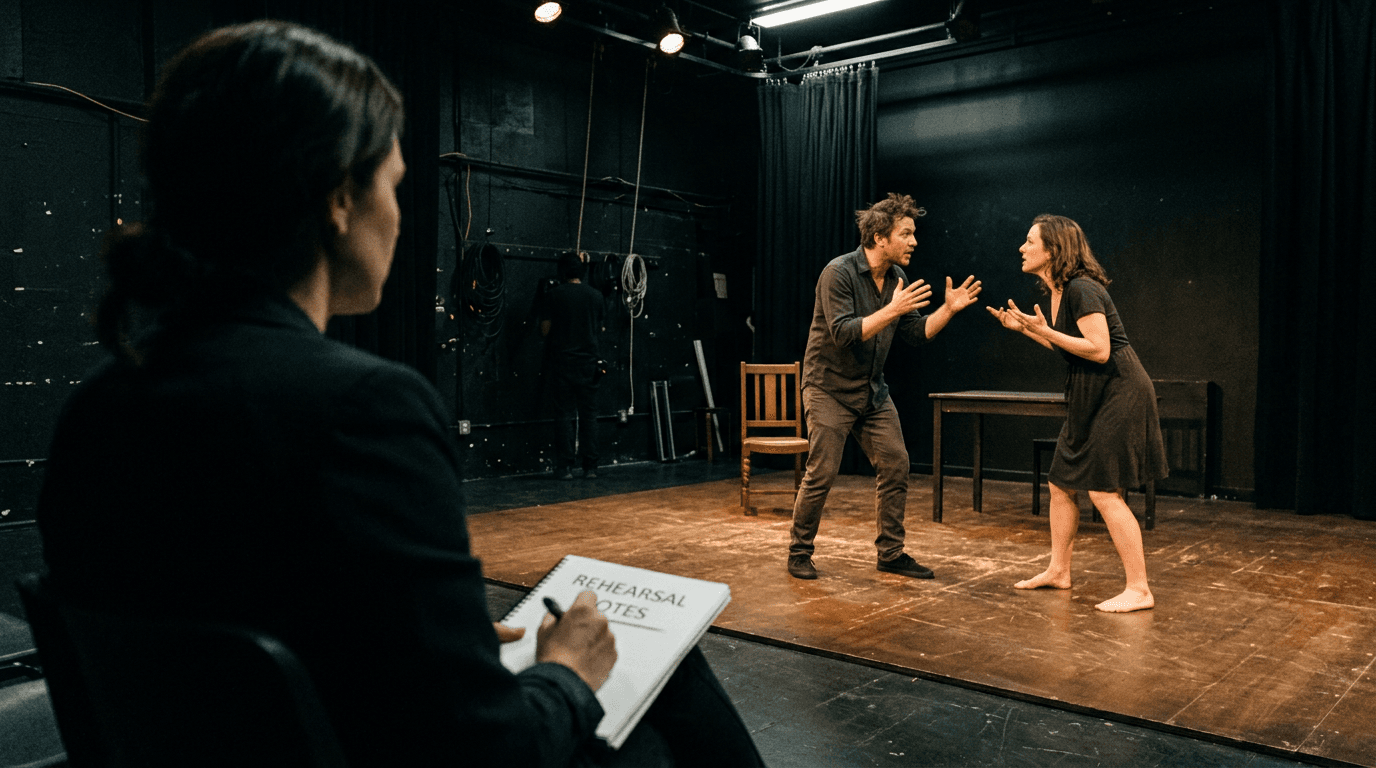
YouTube Placeholder
[YOUTUBE VIDEO: A practical rewrite of a dialogue-heavy scene into a no-dialogue version, showing objective mapping, action-line compression, and nonverbal reversal design.]
Before-and-After Micro Example
Before:
“INT. KITCHEN - NIGHT
Mara and Eli argue about trust.
MARA You never tell me the truth.
ELI I was trying to protect you.
MARA From what?
ELI From me.
She cries.”
Functional, but speech-dependent.
After:
“INT. KITCHEN - NIGHT
Mara opens Eli’s backpack.
Inside: passport, cash, one-way train ticket.
Eli enters. Freezes.
Mara places the ticket on the table between them.
Eli reaches for it.
Mara pins it under a kitchen knife.
Eli slowly pulls his house key off his ring and sets it beside the ticket.
Mara does not pick it up.
She turns off the kitchen light and leaves him in the dark.”
Same emotional payload.
Stronger cinematic behavior chain and clearer reversal.
Ending Perspective: If It Works in Silence, It Works for Real
Writing a screenplay with no dialogue strips away your safest crutch.
That is uncomfortable.
It is also clarifying.
When scenes still land without spoken explanation, you know your objectives are visible, your reversals are earned, and your emotional turns are embodied.
That discipline carries back into every dialogue-rich script you write afterward.
Because then dialogue becomes enhancement, not scaffolding.
So if you want to test whether your storytelling is truly cinematic, try silence seriously.
Not as an aesthetic stunt.
As a craft laboratory.
Build behavior systems.
Write for consequence.
End scenes on action residue.
Do that, and no-dialogue screenwriting stops being “minimalist.”
It becomes one of the most demanding and rewarding forms of narrative precision available on the page.
There is another high-level consideration that separates ambitious silent scripts from enduring ones: information economy.
When dialogue disappears, many writers overcompensate with visual overstatement. Every prop becomes symbolic. Every gesture becomes emphatic. Every scene tries to carry three meanings at once.
The result is visual noise.
Strong no-dialogue writing is selective. It chooses a few recurring information channels and uses them consistently:
object continuity,
spatial control,
timing pressure,
behavior contradiction.
If all four channels fire at full volume in every scene, audience fatigue arrives quickly. If one or two channels dominate each sequence while others support, pacing feels intentional and legible.
Another advanced framework is “silent grammar by act.”
Act One: establish objective and behavior lexicon clearly, avoid heavy ambiguity. Act Two: increase contradiction between visible behavior and inferred intent. Act Three: resolve contradiction through irreversible action, not explanatory gesture.
This progression mirrors dialogue scripts where subtext deepens across acts, but here it is carried almost entirely by action architecture.
You can also design “action motifs with semantic drift.” A character repeatedly wipes a table in Act One to show discipline. In Act Two, same wipe becomes avoidance. In Act Three, they leave the table dirty for first time - an emotional declaration without words. This is one of the most powerful no-dialogue tools because repetition plus change equals meaning.
Practical Drill: Objective Visibility Test
Take any silent scene and remove your own interpretation.
Ask a reader to answer in one sentence: “What does this character want right now?”
If they cannot answer quickly, objective is not visible enough.
Fix with clearer task behavior, not more stylistic prose.
Practical Drill: Reversal Timestamp Pass
Mark every reversal beat in your no-dialogue sequence with approximate page minute.
If reversals are too far apart, scene may feel inert. If reversals are constant but low-impact, scene may feel jittery. Aim for meaningful shifts at rhythmically sensible intervals tied to objective pressure.
This is especially useful in long silent stretches where pace can drift without obvious warning.
Practical Drill: Silent Dialogue Substitution
Choose one dialogue scene from an older draft and rewrite it without any speech.
Then compare:
What information survived?
What emotional nuance was lost?
What became stronger?
This comparison teaches exactly which parts of your writing are truly cinematic and which rely on verbal explanation.
Practical Drill: Prop Burden Audit
List every prop that carries narrative meaning in a silent sequence.
If too many props are required for comprehension, simplify.
Each prop should do one core job. Multi-purpose props are great when clear, disastrous when overloaded.
A frequent beginner issue is building puzzle-box scenes where meaning depends on ten tiny details. Readers should not need forensic memory to follow emotional logic.
One final revision habit makes a huge difference: run a no-dialogue scene aloud as choreography.
Literally speak only action verbs in sequence: opens, hides, hesitates, drops, retrieves, blocks, leaves.
If that verb chain feels repetitive or aimless, scene likely needs structural redesign.
If it feels escalating and specific, prose polish can amplify it safely.
Silent scripts are brutal and beautiful for one reason. They remove verbal camouflage.
What remains is pure scene engineering.
And if your engineering is sound, the emotional impact can be stronger than almost any speech-driven page because the audience is participating, not being instructed.
If you want a final pre-submission check, run a “subtitles off” imagination pass: can the entire film be followed by intent and consequence alone, scene by scene, without your internal explanation running in parallel? Where the answer is no, your next revision target is visible objective design, not poetic action description.
The hidden benefit of this process is transferable. Writers who master no-dialogue sequencing usually return to dialogue scripts with sharper scenes, cleaner blocking, and fewer explanatory lines. They trust action to carry meaning, so speech can become specific, dangerous, and concise instead of functional filler. Even if you never write a fully silent feature, training this muscle improves every genre you touch.
That advantage compounds over years and is visible on every page.
Final Step
Build your next script with Screenweaver
Move from ideas to production-ready pages faster with timeline-native writing and AI-assisted story flow.
Try Screenweaver