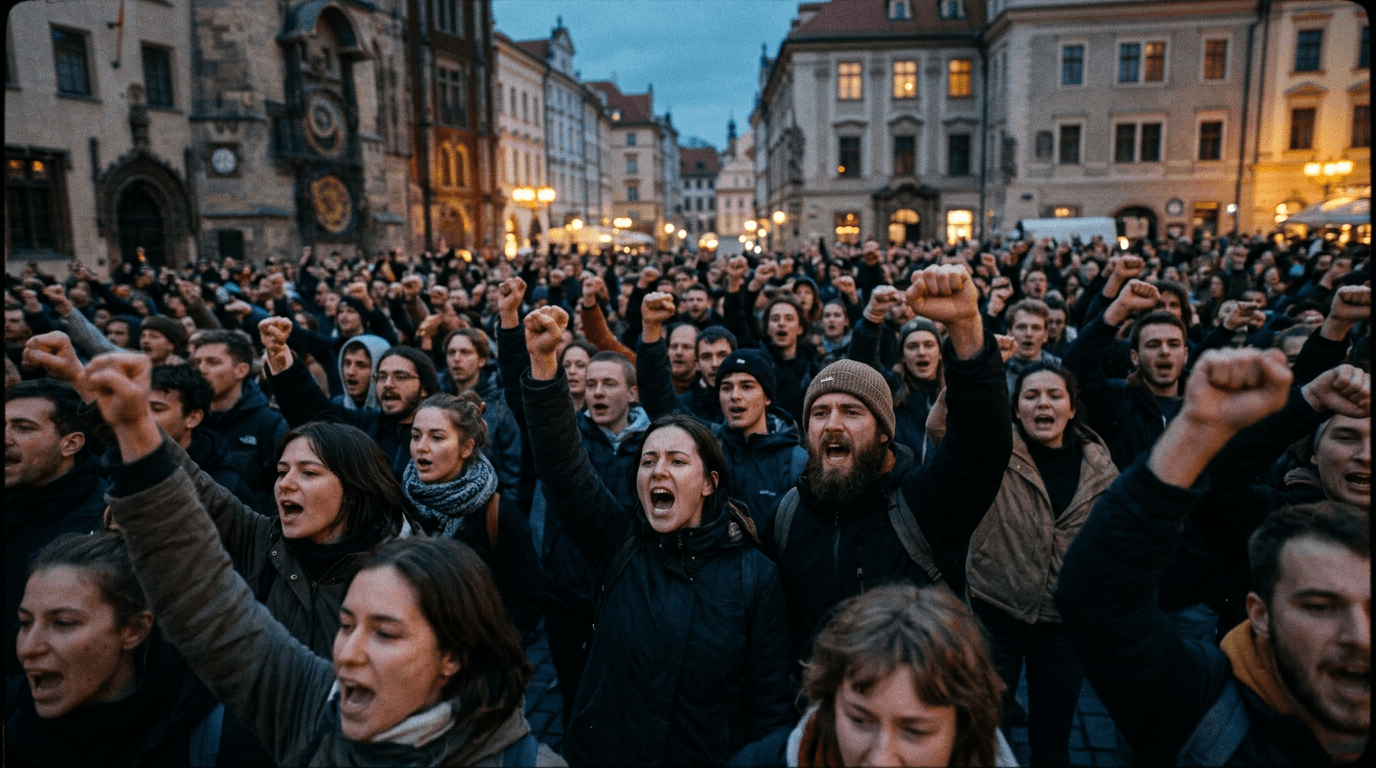

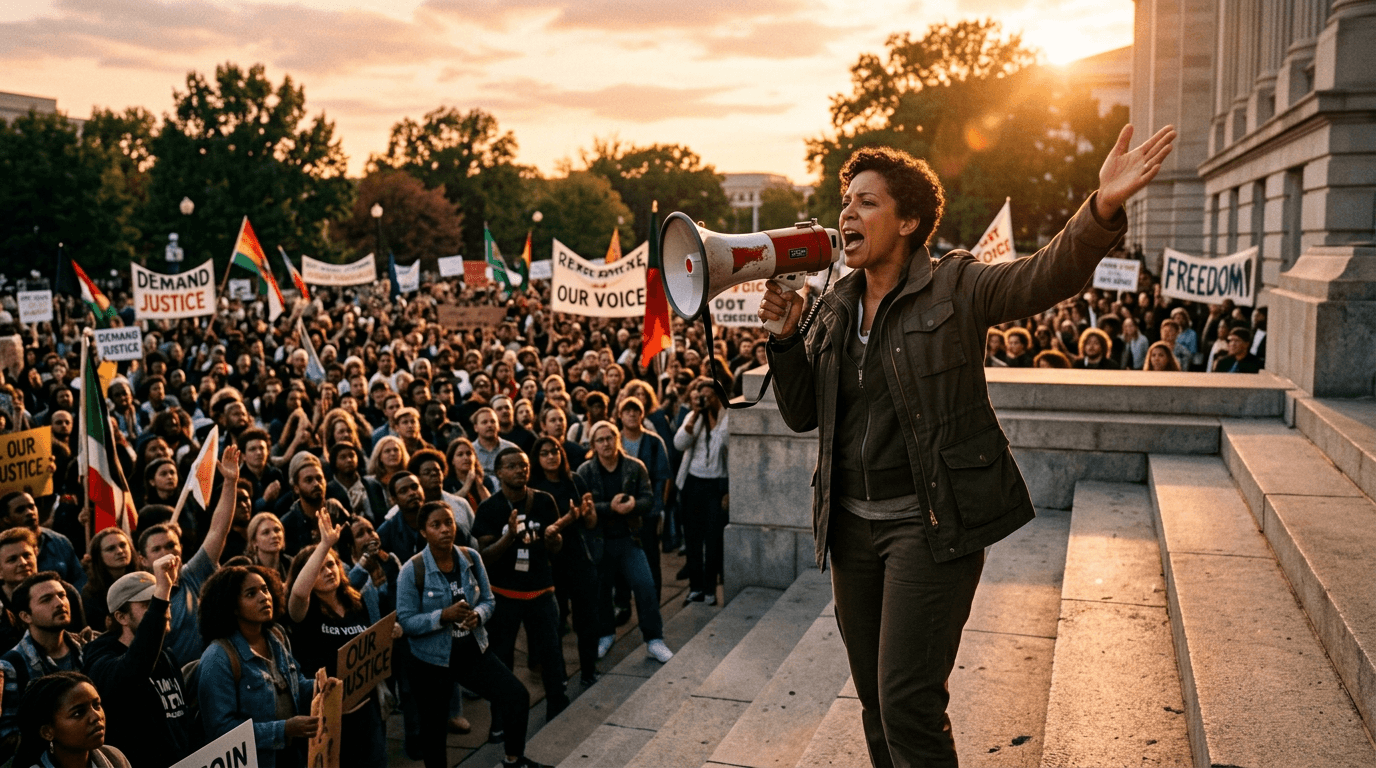
Thousands of voices lock into one phrase.
It starts as atmosphere.
Then it becomes pressure.
Then it becomes the scene’s main antagonist.
That is what chanting crowds can do when written well.
Most beginner scripts either flatten crowds into generic background (“the crowd chants”) or over-transcribe every repeated line until the page becomes unreadable. In both cases, they lose the most important thing: crowd sound as narrative force.
Here’s why that matters: chanting is not just loudness. It is organized collective intention. On the page, that intention can shift power, isolate your protagonist, trigger panic, signal solidarity, escalate violence, or expose social fracture.
Think about it this way: a crowd chant is dialogue spoken by environment.
If you format and stage it precisely, readers feel momentum, threat, and emotional contagion in real time.
Cinematic workflow frames
These two visuals work as a pair: the first shows Cinematic workflow still, first angle, 35mm film grain, and the second shifts to Cinematic workflow still, second angle, 35mm film grain - compare them briefly, then move on.
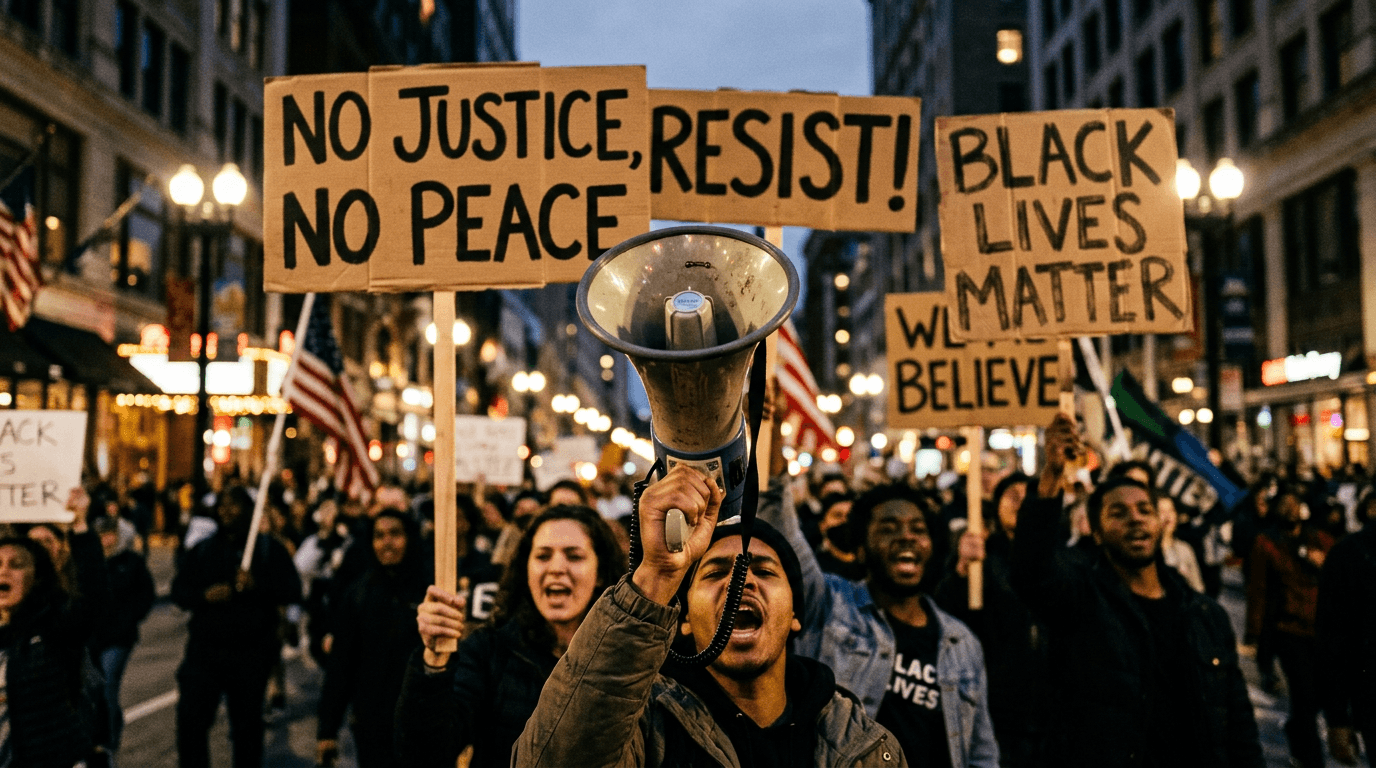
What Chanting Crowds Do Dramatically
Chants are rhythmic, repetitive, and directional. They can be weaponized or protective. They can unify or fracture.
In screenplay terms, chanting crowds can perform at least six strong functions:
set tone fast,
mark power transfer,
externalize political stakes,
compress exposition through slogan language,
disrupt character speech,
force timing decisions under social pressure.
If your scene uses chant only as texture, you are underusing it.
A crowd chant should change what characters can do, not just what they hear.
Core Formatting Patterns That Work
No single rigid template is mandatory, but consistency and page rhythm are.
Pattern 1: CROWD (CHANTING) Dialogue Cue
Example:
CROWD (CHANTING)
NO JUSTICE, NO PEACE.
Simple and readable for controlled chant moments.
Pattern 2: Action-Line Chant Blocks
Use short action beats when chant sits under broader movement:
“The crowd pounds barriers, chanting in waves: NO MORE LIES.”
Good when scene focus remains on individual characters.
Pattern 3: Call-and-Response Formatting
For structured group dynamics:
LEAD CHANTER
WHOSE STREETS?
CROWD
OUR STREETS.
Useful when chant architecture itself matters to scene power.
Pattern 4: Escalation Markers Across Repetitions
Do not copy-paste chant text identically without progression. Add intensity or meaning shifts at key beats.
Comparison Table: Best Use by Scene Type
| Approach | Best Use Case | Strength | Risk |
|---|---|---|---|
CROWD (CHANTING) cue | Focused confrontation scenes | Clear source and rhythm | Repetitive if overused |
| Action chant blocks | Character-centric scenes with ambient crowd pressure | Smooth page flow | Chant language may feel under-specified |
| Call-and-response cues | Protest, stadium, ritual, political scenes | Strong collective dynamics | Can become theatrical if overextended |
| Progressive repetition beats | Escalation arcs | Builds mounting pressure | Mechanical if progression is unclear |
Three Beginner Scenarios That Commonly Fail
Scenario 1: The Protest Scene with Generic Chant Placeholder
Script says “the crowd chants angrily” for two pages with no actual words.
Result: no social specificity, no dramatic leverage.
Fix: write concise chant language reflecting stakes and identity. Even one precise chant can anchor scene reality.
Scenario 2: The Stadium Scene That Drowns Character Action
Writer prints full chant lyrics repeatedly while protagonist’s objective stalls.
Result: sonic realism, narrative paralysis.
Fix: treat chant as obstacle and clock. Pair chant surges with character attempts to act.
Scenario 3: The Riot Sequence With No Chant Evolution
Same phrase repeats unchanged while danger rises.
Result: flat rhythm.
Fix: evolve chant content, volume, or target as scene stakes escalate.
Step-by-Step Workflow for Writing Chanting Crowd Scenes
Step 1: Define Crowd Intent
What does the crowd want in this moment?
Justice?
Punishment?
Access?
Protection?
Identity assertion?
Without clear crowd intent, chant lines will feel generic.
Step 2: Choose Chant Type
Unison chant, call-and-response, fragmented wave, or counter-chant between factions.
This choice determines formatting rhythm.
Step 3: Write Chant Lexicon
Draft 3-5 short chant lines before scene writing.
Keep language punchy, repeatable, and characterful to setting.
Step 4: Assign Chant Beats to Structural Turns
Decide where chant intensifies, fractures, or redirects.
Each major chant beat should align with scene reversal or tactical pressure shift.
Step 5: Integrate Character Objective Friction
How does chant interfere with protagonist goals?
Harder communication, blocked movement, moral panic, false confidence, crowd surge, visual obstruction.
Step 6: Control Page Density
Do not flood pages with repeated text.
Use concise chant insertions and action consequences.
Step 7: Run a Rhythm Read
Read chant lines aloud with action beats.
Does cadence escalate?
Does character action respond?
If rhythm is static, revise beat structure.
Body Image: Chant Escalation Curve
The Trench Warfare Section: What Beginners Get Wrong and Exact Fixes
This is where crowd-chant scenes usually fail.
Failure 1: Placeholder Chant Writing
No specific words, just “chanting.”
Fix: write concrete chant language tied to stakes.
Failure 2: Over-Transcription of Repetition
Same chant printed too many times.
Fix: show first key line, then indicate sustained repetition with action consequences.
Failure 3: No Crowd Agency
Crowd acts like background sound only.
Fix: let crowd choices alter scene trajectory.
Failure 4: One-Dimensional Emotional Tone
Chant stays emotionally identical throughout.
Fix: modulate urgency, confidence, fear, or aggression across beats.
Failure 5: Character Dialogue Unaffected by Noise
Characters exchange clean lines despite extreme chant volume.
Fix: adapt communication behavior to sonic pressure.
Failure 6: Ambiguous Source in Multi-Group Scenes
Unclear which faction chants what.
Fix: label groups cleanly and consistently.
Failure 7: No Physical Consequence to Sound
Chants exist but no body-level impact.
Fix: tie sound to movement, breath, pacing, and spatial compression.
Failure 8: Chant Language Mismatch with World
Phrases feel modern in period setting or vice versa.
Fix: calibrate diction to social context.
Failure 9: No Strategic Silence
Constant chant leaves no contrast.
Fix: use sudden dropouts for dramatic punctuation.
Failure 10: Scene Ends Without Crowd Outcome Shift
Chant pressure builds then evaporates.
Fix: end with altered crowd state that affects next sequence.
Repetition becomes drama only when each repeat carries new consequence.
Advanced Craft: Chant as Collective Character Arc
Strong scripts treat crowd voice as evolving entity.
At first, chant can sound uncertain.
Then unified.
Then splintered by fear, misinformation, or internal disagreement.
This progression gives the crowd a mini-arc that mirrors or opposes the protagonist arc.
You can also write chant as moral mirror.
If protagonist seeks accountability, crowd chant may amplify that desire beyond control.
If protagonist seeks truth, crowd chant may demand certainty too early.
If protagonist seeks escape, chant may expose complicity they can no longer deny.
When chants are dramaturgically linked to character conflict, the scene transcends noise design.
Try it free
Try Screenweaver for free on your script
It is free. Import your existing project, get a clearer view of your outline, and regain control of your story structure in minutes.
Start FreeWorkflow and Revision Discipline
Chant-heavy sequences often degrade in later drafts because repeated lines multiply and source labels drift.
Use a chant ledger:
group/source,
chant phrase,
beat position,
intensity change,
scene consequence.
Normalize cue labels in revision (CROWD, COUNTER-CROWD, LEAD CHANTER) and trim redundant repeats.
Read action lines without chants. Then reintroduce chants only where they alter behavior or stakes.
For comparative rhythm study in produced crowd scenes, the <a href="https://www.studiobinder.com/blog/best-free-screenwriting-software/" rel="nofollow">StudioBinder screenplay resources</a> can provide structural references, but your own escalation logic and source clarity must drive final formatting.
As discussed in our guide on [how to show simultaneous action in two locations in a script], rhythmic switching and consequence chains matter more than sheer volume of events.
If your crowd scene includes mediated alert overlays, pair with [screenplay formatting for on-screen notifications and alerts] so signal channels remain clear.
And when crowd pressure is tracked through surveillance or public feeds, [screenplay formatting for surveillance camera footage] helps preserve perspective logic.
Body Image: Call-and-Response Dynamics Map
YouTube Placeholder
[YOUTUBE VIDEO: A practical scene rewrite demonstrating how to transform a generic protest crowd scene into a clear, escalating chant-driven sequence with visible consequences.]
Before-and-After Micro Example
Before:
“EXT. CITY SQUARE - NIGHT
A crowd chants as Mara pushes through.
MARA Let me through!
The crowd chants louder.
She looks scared.”
Low specificity, low leverage.
After:
“EXT. CITY SQUARE - NIGHT
Barricades tremble under a synchronized chant.
CROWD (CHANTING) OPEN THE GATES. OPEN THE GATES.
Mara tries to thread the side lane. Fails.
LEAD CHANTER WHO DECIDES?
CROWD WE DECIDE.
Mara raises her credential badge. Nobody looks.
CROWD (CHANTING) NO MORE CLOSED DOORS.
Mara pockets the badge and climbs the barricade instead.”
Same core setup.
Stronger rhythm, clearer stakes, better behavior consequence.
Ending Perspective: Write the Crowd Like It Can Answer Back
Chanting crowds are easy to stereotype as atmosphere.
Do that and your scene flattens.
Treat the crowd as active force with intent, rhythm, and consequence, and suddenly your pages gain scale without losing precision.
Use specific chant language.
Control repetition.
Track escalation.
Link sound to choice.
End on altered crowd state.
When those pieces lock, crowd scenes stop feeling like noisy backdrop and start functioning as live dramatic machinery.
That is where readers feel not just what your protagonist wants, but what the world wants from them in return.
There is another craft axis that separates average crowd scenes from unforgettable ones: chant directionality.
A chant can aim at many targets:
a physical gate,
a named person,
an institution,
a symbolic ideal,
or the crowd itself.
When direction is unclear, energy disperses.
When direction is precise, scene pressure sharpens.
You can track this by writing a one-line chant intention above each major beat in your outline. If intention shifts mid-sequence, make the shift visible through wording, volume pattern, or movement vector. Otherwise readers may register escalation but miss meaning.
Another advanced technique is chant fragmentation under stress.
Early in a sequence, chant language may be synchronized and crisp.
As pressure rises, timing fractures. Subgroups start alternate phrases. Counter-chants emerge. Rhythm stutters.
This sonic breakdown can mirror moral or strategic fracture in the story world. It is especially effective in scenes where intervention, misinformation, or fear splinters collective purpose.
Used carefully, this gives your sequence emotional complexity without adding exposition-heavy dialogue.
Practical Drill: Chant Function Audit
For every chant beat in your scene, complete one sentence:
“This chant forces ____ to ____.”
If that sentence is weak, the beat is probably atmospheric filler.
Rewrite or cut.
Practical Drill: Escalation Ladder Pass
Map chant progression across five levels:
presence, coordination, pressure, instability, outcome shift.
Assign each major beat to one level. If you sit on one level too long, sequence flattens. If levels jump without transition, sequence feels arbitrary.
Practical Drill: Counterpoint Rewrite
Rewrite one crowd scene in two versions:
Version A where chant supports protagonist objective.
Version B where chant obstructs protagonist objective.
Keep environment mostly constant.
Compare behavioral outcomes. This reveals whether your crowd writing is interactive or decorative.
Practical Drill: Breath and Body Pass
Read scene and mark where breathing, spacing, and body compression should visibly change due to chant intensity.
If physical consequences are absent, your chant may feel abstract.
Crowd sound lives in bodies. Put that on the page through concrete movement effects.
One more advanced move is lexical evolution by beat.
Do not keep wording frozen unless stubborn unity is your narrative point.
Small word shifts can signal major emotional change:
from demand to accusation, from accusation to threat, from threat to plea, from plea to anthem.
This is an efficient way to show crowd psychology turning in real time.
Operationally, maintain a chant ledger during revisions:
line text, speaker group, beat index, intent category, behavioral consequence.
As notes alter structure, update ledger immediately. Without this, repeated variants and source labels drift quickly, especially in long action runs.
If your script has multiple crowd scenes, design a macro progression across the film. Early chants may be uncertain and fragmented. Midpoint chants become coordinated and forceful. Late chants may radicalize, collapse, or transform into silence at moral pivot moments.
That long-form progression gives your crowd writing narrative memory. Readers feel that the world is changing, not resetting each set piece.
Finally, treat chants as language under pressure, not generic noise under action. Language reveals collective desire, fear, and strategy. If chant language is specific, directional, and evolving, your sequence carries political and emotional weight with minimal page footprint.
That is the highest-value move in this format: maximum consequence, minimal clutter.
One final advanced framework can make chant scenes much easier to control: crowd-vector design.
Instead of describing the crowd as one mass, break it into vectors:
frontline pressure,
lateral drift,
rear hesitation,
authority counter-movement.
Now each chant beat can influence one or more vectors. This instantly improves spatial readability and helps directors imagine staging from the page.
For example, a unison chant may strengthen frontline pressure while rear hesitation drops. A sudden counter-chant may split lateral drift into two opposing directions. An unexpected silence may spike rear panic. With this model, you are not just writing sound; you are writing force distribution.
That is where crowd scenes become tactically cinematic.
Practical Drill: Vector Overlay Pass
Take your scene and annotate each major beat with vector changes:
which direction gains momentum,
which direction loses cohesion,
what the protagonist can do because of that shift.
If protagonist options remain unchanged across multiple chant beats, your crowd pressure may be performative instead of structural.
Practical Drill: Choreography Compression
Rewrite one dense crowd page into half the line count without losing causality.
Keep only:
primary chant cue,
major movement shift,
character decision.
This forces precision and removes ornamental crowd prose.
Practical Drill: Silence Window Calibration
Insert one planned silence window before your highest-stakes beat.
Then test three lengths:
one beat, three beats, five beats.
Read aloud with rhythm. You will feel how silence duration changes threat perception and decision timing. Choose the shortest window that still lands.
Operationally, preserve chant consistency across departments by adding a short appendix note for production drafts listing core chant lines and intended evolution. This is optional in early specs, but valuable once the script enters prep and multiple teams interpret crowd behavior separately.
The point is not to over-control performance. The point is to protect narrative function so chant evolution is not flattened in execution.
When you combine vector clarity, escalation logic, and selective silence, crowd scenes stop being broad spectacle and become precision pressure systems.
That precision is what makes them unforgettable on the page, and production-ready under pressure in fast-moving rewrites on set every day worldwide consistently.
Final Step
Build your next script with Screenweaver
Move from ideas to production-ready pages faster with timeline-native writing and AI-assisted story flow.
Try Screenweaver