

The players enter a 1940s detective office. A phone rings. A recorded voice tells them a witness has been murdered and they have sixty minutes to find the killer before they become the next target. They start searching drawers, finding coded letters, newspaper clippings, photographs with faces crossed out.
This is an escape room. But it's also a story, one the players don't passively watch but actively inhabit. The narrative environment isn't a backdrop; it's the medium through which puzzles make sense, stakes feel real, and the hour becomes memorable.
Writing for escape rooms is unlike any other form of screenwriting. There's no script in the traditional sense, no dialogue actors will perform, no scenes that unfold in sequence. Instead, you're scripting an environment: deciding what story details are embedded in props, what lore is revealed through puzzles, what emotional arc the players experience as they progress.
This is environmental storytelling at its most literal. The room is the story.
Cinematic workflow frames
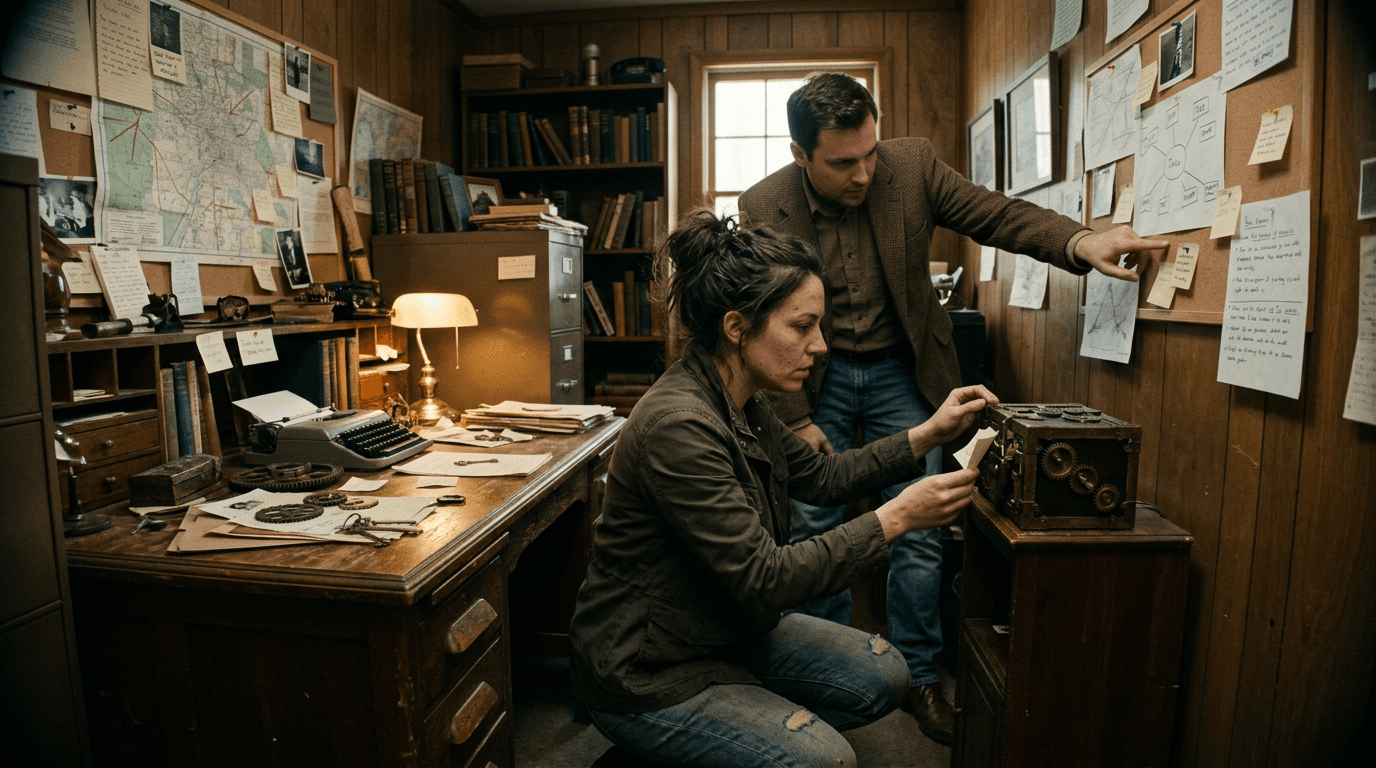
These two visuals work as a pair: the first shows Cinematic workflow still, first angle, 35mm film grain, and the second shifts to Cinematic workflow still, second angle, 35mm film grain - compare them briefly, then move on.

What "Scripting" Means for an Escape Room
When we talk about scripting an escape room, we mean designing the narrative layer that sits on top of (and integrates with) the puzzle structure. This includes:
The premise. What's the situation? Who are the players within the fiction? What's the goal?
The lore. What happened before the players arrived? What backstory explains the puzzles they'll encounter?
The arc. How does the story develop as players progress? What revelations occur? How do stakes escalate?
The props and set dressing. What physical objects convey narrative information? What's readable, examinable, discoverable?
The ending. What happens when players win? What happens when they lose? How does the narrative resolve?
The writer creates a document, often called a "narrative design document", that describes all of this. It's not a screenplay, but it draws on screenwriting skills: world-building, character creation, pacing, and emotional design.
The Relationship Between Story and Puzzle
In a well-designed escape room, story and puzzle are inseparable. Every puzzle should feel like it belongs to the world; every story element should, ideally, serve gameplay.
Story justifies puzzle. Why is there a combination lock on this drawer? Because the detective was paranoid about his files. The combination is hidden in his journal, and finding it reveals his paranoia while advancing gameplay.
Puzzle reveals story. Solving the cipher on the telegram doesn't just open a box, it reveals that the victim was blackmailing someone. The story deepens through gameplay.
The opposite is a "arbitrary" puzzle: a Sudoku grid in a medieval castle, unlocking a door because... math? These puzzles feel disconnected, and they kill immersion.
The best escape room puzzles feel like archaeology. You're not solving arbitrary challenges, you're uncovering a history.
A Table: Story Elements and Their Functions
| Element | Function | Example |
|---|---|---|
| Premise | Sets the frame | "You're investigators in 1940s Chicago." |
| Objective | Drives urgency | "Find the killer before they find you." |
| Backstory | Explains the environment | "This was the victim's office; she kept secrets here." |
| Character artifacts | Humanize the world | "Her diary, with entries you can read." |
| Revelation moments | Reward progress | "Solving the cipher reveals she was blackmailing the mayor." |
| Escalation cues | Raise stakes | "Halfway through, the lights flicker; a note is slipped under the door." |
| Ending | Closure | "You identify the killer and 'call the police' (final puzzle)." |
Writing the Narrative Design Document
A narrative design document for an escape room typically includes:
1. Overview (1 page)
- Title/theme
- One-paragraph premise
- Target audience and difficulty
- Estimated play time
2. Story Summary (1–2 pages)
- Full backstory: what happened before the players arrived
- Character profiles: who are the key figures? (victim, suspect, red herrings)
- The "truth" the players will uncover
3. Player Experience Arc (1–2 pages)
- Emotional beats: How should players feel at start, middle, end?
- Revelation sequence: What do they learn, and when?
- Pacing guidance: Where are the "high" moments? Where's the climax?
4. Puzzle-to-Story Integration (detailed)
For each puzzle, describe:
- What the puzzle is (brief mechanics)
- How it's justified in-world
- What story information solving it reveals
- What physical props are involved
5. Props and Set Dressing
- Detailed list of props with narrative content (letters, photos, newspapers)
- Environmental details (posters, decor, ambient sounds)
- What's "readable" vs. what's decoration
6. Ending(s)
- Win state: What happens when they solve everything?
- Fail state: What happens when time runs out?
- Optional: mid-game reveals or twists
Three Scenarios: Different Escape Room Genres
Scenario A: Mystery/Detective
Theme: 1940s noir. The players are private eyes investigating a murder.
Story elements: The victim's office is the room. Clues reveal multiple suspects with motives. Red herrings lead to wrong conclusions before the true killer is revealed in the final puzzle.
Puzzle integration: A coded letter (cipher puzzle) reveals the victim was being blackmailed. A safe (combination lock) contains evidence pointing to the wrong suspect (a twist). The final puzzle, matching fingerprints or evidence, identifies the real killer.
Scenario B: Horror/Survival
Theme: Abandoned asylum. The players are journalists trapped inside, trying to escape before "something" finds them.
Story elements: The room is a wing of the asylum. Documents reveal unethical experiments. As players progress, they realize the "something" isn't supernatural, it's a surviving test subject, confused and dangerous.
Puzzle integration: Medical files (document puzzles) reveal the experiments. A broken intercom (repair puzzle) broadcasts static... then a voice. The final escape requires understanding the subject's history, the way out is empathy, not violence.
Scenario C: Adventure/Heist
Theme: Casino vault. The players are thieves executing a heist.
Story elements: The room is the vault's antechamber. They've already bypassed external security; now they need to crack the final defenses. The "story" is the heist itself, escalating tension, near-misses, ultimate triumph.
Puzzle integration: Lasers (physical challenge), a keypad (logic puzzle), a timing mechanism (cooperative task). Each success brings them closer to the vault. The ending is opening the vault door and seeing the "treasure."

Try it free
Try Screenweaver for free on your script
It is free. Import your existing project, get a clearer view of your outline, and regain control of your story structure in minutes.
Start FreeThe "Trench Warfare" Section: What Goes Wrong
Failure Mode #1: Story as Afterthought
The puzzles are designed first; the story is stapled on later. The result is arbitrary connections. "Why is there a piano in a spaceship?" "Because the puzzle needed musical notes."
How to Fix It: Design story and puzzle together. Start with the world. Ask: What puzzles would exist in this world? A detective's office has locks, codes, hidden compartments, because a detective would have those things.
Failure Mode #2: Too Much Lore, No Time to Read
The room is packed with readable documents, but players are under time pressure. They skim or ignore the narrative.
How to Fix It: Essential story beats should be delivered through short text (headlines, single sentences) or audio/visual cues. Reserve long text for optional enrichment, not essential plot.
Failure Mode #3: No Emotional Arc
The difficulty escalates, but the emotional stakes don't. Players feel challenged but not invested.
How to Fix It: Build revelation into the sequence. Early puzzles establish the situation; middle puzzles complicate it; late puzzles resolve it. The final puzzle should be emotionally meaningful, not just hard.
Failure Mode #4: Win/Lose States Feel Empty
Players solve all puzzles and... the door opens. That's it. Or they fail and... the door opens anyway. No narrative closure.
How to Fix It: Script the ending. The win state should feel triumphant, a video, a sound cue, a final reveal. The fail state should still provide closure, a "what would have happened" debrief or a graceful narrative out.
Failure Mode #5: Characters Are Forgettable
The victim, the villain, the suspects, all cardboard. Players don't remember names or care about outcomes.
How to Fix It: Give key characters a single defining detail that appears in multiple props. The victim loved roses (roses on desk, rose perfume bottle, rose petals in the murder scene). Specificity breeds memory.
Environmental Storytelling Techniques
Escape rooms are environmental storytelling, a concept borrowed from video games. Here's how to apply it:
Show, don't tell. Instead of a note saying "She was scared," show a barricaded door and broken lock.
Layer information. The first pass reveals surface story; closer inspection reveals deeper truths. The photo on the desk shows a happy couple; on the back is a note: "We can't keep doing this."
Use absence. What's missing tells a story. An empty gun holster. A torn photo with a face removed. A child's room with no toys.
Soundscapes. Ambient audio reinforces mood. Creaking, distant footsteps, muffled voices. A phone that rings at scripted moments.
Lighting shifts. The room darkens at the midpoint. A red light flashes when time is low. Light is a storytelling tool.
Actor Integration (If Applicable)
Some escape rooms include live actors, a gamemaster in costume, an NPC who delivers clues. Writing for actors requires:
Scripted beats. When do they appear? What do they say? How much can they improvise?
Responsive dialogue. What if players ask questions? Provide a "lore sheet" with common queries and answers.
Escalation cues. The actor might deliver a mid-game reveal ("I just remembered, the victim mentioned a safe!") or increase tension ("They're coming. You have to hurry.").
Actor moments should enhance immersion, not break it. The actor is part of the story, not a disruptive presence.

The Perspective: Players Are Protagonists
In film, the audience watches protagonists act. In escape rooms, the players are the protagonists. They make choices. They feel consequences. They succeed or fail based on their own abilities.
This changes the writer's job. You're not crafting a fixed experience; you're crafting a space of possibility. The story you write is a scaffold, players will interact with it differently, notice different things, create their own version.
Your job is to make the scaffold strong enough to support multiple player experiences while flexible enough to feel personal. The best escape rooms make every team feel like they lived a story, even though the room is the same every time.
That's the magic of environmental narrative: it's both designed and emergent. You script the world; the players script their journey through it.
[YOUTUBE VIDEO: An escape room designer walking through how they developed the narrative for a room, showing the progression from story concept to physical props to player experience.]
Further reading:
- For interactive branching narratives, see interactive fiction (Bandersnatch style): formatting a branching script.
- If you're writing for immersive experiences more broadly, see writing for VR: formatting 360-degree action.
- The Escape Room Artist has industry resources and reviews at roomescapeartist.com{:rel="nofollow"}.
Final Step
Build your next script with Screenweaver
Move from ideas to production-ready pages faster with timeline-native writing and AI-assisted story flow.
Try Screenweaver