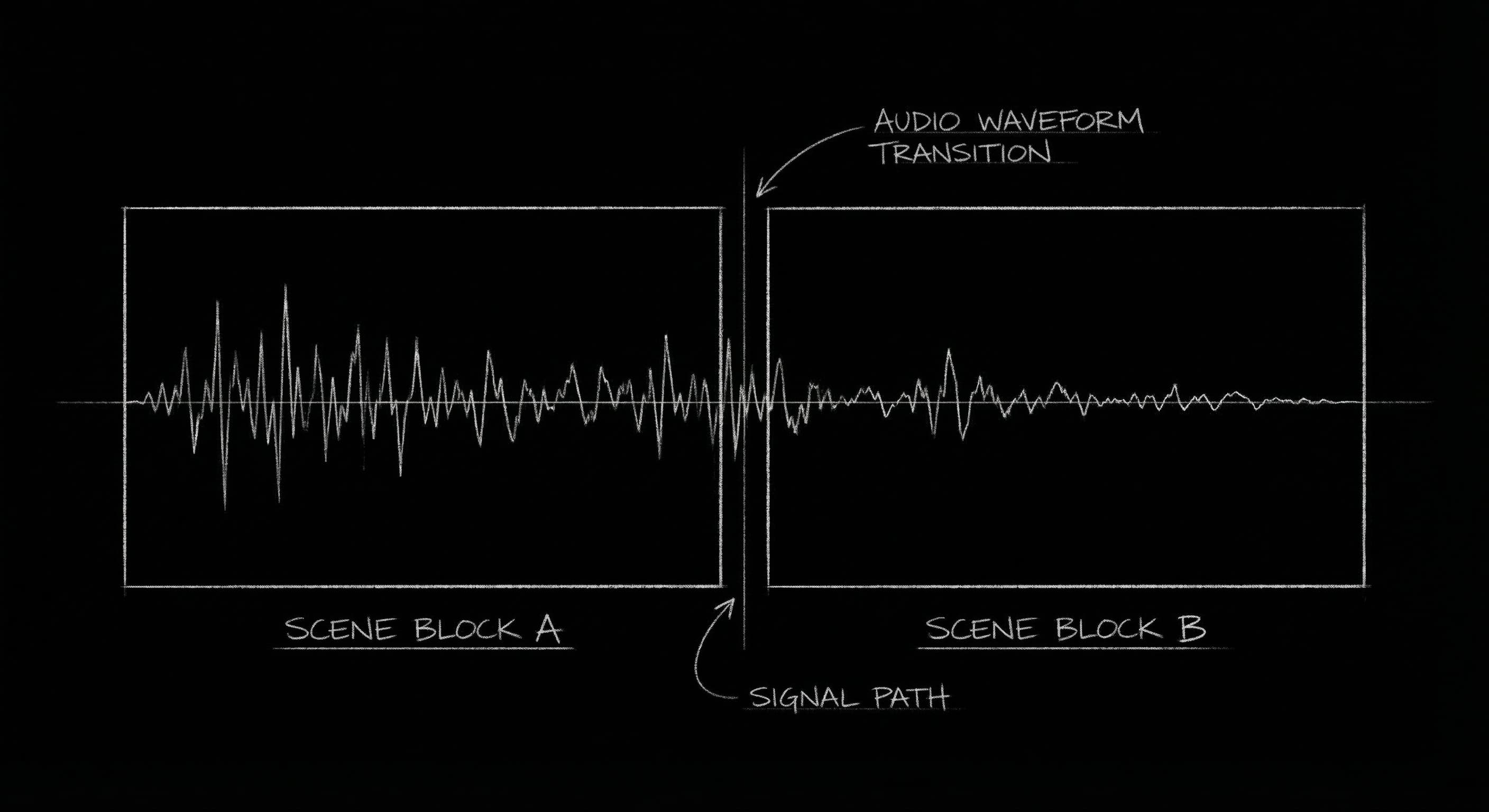

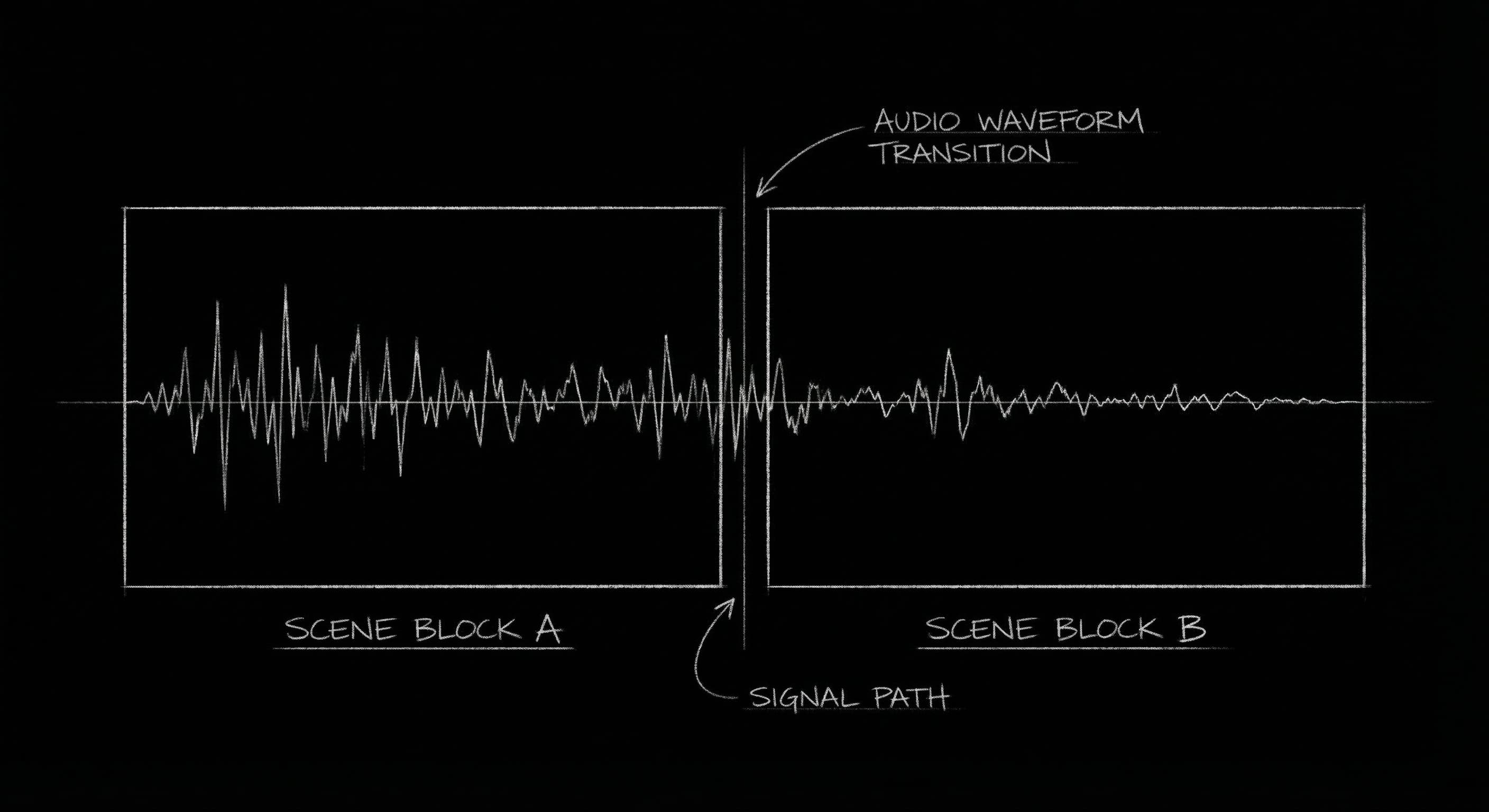
The image is still the old scene,the character in the kitchen, the car on the road. But the sound is already the next scene. A phone ringing. A crowd. A voice. Pre-lap is the moment sound from the coming scene bleeds into the present one. The audience hears the future before they see it. The cut, when it comes, feels inevitable. You’ve already pulled them forward. That’s not a trick. It’s one of the most underused tools in the screenwriter’s kit.
Sound doesn’t have to wait for the picture. Let it lead. The audience will follow.
Think about it this way. A hard cut is a full stop. New scene, new image, new sound. The audience resets. A pre-lap is a bridge. The sound of the next place,or the next moment,starts while we’re still in the old one. So when we cut, we’re not jumping. We’re arriving somewhere we’ve already been invited. Pre-laps can create dread (we hear the alarm before we see the empty room), anticipation (we hear the crowd before we see the stage), or continuity (we hear the same conversation from a new angle). The key is to put it on the page so the reader,and the sound designer,knows what you want.
What Pre-Lap Is (And Isn’t)
Pre-lap means sound that belongs to the next scene is heard before the cut to that scene. We’re in Scene A. We hear dialogue, or music, or a sound effect that we will only see the source of in Scene B. Then we cut to Scene B, and the sound continues or resolves. The audience has been cued. They’re ready for the new space or the new moment.
It’s not the same as sound bridge in the vague sense (sound carrying over a cut). A sound bridge can be sound from Scene A continuing into Scene B. Pre-lap is specifically sound from Scene B starting in Scene A. So the direction of the sound is forward: we hear what’s coming before we see it.
Format on the page: you need to make it clear that the sound is pre-lapping. Common notation is (PRE-LAP) or PRE-LAP: before the sound element,dialogue or sound effect. So you might write, under the current scene’s action: “The phone RINGS. (PRE-LAP: JAKE (O.S.)) Jake: Hello?” Or: “(PRE-LAP: Traffic. Honking.)” Then in the next line you have your new scene heading, and we’re in the new location with the sound already established. The reader and the post team know: this sound is the next scene bleeding back.
Why Use It
Pre-lap does three jobs. First, it smooths the transition. The cut doesn’t feel abrupt because we’ve already been given an anchor in the next scene. Second, it can create tension or irony. We hear the cheerful party before we see the character alone in the car. We hear the verdict before we see the defendant’s face. Third, it can compress time or signal a connection. The same line of dialogue that we hear at the end of one scene is the one we see delivered in the next. We’re not repeating,we’re continuing. The overlap is the point.
A Practical Comparison
| Technique | What happens | Effect |
|---|---|---|
| Hard cut | New scene, new image, new sound | Clear break; audience resets |
| Sound from Scene A continues into B | Same sound over the cut | Continuity; we carry one element over |
| Pre-lap (sound from B in A) | We hear next scene before we see it | Pull forward; anticipation or dread |
| Post-lap (sound from A in B) | We hear previous scene after cut | Echo; aftermath; memory |
Pre-lap is the one that pulls the audience forward. Use it when you want the next scene to feel inevitable or when you want to plant a cue (a voice, a place) before we see it. As with how to describe sound in a screenplay, the goal is clarity: the reader and the team need to know what they’re hearing and when.
Relatable Scenario: The Interrogation to the Jail Cell
Scene: Interrogation room. The detective pushes the suspect. “You’re going away for a long time.” We’re still on the suspect’s face. Then we hear,before we cut,the clang of a cell door, the echo of a corridor. (PRE-LAP: Metal door slamming. Footsteps.) Cut to: INT. JAIL CELL , NIGHT. The suspect is in the cell. The sound we heard was from this scene. We’ve bridged the two spaces with sound. The audience felt the sentence before they saw it. That’s pre-lap doing narrative work.
Try it free
Try Screenweaver for free on your script
It is free. Import your existing project, get a clearer view of your outline, and regain control of your story structure in minutes.
Start FreeRelatable Scenario: The Party We’re Not At Yet
Your protagonist is in the car, driving. She’s anxious. We stay on her face. Then we hear music, laughter, the murmur of a crowd. (PRE-LAP: Party sounds. Music. Laughter.) Cut to: INT. MANSION , NIGHT. The party is in full swing. She’s just arriving. We’ve moved from her isolation to the world she’s about to enter. The sound pulled us in. We didn’t need a title card or a long shot of the building. The pre-lap did the work.
The Trench Warfare Section: What Beginners Get Wrong
Using PRE-LAP for every transition. Not every cut needs a pre-lap. If you use it constantly, it loses force and can feel gimmicky. Fix: Reserve pre-lap for transitions where you want the audience to feel the pull to the next scene,or where the sound of the next scene creates meaning (dread, irony, continuity). Let other cuts be clean.
Not labeling it. You write “We hear a phone ring” and then cut to someone answering. The reader might assume the phone is in the current scene. The sound designer might too. Fix: Use (PRE-LAP: or PRE-LAP: so it’s unambiguous. Same for dialogue: (PRE-LAP: SARAH) Sarah: I’m outside. Then cut to Sarah outside. The convention exists so everyone is on the same page.
Pre-lapping the wrong element. You use pre-lap for a sound that doesn’t matter,background ambience with no narrative weight. The transition feels fussy instead of purposeful. Fix: Pre-lap something that earns it: a line of dialogue that lands, a sound that signals the next location or the next emotion. If the sound could be cut, don’t pre-lap it.
Making the pre-lap too long. We hear ten seconds of the next scene before we cut. By the time we see the image, we’re bored or confused. Fix: Keep the pre-lap short. A line. A sound. A beat. Then cut. The idea is to tease, not to play the whole next scene on the audio track.
Confusing pre-lap with offscreen dialogue in the same scene. If the character in the current scene is hearing someone in the next room, that’s O.S. (off-screen) in the current scene. Pre-lap is when the sound is from the next scene,a different time or place,bleeding back. Fix: If we’re not cutting to a new scene, don’t call it pre-lap. Use O.S. or V.O. as appropriate. Reserve pre-lap for the transition moment.
Step-by-Step: Adding a Pre-Lap to a Transition
Find a cut between two scenes where you want a smoother or more charged transition. Ask: what sound in the next scene could start a moment early? Dialogue (e.g., the first line of the next scene)? A sound effect (door, alarm, crowd)? Music? Write that sound under the last beat of the current scene. Prefix it with (PRE-LAP: and the source if it’s dialogue, e.g. (PRE-LAP: JAKE). Then write your new scene heading and continue. Read it aloud or in your head. Does the sound pull you into the next scene? If it feels forced, try a different sound or drop the pre-lap.
[YOUTUBE VIDEO: Examples of pre-lap from well-known films,same scene transitions with and without pre-lap,to show how sound leads the cut.]
When to Skip Pre-Lap
Use a clean cut when the transition is meant to jar,a sudden shift in time or place. Use a clean cut when the next scene is a quiet, intimate moment and you don’t want to telegraph it with sound. Use a clean cut when you’ve already used pre-lap several times and want the next cut to land with a different rhythm. Pre-lap is a tool, not a rule. The best transitions are the ones that serve the story. Sometimes that’s silence. Sometimes that’s sound from the future.
The Perspective
Pre-lap is the writer saying: the next scene has already started in the audience’s ear. You’re not just moving to a new location. You’re pulling them there. Use it when the pull is the point,when you want the cut to feel inevitable, or when the sound of what’s coming is more powerful than the image of what we’re leaving.
Final Step
Build your next script with Screenweaver
Move from ideas to production-ready pages faster with timeline-native writing and AI-assisted story flow.
Try Screenweaver