

The episode is seven minutes long. Seven. Not forty-two. Not sixty. Seven minutes from cold open to end card. And somehow, in those seven minutes, you need to establish character, advance plot, land jokes, and leave the audience hungry enough to click "next episode."
This is web series writing. It's not a shortened version of television, it's a different animal entirely. The pacing rules you learned from broadcast don't apply. The act structures designed around commercial breaks are irrelevant. The slow builds, the patient character work, the luxury of a B-plot that develops across an hour, all of that evaporates when you're working in eight-to-fifteen-minute increments.
What replaces it isn't simplification. It's compression. Every scene does double duty. Every line carries weight. The skill isn't writing less, it's writing denser, without the density feeling rushed or airless.
Writers coming from traditional television often struggle with this shift. They bring their instincts for forty-two-minute episodes and wonder why their web series feels bloated or boring. The answer isn't that they're bad writers; it's that they haven't recalibrated for a format where the audience's attention is one click away from something else.
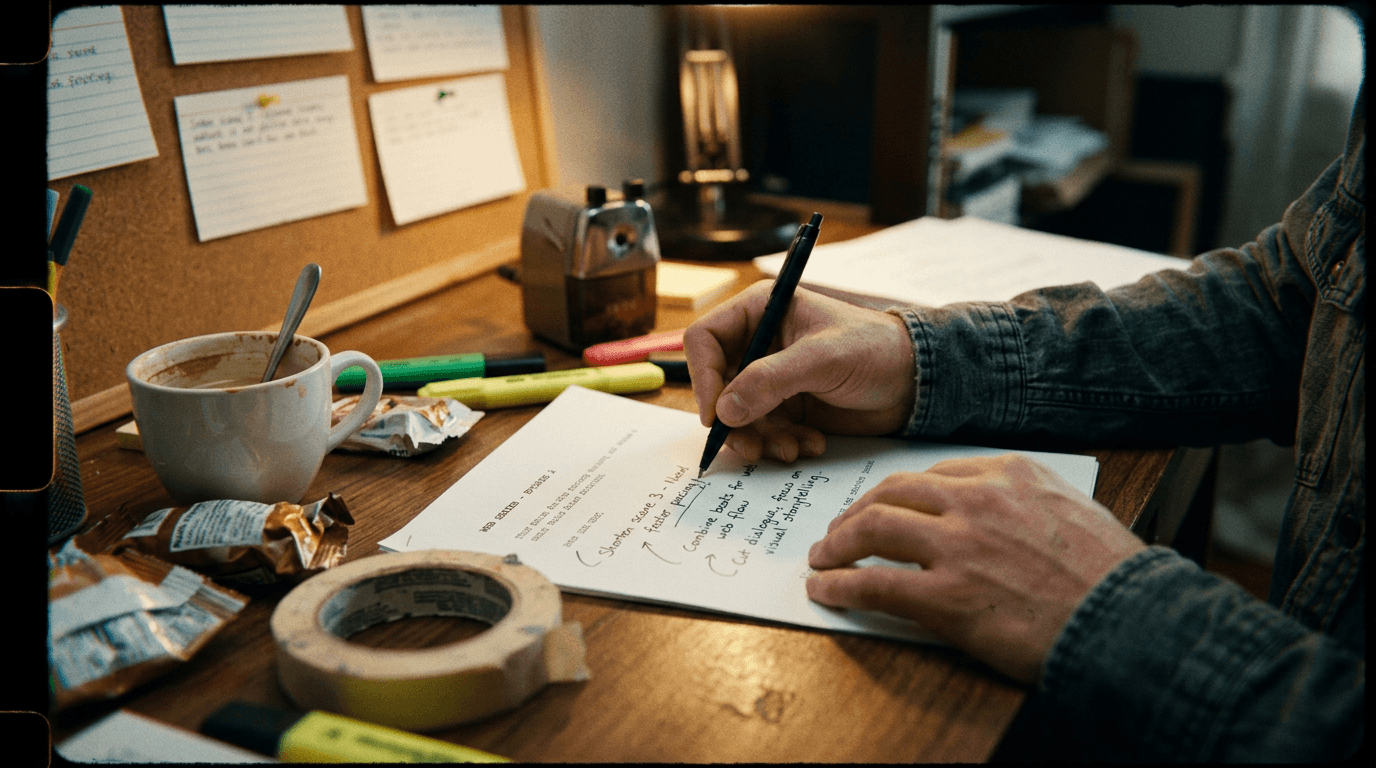
Cinematic workflow frames

These two visuals work as a pair: the first shows Cinematic workflow still, first angle, 35mm film grain, and the second shifts to Cinematic workflow still, second angle, 35mm film grain—compare them briefly, then move on.
Why Web Series Pacing Is Fundamentally Different
Traditional television was designed for appointment viewing. The audience committed to a time slot, settled into their couch, and granted the show sixty minutes (or twenty-two, for half-hours). Commercial breaks provided natural breathing room. Act structures created predictable rhythms. The implicit contract was: you've shown up, we'll reward your patience.
Web series don't get that contract. The audience is browsing. They clicked because a thumbnail looked interesting. They'll leave if the first thirty seconds don't hook them. And even if they stay, they're comparing you, consciously or not, to every other video in their queue.
This changes everything.
Cold opens must hook immediately. No slow establishing shots. No leisurely introductions. The first image, the first line, the first moment must create a question or a tension that demands resolution.
Act breaks are optional, but momentum isn't. Without commercials, there's no structural need for a cliffhanger at page eight. But there's still a need for forward motion. Every scene must pull the viewer into the next scene. Dead spots kill.
Episodes end on hunger, not satisfaction. A traditional TV episode often resolves its A-plot while leaving the season arc open. A web series episode resolves almost nothing, it ends on a pivot, a reveal, a cliffhanger, a laugh that reframes what came before. The goal is to make "next episode" feel irresistible.
Runtime is flexible but ruthless. A broadcast episode must fill exactly forty-two minutes. A web series episode can be six minutes or sixteen. But whatever runtime you choose, not a second should feel wasted. Audiences will forgive a seven-minute episode that's tight; they won't forgive a twelve-minute episode that drags.
In broadcast, you fill time. In web series, you earn every second.
The Anatomy of a Web Series Episode
Let's break down what a typical short-form web episode contains, and what it omits.
What stays:
- A clear protagonist or ensemble focus
- A single dominant story question per episode
- Scene transitions that maintain momentum
- Character voice and distinctiveness
- An ending that propels forward
What goes:
- Extensive setup before the inciting incident
- B-plots that don't directly intersect with the A-plot
- Breathing room scenes (characters reflecting, regrouping)
- Leisurely dialogue exchanges
- Recap or "previously on" segments (usually)
A ten-minute web episode often contains what a forty-two-minute broadcast hour would spread across its first act. The inciting incident happens fast, sometimes in the cold open, sometimes before the title card. The complication lands within the first few minutes. The escalation is immediate. The episode ends just as the situation becomes untenable.
This doesn't mean the story is shallow. It means the story moves. Depth comes through implication, subtext, and the cumulative effect of episodes, not through lengthy exploration within any single installment.
Formatting Adjustments for Short-Form
The page format doesn't change, screenwriting software still produces standard pages, but the way you use those pages shifts.
Shorter scenes. In broadcast, a scene might run three to four pages. In web series, a scene often runs one to two. Some scenes are half a page. The question to ask: does this scene do one thing or two? If it does one thing, consider whether that thing can be folded into an adjacent scene.
Fewer scene headings. Locations take time to establish. Every new location requires the audience to reorient. Web series often consolidate action into fewer locations, or use quick-cut montages to cover multiple locations without fully establishing each one.
Dialogue that does triple duty. In broadcast, a line might reveal character. In web, a line reveals character, advances plot, and sets up a payoff in the same breath. Economy isn't just preferred, it's required.
Action lines that move fast. Dense, blocky action paragraphs slow the read and suggest a slow watch. Keep action lines short: two to three sentences max. White space on the page implies visual speed.
Here's an example of the difference:
Broadcast-style action:
Sarah enters the coffee shop. It's the same one she used to come to with her ex. The memories flood back as she sees the corner booth where they had their first fight. She hesitates, then steels herself and walks to the counter.
Web series-style action:
Sarah enters. Freezes. The corner booth, their booth.

She shakes it off. Walks to the counter.
Same information, half the words, twice the speed.
A Structural Template: The Seven-Minute Episode
Here's one template that works for short-form serialized content. It's not the only structure, but it illustrates the compression required.
0:00–0:30 , The Hook
Cold open. We're in the middle of something. A situation, a conflict, a joke, a danger. No setup, pure present tense.
0:30–1:30 , The Situation
Now we understand what's happening and why it matters. The protagonist's goal is clear. The obstacle is visible.
1:30–4:00 , Escalation
Attempts and failures. The protagonist tries to solve the problem; complications arise. Each beat raises stakes or reveals new information.
4:00–5:30 , The Turn
Something changes. A reveal, a reversal, a new complication that reframes everything. This is the emotional pivot of the episode.
5:30–6:30 , The Fallout
The protagonist reacts. Decisions are made. The situation is now different than it was at the start.
6:30–7:00 , The Cliffhanger
End on a question, a threat, a surprise. Don't resolve, propel.
Notice what's missing: there's no "getting to know the character" sequence, no subplot, no breathing room. The episode is pure forward motion from start to finish.

Three Scenarios: Different Web Series Formats
Scenario A: Comedy Sketch Series (3–5 minutes)
Each episode is essentially a standalone sketch with recurring characters. There's no serialized plot, just a premise, escalation, and punchline.
Pacing requirements: Get to the premise in under fifteen seconds. Escalate relentlessly. Land the biggest laugh at the end. Don't overstay the joke.
Common mistake: Setting up the premise too carefully. Audiences will accept absurdity if you commit immediately; they lose patience if you explain.
Scenario B: Serialized Drama (12–18 minutes)
Each episode advances a season-long arc. Characters develop. Storylines build. But episodes still need individual shape.
Pacing requirements: Each episode should have its own turn, a revelation, a decision, a shift. Don't rely entirely on the season arc to provide momentum. Individual episodes must stand alone while contributing to the whole.
Common mistake: Writing episodes that are "just the next chapter" with no internal structure. Even in serialized drama, each installment should feel like it goes somewhere.
Scenario C: Anthology Series (8–10 minutes)
Each episode is a self-contained story with new characters. No serialization, just a thematic or tonal link.
Pacing requirements: Establish character and world in under two minutes. Drive toward a single emotional or narrative payoff. End on impact.
Common mistake: Trying to build too much world or character complexity. In anthology, viewers meet characters once; they need to understand them fast, not deeply.
Try it free
Try Screenweaver for free on your script
It is free. Import your existing project, get a clearer view of your outline, and regain control of your story structure in minutes.
Start FreeA Table: Broadcast vs. Web Series Pacing
| Element | Broadcast (42–60 min) | Web Series (7–15 min) |
|---|---|---|
| Inciting incident | Page 8–12 | Page 1–2 |
| Midpoint | Page 25–30 | Page 4–5 |
| Climax | Page 50–55 | Page 8–10 |
| B-plot presence | Standard | Rare or absent |
| Scene count | 30–50 scenes | 8–15 scenes |
| Average scene length | 2–4 pages | 0.5–1.5 pages |
| Cold open expectation | Optional | Nearly mandatory |
| Recap/previously | Common | Rare |
| End-of-episode resolution | Partial (A-plot resolves) | Minimal (cliffhanger) |
The numbers shift based on specific series, but the pattern holds: web series compress every structural element.
The "Trench Warfare" Section: What Goes Wrong
Failure Mode #1: The Broadcast Hangover
You write a web series episode with the rhythm of broadcast. It takes three pages to get to the inciting incident. There's a scene of the protagonist waking up, checking their phone, having coffee. By the time anything happens, the audience is gone.
How to Fix It: Cut your first two pages. Start with what used to be page three. If the story still makes sense, you found your real opening.
Failure Mode #2: The Overstuffed Episode
You try to pack a broadcast episode's worth of story into ten minutes. The episode has three plotlines, eight characters, and four locations. It's chaotic. The audience can't track.
How to Fix It: One storyline per episode. Two characters in conflict. Simplify until the story is clear.
Failure Mode #3: The Talking-Heads Trap
To save time, you eliminate action and make the episode all dialogue. Two characters sit and talk for eight minutes. It's efficient but static.
How to Fix It: Dialogue can carry web episodes, but it needs visual variety. Put the characters in motion. Split the conversation across locations. Intercut with reaction shots or parallel action.
Failure Mode #4: No Internal Structure
The episode is "stuff that happens between episode 3 and episode 5." It has no beginning, middle, or end, just middle.
How to Fix It: Even short episodes need shape. Ask: What's the question at the start? What's the answer (or new question) at the end? If you can't identify the arc, the episode doesn't have one.
Failure Mode #5: The Rushed Ending
You spend seven minutes on setup and thirty seconds on payoff. The ending feels like you ran out of time (because you did).
How to Fix It: Work backward. Design the ending first. Then budget time to land it properly. Endings in web series should hit hard, they're what brings people back.
Platform Considerations
Different platforms have different expectations, and your pacing should adjust.
YouTube: Longer episodes (10–20 minutes) can work because the algorithm favors watch time. But you still need hooks; YouTube audiences click away fast.
Instagram/TikTok (vertical short-form): Episodes under three minutes. Pacing is extreme, every five seconds should have a hook, a joke, or a reveal. These aren't really "series" in the traditional sense; they're serialized content designed for infinite scroll.
Streaming (Netflix, Amazon, etc.): If you're producing for a streamer, you may have more latitude, episodes can run 25–40 minutes. But even here, pacing expectations are faster than broadcast. Binge culture means audiences expect momentum.
Patreon/Substack (direct-to-audience): Your audience is already invested; they subscribed to see your work. You can afford slightly slower pacing because they've opted in. But respect their time anyway.

Writing the Pilot: Special Considerations
The pilot episode of a web series has unique challenges. It must establish character, world, and tone while also functioning as a standalone piece of entertainment. And it must do all this in ten minutes or less.
Establish through action, not explanation. Don't tell the audience who your protagonist is; show them doing something that reveals character. A character who steals a candy bar from a gas station tells us more than a monologue about their financial struggles.
Imply the world. You don't have time for worldbuilding exposition. Drop the audience into the world and let them infer the rules. If it's a sci-fi series, show one piece of technology in use rather than explaining the whole setting.
Create immediate stakes. The pilot must give the audience a reason to care within the first minute. A character in danger, a mystery posed, a conflict introduced. Something must be at stake before the title card.
End with a promise. The pilot ending should make the audience think: "I need to know what happens next." It doesn't have to be a cliffhanger, it can be an unanswered question, an introduced complication, a new character's arrival.
The Perspective: Density Is Not Shallowness
The fear writers have about web series is that short episodes mean shallow storytelling. This isn't true, but it requires rethinking what depth means.
Depth in web series doesn't come from leisurely character exploration. It comes from accumulation. Each episode adds a layer. By episode ten, the character has as much depth as a broadcast character, maybe more, because every moment with them mattered.
Depth also comes from what's left unsaid. When you don't have time to explain, you imply. Implication invites the audience to participate, to fill in gaps, to interpret, to invest. This active engagement can create deeper attachment than passive absorption.
The key is trusting the format. Don't fight the constraints; use them. Write dense, not thin. Write fast, not shallow. Write for an audience that's smart enough to keep up.
The seven-minute episode isn't a compromise. It's a discipline. And like all disciplines, it produces its own kind of excellence.
[YOUTUBE VIDEO: A breakdown of a successful web series pilot, analyzing how it establishes character, world, and stakes within its first two minutes while setting up the season arc.]
Further reading:
- For traditional TV structures that can inform your web series, see our guide on outlining a 60-minute TV drama pilot.
- If your web series is designed for social platforms, see writing short films for TikTok, YouTube Shorts, and Reels.
- YouTube Creator Academy offers resources on retention and pacing at creatoracademy.youtube.com{:rel="nofollow"}.
Final Step
Build your next script with Screenweaver
Move from ideas to production-ready pages faster with timeline-native writing and AI-assisted story flow.
Try Screenweaver