

A mother opens a voicemail from her son. We hear his voice, calm and warm, saying he will be home for dinner. Then we cut to a stainless-steel drawer in a morgue with his name on the tag.
That is a flashforward.
When it works, it creates dread, momentum, and hunger for answers in a single move. When it fails, it looks like a continuity error and your reader starts distrustful, not intrigued.
Here’s why that matters: screenplay readers do not forgive confusion quickly. They read fast, they track causality, and they are under pressure. If you make them stop to decode timeline logic, you are burning the exact fuel your script runs on: forward drive.
A flashforward is not just “future stuff.” It is a contract with the audience. You promise two things at once. First, that this glimpse of the future is intentional and structurally meaningful. Second, that getting from now to that future moment is worth their attention.
Think about it this way: a flashforward is like seeing a crime scene photo before meeting the victim. The image does not tell you the story. It sharpens your appetite for the story.
In this guide, we are going deep into craft and formatting choices that make flashforwards readable and powerful on the page. Not abstract theory. Real workflow, real mistakes, real fixes.
Cinematic workflow frames
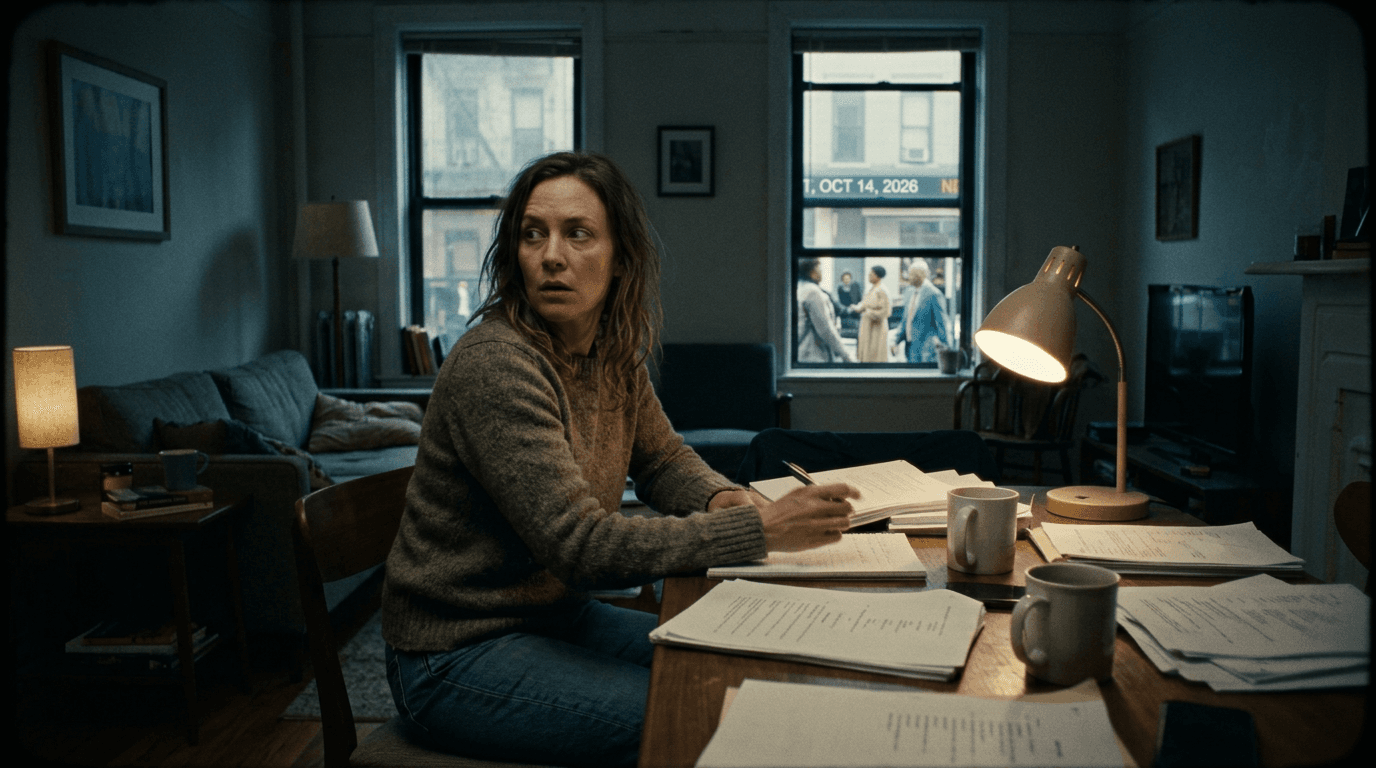
These two visuals work as a pair: the first shows Cinematic workflow still, first angle, 35mm film grain, and the second shifts to Cinematic workflow still, second angle, 35mm film grain - compare them briefly, then move on.

The Real Job of a Flashforward
Most beginners treat flashforwards like decorative mystery. A cool fragment. A shocking image. A teaser.
But the deeper function is structural pressure.
A strong flashforward does three things simultaneously. It reorders audience attention, it reframes current scenes with future consequence, and it creates a silent question that each subsequent sequence keeps answering in partial ways.
If your flashforward only delivers surprise, it expires quickly. If it delivers dramatic irony, thematic pressure, and a narrative target, it keeps paying rent for the next 60 pages.
Flashforward vs. Foreshadowing vs. Cold Open
These are often mixed up, and the distinction matters for execution.
A flashforward is a direct temporal jump to a future moment that will occur later in the same story timeline. Foreshadowing stays in present chronology and hints symbolically. A cold open is simply an opening scene style, which may or may not include temporal displacement.
Below is a quick craft comparison you can use when outlining.
| Technique | What the audience sees | Timeline status | Typical risk | Best use case |
|---|---|---|---|---|
| Flashforward | A concrete future event | Explicit jump ahead | Reader confusion if return is unclear | Build dread, destination tension, narrative promise |
| Foreshadowing | A clue, motif, or line that hints | Present timeline only | Feels on-the-nose if too literal | Seed payoff, thematic layering |
| Cold Open | A hook scene before main flow | Any timeline | Feels gimmicky if disconnected | Grab attention, establish tone quickly |
The catch is simple: only one of these requires formal timeline navigation on the page. That one is the flashforward.
Formatting the Flashforward So Nobody Gets Lost
Formatting is not cosmetic. It is cognitive ergonomics.
When readers track a non-linear timeline, they need visual anchors. Your screenplay formatting is the map, and maps fail when landmarks are vague.
The Three Anchors Every Flashforward Needs
You need an entry marker, an in-scene orientation cue, and an exit marker.
Entry marker: call out the temporal jump in the scene heading or transition line. Do not be shy.
Example style:
INT. COUNTY HOSPITAL - ICU - NIGHT (SIX MONTHS LATER)
Or:
FLASHFORWARD - INT. COUNTY HOSPITAL - ICU - NIGHT
Either can work. Consistency is everything.
In-scene orientation cue: within 3-6 lines, include a concrete detail that confirms this is not present day. A wedding ring that was missing earlier. A cast on a previously healthy arm. A campaign poster with a date. Something undeniable.
Exit marker: signal the return to present timeline with a clear transition.
BACK TO PRESENT:
or a fresh scene heading that re-establishes current chronology.
If you skip any of these, the reader starts performing forensic timeline analysis instead of feeling your scene.
What Software Settings Actually Help
Whether you use Final Draft, WriterDuet, Arc Studio, or another tool, the workflow is similar.
Set up a lightweight timeline label system before you draft the first flashforward-heavy sequence. This is boring, yes. It also saves your script.
Create a custom color tag or annotation tag called TIMELINE. Then use short values like PRESENT, +6M, +1Y, or POST-TRIAL. Keep labels semantic, not vague. “Future” is less useful than “After explosion” or “Before verdict.”
When exporting a PDF for feedback, run a manual pass where each flashforward scene heading is visually scanned against your outline timeline. In practical terms, this means opening your beat board and your script side by side and verifying every jump has both an arrival and a return.
If your timeline cannot be understood in a silent skim of scene headings, the problem is not your reader.
This is one of the fastest quality checks you can run before sending pages to a producer, coverage reader, or writing group.
Three Beginner Scenarios That Feel Painfully Familiar
Let’s ground this in real writing situations. Not classroom examples. The messy versions.
Scenario 1: The Prestige Pilot That Opens With Disaster
You are writing a drama pilot. You open on a burning warehouse and your lead detective limping through smoke with blood on her shirt. Smash cut to “48 HOURS EARLIER.”
On paper, this sounds strong. On page five, your reader is already asking: Why should I care about present scenes if I already know where we end up this episode?
The fix is not removing the flashforward. The fix is changing what the flashforward reveals.
If you show the entire disaster mechanics, you flatten suspense. Instead, show the emotional fracture but hide key causality. Maybe we see the detective refuse to enter the warehouse while someone screams inside. Now the audience is not waiting for fire. They are waiting to understand betrayal, fear, and moral collapse.
Your flashforward should answer one question and create two better ones.
Scenario 2: The Indie Thriller With Too Many Timeline Jumps
You’re drafting an indie psychological thriller with four future glimpses in Act One. Each jump is stylish. Together, they are exhausting.
Readers can process nonlinearity. They cannot process arbitrary nonlinearity.
The problem here is frequency without escalation logic. Each flashforward should either intensify stakes, reveal new contradiction, or alter audience assumptions. If jump #3 feels equivalent to jump #1, you have repetition disguised as complexity.
You solve this by assigning each flashforward a narrative job:
Jump A reveals outcome pressure.
Jump B reveals relationship fracture.
Jump C reveals moral inversion.
Now each jump has unique informational territory, and your present-day sequences can be engineered to collide with those future truths.
Scenario 3: The Writer Who Uses Flashforwards to Patch a Slow First Act
This one is common and understandable. You fear your setup pages feel quiet, so you inject a violent future image to “wake up” the script.
But there’s a catch: if your present timeline remains inert after that jolt, the flashforward reads like caffeine, not structure.
A proper flashforward does not compensate for weak scene goals. It amplifies strong ones.
If Act One is dragging, your first intervention is not timeline gimmickry. It is objective clarity. Who wants what right now? What blocks them right now? What cost begins right now?
Once present-tense conflict is alive, the flashforward becomes a pressure chamber rather than a defibrillator.
How to Build a Flashforward Sequence Step by Step
This is the workflow professionals actually use, adapted for writers working solo.
Step 1: Define the Future Event in One Brutal Sentence
Write one sentence describing the future moment as if this were the only thing a stranger would read.
Bad version: “Later, everything is different.”
Good version: “At dawn, Mara signs a plea deal while her brother watches from the gallery, realizing she sold him out.”
This sentence is your north star. If it is vague, every draft decision downstream will be vague.
Step 2: Extract the Audience Question
From that future sentence, derive the core audience question that will pull them through present timeline scenes.
Not “What happens?”
Specific question: “Why would Mara betray her brother after risking everything for him?”
Specificity creates propulsion.
Step 3: Choose Reveal Depth (30%, 60%, or 80%)
You decide how much information the flashforward gives away.
At 30%, you show atmosphere and emotional shape but little causality.
At 60%, you reveal one major fact and conceal mechanism.
At 80%, you reveal near-outcome and rely on “how” to sustain suspense.
Most beginners accidentally write 90% reveals and then wonder why the middle act feels airless.
Step 4: Build the Present-Day Counterforce
For every visible future outcome, create a present-day force that appears to move in the opposite direction.
If future Mara betrays her brother, present Mara should be making costly sacrifices for him. The tension comes from contradiction.
No contradiction, no magnetism.
Step 5: Mark Timeline Language in Scene Headings Before Dialogue Pass
Do this before polishing dialogue. Timeline clarity is architecture. Dialogue is upholstery.
Insert explicit timeline markers into the first draft. Later, if the script reads clean enough, you can reduce marker verbosity. But early drafts need hard edges.
Step 6: Run the “Cold Reader Timeline Test”
Give pages to someone and ask only three questions:
Can you identify when we jump to the future?
Can you identify when we return?
What exact question about the story did that jump create for you?
If answer three is fuzzy, the flashforward lacks narrative intent.
Step 7: Tighten to Emotional Compression
A flashforward should feel denser than a normal scene. Not rushed, denser.
Cut setup chatter. Keep action lines lean. Focus on image, conflict beat, and unresolved emotional turn. You are not writing a mini-movie trailer; you are planting narrative explosives.
Body Image: Timeline Mechanics in Practice

The Trench Warfare Section: What Beginners Get Wrong (And Exactly How to Fix It)
This is where scripts usually bleed out.
Failure Mode 1: Ambiguous Temporal Language
Writers use phrases like “later,” “in the future,” or “someday” in action lines and assume the reader will track chronology intuitively.
They won’t.
Fix: put temporal data where the eye lands first, inside scene headings or immediate transition lines. Replace lyrical time hints with concrete orientation.
Instead of “Sometime later, the city is different,” write “EXT. CITY CENTER - DAY (+1 YEAR).” Then show one visual proof of elapsed time in the first two action lines.
Failure Mode 2: Flashforward Feels Tonally Detached
You open with a bleak funeral, then spend 20 pages in breezy workplace banter with no tonal bridge. Readers feel like they are in two different scripts.
Fix: seed tonal DNA from page one of present timeline. Not full darkness, but compatible undertones. A joke can stay a joke while carrying edge. A warm scene can still include one dissonant detail that echoes future fracture.
Tone is not mood uniformity. It is emotional coherence.
Failure Mode 3: Revealing Outcome Without Preserving Volatility
You show who survives, who dies, who betrays whom, and where everyone ends up. You think this is sophisticated inevitability. In practice, it kills scene-level uncertainty.
Fix: preserve at least one volatile axis in every major sequence after the flashforward. If destination is known, route must stay dangerous. If route is known, emotional interpretation must stay unstable.
Ask yourself after each sequence: what can still break?
Failure Mode 4: Too Many Flashforwards Too Early
Multiple jumps in first 15 pages can work in expert hands. Most of the time, it creates timeline tax the story cannot afford.
Fix: limit early jumps to one major flashforward unless your concept is explicitly non-linear by design. Earn additional jumps only after reader trust is built through clear present-tense progression.
Reader trust is cumulative. Spend it carefully.
Failure Mode 5: Returning to Present Without Re-anchoring Stakes
You jump back and continue casual dialogue as if nothing happened. Emotional momentum evaporates.
Fix: immediately frame a present action that now feels charged by future knowledge. Even a small decision should gain new weight because we glimpsed consequence.
A simple cup of coffee can become ominous if we know who will poison it later.
Failure Mode 6: Overwriting the Flashforward With Directional Prose
Writers panic that the moment won’t land, so they over-direct camera movement, actor microbeats, and editorial rhythm in dense blocks.
Fix: strip to readable cinematic essentials. One image per line. One action beat per line when tension peaks. You’re writing a script, not a shot list.
Clarity beats flourish under pressure.
Failure Mode 7: No Thematic Link Between Present and Future
Future scene says “power corrupts.” Present storyline is about family reconciliation with zero relationship to power. The jump feels ornamental.
Fix: define the thematic sentence both timelines serve. Example: “Love becomes control when fear is unspoken.” Then ensure present scenes dramatize early-stage versions of the same pattern.
A flashforward is strongest when it is not only temporal contrast, but thematic compression.
Failure Mode 8: False Mystery Through Withholding Basic Logic
Writers hide simple cause-and-effect to appear clever. Readers are not confused in an exciting way. They are confused in a bookkeeping way.
Fix: hide implications, not grammar. Audience can be uncertain about meaning while still understanding immediate causality within each scene.
If a character collapses, the reader should know they collapsed. You can delay why.
Failure Mode 9: Timeline Markers Drift Across Drafts
Draft 2 adds scenes, Draft 3 cuts transitions, Draft 4 changes chronology, and now your “six months later” label no longer matches internal events.
Fix: keep a dedicated timeline ledger outside the screenplay file. Every time you move a scene, update both the ledger and timeline markers in headings. Treat this like continuity, because it is.
If you work with collaborators, freeze naming conventions (+6M, not alternating with SIX MONTHS LATER) before group rewrite week.
Failure Mode 10: Ending Does Not Pay Off the Flashforward Promise
You open with a future event that implies moral catastrophe, then resolve it with a minor misunderstanding. Reader trust breaks.
Fix: ensure your eventual arrival at the flashforward moment delivers equal or greater dramatic weight than the promise implied on page one.
You can subvert expectation. You cannot underdeliver emotion.
A flashforward is a debt instrument. You borrow attention early and must repay with interest.
Try it free
Try Screenweaver for free on your script
It is free. Import your existing project, get a clearer view of your outline, and regain control of your story structure in minutes.
Start FreeWhere to Place Flashforwards in Feature Structure
Placement is strategic, not decorative.
Opening-page flashforwards are common because they create immediate narrative voltage. But they are not automatically best.
A late-Act-One flashforward can be more effective when your opening must establish fragile normalcy first. In thrillers, this can produce a harder tonal collision because the reader has already invested in baseline world logic.
Midpoint flashforwards are less common but potent in stories with identity inversion. You show a future version of the protagonist behaving in contradiction to current values, then build the bridge across the second half.
Pre-climax flashforwards are rare and risky, but can work when the story concerns inevitability and failed avoidance. You show a fragment of terminal outcome, then force characters through futile attempts to dodge it.
None of these are universally superior. The right choice depends on what question your story needs the audience asking earliest.
Body Image: Emotional Contradiction Blueprint

The YouTube Breakdown That Fits Here
[YOUTUBE VIDEO: A timeline workshop showing a writer building one flashforward sequence from blank page to polished scene headings, including before/after examples of confusing vs clear temporal transitions in Final Draft and WriterDuet.]
Advanced Craft: The “Known Outcome, Unknown Meaning” Advantage
Many writers fear flashforwards spoil suspense. That fear makes sense if suspense is only “what happens.”
But mature screenwriting often runs on a more interesting engine: “What does it mean when it happens?”
If we know the protagonist is alive in the future, we lose survival suspense in a narrow sense. We gain interpretive suspense. At what cost did survival happen? Who paid for it? Did survival equal victory or moral collapse?
Think of sports. If I tell you the final score before the game, you still want to watch if rivalry, momentum swings, and tactical adaptation are compelling enough.
Same principle.
A strong flashforward shifts your script away from trivia suspense and toward consequence suspense.
That shift can make your story feel more sophisticated because it asks the audience to track causality, ethics, and transformation rather than just incident.
A Practical Revision Pass for Flashforward Scripts
When your first draft is done, do this dedicated pass before dialogue polish.
Start by printing only scene headings and first action lines from every flashforward-related scene. This mini-document reveals timeline logic faster than reading full pages.
Then check sequence by sequence:
Does each jump create a distinct narrative question?
Does each return to present reactivate stakes immediately?
Does each flashforward reveal less than the eventual full scene reveal later in script chronology?
Finally, verify thematic continuity by extracting one sentence from each jump that captures value conflict. If those conflicts are random, your flashforwards are probably ornamental. If they escalate around one core moral fracture, your structure is likely healthy.
For foundational formatting standards while you set this up, the <a href="https://www.wgawregistry.org/" rel="nofollow">WGA registration and resources portal</a> is useful context for professional workflow hygiene, though your immediate gains will come from scene-level clarity and chronology discipline.
As discussed in our guide on [screenplay formatting for split timelines], naming timeline states early keeps later rewrites from turning into continuity archaeology.
And if your challenge is scene-level tension after a big reveal, our breakdown on [writing argument scenes without repetitive dialogue] helps preserve volatility when outcomes are partially known.
You can also cross-reference [screenplay formatting for surveillance camera footage] to study how constrained visual language can still carry temporal clarity.
A Concrete Micro-Example: Before and After
Before revision:
“INT. APARTMENT - NIGHT
Lena stares at the ring. She already knows what she will do.
CUT TO:
INT. COURTHOUSE - DAY
Lena signs.”
The issue is not minimalism. The issue is disorientation. Are we in the present? Future? Dream? Hypothetical?
After revision:
“FLASHFORWARD - INT. COURTHOUSE - DAY (+8 MONTHS)
LENA, thirty-two and hollow-eyed, signs a cooperation agreement.
Across the aisle, her husband refuses to look at her.
BACK TO PRESENT:
INT. APARTMENT - NIGHT
Lena turns the engagement ring in her fingers, unable to put it on.”
Notice what changed. Not much text. Just structural certainty and emotional linkage.
Small changes. Massive readability gain.
Why Flashforwards Fail in Notes Meetings
You know this room. Someone says, “I was confused by the timeline,” and the writer replies, “But that confusion is intentional.”
Sometimes that defense is legitimate. Usually it is a shield against clarity work.
Good ambiguity and bad ambiguity feel different in the body.
Good ambiguity feels like tension. You lean forward.
Bad ambiguity feels like clerical friction. You flip back three pages.
In notes meetings, people often use the same word, confused, for both experiences. Your job is diagnosing which one you created.
If readers can explain the timeline but disagree about character motives, you are in healthy ambiguity territory.
If readers disagree about basic chronology, fix the page mechanics first. No amount of thematic argument will rescue broken orientation.
The Perspective That Changes Everything
A flashforward is not a trick.
It is an ethics of disclosure.
You are deciding when the audience earns information, what kind of information they earn, and how that information changes emotional accountability in every scene that follows.
Do it lazily and you borrow hype from the future while hollowing out the present.
Do it well and every ordinary moment becomes haunted by consequence.
That is the goal. Not confusion. Not cleverness.
Pressure.
Narrative pressure the audience can feel before they can explain it.
When you format clearly, reveal selectively, and build contradiction between present intent and future outcome, flashforwards stop feeling like flashy editing on paper. They become one of the most disciplined structural tools in your screenwriting arsenal.
And once you experience that click, you will never write them casually again.
Final Step
Build your next script with Screenweaver
Move from ideas to production-ready pages faster with timeline-native writing and AI-assisted story flow.
Try Screenweaver