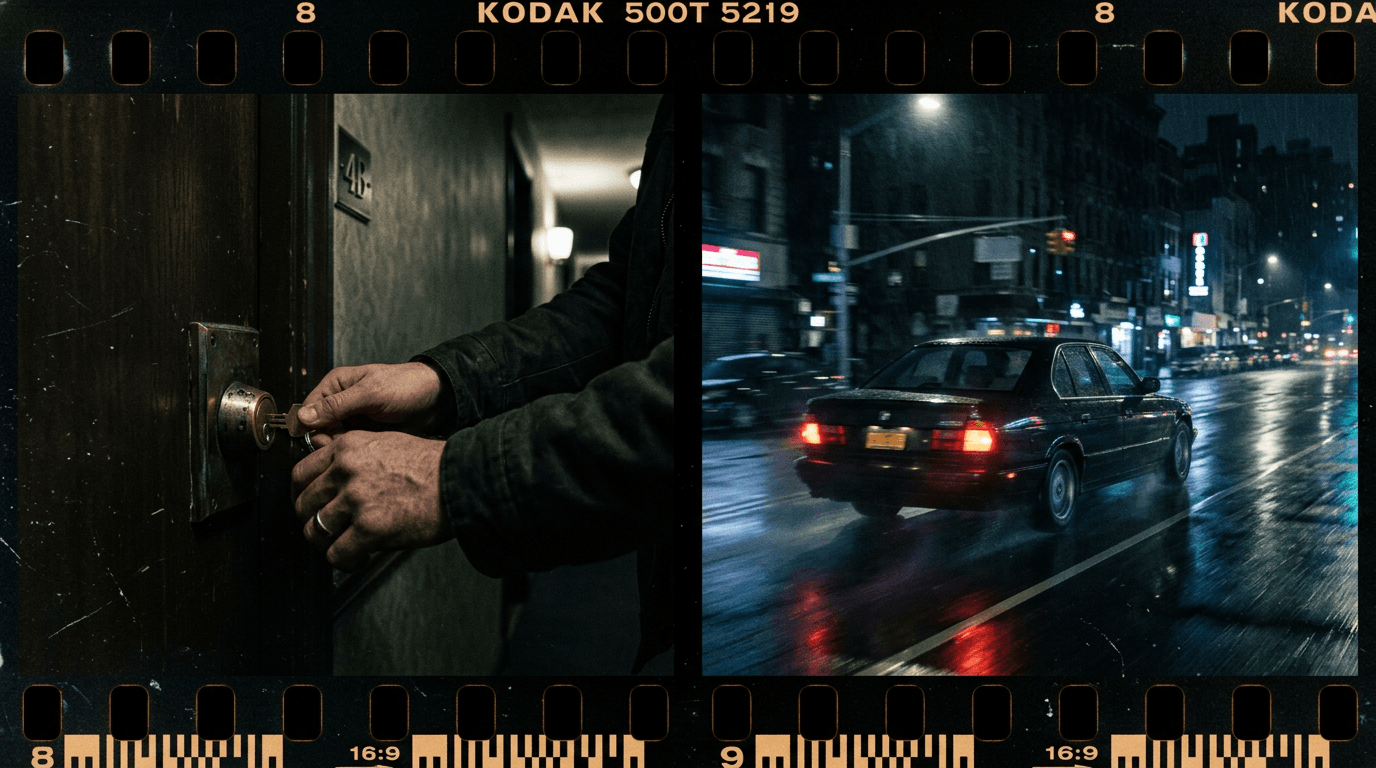

A bomb countdown starts in a subway locker.
At the same moment, your protagonist races through city traffic to find the code.
Two places.
One clock.
If you format this badly, your scene turns into timeline soup. If you format it well, you get one of the cleanest ways to build urgency and narrative pressure on the page.
Writers often say they want “cross-cut tension,” but what they actually produce is alternating scenes with no temporal contract. Readers then wonder: is this happening now-now, or just nearby in story order? That uncertainty burns attention you needed for suspense.
Here’s why that matters: simultaneous-action writing is less about adding more events and more about controlling causality across distance.
Think about it this way: when two locations share one deadline, your job is to make the page feel like a single heartbeat split across two bodies.
Done right, simultaneous action delivers pace, scale, and emotional counterpoint without bloating exposition.
Cinematic workflow frames
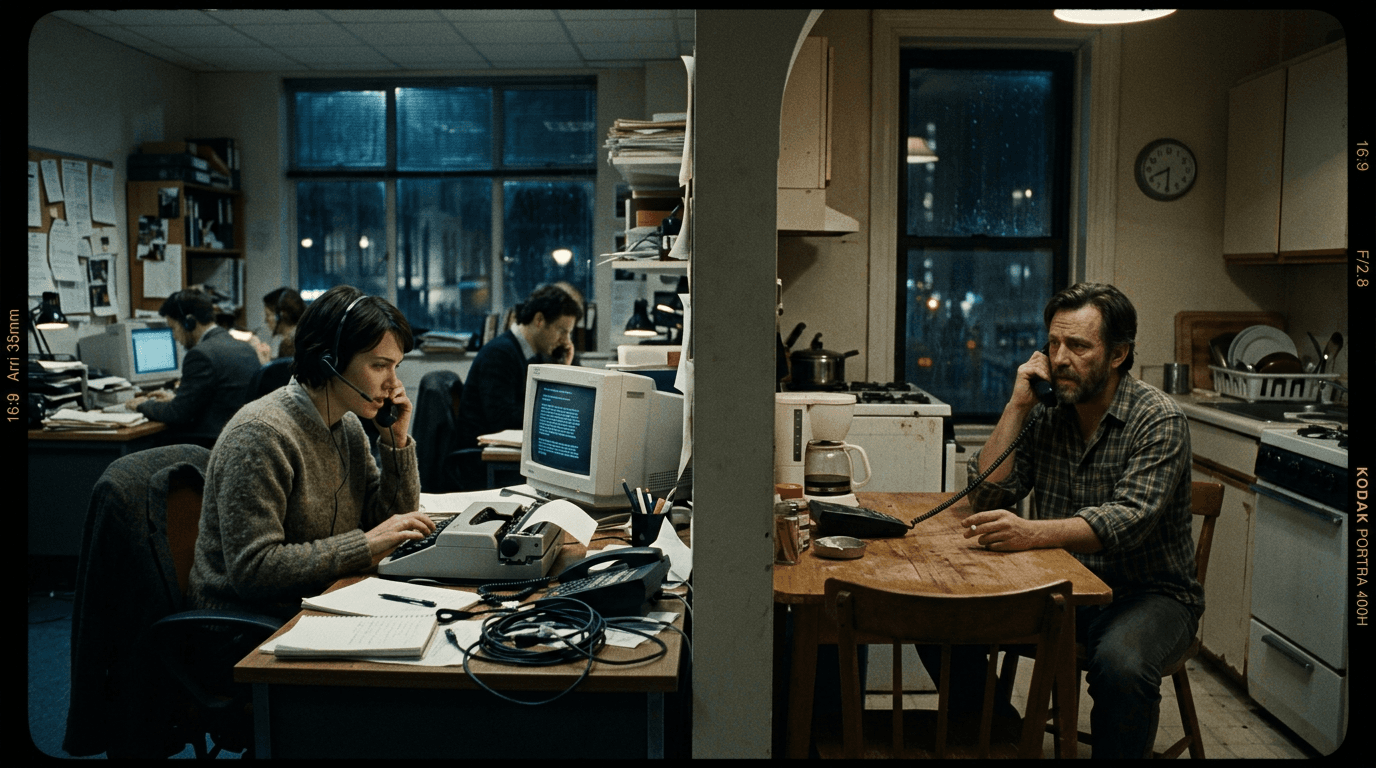
These two visuals work as a pair: the first shows Cinematic workflow still, first angle, 35mm film grain, and the second shifts to Cinematic workflow still, second angle, 35mm film grain - compare them briefly, then move on.
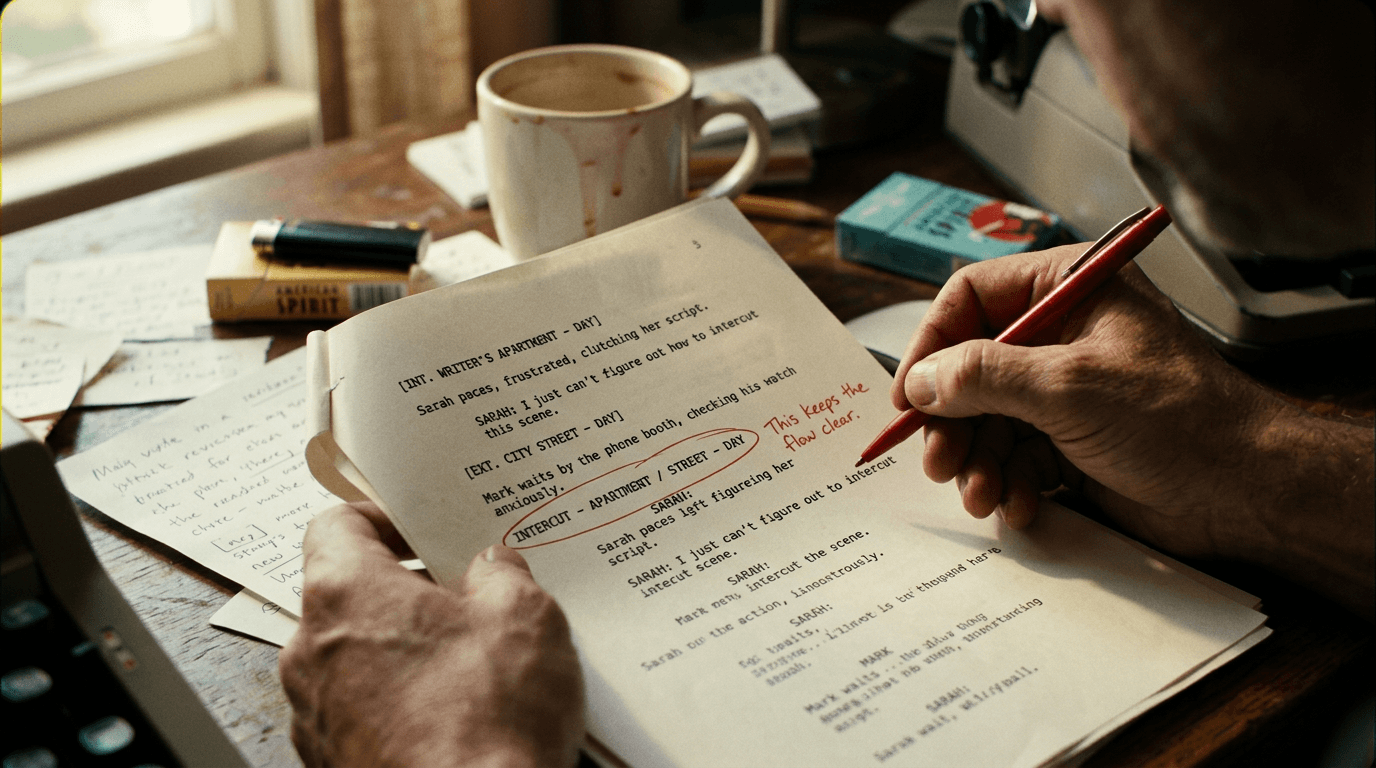
What “Simultaneous” Means in Screenwriting Terms
Not every back-and-forth is simultaneous.
True simultaneous action means events in different locations occur within overlapping real-time windows and influence each other through timing, information flow, or consequence.
If Location A could happen ten minutes earlier with no effect on Location B, you likely have parallel sequencing, not true simultaneity.
This distinction matters because formatting choices differ.
Parallel scenes can tolerate looser transitions.
Simultaneous scenes require explicit temporal cohesion.
Simultaneous action is a timing contract, not a montage vibe.
Core Formatting Patterns That Work
There are multiple valid styles, but each must preserve temporal clarity.
Pattern 1: INTERCUT Between Two Scene Headings
Set both locations, then declare intercut:
INT. SUBWAY LOCKER ROOM - NIGHT
EXT. CITY BRIDGE - NIGHT
INTERCUT - SIMULTANEOUS ACTION
This is a reliable pattern for sustained two-location tension.
Pattern 2: Repeated Scene Headings with Tight Time Anchors
Use full headings each switch when geography is complex or more than two subzones exist. Helps avoid drift.
Pattern 3: Split-Sequence Strip with Synchronized Beat Labels
In high-precision thriller moments, use concise beat markers (T-02:00, T-01:30) sparingly to reinforce shared clock.
Pattern 4: Information Relay Anchor
If one location updates the other through phone, comms, or video, treat each relay as timing hinge. This clarifies cause-and-effect.
Comparison Table: Trade-Offs by Approach
| Approach | Best Use Case | Strength | Risk |
|---|---|---|---|
| INTERCUT declaration | Two-location sustained tension | Efficient and readable | Can get messy if more than two major zones |
| Full heading switches | Complex geography, many micro-beats | Maximum spatial clarity | Slower read rhythm if overused |
| Countdown markers | Deadline-driven thriller beats | Strong temporal alignment | Feels mechanical if over-applied |
| Comms-relay hinges | Tactical coordination scenes | Clear causal chain | Over-exposition risk if dialogue gets too procedural |
Three Beginner Scenarios That Commonly Fail
Scenario 1: The Rescue Scene with No Shared Clock
One team cuts wires in warehouse while another drives toward it. Script alternates locations but never establishes countdown or deadline anchor.
Result: scenes feel adjacent, not simultaneous.
Fix: establish one explicit shared clock and tie switches to clock consequences.
Scenario 2: The Heist Split with Geographic Blur
Writer uses INTERCUT across vault, control room, and getaway van without re-anchoring locations.
Result: reader cannot track who is where when things fail.
Fix: either reduce active zones or reinstate full headings at critical switches.
Scenario 3: The Romance/Action Cross-Cut That Feels Tonally Disconnected
One location is emotionally intense, other is mechanically procedural, but no thematic bridge connects them.
Result: tonal whiplash.
Fix: align both threads around one core emotional stake, even if actions differ.
Step-by-Step Workflow for Simultaneous Two-Location Sequences
Step 1: Define Shared Deadline
What exact event both locations are racing toward?
Explosion, vote close, train departure, confession, handoff window.
Write it as one sentence and keep it visible in your outline.
Step 2: Map Causal Chain Across Locations
List beats where Location A affects B and B affects A.
If causal links are weak, sequence may be alternating spectacle rather than true simultaneity.
Step 3: Choose Switching Strategy
INTERCUT for clean two-thread flow.
Full headings for complex topology.
Hybrid only if carefully managed.
Pick one dominant mode.
Step 4: Assign Beat Ownership
Each switch should advance one specific thing:
time pressure
new information
tactical setback
emotional inversion
Avoid switches that simply “check in” without movement.
Step 5: Control Temporal Anchors
Use minimal but clear anchors: countdown, environmental cue, synced event noise, simultaneous trigger action.
You do not need timestamp on every beat. You need trustable time flow.
Step 6: Write Transition Lines as Energy Transfer
A good transition carries momentum from one location into the next.
Siren in A becomes siren heard in B.
Phone ring in A is answered in B.
Alarm light triggered in A flashes in B.
These bridges make simultaneity feel physical.
Step 7: Run a Chronology Pass
Strip to headings + first action lines.
Can reader reconstruct exact event order and overlap?
If not, revise structure before dialogue polish.
Body Image: Shared Clock Causality Map

The Trench Warfare Section: What Beginners Get Wrong and Exact Fixes
This is where simultaneous-action scenes usually collapse.
Failure 1: Alternation Mistaken for Simultaneity
Scene hops look dynamic but lack shared clock.
Fix: establish explicit deadline and recurring temporal anchors.
Failure 2: Overusing INTERCUT Without Re-anchoring
Reader loses geography after multiple switches.
Fix: reinsert full headings at critical junctures.
Failure 3: Switches Without Narrative Function
Cutting just to keep energy up.
Fix: every switch must change stakes, info, or options.
Failure 4: Mismatched Pace Between Threads
One location sprints while other stalls.
Fix: tighten slower thread with active objectives or reduce on-page time there.
Failure 5: Dialogue Overexplains Timeline
n Characters narrate obvious timing to compensate structure gaps.
Fix: improve structural anchors; cut redundant line explanation.
Failure 6: No Causal Feedback Loop
Actions in one location do not influence the other.
Fix: add at least two bidirectional impact beats.
Failure 7: Confusing Pronouns and Subjects Across Switches
“he” and “they” become ambiguous after rapid cuts.
Fix: use precise subject references in first line after each switch.
Failure 8: Too Many Active Locations
Three or more zones introduced without hierarchy.
Fix: prioritize two primary locations; demote others to brief inserts.
Failure 9: Countdown Markers Overcrowd Page
Every beat stamped with time, killing flow.
Fix: mark only pivot intervals.
Failure 10: Sequence Ends Without Convergent Consequence
Threads run in parallel but resolve separately.
Fix: land on one combined outcome proving simultaneity mattered.
Good simultaneous action feels inevitable in hindsight and urgent in real time.
Advanced Craft: Emotional Counterpoint Across Distance
The best two-location sequences do more than sync events. They sync emotional pressure.
You can pair tactical action in one place with emotional revelation in another.
You can mirror choices: one character cuts red wire while another chooses whether to betray.
You can invert power: the physically trapped character holds informational control, while the mobile character is tactically blind.
This counterpoint makes sequence texture richer than simple race-against-time mechanics.
Another advanced move is controlled asymmetry of information.
Location A sees danger first.
Location B has tools to solve it but gets delayed signal.
That gap becomes your suspense engine.
The key is fairness: audience should understand why information delay exists, not feel manipulated by arbitrary withholding.
Try it free
Try Screenweaver for free on your script
It is free. Import your existing project, get a clearer view of your outline, and regain control of your story structure in minutes.
Start FreeSoftware Workflow and Revision Discipline
Simultaneous scenes degrade quickly in rewrites because extra beats get inserted unevenly and chronology drifts.
Create a sequence ledger:
beat number
location
relative time
causal trigger
consequence
Then verify every beat transition during final pass.
In drafting tools, search for all INTERCUT and time markers. Ensure start and end boundaries are explicit.
Read headings only. If overlap logic is unclear there, full prose will not fix it.
For produced sequence readability references, the <a href="https://screencraft.org/blog/38-screenplays-you-should-read-and-download-now/" rel="nofollow">ScreenCraft script resource roundup</a> can be useful for comparative pacing study, but your internal timing contract is what keeps your sequence functional.
As discussed in our guide on [how to format police dispatch audio in a script], high-pressure channel clarity and timing anchors are essential in multi-threaded action.
If one location includes surveillance review while the other executes action, pair with [screenplay formatting for surveillance camera footage] so evidence and live action remain distinct.
And if your thread includes mobile call coordination, [screenplay formatting for FaceTime and video chat scenes] helps maintain source and location clarity.
Body Image: Intercut Momentum Strip

YouTube Placeholder
[YOUTUBE VIDEO: Practical editing of a two-location simultaneous action sequence from a confusing draft into a clear, high-tension intercut structure with shared-clock logic.]
Before-and-After Micro Example
Before:
“INT. LOCKER ROOM - NIGHT
Sam cuts a wire.
EXT. BRIDGE - NIGHT
Lena drives.
INT. LOCKER ROOM - NIGHT
Sam says hurry.
EXT. BRIDGE - NIGHT
Lena says she is coming.”
Technically alternating. Dramatically thin.
After:
“INT. SUBWAY LOCKER ROOM - NIGHT
Digital timer: 01:45.
Sam peels back the panel, hands shaking.
EXT. CITY BRIDGE - NIGHT
Lena swerves through gridlock, phone on speaker.
LENA (into phone) How much time?
INTERCUT - SIMULTANEOUS ACTION
SAM One forty.
He clips the wrong wire. Timer jumps: 00:59.
Lena slams through a red light.
LENA Don’t touch anything. I’m thirty seconds out.
A train horn erupts under both scenes.”
Same basic idea.
Now it has shared clock, causal feedback, and convergent urgency.
Ending Perspective: One Clock, Two Lives, Zero Confusion
Showing simultaneous action is one of the fastest ways to make a screenplay feel cinematic and expensive.
It is also one of the easiest ways to lose readers if timing and geography are muddy.
The fix is not more explanation dialogue.
The fix is structural discipline:
shared deadline.
clear switching logic.
causal links across locations.
targeted temporal anchors.
convergent payoff.
Do this, and your intercut pages stop feeling like busy alternation.
They become narrative machinery with teeth.
That is where two locations stop competing for attention and start generating pressure together.
There is an additional layer most beginner drafts miss: simultaneous action is also about value collision, not only time collision.
If both locations pursue the same tactical objective, scenes can feel redundant.
If one location pursues survival while the other pursues truth, or one pursues justice while the other pursues loyalty, intercutting gains thematic force. The reader is no longer just tracking whether they make it in time; they are tracking what “making it” means in competing moral terms.
That gives your sequence depth without slowing pace.
Another professional move is asymmetrical control of tempo.
You do not need both threads to escalate identically. You need them to escalate compatibly.
Location A can sprint physically while Location B escalates informationally.
Location A can be noisy and kinetic while Location B is quiet and procedural.
What matters is synchronized consequence: a beat in one thread should change available choices in the other.
When that happens, intercutting feels like one engine with two cylinders.
When it does not, intercutting feels like channel surfing.
Practical Drill: Switch Justification Audit
Print your sequence and mark every location switch.
Next to each switch, write one short reason:
time pressure increase,
new info,
failed tactic,
emotional reversal,
causal response.
If you cannot justify a switch in one phrase, that switch is likely ornamental. Cut or rewrite it.
This drill alone can dramatically improve readability.
Practical Drill: Shared-Clock Compression Pass
Run a pass where you remove all explicit timestamps except three: opening anchor, midpoint pivot, and final deadline beat.
If sequence becomes confusing, your causal transitions are weak and timestamps were compensating.
Fix transitions first. Re-add only essential markers.
This prevents “countdown clutter,” a common issue in action drafts where writers stamp time everywhere instead of designing momentum transfer.
Practical Drill: Causal Swap Test
Temporarily swap two adjacent beats from different locations.
Does the sequence still make sense?
If yes, your causality may be too loose.
Strong simultaneous sequences are order-sensitive because each beat triggers next-beat pressure across distance.
Use this test to detect accidental modularity.
Practical Drill: Convergence Proof
Write one sentence completing this prompt:
“If thread B were removed, thread A’s outcome would change because ____.”
Then reverse:
“If thread A were removed, thread B’s outcome would change because ____.”
If either sentence is weak, your threads are likely adjacent rather than integrated.
Integrated threads produce stronger endings because convergence feels earned.
Another advanced consideration is sensory bridge design.
Readers experience simultaneity more strongly when a sensory element travels across threads: siren, gunshot echo, train vibration, alarm light, broadcast line, countdown beep.
These bridges are tiny but powerful. They reduce cognitive reset cost at each switch and preserve tension continuity.
Use them deliberately, not constantly.
You can also escalate suspense through mismatch between perceived and actual simultaneity. For instance, a character in one location believes they are thirty seconds behind when they are actually thirty seconds ahead because of delayed relay. That gap can fuel high-stakes errors while staying fair if clues are planted.
The key, again, is reader trust. They must understand timing logic even when characters do not.
One final operational habit for revision week: maintain a sequence ledger with four columns:
relative time,
location,
trigger,
consequence.
When notes add or cut beats, update ledger immediately.
This prevents the most common late-draft simultaneous-action bug: invisible timeline drift that only appears when someone external reads cold.
If you keep this discipline, your intercut sequences remain legible under pressure and your action pages gain the one quality readers crave most: momentum they can trust.
And once momentum is trustworthy, you can safely push complexity higher without sacrificing reader confidence.
If you want a final sanity check before sending pages, read the sequence backward by switch points only. This odd exercise reveals hidden dependencies and weak transitions fast. Beats that rely on vague momentum instead of explicit trigger logic will stand out immediately. Repair those first. Then do one forward read at full speed. If the sequence feels inevitable and urgent in both passes, you have likely built simultaneous action that is not just flashy, but structurally sound enough to survive notes, rewrites, and production pressure.
Final Step
Build your next script with Screenweaver
Move from ideas to production-ready pages faster with timeline-native writing and AI-assisted story flow.
Try Screenweaver